Project 2 - Design and Development of Pulse Oximeter (Medical Technology)
Task 1
The global pulse oximeter market in terms of revenue was estimated to be worth $2.8 billion in 2022 and is poised to reach $4.3 billion by 2027, growing at a CAGR of 8.8% from 2022 to 2027. The new research study consists of an industry trend analysis of the market.
Some of the prominent players in the pulse oximeter market include:
- Medtronic (Covidien)
- Carefusion Corp
- GE Healthcare
- Philips Healthcare
- Masimo
- CAS Medical Systems, Inc
- Opto Circuits India Ltd
- Nonin Medical, Inc.
Market trends include :
- Nellcor™ OxySoft™ SpO2 sensor is the first pulse oximetry sensor to use a silicone adhesive to protect fragile skin and improve repositionability. It is engineered with brighter LEDs on a flexible circuit — all to help stay connected to patients and their data. (It's from Medtronic) expected to receive 510 (k) clearance from US FDA
- Limited market release of Masimo W1 health watch (non invasive blood parameter monitoring solution) from Masimo
- Acquisition of Sound United (US) by Masimo Corporation leads to establishment of superior technology to its healthcare protifolio.
Task 2
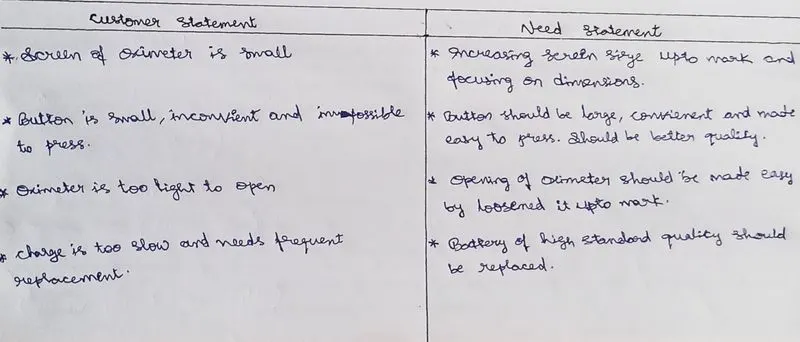
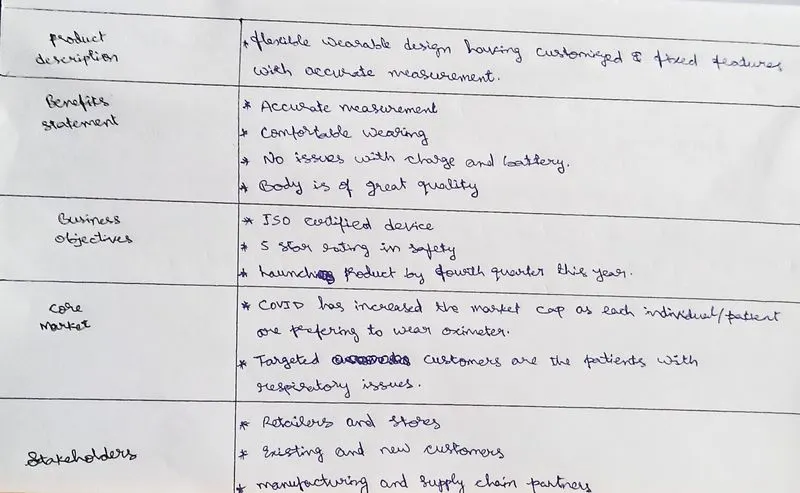
Mission statement : Focused on accuracy and standards for better safety management of patients.
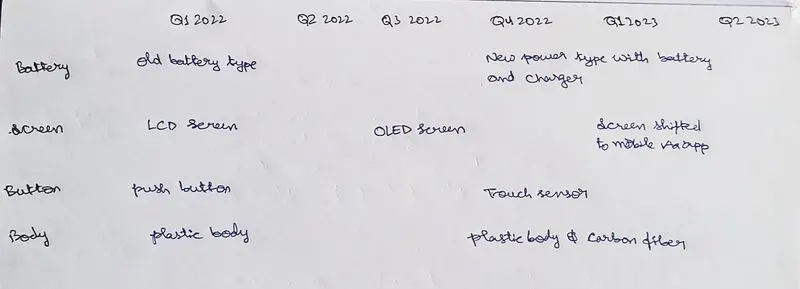
Product road map
Resource requiements
Design engineer is required to integrate all the components and make it minimal in order to fit in device. Coder is required to integrate the code for the app of device that can show measurements in mobile screen. Device body requires carbon fiber to be strong and efficient.
Task 3
Work breakdown structure
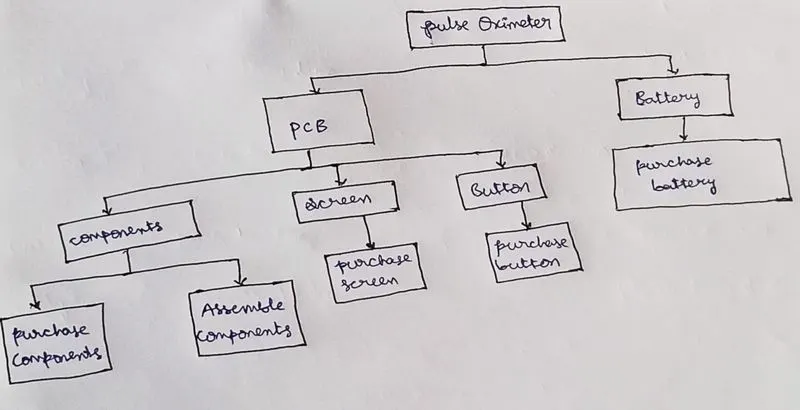
Product architecture :
I would prefer integral architecture because of stiffness of the components and of longer shelf life. Regular versions can be replaced with advanced components that will increase the device accuracy and quality. Integral architecture also cuts cost of the device.
Also refer attached documents for 3D rendering of pulse oximeter.
Task 4
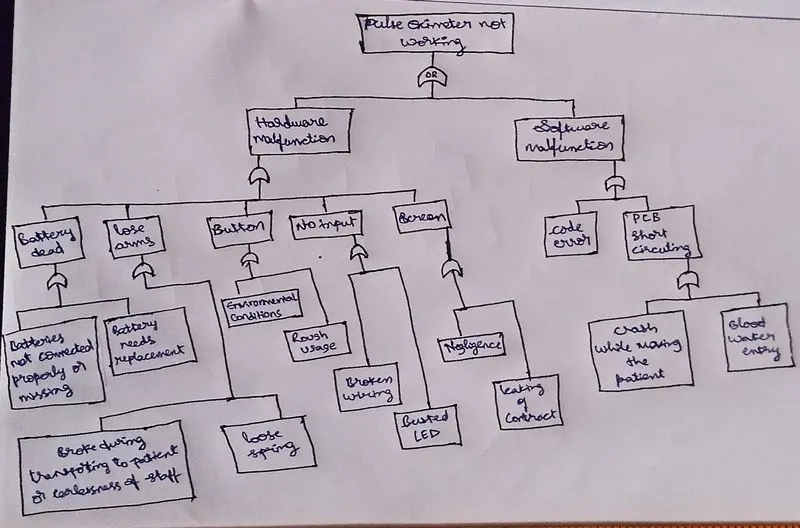
Failure mode effect analysis (FMEA) of the PULSE oximeter.
https://docs.google.com/spreadsheets/d/1pc_HnIOt9owu1V_XMdDlYR_5hihFoHIYB8uTY57tCQI/edit?usp=sharing
Task 5
DFMA is a design methodology that emphasises manufacturing simplicity and assembly efficiency. As a result, oximeter design can be improved to enable faster, safer, more cost-effective, and more efficient manufacturing and assembly. DFMA methods enable oximeter components easy to assemble and energy efficient. Numerous layers of adhesive in oximeter and enable incorporate all those layers into one part, saving OEMs from having to manage multiple separate products that typically must be placed together manually.
Use of AI can make it so hard for the oximeter to be reverse engineered. And make it happen with less waste material for lower environmental impact. Assembly should be planned in order to make it nearly impossible for oximeter to be reverse engineered.
With use of AI analysis and background research we can reduce the subsequent steps which saves us time and money. This enables lesser energy utilization and reduces production cost. Some of the materials and components can be 3D printed that is cost effective and much efficient. Unique design innovation can attract customers to purchase our oximeter. Carbon fiber production will be 3D printed giving our oximeter unique mark and much cost effective.
Making the material 3D printed and other components production in home company can reduce costs and make it convenient. Parts can be repaired and replaced which reduces wastes and made our oximeter also an environmental efficient.
Once design was approved prototyping can be done in manufacturing unit. Prototypes were tested and collected from few targeted customers like doctors about the working condition of oximeter. Successful prototype enables production.
PCB should be complex and making oximeter nearly immpossible to open and coding of the oximeter should be done within our company by hiring a coding engineer enabling only patient use applications after downloading the code making it harder for people to do reverse engineering.