Project 2
In the medical device industry, risk management goes beyond product development and manufacturing; it forms a vital aspect of the lifecycle of your product. ISO 14971:2019 defines the international requirements of risk management systems for medical devices, defining best practices throughout the entire lifecycle of a device.
Regulatory requirements for risk management
The Medical Devices Regulation (MDR) (EU) 2017/745 and the In Vitro Diagnostic Regulation (IVDR) (EU) 2017/746 include the requirements for risk management.
Compliance to risk management standards is not mandatory for CE marking medical devices under the European Medical Device Regulations (IVDR and MDR). Although it isn’t currently harmonized to the Regulations, EN ISO 14971:2019 represents the state-of-the-art for risk management.
EN ISO 14971:2012 is harmonized to the European Medical Device Directives (AIMDD, IVDD and MDD), which allows presumption of conformity to the Directives.
Manufacturers certified under the Directives may choose to comply with the harmonized 2012 version or the state-of-the-art 2019 version of the standard. Manufacturers certified under the Regulations choosing to utilize ISO 14971 should comply with the state-of-the-art 2019 version of the standard.
What are the benefits of ISO 14971:2019?
ISO 14971:2019 provides internationally recognized methods to reduce risk for all stakeholders. Adopting this standard early in the planning process will support you in ensuring that your medical device is compliant with EU Regulations and in bringing your medical device to the global market efficiently and safely.
Product: Electrosurgical Unit
Background: Electrosurgery is widely used in reproductive related surgeries and technological advancements to improve efficacy and reduce potential complications. However, some reports have indicated lack of sufficient knowledge and training about basic principles and technical aspects of electrosurgery among obstetricians and gynecologists.
Electrosurgical units (ESUs) are among the most frequently-used devices in surgeries since they conduct electricity through a surgical tool to the patient’s body. By creating hemostasis during surgery, ESUs enable the surgical team to make a surgical incision without causing bleeding and, thus, have a better view of the area under operation. On the other hand, incorrect use of ESUs can have many serious consequences for both the patient and surgical team, among them burning the patient’s skin, starting a fire in the operating room, inhaling the smokes from ESU, and disrupting cardiac pacemakers. Inhalation of the smokes made by ESUs can cause gene mutation in the personnel in the long run.
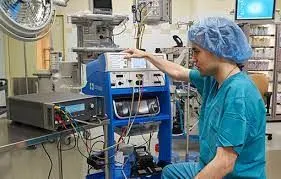
Methods: The basic concepts and principles of electrosurgery and review the recent evidence on the use of electrosurgical devices in gynecologic procedures including endometrial ablation, gynecologic malignancies, loop electrode excision procedure (LEEP), and infertility.
Description:
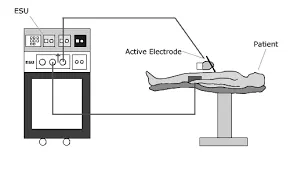
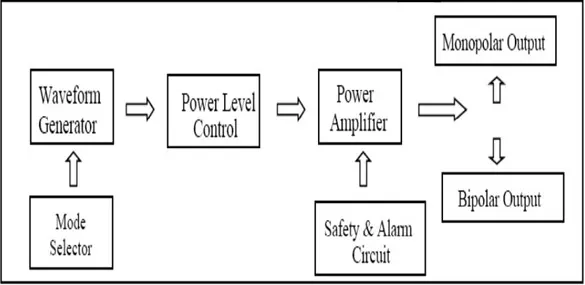
An electrosurgical unit is a device that uses high-frequency (HF) electrical currents to cut or coagulate tissue during surgery, known as electrosurgery. It consists of an electrosurgical generator that transforms electrical energy into HF current. It is operated using a specific control. The generator is connected to an active electrode. It is this active electrode that comes into contact with the tissue it will create a thermal effect on. Electrosurgical units have multiple functions and electrodes that vary according to the surgical applications
Classification:
Class: I
Type: CF
Input Power Supply:
Volts : 180-270 VAC
Current Fuse : 6Amps
Power consumption-800 VA
Regulatory Approvals:
CE, ISO:13485(2017), IEC 60601-1, IEC 60601-2 and IEC 60601
Regulatory Status of Similar Product:
Ultrasound surgical unit: these units work with ultrasonic handpieces. They have an ultrasonic wave generator. These ultrasound waves break the hydrogen bonds of the cells during coagulation, while the cutting is done by cavitation.
CE, CDSCO, ISO:13485(2107)
Safety and Performance Infromation:
PRIOR TO USE
- Know which E.S.U. will be used and how to use it. Consult the instruction manual.
- Do not wrap wet cloth on the stainless steel patient plate and attach to patient.Apply ECG gel instead on the patient plate and then attach to the patient at the most vascular area of the patient.
- Have all equipment and accessories available and use only accessories designed And approved for the unit.
- Check the operation of the alarm systems. If applicable, check the operation of the return cable sentry prior to placement of the return electrodes.
- Replace all broken, bent, excessively scratched or otherwise damaged return electrodes.
- Do not cut, crease or sharply bend a disposable return electrode.
- Avoid the use of flammable anesthetics. (A warning to this effect should be evident on the E.S.U. cover.
- Always place E.C.G. electrodes as far away from the site of surgery as possible.
- Do not use any needle E.C.G. electrodes
- Replace uninsulated instruments with updated equipment.
- Check the line cord and plug on the E.S.U. Extension cords should not be used.
- Do not use any power or accessory cord that is broken, cracked, frayed o taped.
- Use a conductive gel specifically designed for electrosurgery.
- Have back-up equipment available. (Patient Return Electrode Placement)
- Always place the return electrode of the patient as close to the electrosurgery site as possible. Avoid fatty, bony, hairy, heavily scarred areas and bony protuberances.
- Avoid placing the return electrode where fluids may pool.
- Do not slide the return electrode under the patient. The Patient should be lifted and placed on the return electrode.
- If the patient has a pacemaker, the return electrode should be as far from it as possible.
DURING USE
- Use the lowest possible power settings or go as per the programs to achieve the desired surgical effect. The need for abnormally high settings indicates something is wrong.
- Do not wrap wet cloth on the stainless steel patient plate and attach to patient. Apply ECG gel instead on the patient plate and then attach to the patient at the most vascular area of the patient.
- Position cords so that they present no tripping hazard. Do not wheel equipment over electrical cords.
- If the patient is moved or repositioned, check that the return electrode is still in good contact with the patient. (If using an adhesive electrode, make sure the gelled area is in good contact, not just the adhesive border.
- When active accessory is not in use, remove it from the surgical field and contact with the patient.
- Do not coil up active or patient cables this will increase R.F. leakage currents and present a potential danger to the patient.
- Do not spark the active electrode to ground to confirm operation of the unit. This may damage the unit or introduce a patient hazard.
- Do not active the electrosurgical unit for long lengths of time.
- Avoid "buzzing" forceps and creating a metal to metal arc. Touch the forceps with the electrodes and then activate the generator. (This will eliminate the majority of "jolts" to the surgeon.)
- Only use endoscopes with insulated eye pieces.
- Keep active electrodes clean. Escher build-up will increase resistance, reduce performance, and require higher power settings.
- Do not submerse the active accessory in liquids. This may cause the accessory to activate.
AFTER USE
- Turn the unit off from the front panel.
- Turn the unit off from the mains.
- Disconnect all cords by grasping the plug, not the cord, disconnect the power supply cord first.
- Coil electrical cords when storing; don't bend or kink them.
- Wash all reusable accessories with a damp cloth. Do not immerse or soak.
- ETO sterilize accessories if possible this will prolong their life.
Principle:
In electrosurgery, the patient is included in the circuit and current enters the patient's body. During electrocautery, current does not enter the patient's body. Instead, current flows through a heating element, which burns the tissue by direct transfer of heat.
Design and Manufacturing Information:
Safety measures for prevention of electrosurgical complications:
-
Inspect insulation carefully
-
Use the lowest possible power setting
-
Use a low-voltage waveform (cut)
-
Use brief intermittent activation
-
Do not activate in open circuit
-
Do not activate in close proximity or direct contact with another instrument
-
Use bipolar electrosurgery when appropriate
-
Select an all metal cannula system as the safest choice
-
Utilize available technology (tissue response generator, active electrode monitoring) to eliminate concerns about insulation failure and capacitive coupling.
ESUs produce very high current that can injure both patient and operator if not properly used and maintained. Many problems have been associated with the use of ESUs, such as burns at the return electrode site and surgical fires. Some of these safety problems can be avoided by taking simple precautions.
Dos
-
The hand piece should always be placed in the nonconductive holster when not in use.
-
Always use the lowest possible generator setting that will achieve the desired surgical effect. When higher than necessary voltages are used, the chances of arcing are increased. If the surgeon continues to ask for a higher setting, this could be a signal that the integrity of the skin/dispersive pad interface is compromised.
- Clean the electrode tip frequently. As eschar (dead tissue from burning) builds up on the tip, electrical impedance increases and this can cause arcing, sparking or ignition and flaming of the eschar. When cleaning the electrode, the eschar should be wiped away using a sponge rather than the common scratch pad, because these pads will scratch grooves into the electrode tip, increasing eschar build-up.
Don'ts
-
ESUs should not be used in the presence of flammable agents or in oxygen-enriched environments.
-
Avoid using flammable substances that can be ignited by sparks, such as alcohol and skin degreasers. If you must use alcohol-based skin preps, do not allow them to pool near the dispersive pad; be sure prep solutions are thoroughly dry and fumes have dissipated before ESU activation.
-
Rubber catheters or other materials should not be used as a sheath on active electrode tips.
-
Cables should never be wrapped around metal instruments, as the current running through them can pass into the metal instrument, causing burns.
-
Do not use sharp towel clips or metal instruments to attach cables to drapes. Sharp metal clips can damage electrical cables or provide an unwanted point of contact with the patient's skin. Overlapping electrical wire around a metal clip creates an electrical transformer that can cause a hazard and may ignite drapes.
-
Never operate electrosurgical equipment with wet hands or wet gloves. If sterile gloves have holes in them, electrical current can pass through. Be sure that all team members at the surgical field have intact gloves.
-
Never operate electrosurgical equipment while standing on a wet surface. Keep the foot pedal dry. Protect it from fluid spillage by covering it with a clear, waterproof cover.
-
Determine whether the patient has any metal implants, including cardiac pacemakers. There is potential for injury if a patient return electrode is placed on the skin over a metal orthopaedic implant.
-
For optimum safety, have the patient remove any jewellery to avoid complications from possible current leakage.
-
Position and insulate the patient so that she or he is not touching any grounded metal objects.
-
Choose a location for the return electrode/dispersive pad that is as close to the operative site as possible, clean and dry, well vascularised, and over a large muscle mass. Avoid bony prominences, adipose tissue, scar tissue, skin over implanted metal prostheses, hairy surfaces, and pressure points. If necessary, shave very hairy skin at the dispersive pad site. Make sure that conductive gel is moist and uniformly spread all over the contact area and that the dispersive pad achieves uniform contact with the patient's skin.
-
Position ECG electrodes away from the electrosurgery site and the current pathway through the body.