Project 2
Using MATLAB/Simulink and the drive cycle from the attached excel sheet, find-
- The max heat generation of the battery
- The SOC of the battery at 2 *104second of the battery operation
| Time | Time Step | Battery Current |
| 00:00.4 | 0.1 | -0.9632 |
| 00:00.5 | 0.2 | -0.952 |
| 00:00.6 | 0.3 | -0.9072 |
| 00:00.7 | 0.4 | -0.9632 |
| 00:00.8 | 0.5 | -1.0304 |
| 00:00.9 | 0.6 | -0.9632 |
| 00:01.0 | 0.7 | -1.0304 |
| 00:01.1 | 0.8 | -1.008 |
| 00:01.2 | 0.9 | -0.9856 |
| 00:01.3 | 1 | -0.9632 |
| 00:01.4 | 1.1 | -0.9184 |
| 00:01.5 | 1.2 | -0.9296 |
| 00:01.6 | 1.3 | -0.9296 |
| 00:01.7 | 1.4 | -0.9296 |
| 00:01.8 | 1.5 | -0.9184 |
| 00:01.9 | 1.6 | -0.9408 |
| 00:02.0 | 1.7 | -0.896 |
| 00:02.1 | 1.8 | -0.9072 |
| 00:02.2 | 1.9 | -0.9072 |
| 00:02.3 | 2 | -0.9408 |
| 00:02.4 | 2.1 | -0.9296 |
| 00:02.5 | 2.2 | -0.9296 |
| 00:02.6 | 2.3 | -0.9968 |
| 00:02.7 | 2.4 | -0.9968 |
| 00:02.8 | 2.5 | -0.9408 |
| 00:02.9 | 2.6 | -0.9408 |
| Battery resistance | 2 milli ohm |
Consider the battery resistance is 0.5 mOhm, delta time is 0.1 and entropic factor is 2
AIM: To find maximum heat generation by the battery and SOC of the battery at 2*104 second of battery operation
THEORY:
Heat generated = Joules heat + Entropy heat
joules heat
from ohm's law, we know that
V=IR
when the current flows through a resistance, there is heat dissipated in the resistor this heat dissipation is called joules heating.
joules heating is also known as ohmic heating
power
P=V*I=I^2*R
heat
H=∫P.dt with the limits of time 0 to t
H=I^2*R*t
where,
P=power
V=voltage
I=current
R=resistance
H=heat
T=time
Entropy Heat
The heat generation due to entropy change inside a battery occurs when electrochemical reactions are performed. the entropy heat is reversible heat resulting from the change in open circuit voltage with respect to temperature at two electrodes.
CALCULATION:
batterry resistance = 0.5m ohm = 0.0005ohm.
Maximum heat generated in the battery pack:
The maximum current in the drive cycle is -0.896 at 2 minutes(120 seconds)
--> maximum heat generated =I^2Rt=(-0.896^2)*2*120=192.676 mJ
-->The total Maximum heat generated =Joule heat+Entropic heat=192.676 +2(192.676 ) =74.248 mJ
The average heat generation in the battery pack:
Average heat is calculated by taking the average value of current and time
--> average of time =1929/26=74.19sec
-->Average value of current =-24.7184/26=-0.9507
--> Therefore joule heat generated=I^2Rt=(-0.9507^2)*2*74.19=134.11mJ
--> Total heat generated=Joule heat+Entropy heat=134.11 +2(134.11 )=0.402 mJ
b. The SOC of the battery at 2 *104second of the battery operation
For this, Simulink model is designed as shown below :
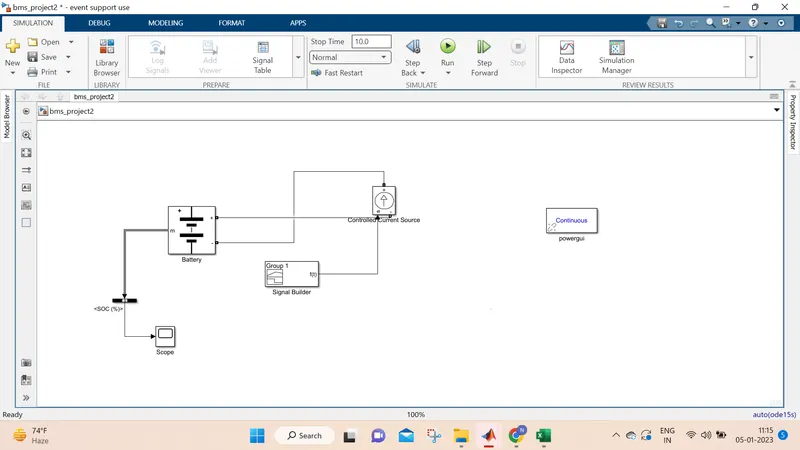
Blocks used and its significance :
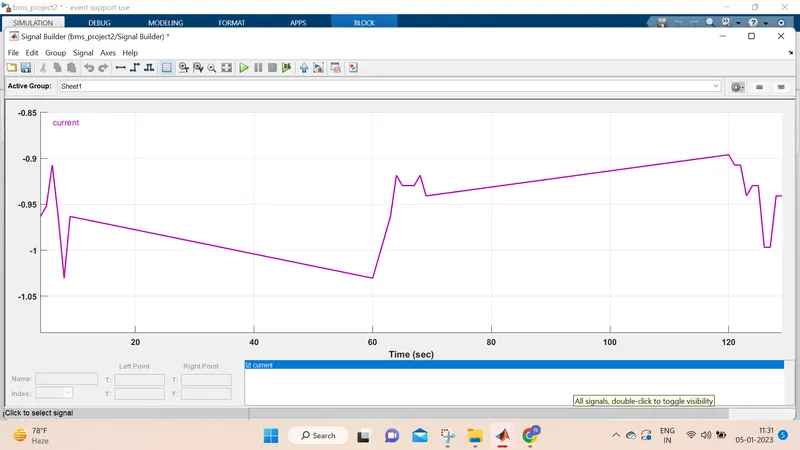
1. Signal builder block:
The Signal Builder block allows us to create interchangeable groups of piecewise linear signal sources and use them in a model. we can quickly switch the signal groups into and out of a model to facilitate testing. In the Signal Builder window, create signals and define the output waveforms.
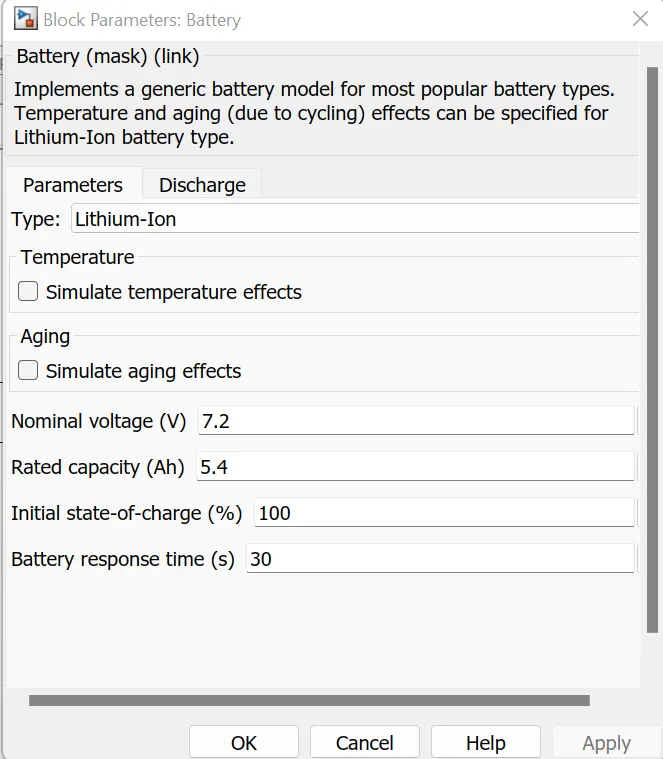
2. Generic Battery Model:
The Battery block implements a generic dynamic model that represents the most popular types of rechargeable batteries.
3. Controlled current source: Converts the Simulink input signal into an equivalent current source. The generated current is driven by the input signal of the block..Here it acts as a load that discharges the battery.
4. Bus Selector -This block accepts a bus as input which can be created from a Bus Creator, Bus Selector, or a block that defines its output using a bus object. The left Listbox shows the elements in the input bus. Use the Select button to select the output elements. The right Listbox shows the selections. Use the Up, Down, or Remove buttons to reorder the selections. Check 'Output as virtual bus' to output a single bus.
5.Power gui: Set simulation type, simulation parameters, and preferences
OUTPUT RESULT:
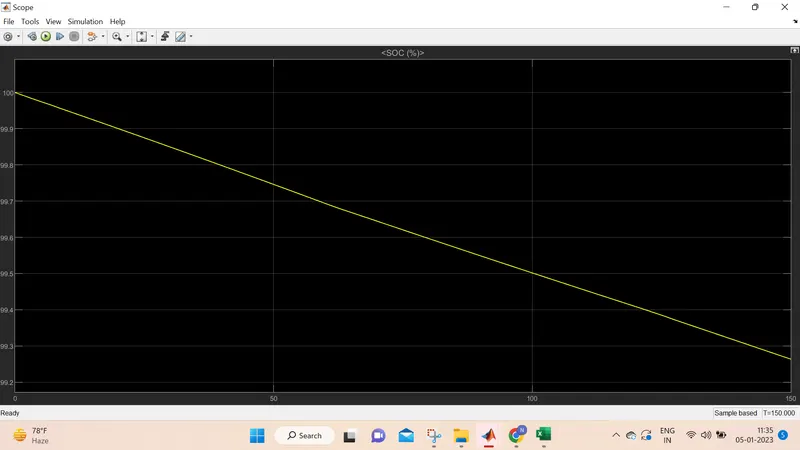
** .slx file attached with this project**
THE SOC OF THE BATTERY AT 104 SEC IS 99.4%.
CONCLUSION:
Thus maximum heat produced by the battery is 0.402mJ by mathematical calculation .
and soc at 104 seconds is 99.4% using simulink.