Project 2
Robotic surgery can be used to treat conditions affecting your heart, digestive system, bladder, prostate and more. Benefits include less blood loss, shorter hospital stays and quicker recovery. Surgeons who have performed a high volume of these procedures typically deliver optimal outcomes.
Robotic-assisted partial nephrectomy allows the removal and reconstruction of the kidney to be performed through multiple keyhole-sized incisions, as opposed to a single open incision measuring several inches across the side of the abdomen.
Robotic Donor Nephrectomy - is a minimally invasive surgical procedure which is performed to procure a kidney from its donor. Compared to open donor Nephrectomy, robot-assisted donor Nephrectomy demonstrates lesser postoperative pain, faster donor rehabilitation and lesser length of hospital stay.
Robotic assisted nephrectomy for living donation (RANLD)
Robotic assisted nephrectomy for living donation (RANLD) is a rapid emerging surgical technique competing for supremacy with totally laparoscopic and laparoscopic hand assisted techniques.
Opinions about the safety of specific techniques of vascular closure in minimally invasive living kidney donation are heterogeneous and may be different for laparoscopic and robotic assisted surgical techniques.
methods -
We retrospectively analyzed perioperative and short-term outcomes of our first (n=40) RANLD performed with the da Vinci Si surgical platform. Vascular closure of renal vessels was performed by either double clipping or a combination of clips and non-transfixing suture ligatures
Nephrectomy for living kidney donation has been performed laparoscopically for more than two decades .
Minimally invasive surgical techniques have substantially contributed to the future development of transplant programs and among others significantly increased the number of potential living donors .
This evolution was fueled by the fact that minimally invasive operative techniques generate significant patients’ benefits such as reduction in postoperative pain, decreased length of hospital stay, better cosmetic results and lower morbidity rates
robotic assisted nephrectomy for living kidney donation has become a well-established procedure, competing for supremacy with laparoscopic and hand assisted minimally invasive approaches .
Unlike in other surgical interventions, living kidney donation involves healthy altruistic individuals, who are willing to undergo major surgery for the wellbeing of another human being.
Minimization of any potential risk factors thus maximizing donor safety is even more highest priority
Hemorrhagic complications resulting from inadequate renal artery closure in living kidney donation surgery have been shown to jeopardize donor life and health.
From a technical perspective robotic assisted surgery provides the surgeon with enhanced 3D visualization of the operative field and the use of wristed instrumentation allows tremor free articulation with seven degrees of freedom.
Surgeons intraoperative comfort while using the robotic unit has been described to be extremely high, resulting in continuous steep reproducibility rates of various major surgical interventions
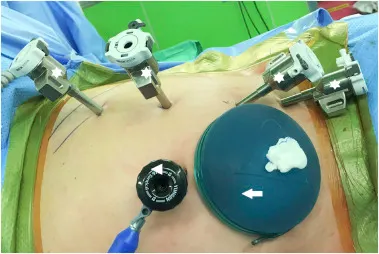
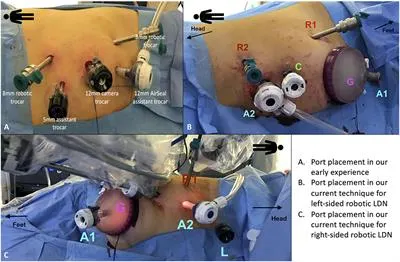
1 - method -
- Step 1: Patient Positioning and Port Placement.
- Step 2: Identification of the Retroperitoneal Anatomic Landmarks of Dissection.
- Step 3: Isolation and Dissection of the Renal Hilum and the Kidney.
- Step 4: Management of Renal Vessels.
In a living-donor laparoscopic nephrectomy, the surgeon uses a special camera called a laparoscope to view the internal organs and guide the procedure to minimize scarring and recovery time. The donor kidney is removed through a small incision below the bellybutton and transplanted into the recipient.
The left kidney is preferred for living-donor nephrectomy because the renal vein is longer on the left. However, when vascular, urological or other abnormalities are present, the right kidney may be procured
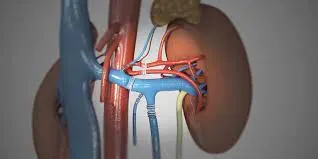
You can donate a kidney to a family member or friend who needs one. You can also give it to someone you don't know. Doctors call this a “nondirected” donation, in which case you might decide to meet the person you donate to, or choose to stay anonymous.
Your blood and tissue type must be compatible with your recipient's. Besides being healthy, living donors must have compatible blood and tissue types with the kidney recipient. The transplant team will perform tests to see if your blood and tissues are compatible (are a healthy match) with the kidney recipient.
There are some medical conditions that could prevent you from being a living donor. These include having uncontrolled high blood pressure, diabetes, cancer, HIV, hepatitis, or acute infections. Having a serious mental health condition that requires treatment may also prevent you from being a donor.
cost of donating kidney - 5 Lakh to Rs. 6 Lakh in private hospitals of the country. And post-treatment, the monthly cost is around Rs. 15,000 with the lifelong medicines costing around Rs.
Donating a kidney does not affect a person's life expectancy. On the contrary, studies show that people who donate a kidney outlive the average population. Twenty years after donating, 85 percent of kidney donors were still alive, while the expected survival rate was 66 percent.
after surgery -
Once the surgery is completed, you will be taken to the recovery room where your condition will be monitored as you start to wake up from the anesthesia. Once fully awake and stable, you will be transferred to your room on the Treatment Recovery Unit (TRU).
You will be given medications as needed to help alleviate the pain associated with the surgery. Your nurse will instruct you on coughing and deep breathing exercises to prevent pneumonia and will help you get out of bed several times a day to prevent blood clots from forming in your legs.
Your first meal after the surgery will be clear liquids and you will be given a regular meal once you are able to tolerate the clear liquid meal. The IV will remain in your arm until you are able to tolerate fluids by mouth.
On the day of your discharge, the Inpatient Pharmacist will most likely bring you the medications you need to take. If they are not available, you will need to stop by the Outpatient Pharmacy located on the B-Level in the East wing of the hospital. You will have three prescriptions, which are provided without charge.
You will have to pay for these prescriptions if filled by an outside pharmacy. One of the prescriptions is for pain and the other two are to prevent constipation caused by the pain medication.
3 - In order to be eligible to receive a kidney transplant: You must have chronic irreversible kidney disease that has not responded to other medical or surgical treatments. You are either on dialysis or may require dialysis in the near future. You must qualify for and be able to tolerate major surgery.
Robot Assisted Kidney Transplantation (RAKT) is a minimally invasive technique that uses a robotic support to perform the KT. As a high level of expertise is required in KT and robotic surgery, RAKT is performed by transplant surgeons with extensive training and experience in robotics and transplant surgery.
HOW DOES ROBOT ASSISTED KIDNEY TRANSPLANT SURGERY WORK
The Technique:
Compared to conventional open kidney transplant surgery, a much smaller incision (about 7cm) is made in RAKT to remove the diseased kidney and insert the donor kidney into the abdomen., and then to stitch the blood vessels and the ureter. Another four or five small (0.5 to 1cm) incisions are used to insert the instruments into the abdomen.
One of the arms holds a high magnification 3D camera which is inserted into the abdomen through one of the key holes and provides a high-definition, magnified (12×), 3-D view of the surgical site. The other mechanical arms have surgical instruments attached to it that are designed to mimic the movement of the human hands and wrists.
The surgeon uses the console of the computer to manipulate the small surgical instruments that are more flexible and manoeuvrable as compared to the human hand.
features - Robot-assisted surgery uses specialized technology that enhances the capabilities of your surgeon's hands. It allows surgeons to perform procedures in hard-to-reach areas through small incisions. The specialized technology also enables precise movements and enhanced magnification.
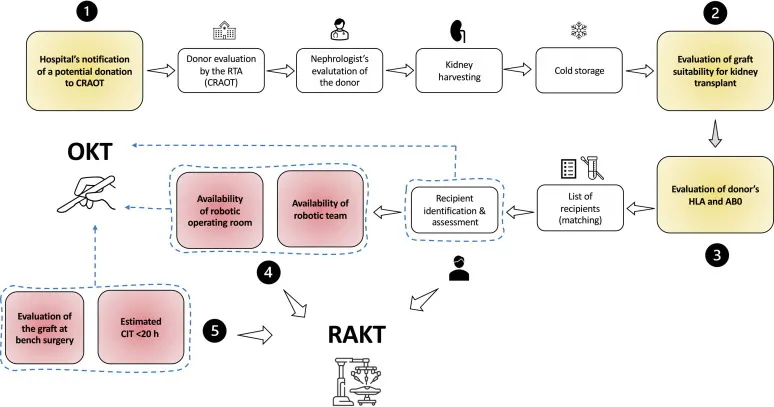
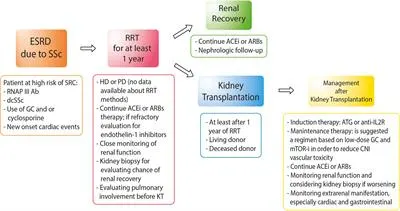
flow chart
postoperative -
- Adopt a healthy diet.
- Start an exercise program.
- Make sure you have an emotional support team.
- Avoid being around sick people.
- Keep taking your anti-rejection medicine as prescribed.
- Avoid anyone who's recently had a live vaccine.
- Keep all your appointments and have all needed lab tests.
preoperative care - Avoid blood thinners including aspirin for at least one week prior to surgery. The day before surgery, eat light meals until noon and then clear liquids. Stay well hydrated; the day of surgery, you should drink clear liquids until two hours before arrival at the hospital
Do not eat any solid food or complex liquids after mid-day before surgery. Make sure that you have a good bowel movement either the night before, or the morning of surgery. If you have difficulty with bowel movements start a clear liquid diet one day before surgery and if necessary, take a laxative (i.e. magnesium citrate)
ethical concern -
Controversies revolve around two main areas: the ethically acceptable sources of donation and the system of organ allocation. Organs are taken either from deceased or living donors. Cadaveric transplant is problematic because the availability of the organs means that someone has died.
Utility, justice, and respect for persons are three foundational ethical principles that create a framework for the equitable allocation of scarce organs for transplantation.
IEC 60601 is a series of technical standards for the safety and effectiveness of medical electrical equipment.