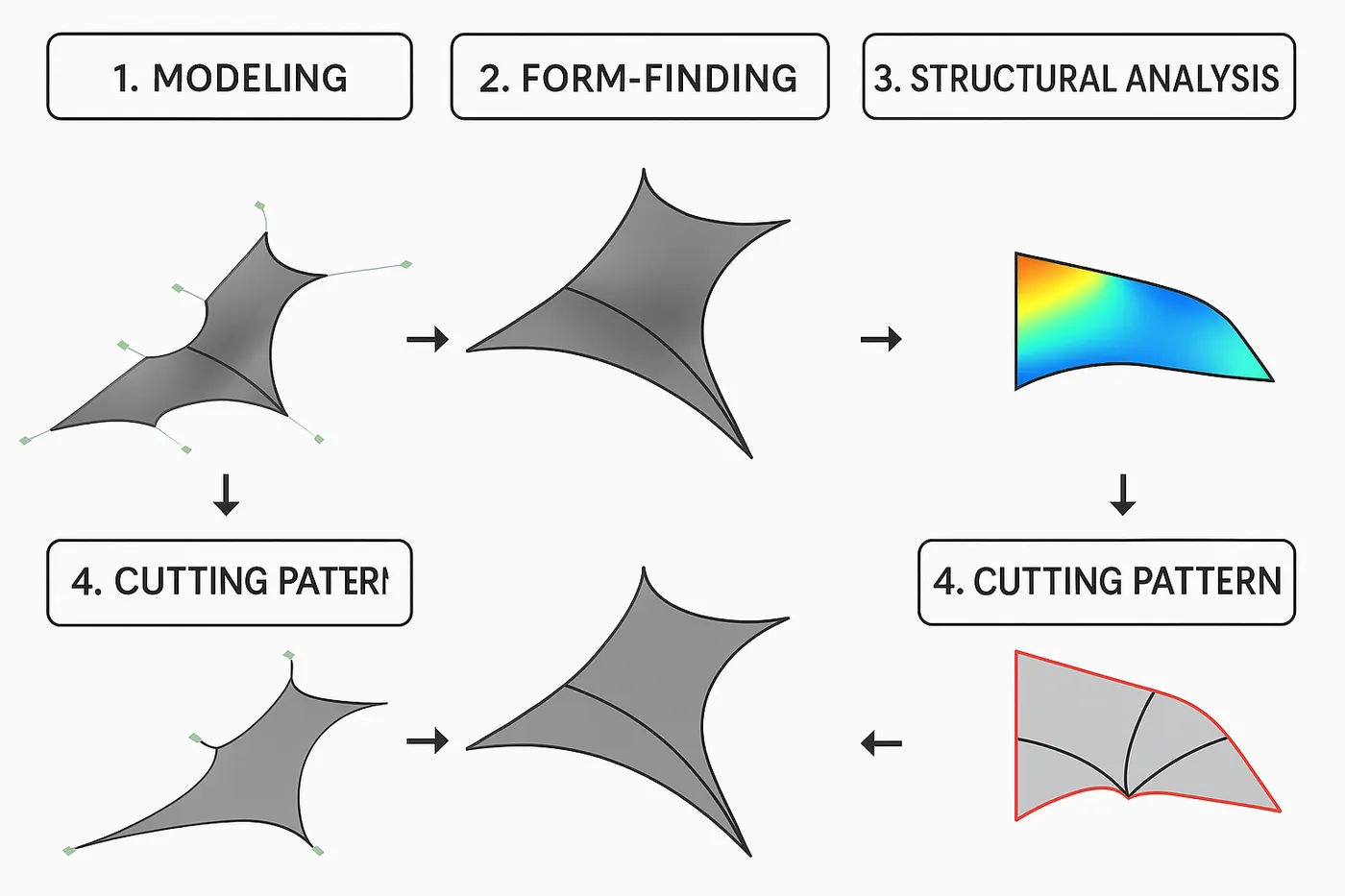
Project 2
1. Modeling
-
Software: Use specialized tools like Rhino + Grasshopper with Kangaroo, SOFiSTiK, Easy, or Formfinder.
-
Geometry: Define membrane surface using NURBS or mesh geometry.
-
Boundary conditions: Set points with fixed or cable-supported constraints (green squares in the image).
-
Cables: Model edge cables as tension-only elements.
-
Material: Assign membrane properties (e.g., PVC-coated polyester or PTFE-fiberglass) with isotropic/orthotropic behavior.
2. Form-Finding
-
Objective: Achieve a stable form under pre-stress or gravity loads.
-
Methods:
-
Force Density Method (FDM): Quick, good for concept stages.
-
Dynamic Relaxation: Iterative, accounts for nonlinear behavior.
-
-
Output: A naturally curved tensioned shape (minimal surface) resisting loads efficiently.
3. Structural Analysis
-
Loads: Apply dead load, prestress, wind (CFD can help here), and snow (if applicable).
-
Analysis Type: Nonlinear static analysis due to the flexible nature of membranes.
-
Outputs:
-
Membrane stress distributions (warp/weft or principal directions).
-
Cable forces and reactions at supports.
-
4. Cutting Pattern Generation
-
Flattening the surface while:
-
Minimizing distortion (strain and shear).
-
Maintaining original dimensions in warp/weft direction.
-
-
Steps:
-
Divide the curved surface into panels.
-
Use tools like Rhino Membrane, Easy, or GSA for patterning.
-
Add seam allowances and direction of fabric (warp/weft orientation).
-
Summary Workflow
| Step | Tools | Key Output |
|---|---|---|
| Modeling | Rhino + Grasshopper | Membrane + cable geometry |
| Form-Finding | Kangaroo, Easy | Equilibrium shape |
| Structural Analysis | SOFiSTiK, GSA | Stresses, reactions |
| Cutting Pattern | Rhino Membrane, Easy | Fabric layout |