Project 2
PROJECT 2
AIM -: Study of Li-ion Battery System Design using MATLAB/Simulink.
OBJECTIVE -:
- The max heat generation of the battery
- The SOC of the battery at 2 *104second of the battery operation
Introduction -:
Large battery packs are used in electric vehicles. Heat is generated when the battery pack is being used. Therefore, it is necessary to predict battery heat generation.Operating temperature of lithium-ion battery is an important factor influencing the performance of electric vehicles. During charging and discharging process, battery temperature varies due to internal heat generation, calling for analysis of battery heat generation rate. The generated heat consists of Joule heat and reaction heat, and both are affected by various factors, including temperature, battery aging effect, state of charge (SOC), and operation current. In this article, a series of experiments based on a power-type lithium manganese oxide/graphite battery was implemented under different conditions. The parameters for Joule heat and reaction heat are determined, and the Joule heat, reaction heat as well as total heat generation rate is detailed and analyzed considering the influence of temperature, aging, SOC, and current. In order to validate the accuracy of heat generation rate, a lumped battery heat transfer model is applied to calculate the temperature variation, and the estimated temperature variation shows good correspondence with experimental results under different currents and aging conditions. Due to its simplicity, the temperature variation estimation method is suitable for real time applications.
Factors affecting Heat generation in Battery -:
The generated heat consists of Joule heat and reaction heat, and both are affected by various factors, including temperature, battery aging effect, state of charge (SOC), and operation current. Battery thermal management is a huge challenge in electric vehicles. In addition to increasing the risk of fire, high temperatures can have a direct influence on range. By efficiently controlling EV temperature levels, battery range can be maximized. Just like internal-combustion engine vehicles, when an electric power train works harder, it gets hotter. Therefore, EVs require effective, efficient and durable cooling systems. Heat management can have a major impact on not only the components within a vehicle, but also its overall performance.
Importance of Thermal management in EV-:
The thermal management system regulates the excessive heat in battery packs, improving electric vehicles' performance. The primary role of the BTMS (Battery Thermal Management System) is to keep the battery temperature within safe limits in order to avoid thermal runaway. It employs several mechanisms, such as insulating, cooling, heating, and so on, to guarantee that the battery pack operates efficiently. The cooling function minimises excessive heat in the battery pack, keeping the temperature within the permitted range and limiting the adverse effect on surrounding cells.
Types of Thermal Management System -:
The increasing demand for electric vehicles puts pressure on manufacturers to design batteries with a proper thermal management system that ensures high levels of safety. Thermal runaway, caused by electrical, mechanical and thermal abuse, can be significantly reduced by incorporating a proper cooling system, selecting a good battery design and using efficient battery materials. The design of electric vehicle batteries is limited by prescribed temperature ranges within which they can operate efficiently. If the temperature exceeds the specified capacity, the batteries may experience reduced performance, overheating, or even thermal runaway.
Thermal Rumaways in EVs -:
Thermal runaway is a chain of events that typically starts with the gradual breakdown of EV battery cells, causing pre-heating of the EV battery cells and pack. The elevated temperature within the EV battery cells causes the organic solvents to break down, resulting in the release of gases, increased pressure and temperature beyond its flashpoint.
As different materials within the EV battery pack break down—such as the metal-oxide cathode—oxygen is released, which can cause an ignition. The electrolyte used in EV LIBs is flammable and spreads the fire. TR may occur over a prolonged period of time before an actual fire starts, or the fire could be instantaneous
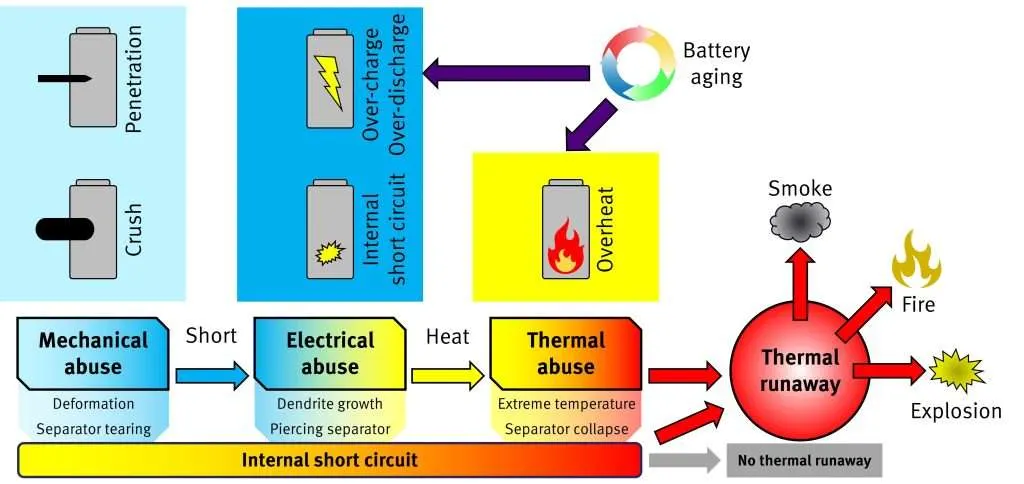
What causes the battery to overheat which leads to thermal runaway?
1. Ambient Temperature
2. Age of the Battery
3. Float Charging Voltage
4. Overcharging
Approaches to Minimize Thermal Runaway-:
The reduction of the Thermal Runway hazard can be fulfilled on three levels-
1. First: improve the intrinsic safety of anti-TR properties by material modification;
2. Second: set passive defense against the practical abuse conditions and develop an early warning algorithm before TR;
3. Third: postpone or inhibit the secondary hazard, such as Thermal Runway propagation, to win sufficient time for the passenger to escape from the EV after the accident.
Heat Generation Calculation:
There are two heat sources for battery heat generation.
- Joule heat
- Entropy heat
Joule Heat:
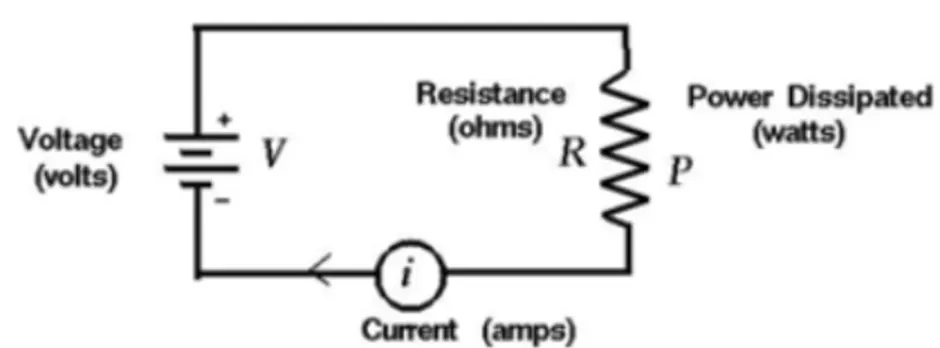
From Ohm's law, V= IR
When a current is flowing through a resistance, there is heat dissipated in the resistor. This heat dissipation is called joule heating. Joule heating is also known as Ohmic heating.
Power:

Heat:

where P = Power
V = Voltage
I = Current
R = Resistance
H = Heat
t = Time
The heat produced in a resistor is
- directly proportional to the square of the current flowing through it.
- directly proportional to the resistance
- directly to the time for which current flows through it.
Entropy heat:
The heat generation due to the entropy change inside a battery occurs when electrochemical reactions are performed. The entropy heat is reversible heat resulting from changes in open circuit voltage with respect to temperature at two electrodes.
Heat generated = Joule heat + Entropy heat
As entropic heat is twice the joule heat, the formula will be as shown below
Average heat generated = Average joule heat + 2(Average joule heat)
Maximum heat generated = Maximum joule heat + 2(Maximum joule heat)
State of Charge (SOC):
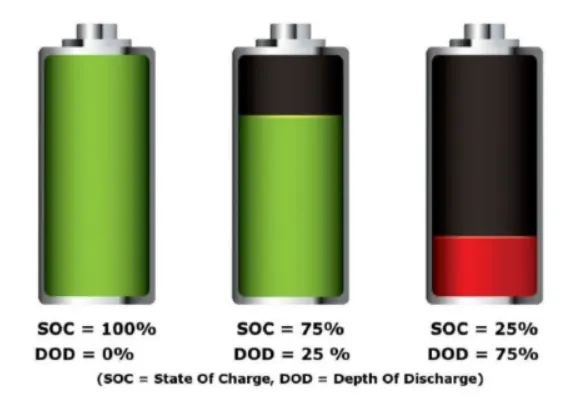
The SOC is the level of charge of an electric battery related to its capacity. The units of SOC are percentage points (0% = empty; 100% = full). It is also defined as the ratio of the remaining capacity to the fully charged capacity.
Depth of Discharge (DOD):
A battery's depth of discharge (DoD) indicates the percentage of the battery that has been discharged relative to the overall capacity of the battery. Depth of Discharge is defined as the capacity that is discharged from a fully charged battery, divided by the battery's nominal capacity.
SOC Estimation Methods
Voltage Translation Method:
The battery voltage (open circuit voltage) is used to determine the state of charge of the battery pack. The voltage translation method is used in applications like consumer electronics (battery banks, trimmers, torch light) and small energy storage systems. The LCD and LED are used to determine the SOC. The errors in voltage translation methods are voltage fluctuation, noise in the system and cell chemistry. So, it is not used in electric vehicles.
Coulomb Counting Method:
The SOC is estimated based on in and outflow of current in the battery pack.
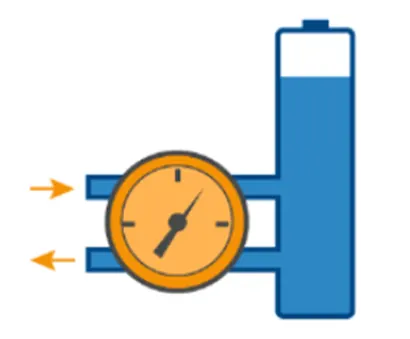
Case 1: Estimating SOC that before charging SOC is 0%. Let's assume that the battery capacity is 100 Ah. if we charge the battery with a 4A current for 4 hours, then the total charge will be 4A x 4h = 16 Ah.
SOC% = Total charge input / max battery capacity x 100
= 16 Ah / 100 Ah = 16% SOC
Case 2: Estimating SOC that the battery already has 50% charge

where,
Z(t) = State of charge
Z(0) = Initial SOC
Cn = Battery nominal capacity
ηi = Coulomb efficiency
i(t) = Instantaneous cell current
t = Time
CALCULATION -:
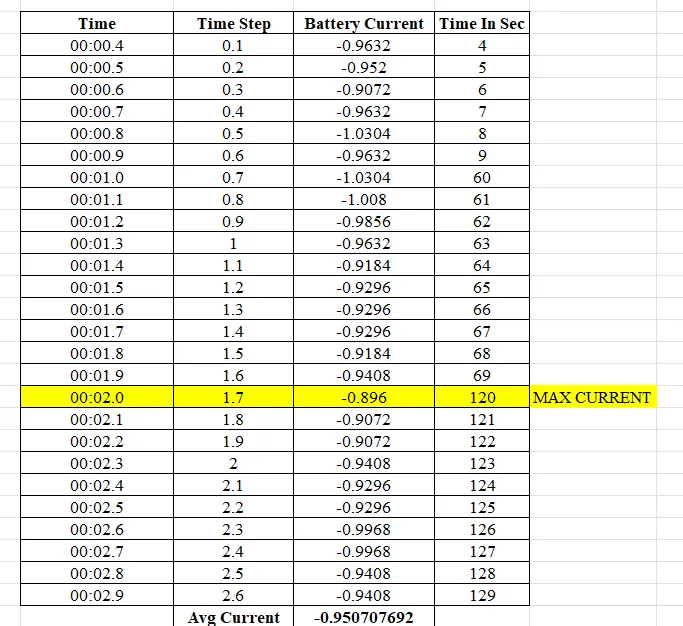
a) To Find maximum Heat generation of battery
Given - Battery resistance = 0.5mOhm
Entropic Factor = 2
Delta time - 0.1
From drive cycle, Max Current - -0.896 @ 120sec
Max heat generation = Joules Heat + Entropic heat
Where Joules Heat ,
Joules Heat = (-0.896)^2*0.5*120
Joules Heat = 48.168 mJ
Now, Max heat generation = Joules Heat + Entropic heat .....(Entropic is of factor of 2)
Max heat generation = 48.168mJ + 2(48.1688mJ)
Max heat generation = 144.504 mJoules
b) The SOC of the battery at 2 *104second of the battery operation
The SOC of the battery pack can be calculated using the MATLAB/Simulink.
SIMULINK MODEL-
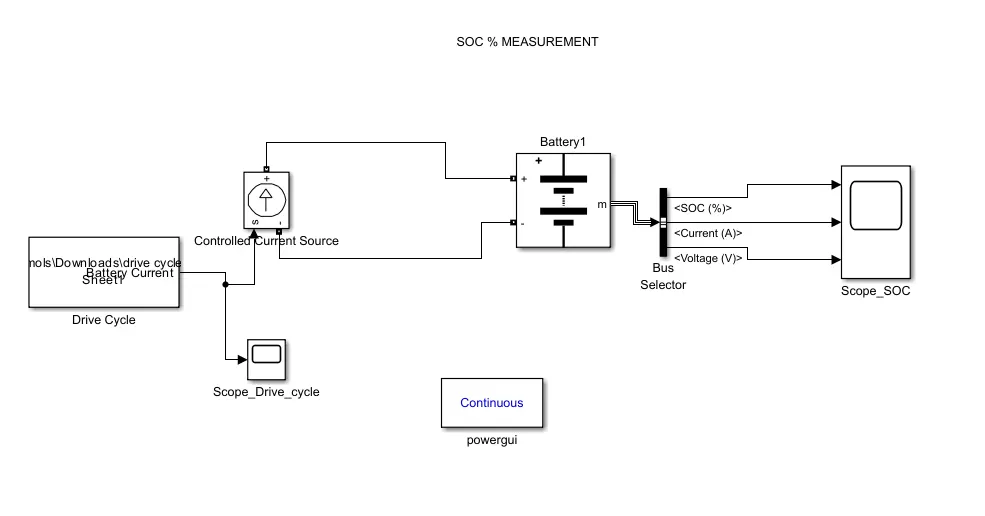
The above model consist of Excel spreedsheet as a drive cycle block, Scope block, Battery block, Controllled current source, Bus selector & Oower Gui.
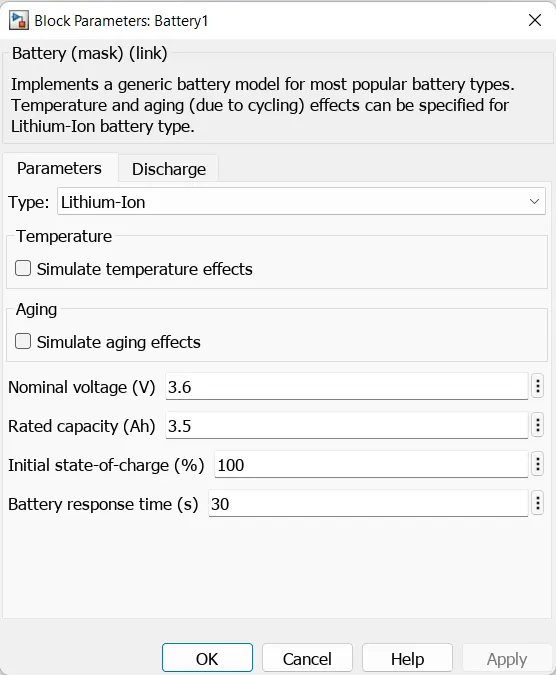
Scope Block for Time Vs Current (Drive Cycle)
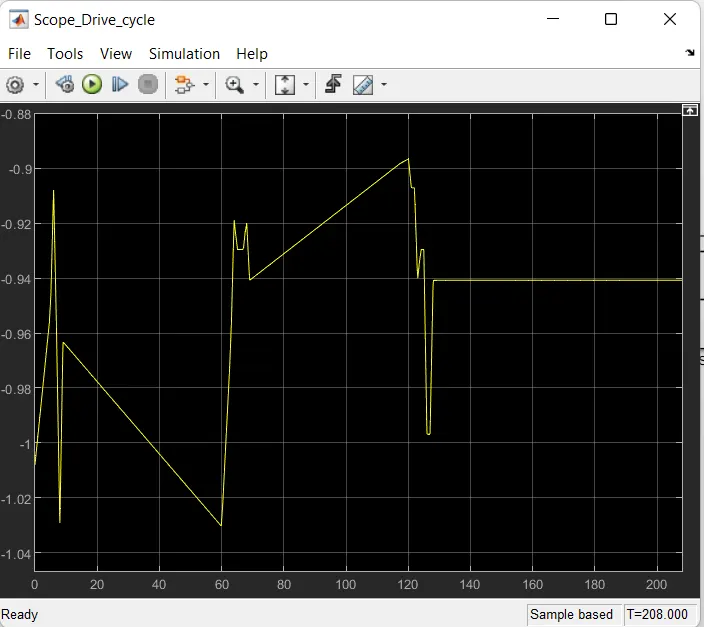
RESULTS SCOPE-:
The simulation is done for 2*104 seconds of battery operation.
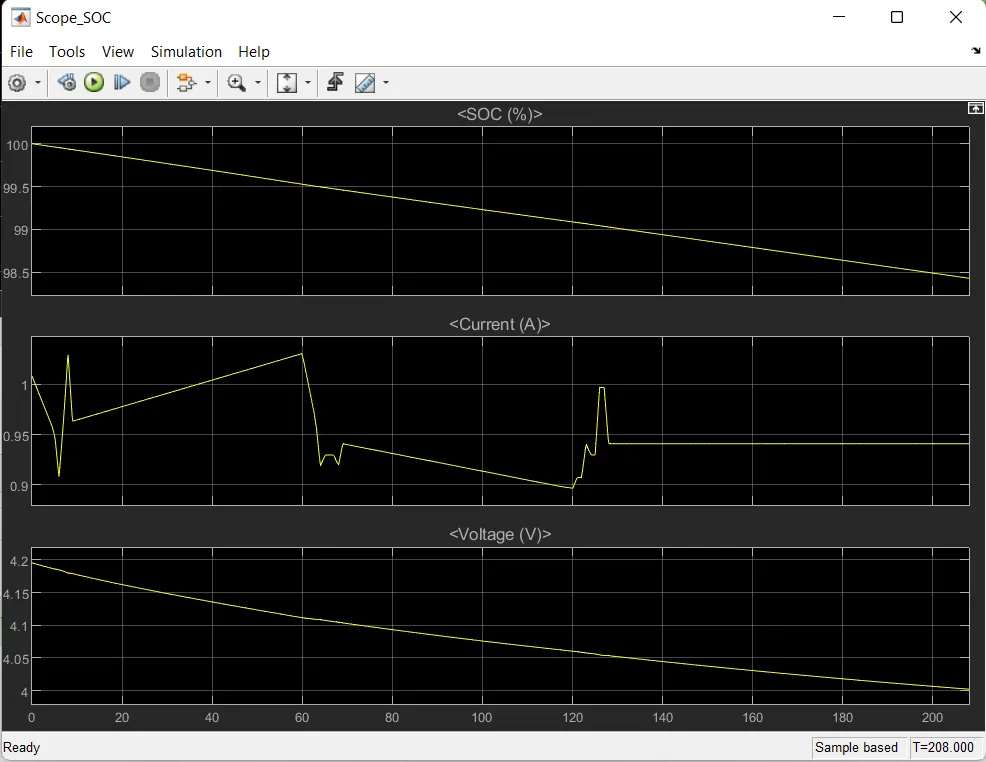
we are using Battery of 3.6Volt, 3500mAh.
From above results it can be seen that %SOC is reducing from 100% to 98.5% in a time span of 208seconds. Also variations in Current & voltage waveforms can also been seen from above graph.
Voltage of cell is slightly decreased from 4.2Volt to 4Volt.
Conclusion -:
1.Internal heat generation during the operation of a battery is a critical concern. If batteries get too hot, they can rupture or explode. And Lithium and Lithium-ion cells/batteries can catch on fire when they rupture, creating even more of a safety hazard.
2. Here, Maximum heat generated in a battery pack is 144.50mJoules.
3. Accurate SOC estimations reflect important information, such as battery performance, remaining battery life, etc., which ultimately leads to efficient management and utilization of battery power and energy.
4. Estimated SOC% of a battery pack is 98.5%