Project 2
Aim: To measure the Maximum Heat generation and SOC of the battery from given drive cycle.
Tools Used: MATLAB, Excel spread sheet.
Description:
1. Maximum Heat generation of the Battery:
Batteries generate heat during charge and discharge due to enthalpy changes, electrochemical polarization and resistive heating inside the cell. Temperature variation inside the batteries can lead to uneven temperature distribution which creates uneven charge/discharge behaviour within the battery pack. So, thermal runaway may occur in a cell when heats are not properly controlled and possible to cause fire and explosion. For this reason, the need for battery thermal management is vital for electric and hybrid vehicles in order to keep the vehicle at its optimum performance.
how a battery catches fire.
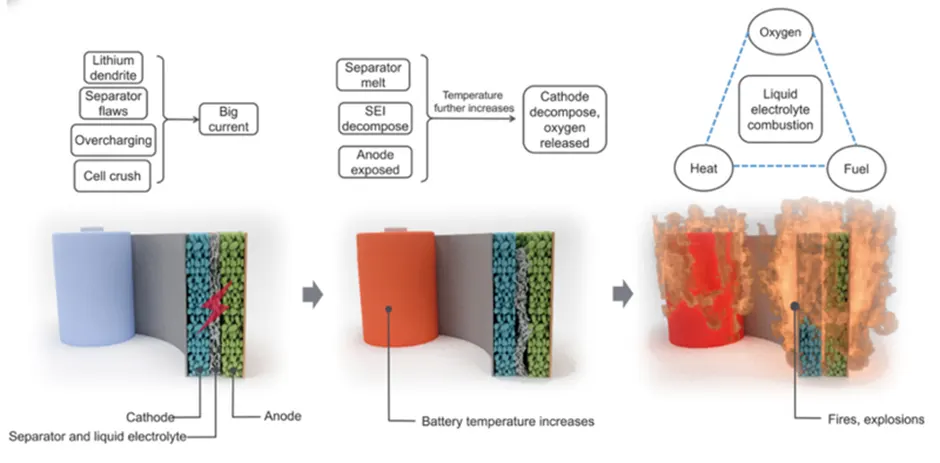
Stage 1: Overheating
Stage 2: Heat accumulation and gas release process
Stage 3: Combustion and explosion
Stage 1: Overheating
The battery pack overheating leads to thermal runaway. The overheating happens in many ways such as charging and discharging the cell, cell temperature, internal resistance, State of Charge, ambient temperature due to different climatic changes. In this stage, battery system operation changes from normal to abnormal condition. This is because of the above listed issues. So, it moves to stage 2.
Stage 2: Heat accumulation and gas release process
The Solid Electrolyte Interface (SEI) layer decomposition due to overheating. The temperature rises quickly, and oxygen accumulates inside the battery. So, it moves to stage 3 for battery combustion.
Stage 3: Combustion and explosion
The oxygen and heat released from stage 2 leads to combustion. The combustion happens in a flammable electrolyte and leads the battery to fire.
Now, let us see heat generation calculations.
Heat Generation Calculation:
There are two heat sources for battery heat generation.
- Joule heat
- Entropy heat
Heat generated = Joule heat + Entropy heat
Joule heat:
From ohm’s Law, V = IR
When a current is flowing through a resistance, there is heat dissipated in the resistor. This heat dissipation is called joule heating. Joule heating is also known as ohmic heating.
Power,

<!--[endif]-->
Heat,

<!--[endif]-->
Joule heat,
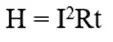
<!--[endif]-->
Where, P = Power
V = Voltage
I = Current
R = Resistance
H = Heat
t = Time
The heat produced in a resistor is-
- directly proportional to the square of current flowing through it.
- directly proportional to resistance.
- directly proportional to time for which current flows through it.
Entropy heat:
The heat generation due to entropy change inside a battery occurs when electrochemical reactions are performed. The entropy heat is reversible heat resulting from changes in open circuit voltage with respect to temperature at two electrodes.
Heat generation = joule heat + entropic heat
As entropic heat is twice the joule heat, the formula will be as shown below.
Average heat generated = average joule heat + 2(average joule heat)
Maximum heat generated = maximum joule heat + 2(maximum joule heat)
Maximum Heat = Maximum Joule Heat + Maximum Entropic heat
Maximum Joule heat = I^2*R*t
I = Maximum current = -0.896 (Here, Negative sign indicates, Reverse flow of Current)
R = Maximum Resistance = 0.002
t= Time = 2 min = 120
Joule Heat = (0.896)^2*0.002*120 = 0.1928
Maximum Joule heat = 0.1928
Entropic heat = 2* Joule heat = 2* 0.1928
Entropic Heat = 0.3853
Maximum Heat generation = 0.1928 + 0.3853
= 0.5781
Maximum heat generation of the battery = 0.5781
<!-- [if !supportLists]-->2.SOC of the Battery Pack:
The SOC is the level of charge of an electric battery related to its capacity. The units of SOC are percentage points (0% = empty; 100% = full). It is also defined as the ratio of remaining capacity to the fully charged capacity.
SOC Estimation Methods:
- Voltage translation method
- Coulomb counting method
Voltage Translation Method:
The battery voltage (open circuit voltage) is used to determine the state of charge of the battery pack. The voltage translation method is used in applications like consumer electronics (battery bank, trimmer, torch light) and small energy storage systems. The LCD and LED are used to determine the SOC. The errors in voltage translation methods are voltage fluctuation, noise in the system and cell chemistry. So, it is not used in electric vehicles.
Coulomb Counting Method:
The SOC is estimated based on in and out flow of current in the battery pack.
Case 1: Estimating SOC that before charging SOC is zero%
SOC % = Total charge input / max battery capacity x 100.
Case 2: Estimating SOC that battery already has some amount of charge
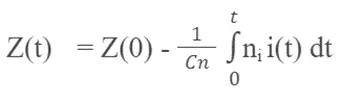
<!--[endif]-->
Where,
z(0) - Initial SOC
Cn - Battery nominal capacity
z(t) - State of charge
i(t) - Instantaneous cell current
t - time
ni - Coulomb efficiency
Simulink model For calculation of Battery SOC:
Blocks Used:
1.Battery
2.Signal Generator
3.Controlled Current source
4.Current Measurement
5.series RLC Branch
6.Scope
7.Power GUI
Simulink Model:
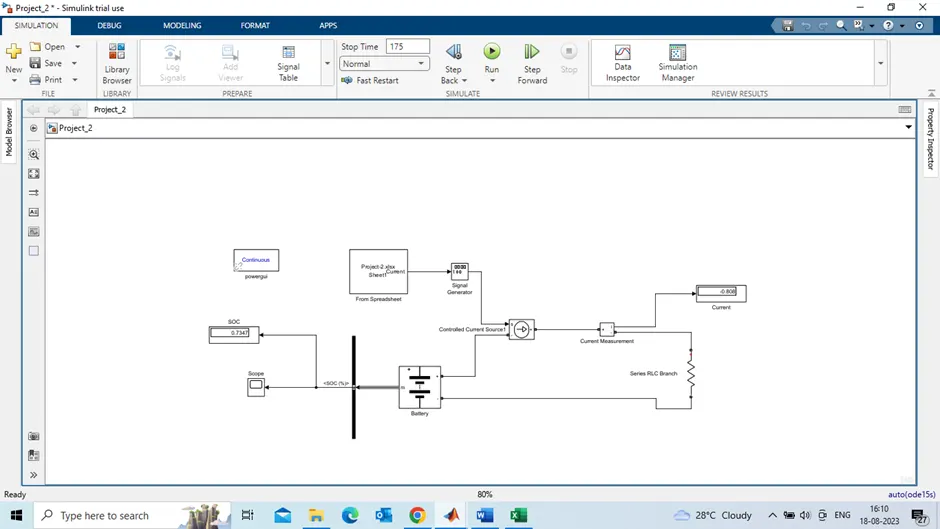
Output:
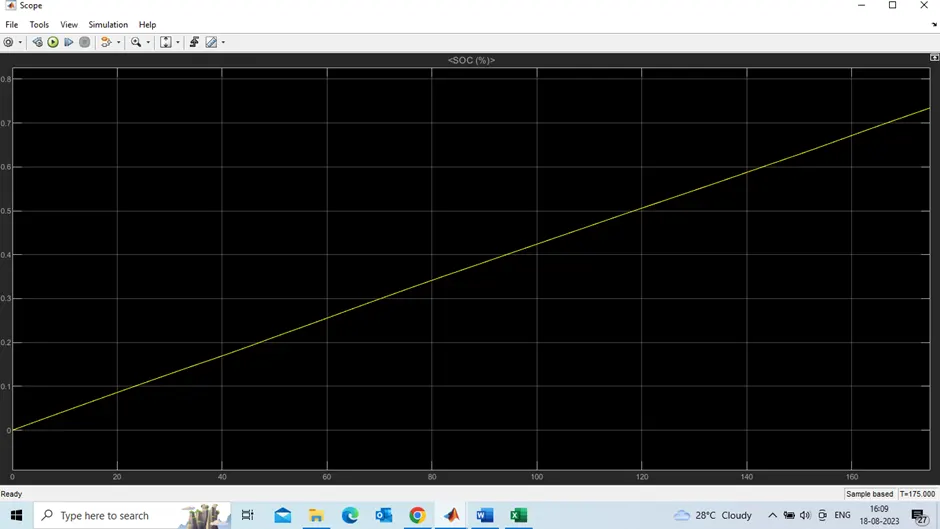
From the Output, The initial SOC is 0% and It reaches to 73% at the end of drive cycle(175 sec). Here drive cycle is ended at 174 sec. Battery SOC at 2*104 Sec is 208 sec. It can Assume 100% SOC .Current Value output in negative due to its flow is in reverse( charging).
Conclusion:
The maximum heat generation and SOC of the battery is Calculated and Results are shown Above. Maximum Heat generation from the battery by given drive cycle is 0.5781 and the SOC of the battery from given drive cycle is 73 %.