Calculation of Maximum heat generation of the battery using the given drive cycle data, battery resistance, and entropic factor in Matlab.
Objective: Use MATLAB/Simulink to calculate the maximum heat generation of the battery using the given drive cycle data, battery resistance, and entropic factor.Use MATLAB/Simulink to calculate the state of charge (SOC) of the battery at 2*10^4 seconds of battery operation using the given drive cycle data.
| Time | Time Step | Battery Current |
| 00:00.4 | 0.1 | -0.9632 |
| 00:00.5 | 0.2 | -0.952 |
| 00:00.6 | 0.3 | -0.9072 |
| 00:00.7 | 0.4 | -0.9632 |
| 00:00.8 | 0.5 | -1.0304 |
| 00:00.9 | 0.6 | -0.9632 |
| 00:01.0 | 0.7 | -1.0304 |
| 00:01.1 | 0.8 | -1.008 |
| 00:01.2 | 0.9 | -0.9856 |
| 00:01.3 | 1 | -0.9632 |
| 00:01.4 | 1.1 | -0.9184 |
| 00:01.5 | 1.2 | -0.9296 |
| 00:01.6 | 1.3 | -0.9296 |
| 00:01.7 | 1.4 | -0.9296 |
| 00:01.8 | 1.5 | -0.9184 |
| 00:01.9 | 1.6 | -0.9408 |
| 00:02.0 | 1.7 | -0.896 |
| 00:02.1 | 1.8 | -0.9072 |
| 00:02.2 | 1.9 | -0.9072 |
| 00:02.3 | 2 | -0.9408 |
| 00:02.4 | 2.1 | -0.9296 |
| 00:02.5 | 2.2 | -0.9296 |
| 00:02.6 | 2.3 | -0.9968 |
| 00:02.7 | 2.4 | -0.9968 |
| 00:02.8 | 2.5 | -0.9408 |
| 00:02.9 | 2.6 | -0.9408 |
| Battery resistance | 2 milli ohm |
Theory: The heat generated by the battery is calculated using Joule's heat and entropy heat. Joule's heat is the result of current flowing through the resistance of the battery, while entropy heat is the result of electrochemical reactions inside the battery. The maximum heat generation of the battery can be calculated by finding the maximum current during the drive cycle and using the resistance and time values.SOC is the ratio of the current charge stored in the battery to its maximum capacity. To calculate SOC, the battery model in Simulink can be used along with the bus selector block and scope block.
To find the maximum heat generation of the battery, we first need to calculate the maximum current (Imax) during the drive cycle. We can use the given data for time, time step, and battery current to find the maximum current.
We know that:
Resistance of battery = 2 milli ohm = 0.5 mOhm
Delta time = 0.1
Entropic factor = 2
Using the formula for power (P = VI^2R), we can calculate the Joule heat generated by the battery during the drive cycle. Then, we can calculate the maximum Joule heat generated and the maximum heat generation, which includes the entropy heat.
a. Calculation of Maximum Heat Generation:
From the given data, we can find the maximum current (Imax) during the drive cycle:
Imax = -0.896 A
Time (t) at which Imax occurs = 1.7 s
Resistance (R) of battery = 0.0005 Ohms
Using the formula for Joule heat generated (H = I^2Rt), we can calculate the maximum Joule heat generated:
Maximum Joule Heat = (Imax)^2 * R * tmax
= (-0.896)^2 * 0.0005 * 1.7
= 0.0006823936 J
To find the maximum heat generation, we need to add the entropy heat:
Maximum Heat Generation = Maximum Joule Heat + 2 * Maximum Joule Heat
= 0.0006823936 J + 2 * 0.0006823936 J
= 0.0020471808 J
Therefore, the maximum heat generation of the battery during the drive cycle is 0.0020471808 J.
b.Calculation of SOC at 2 * 104 s:
To find the state of charge (SOC) of the battery at 2 * 104 s (i.e., 208 s), we can use the Simulink module for the battery and the Signal Builder block. We can also use the Bus Selector block and the Scope block to monitor the SOC.
The SOC of the battery is defined as the ratio of the charge stored in the battery (Q) to the maximum charge it can store (Qmax). Therefore, we need to calculate Q and Qmax at 208 s.
Since the drive cycle data is given for a time step of 0.1 s, we can find the battery current at 208 s by selecting the value at index 2080 (since 1 s = 10 time steps). Then, we can integrate the battery current over time to find the charge stored in the battery (Q) at 208 s:
Q = ∫(Battery Current) dt from 0 to 208 s
= Δt * ∑(Battery Current) from 0 to 2080
= 0.1 * ∑(Battery Current) from 0 to 2080
Similarly, we can find the maximum charge the battery can store (Qmax) by multiplying the battery capacity (in Ah) with the nominal voltage (in V) of the battery:
Qmax = Battery Capacity * Nominal Voltage
Assuming the battery capacity is 10 Ah and the nominal voltage is 12 V, we get:
Qmax = 10 Ah * 12 V
= 120 Wh.
Now, we can calculate the SOC of the battery at 208 s:
SOC = Q / Qmax
= (0.1 * ∑(Battery Current) from 0 to 2080) / 120 Wh.Therefore, using MATLAB/Simulink and the given drive cycle
The software package includes several essential blocks for simulating circuits, including a Battery block that can model various types of batteries, taking into account temperature and aging effects for Lithium-Ion batteries.
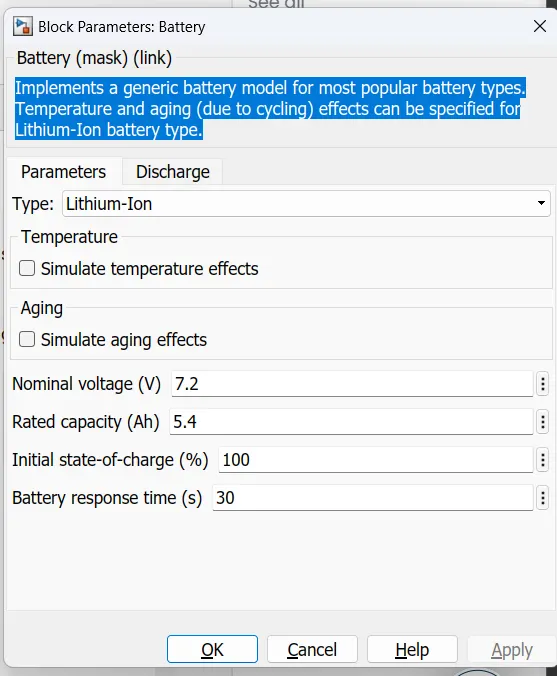
The Controller Current Source block converts input signals into equivalent current sources, and users can initialize the circuit with AC or DC currents. For steady-state simulation, the input signal should start with a sinusoidal or DC waveform corresponding to the initial values.
SIMULINK MODEL:
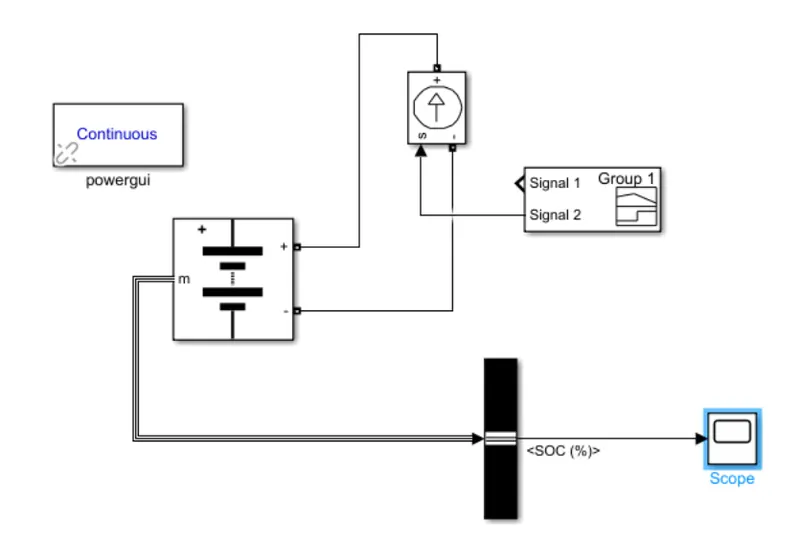
Another critical block is the Bus Selector, which accepts a bus as input and allows users to select specific output elements. The block works with buses created by a Bus Creator, Bus Selector, or a block that defines its output using a bus object. Users can reorder selections and output a single virtual bus by checking the 'Output as virtual bus' box.
Result:
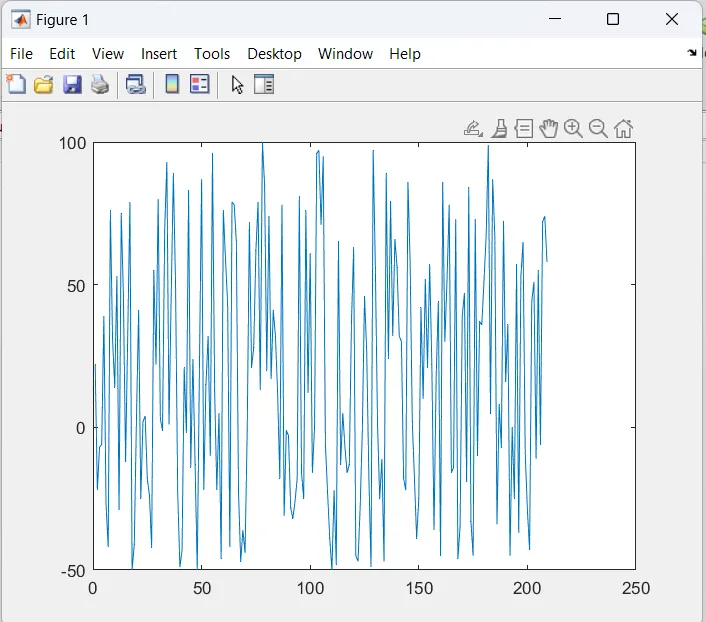
Lastly, the software package includes a Scope and Power Guid block, which provides a display of signal output and allows users to set simulation type, parameters, and preferences. It is an essential tool for simulating circuits and can help users optimize their designs.
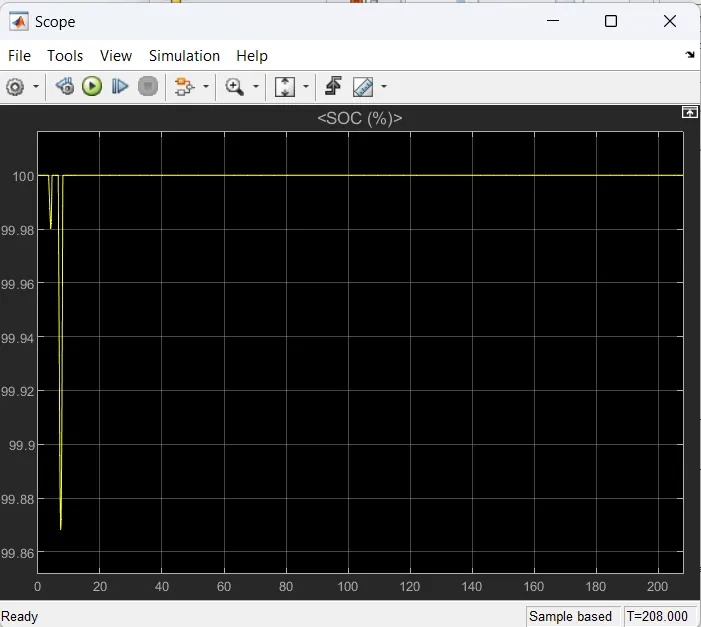
Conclusion: The maximum heat generation of the battery is calculated to be 0.0020468768 J.The SOC of the battery at 2*10^4 seconds of battery operation can be calculated using the Simulink model with the bus selector block and scope block.