Project - 2
Introdution:
In additive manufacturing, machinery that deposits material in successive layers to construct complicated geometries is controlled by data from CAD programmes or 3D object scanners. The process of making a product while continuously adding material to it is known as additive manufacturing. However, while creating something the old-fashioned way, you frequently need to remove material by milling, machining, carving, sculpting, or doing other necessary tasks. Rapid prototyping and 3D printing are two techniques that are included in additive manufacturing and are frequently used interchangeably. Despite appearing to be a new technology, many people are shocked to hear that additive manufacturing has been around for years.
Due to its advantages in creating components with intricate geometries and shapes, additive manufacturing has developed as a different manufacturing technique to create implants with the appropriate qualities. Human bones have an anisotropic structure that is biologically functionally graded, meaning that the structure has various qualities in each direction. As a result, different orthopaedic implants like knee, hip, and other bone plates can work more effectively if they are functionally graded. Utilizing additive printing has made it simpler to create functionally graded (FG) parts for orthopaedic applications with specialised anisotropic qualities (AM).
What is Orthopedic Implants:
A medical device known as an orthopaedic implant is intended to repair a bone, joint, or cartilage that has been damaged or deformed. For instance, a patient might require an implant as a result of a congenital impairment, limb loss, or leg fracture. The implant can be utilised to replace the articulating surfaces in various body joints and aid in bone fixation. The implant is used to strengthen or completely replace the joints in the damaged bones or places where a patient may be experiencing discomfort in their joints or bones that may need to be repaired.
Depending on the patient's condition, the orthopaedic surgeon uses a variety of surgical techniques to implant the implants into the body. Consider a joint that has deteriorated past a certain point. In that situation, the surgeon uses a variety of orthopaedic instruments created specifically for the operation to remove the injured joint and replace it with an orthopaedic implant.
The majority of orthopaedic implants are constructed from titanium alloys and stainless steel, and some of them could even have a plastic lining. The implant's essential strength is provided by the steel framework, while the plastic lining acts as synthetic cartilage. In most cases, the implant is put in position so that the bone can grow into it and strengthen it. To improve adhesion, the surgeon may occasionally additionally cement the orthopaedic implant.
Types of Orthopedic Implants:
Screws:
An orthopaedic implant known as a screw looks similar to the screws you can buy at any hardware shop. An orthopaedic screw, however, can have either a flat head or a crosshead. The main purpose of the screws used in orthopaedic implants is to provide compression, which aids in bone healing where an injury has occurred. The rotator cuff or torn labrum are two examples of injured areas that are tightened using a screw. Additionally, the orthopaedic surgeon may use screws to fix a broken bone or regain stability in a weak spot. Permanent implants of the screws are an option. They exist in a variety of shapes and sizes; for example, a reduction screw's thickness might range from 4.5 to 8.5 millimetres.
Plates:
Orthopaedic plates were first used in 1886 to treat long bone fractures, and they are still frequently used today. They come in a variety of forms, as follows:
- Buttress plates: These are used for holding together fractures occurring in the knee and ankle if there are large compressive and distorting forces. Buttress plates are contoured and can move with the body and maybe L or T-shaped.
- Neutralisation Plates: This is a category of plates that works to span a fractured area. They balance the load enabling screws and other types of orthopaedic implants to secure and stabilise the area.
- Bridging plates: These types of orthopaedic implants provide length and alignment and help stabilise the area while promoting secondary bone healing.
- Tension Plates: These are typically wires which are used in securing an area while it heals.
- Compression plates: These are metallic plates used for repairing bones by using dynamic pressure between the bone fragments, thus promoting healing.
Prostheses:
Prosthesis is yet another kind of orthopaedic implant that can restore lost bones or joints. It can also be utilised to provide broken bones the support they need. Patients can quickly restore their physical strength and activities after receiving this implant, which is generally utilised for knees and hips. Sometimes, the surgeon will use healthy bones along with prosthetic materials to completely replace certain sections of a bone or to repair broken or diseased bones.
Orthopediac Knee Implant:
Damaged Knee:
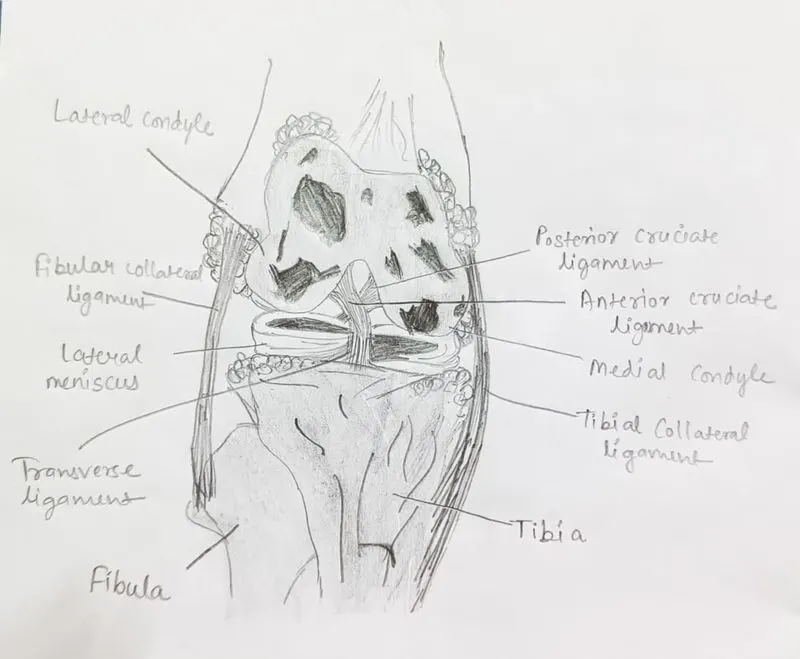
Knee Implant Diagram:
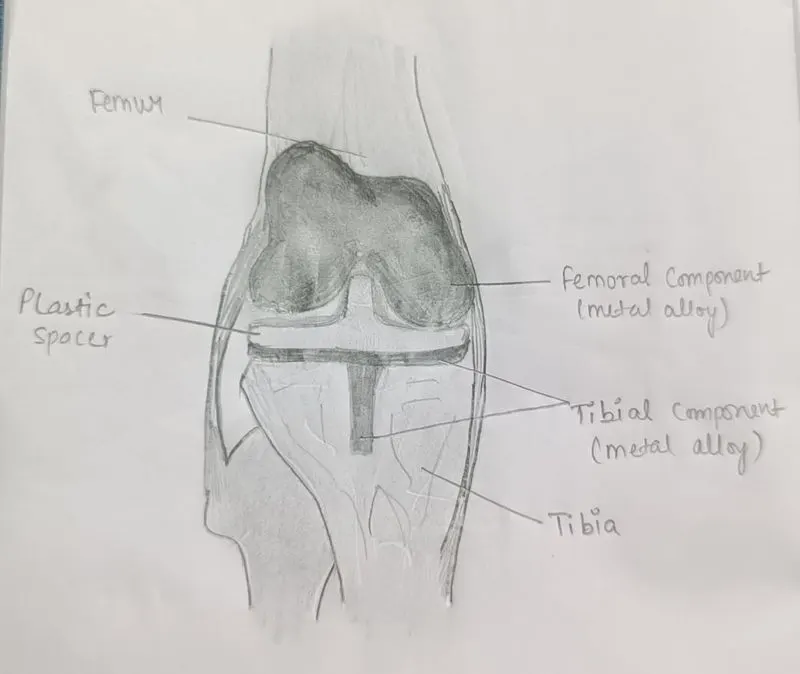
Implant Components:
Implants are made of metal alloys, ceramic material, and strong plastic parts. Up to three bone surfaces may be replaced in a total knee replacement:
- The lower end of the femur: The metal femoral component curves around the end of the femur (thighbone). It is grooved so the kneecap can move up and down smoothly against the bone as the knee bends and straightens.
- The top surface of the tibia (shinbone): The tibial component is typically a flat metal platform with a cushion of strong, durable plastic, called polyethylene. Some designs do not have the metal portion, and instead, the polyethylene attaches directly to the bone. For additional stability, the metal portion of the component may have a stem that inserts into the center of the tibia bone.
- The back surface of the patella: The patellar component is a dome-shaped piece of polyethylene that duplicates the shape of the patella (kneecap). In some cases, the patella does not need to be resurfaced.
Components are designed so that metal always interfaces with plastic, which provides for smoother movement and results in less wear of the implant.
The metal parts of the implant are made of titanium- or cobalt-chromium-based alloys. The plastic parts are made of medical grade polyethylene. Some implants are made of ceramics or ceramic/metal mixtures such as oxidized zirconium. These implants typically weigh between 15 and 20 ounces.
Material Criteria:
The implant materials used must meet several criteria:
- They must be biocompatible; that is, they must not be rejected by the body.
- They must be able to duplicate the knee structures they are intended to replace. They must be strong enough to take weightbearing loads, flexible enough to bear stress without breaking, and able to move smoothly against each other as required.
- They must be able to retain their strength and shape for a long time.
Materials and functional aspects of orthopedic implants:
By 1895, implants were already being used for orthopaedic purposes. For accelerated healing, a metallic plate was placed at the fracture site. Since that time, scientists have been working continuously to advance implant technology for orthopaedic uses. When stainless steel was first used as a bone screw material in 1920, the era of modern screws for fracture therapy began. It was demonstrated to be biocompatible and corrosion-resistant.
Orthopedic implants and additive manufacturing:
In the creation of orthopaedic implants, AM is essential. The production of scaffolds, implants, and other fixtures is becoming more and more common because to its high speed, accuracy, and capacity for mass customisation. The orthopaedic industry has undergone a revolution thanks to the ability to create fixtures and implants that are customised for each patient. Strong porous implants made possible by AM have aided in the ingrowth of bone, which has sped up healing and improved osseo-integration.
Functionally graded orthopedic implants with additive manufacturing:
To create implants or fixtures with enhanced mechanical and biological qualities, FGM is used in orthopaedics. The idea of FGM has improved implant quality in orthopaedics. With FGM via AM, problems including stress shielding and lingering strains on the surfaces of the implant and joint are being addressed.
Limitation of additive manufacturing for orthopedic applications:
Orthopedics is a field where AM is currently expanding more quickly. With the use of additive manufacturing, researchers are working to create effective and dependable patient-specific implants. Because implants and scaffolds are manufactured layer by layer, there are some restrictions on the mechanical strength of these devices. Necrosis may result from the poor bionic difficulties with the traditional additive manufacturing technique.
Conclusions
Implants now have better mechanical qualities thanks to FGM. It is the ideal choice for scaffolds and surgical instruments used in orthopaedic procedures due to the control over porosity and material concentration. The orthopaedic industry has undergone a change as a result of the use of FGM. The thermal stresses between the implants have been significantly reduced.