Project
AIM: To carry out a system-level simulation of an all-terrain vehicle using Simulink.
OBJECTIVE: To prepare a technical report on BAJA ATV explaining model properties for the following:- without using the Lookup table - using the Lookup table
SOLUTION:
Part #1: BAJA ATV Model without Lookup Table
1.1 Without Dashboard
A Simulink model for the BAJA ATV Model is shown below.
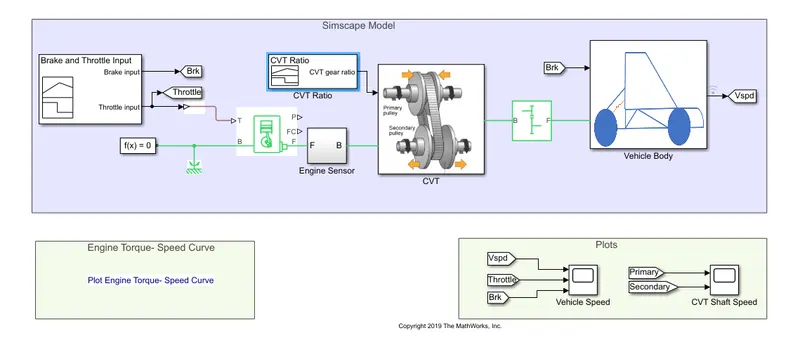 The models consist of common blocks as follows:
Signal Builder: The Signal Builder block allows you to create interchangeable groups of piecewise linear signal sources and use
them in a model. You can quickly switch the signal groups into and out of a model to facilitate testing.
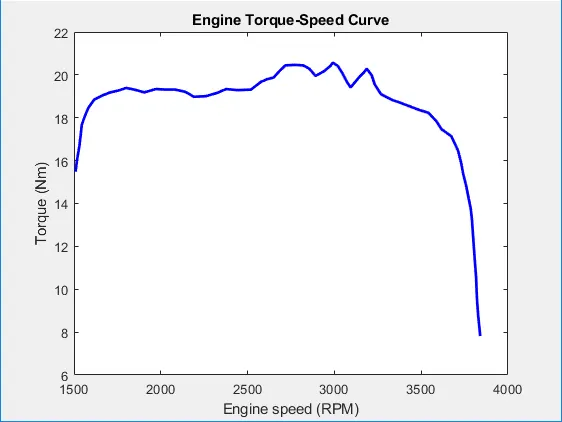
Generic Engine: Represents a system-level model of spark-ignition and diesel engines suitable for use at the initial
stages of modeling when only the basic parameters are available. Optional idle speed and red
line controllers are included.
The throttle input signal T lies between zero and one and specifies the torque demanded from
the engine as a fraction of the maximum possible torque. If the engine speed falls below the
Stall speed, the engine torque is blended to zero. If the engine speed exceeds the maximum
speed, the simulation stops and issues an error message.
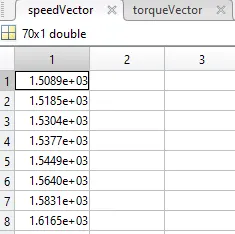
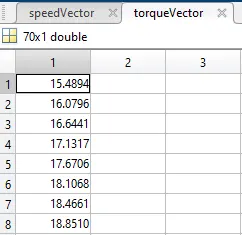
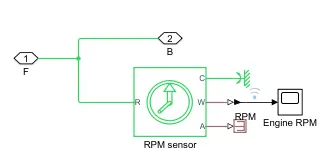
Engine Sensor
Ideal Rotational Motion Sensor: The block represents an ideal mechanical rotational motion sensor, that is, a device that converts an across variable measured between two mechanical rotational nodes into a control signal proportional to angular velocity or angle. The sensor is ideal since it does not account for inertia, friction, delays, energy consumption, and so on. Connections R and C are mechanical rotational conserving ports and connections W and A are physical signal output ports for velocity and angular displacement, respectively.
Connections B (base) and F (follower) are mechanical rotational conserving ports. Specify the relation between base
and follower rotation directions with the Output shaft rotates parameter. Optionally include thermal effects and
expose thermal conserving port H by right-clicking on the block and selecting Simscape block choices to switch
between variants.
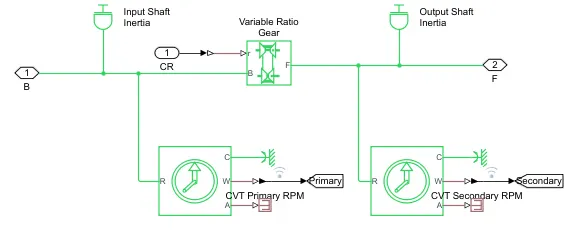
CVT BLOCK
Inertia Shaft:- 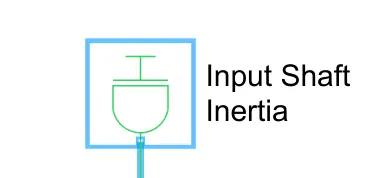
The block represents an ideal mechanical rotational inertia.
The block has one mechanical rotational conserving port. The block's positive direction is from its port to
the reference point. This means that the inertia torque is positive if the inertia is accelerated in a positive
direction
Variable gear ratio:- 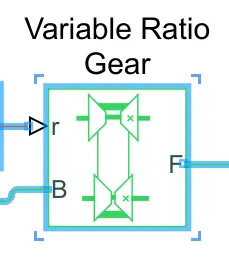
Represents a variable ratio gearbox such as implemented by mechanical belt CVT, electric, or hydraulic transmissions. The physical signal input r defines the ratio of input to output angular shaft velocities. Connections B (base) and F (follower) are mechanical rotational conserving ports. Specify the relationship between the base and follower rotation directions with the Output, shaft rotates parameter.
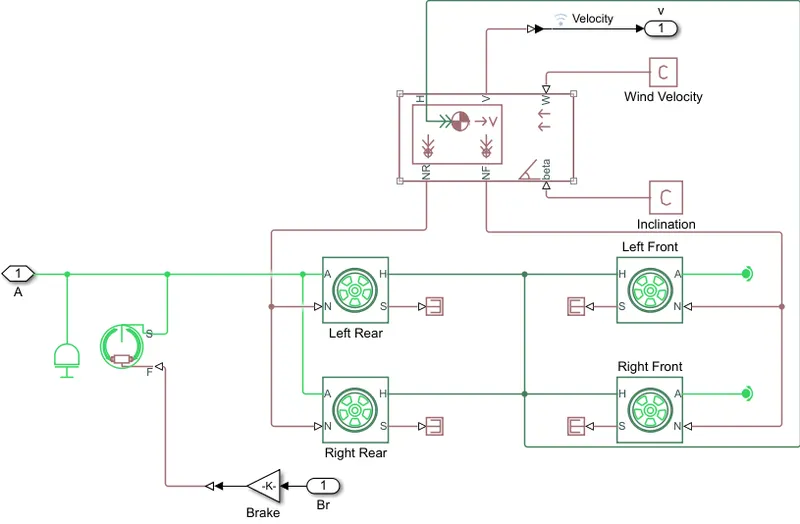
Vehicle body subsystem
Vehicle Body: Represents a two-axle vehicle body in longitudinal motion. The block accounts for body mass, aerodynamic drag,
road incline, and weight distribution between axles due to acceleration and road profile. The vehicle can have the same or a
different number of wheels on each axle. Optionally include pitch and suspension dynamics or additional variable mass and
inertia. The vehicle does not move vertically relative to the ground
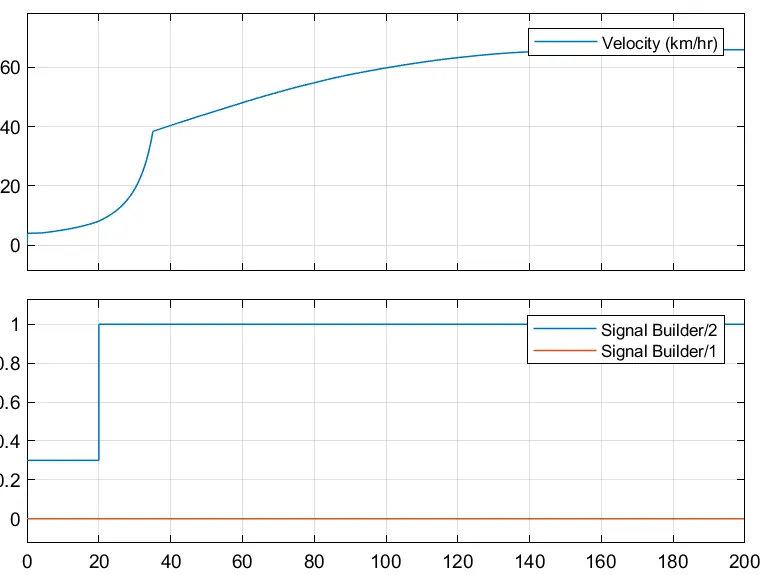
Vehicle Speed
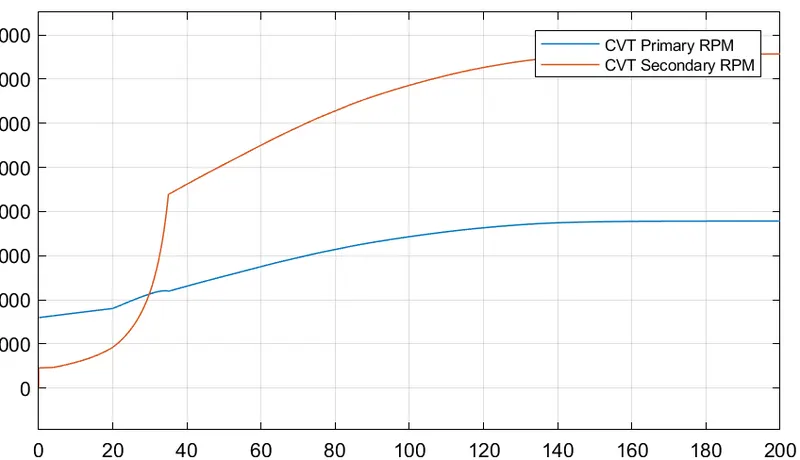
Cvt Shaft SPEED
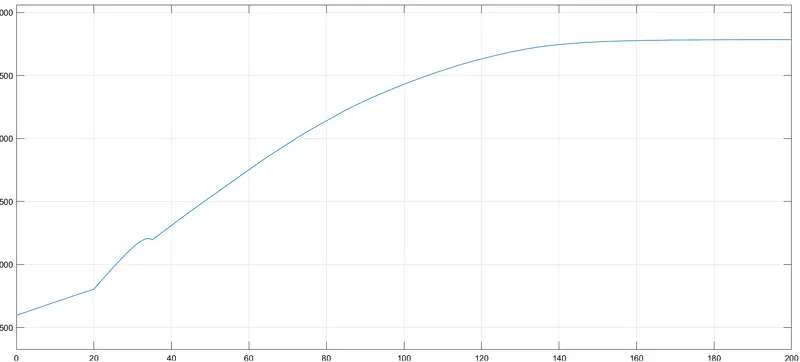
Engine RPM
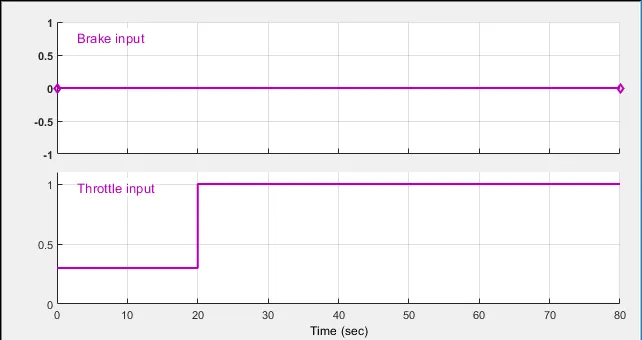
Input Of the signal builder for brake and Throttle:-
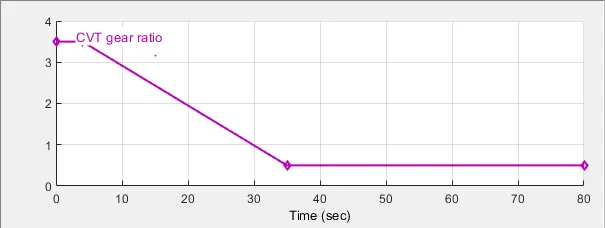
The input of the signal builder for CVT Gear ratio:-
1.2 With Dashboard
A Simulink model for the BAJA ATV Model including the dashboard is shown below. The rest of the parts and subsystems are
common in the above part.
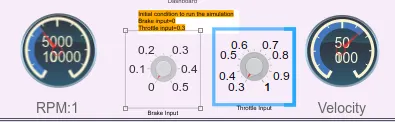
Dashboard: A dashboard (also called dash, instrument panel (IP), or fascia) is a control panel usually located directly ahead of a
vehicle's driver, displaying instrumentation and controls for the vehicle's operation.
The initial conditions are as follows:
Brake Input = 0
Throttle Input = 0.3
Vehicle Speed
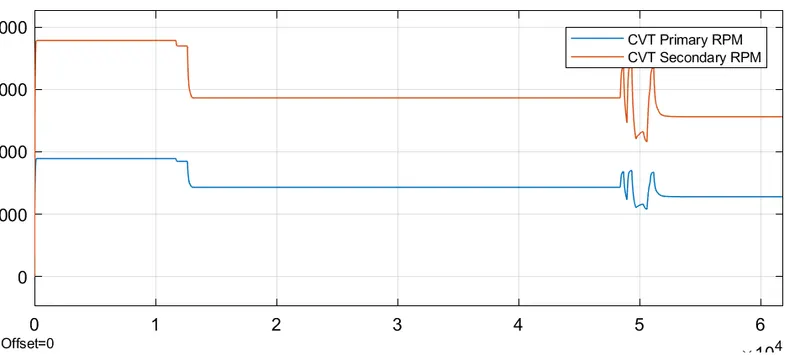
Cvt Shaft SPEED
Engine RPM
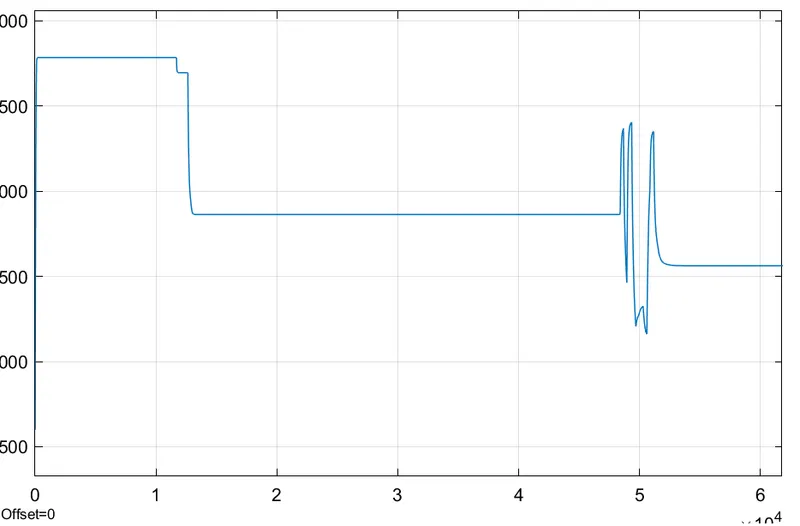
With look up table W/O Dashboard
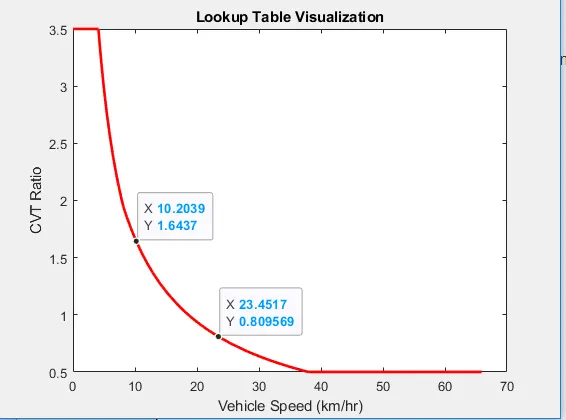
Lookup Table: A lookup table is an array of data that maps input values to output values, thereby approximating a mathematical
function. Given a set of input values, a lookup operation retrieves the corresponding output values from the table. If the lookup
table does not explicitly define the input values, Simulink can estimate an output value using interpolation, extrapolation, or
rounding, where:
- Interpolation is a process for estimating values that lie between known data points.
- Extrapolation is a process for estimating values that lie beyond the range of known data points.
- Rounding is a process for approximating a value by altering its digits according to a known rule.
A lookup table block uses an array of data to map input values to output values, approximating a mathematical function. Given
input values, Simulink performs a “lookup” operation to retrieve the corresponding output values from the table. If the lookup
table does not define the input values, the block estimates the output values based on nearby table values.
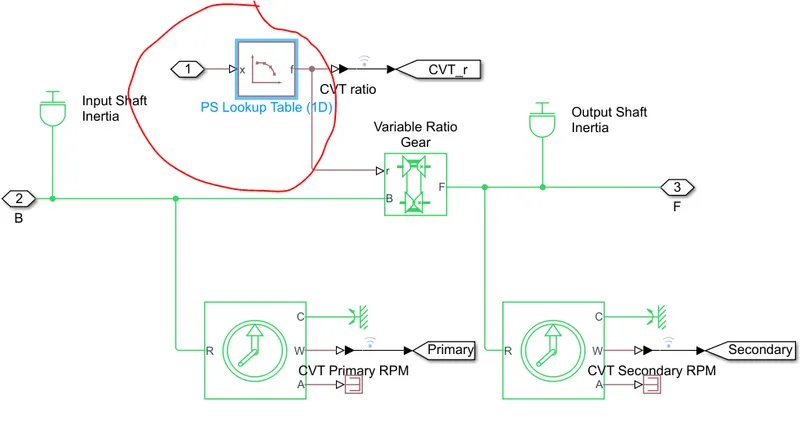
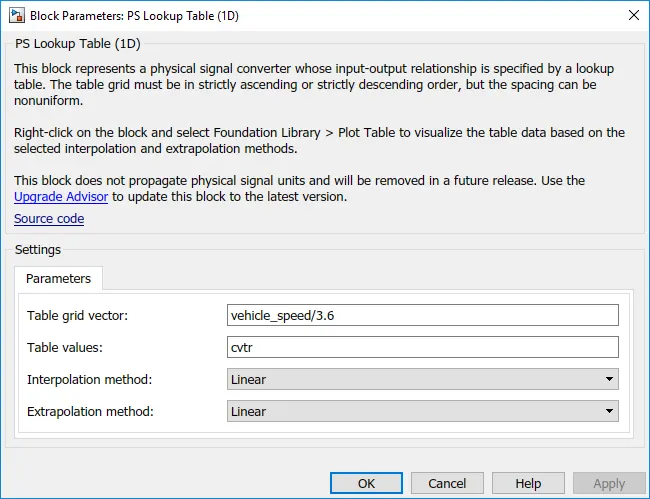
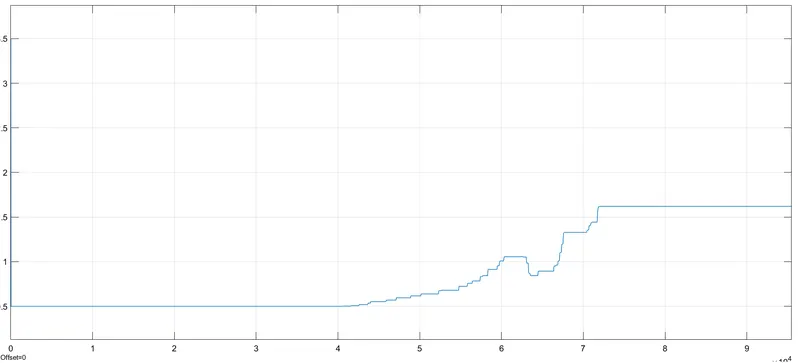
CVT Ratio vs Vehicle Speed:
0 to 20 km/hr, the CVT ratio is constant at 2.3
20 to 30 km/hr, the CVT ratio drops down to 2.03
30 to 50 km/hr, the CVT ratio drops down to 1.8
50 km/hr onwards, the CVT ratio is constant at 1.8
They are given in steps using the step block. Parameters are:
Brake Input:
Step time: 35
Initial value: 0
Final value: 0
Sample time: 0
 Step Block
Throttle Input:
Step time: 20
Initial value: 0.3
Final value: 1
Sample time: 0
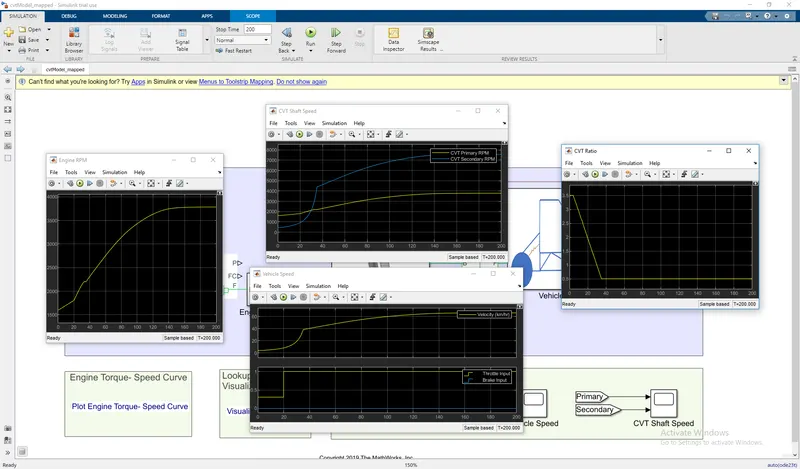
CVT RATIO :-
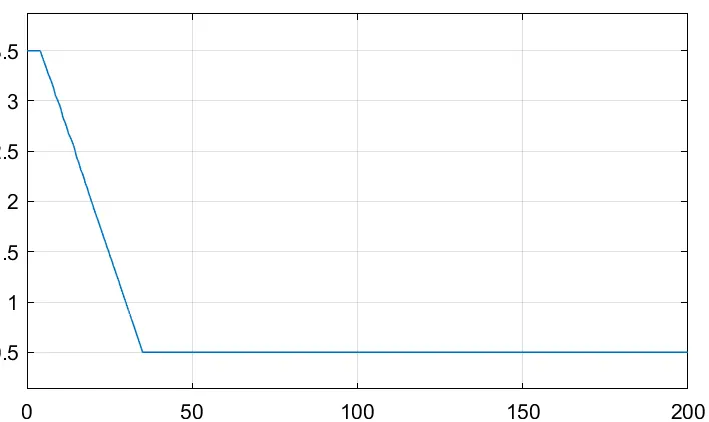
VELOCITY:-
CVT Shaft speed
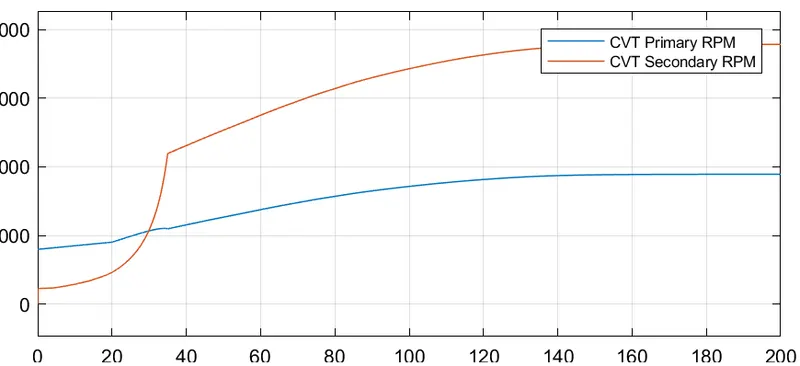
Engine RPM
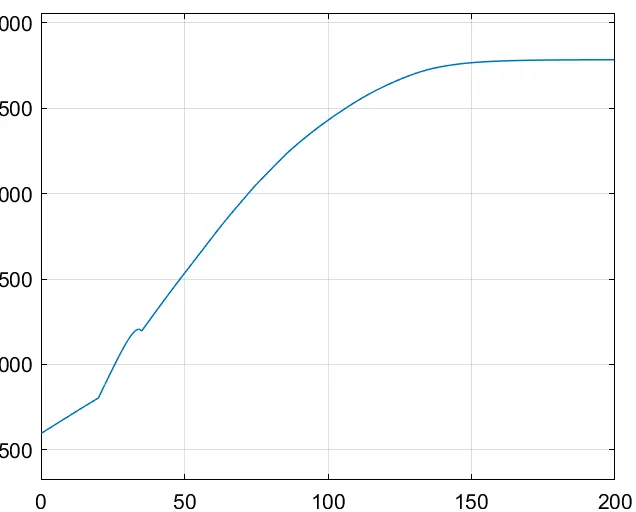
With Dashboard And lookup table.
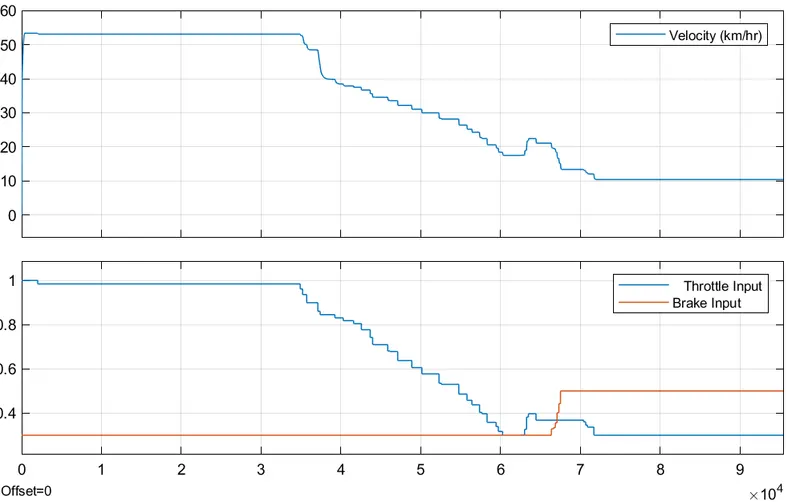
Vehicle Speed.
CVT ratio
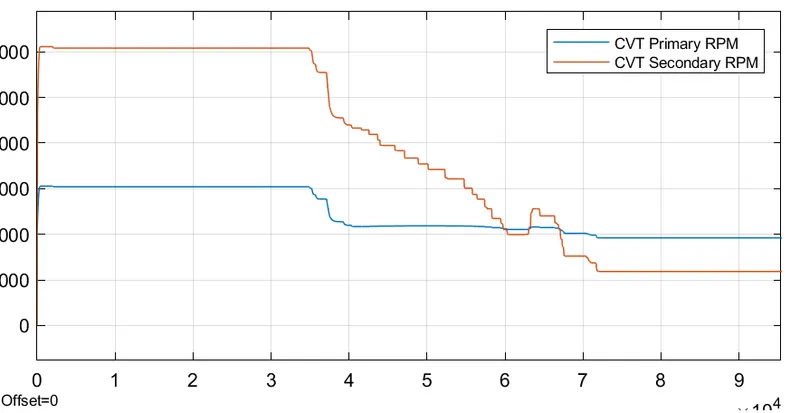
CVT Shaft Speed
CONCLUSION: Hence, the given BAJA ATV Model was simulated successfully and from the above results, we can infer that:
- Velocity, CVT Shaft Speed, and Engine Speed are directly proportional to the Throttle input and inversely proportional to the
Brake input.
- CVT ratio is directly proportional to Torque and inversely proportional to the throttle input.
- CVT Primary speed is greater than CVT Secondary speed as they are directly proportional to their shaft diameter.
- The speed might get null at a particular braking resistance.