Project
AIM: To study the system-level simulation of an all-terrain vehicle.
OBJECTIVE:
- To analyze the baja ATV model without a dashboard.
- To analyze the baja ATV model with a dashboard.
- To analyze the baja ATV model using the lookup table without a dashboard.
- To analyze the baja ATV model using a lookup table with a dashboard.
THEORY:
According to the American National Standards Institute (ANSI), an all-terrain vehicle (ATV), also known as a light utility vehicle (LUV),[1] a quad bike, or simply a quad, is a vehicle that rides on low-pressure tires, has a seat that the operator straddles and handlebars for steering control. It is built to tackle a greater variety of terrain than most other vehicles, as its name suggests.
- BAJA SAE:
The Society of Automotive Engineers International sponsors the Collegiate Design Series competition known as Baja SAE (SAE International). Small ATVs are designed and constructed by groups of students from universities all around the world. The main focus is on driver safety and better ergonomics simultaneously because an ATV is made to go on various terrains, including soil, gravel, pebbles, and more.
TRANSMISSION: The transmission system is one of the essential blocks of automobiles that helps transmit power from the engine block to the vehicle's wheels. There are 4 different types of transmission that are in use nowadays.
- Manual Transmission
- Continous Variable Transmission
- Semi-Automatic Transmission
- Automatic Transmission
Continous variable transmission:
An automated transmission that can vary smoothly across a continuous range of gear ratios is known as a continuously variable transmission (CVT). Other transmissions, in comparison, only offer a finite number of gear ratios in predetermined increments. With the right control, a CVT's flexibility may enable the engine to run continuously at a set RPM even while the vehicle's speed changes. Automobiles, tractors, motor scooters, snowmobiles, bicycles, and earthmoving machinery all employ CVTs. There are various different CVT designs that have occasionally been used, but the most popular one uses two pulleys connected by a belt or chain.
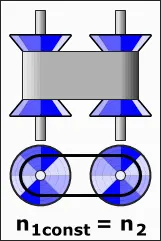
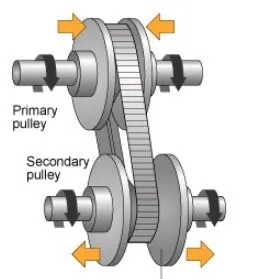
The CVT system used in the model is shown below:
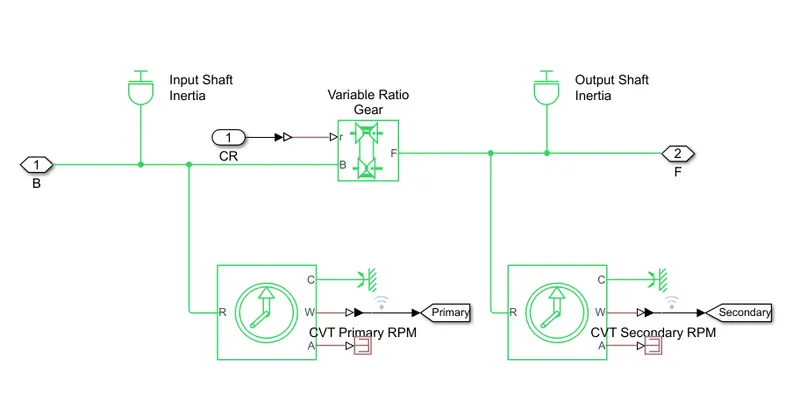
VEHICLE BODY:
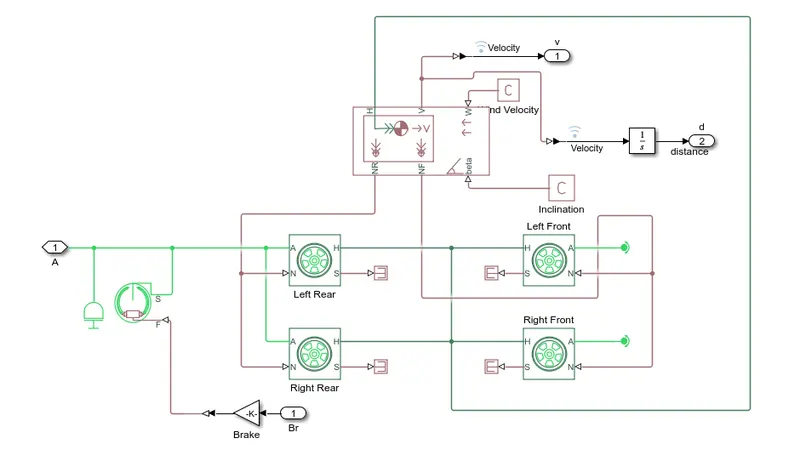
The Vehicle body block is shown below which represents a two-axle vehicle body in longitudinal motion.
STUDY 1: Simulink Simulation of Baja ATV model without a dashboard.
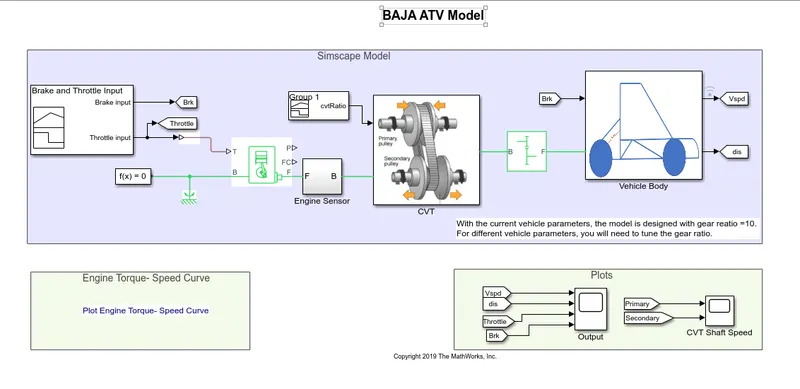
- Model:
- Working:
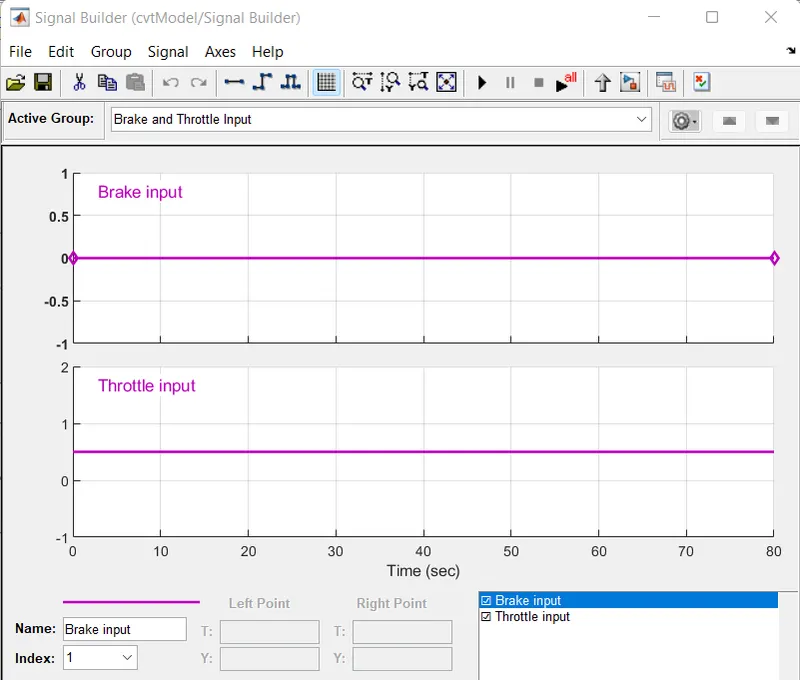
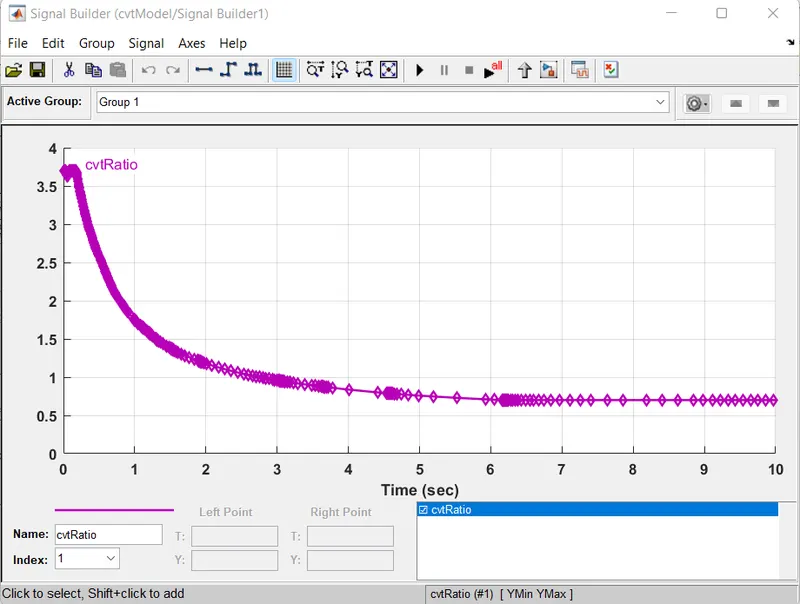
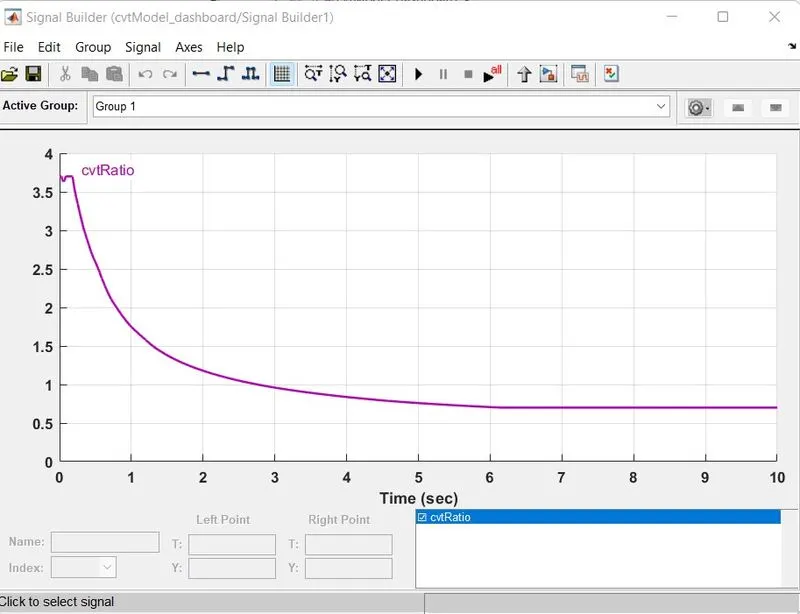
- Brake input, throttle input, and CVT gear ratio input are all provided by the Signal Builder block.
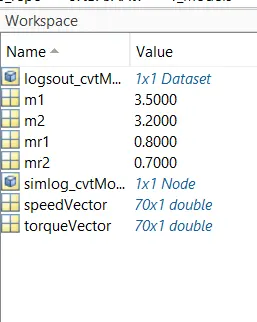
- The input for the speed and torque vectors comes from MATLAB Workspace.
- The engine receives a throttle input, and the engine characteristics change as a result.
- The pass through the Engine Sensor block is the Generic Engine's output.
- This sensor block transmits the engine output and records the engine rpm.
- The Gain block delivers the break input to the Double Shoe Brake block.
- The braking block's output is sent to the tires.
- The vehicle body block gives all tires motion.
- Utilizing an integrator, it also offers output signal velocity and displacement.
- Input Data:
Brake and throttle input:
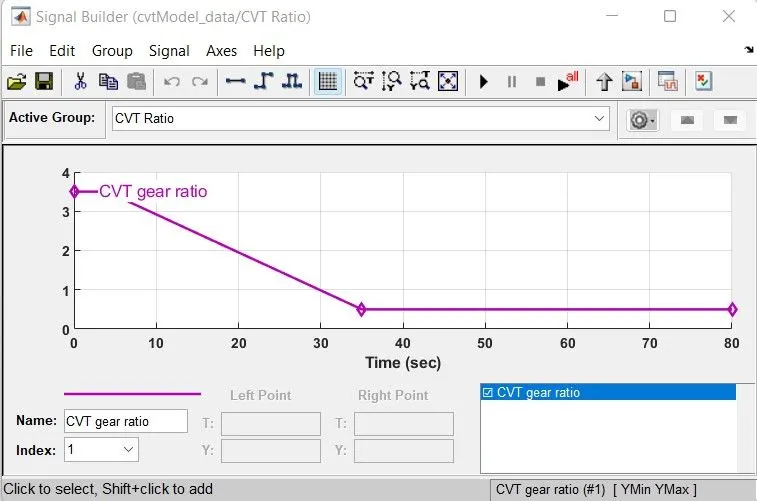
CVT ratio:
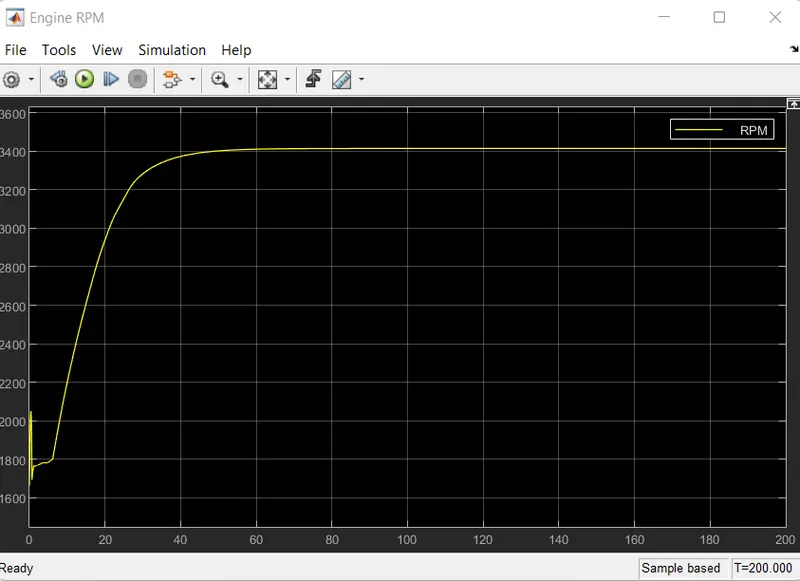
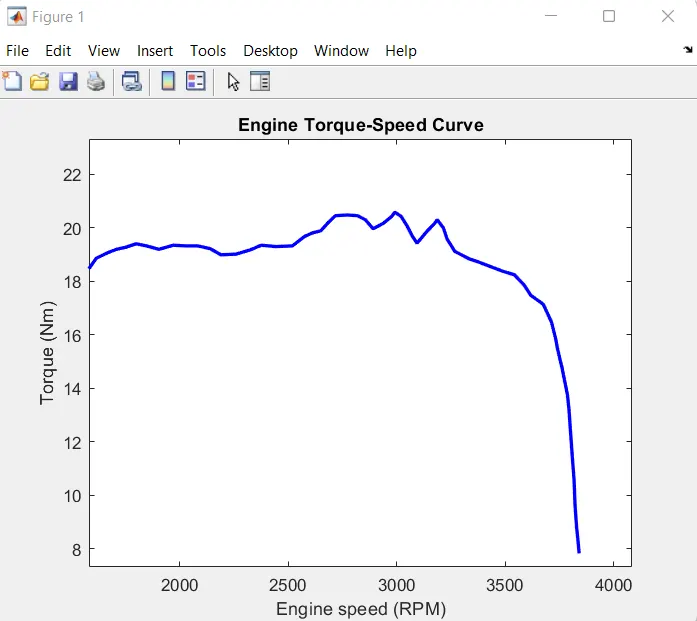
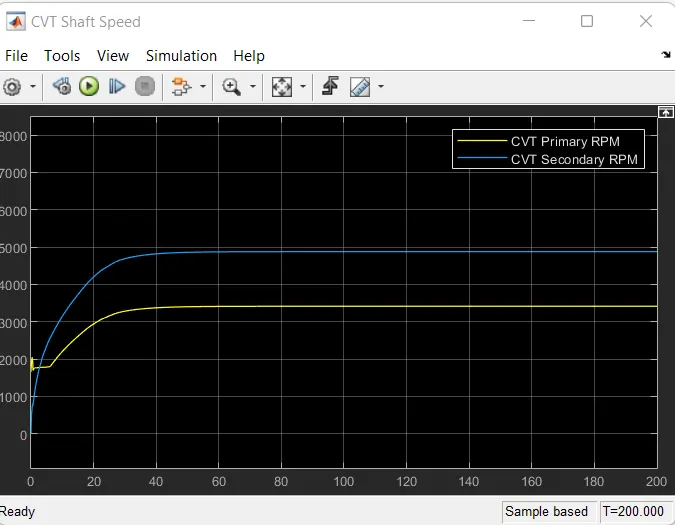
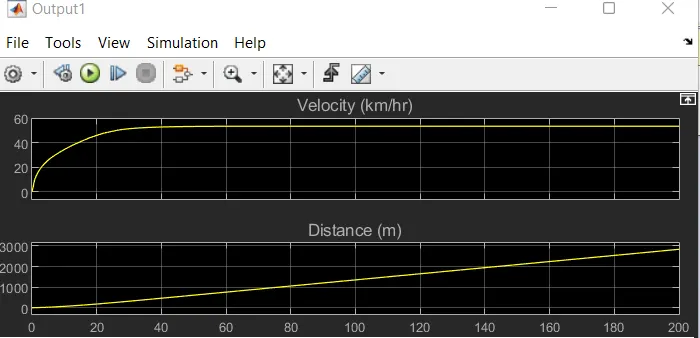
- Result: The simulation duration was 200 seconds. The outputs are shown below.
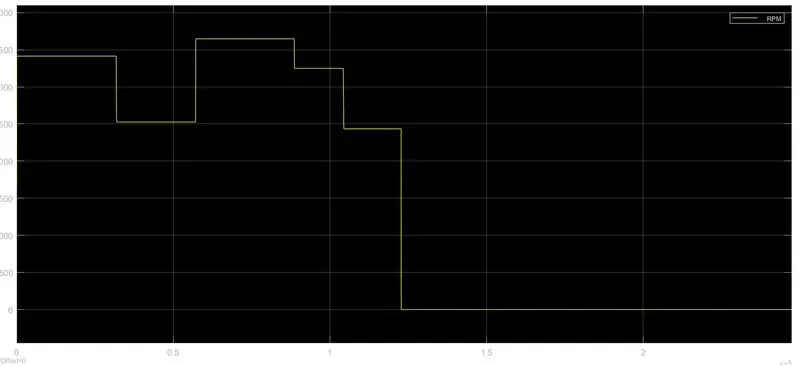
Engine RPM:
Engine Torque curve:
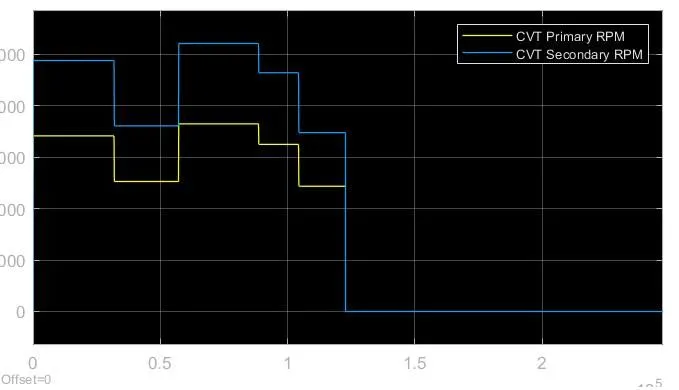
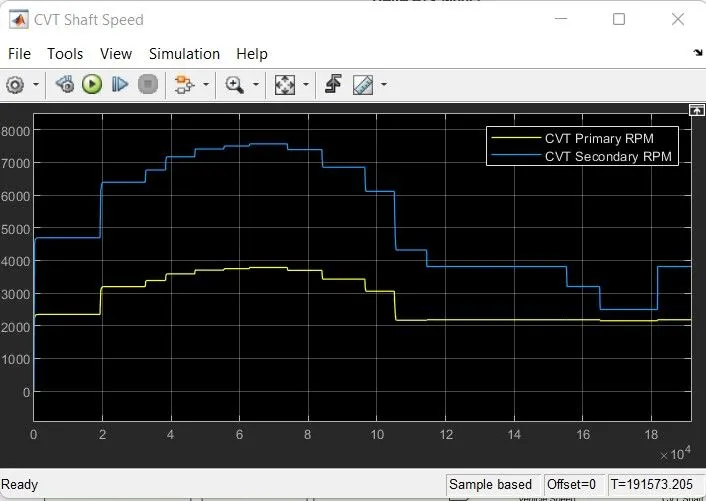
CVT shaft Speed:
Velocity and Displacement:
MATLAB Workspace:
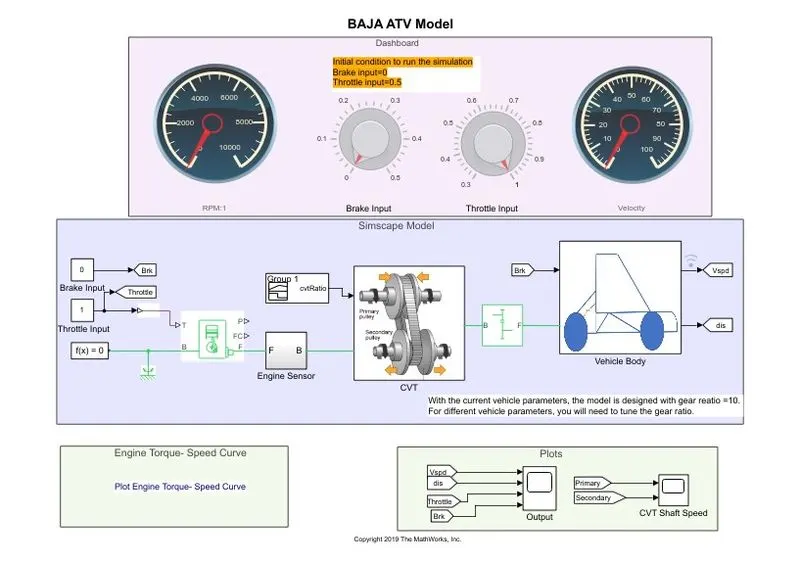
STUDY 2: Simulink Simulation of Baja ATV model with a dashboard.
- Model:
- Working:
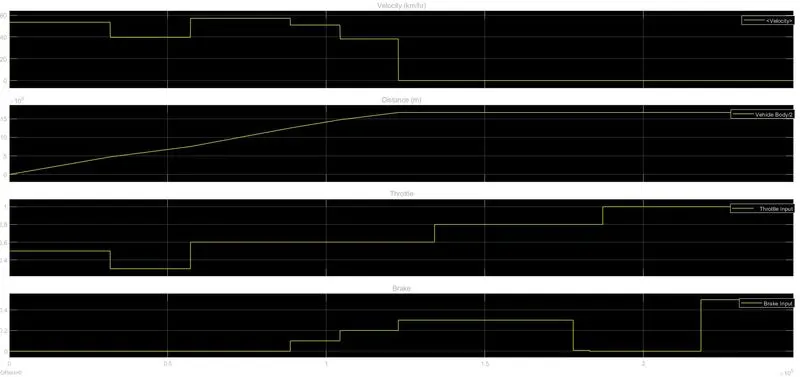
The working is the same as in study 1, however, the inputs- Throttle & Brake are provided using a knob instead of a signal builder. The knobs are used to control both parameters during simulation.
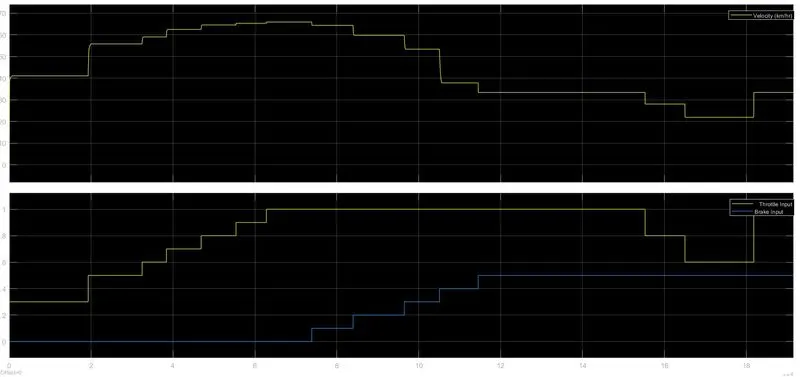
The basic idea behind employing a dashboard is to observe the results of altering the brake and throttle inputs, which demonstrate the engine's velocity and speed. The speed and velocity decrease when the brake input fluctuates between 0 and 0.5. The engine and shaft's velocity and speed increase as the throttle is opened wider.
- Result:
The outputs of the simulation are as follows:
CVT Ratio:
Engine RPM:
Engine Torque vs speed curve:
CVT Shaft Speed:
Velocity, Displacement, Throttle, and Brake:
STUDY 3: Simulink Simulation of Baja ATV model with CVT using Lookup Table.
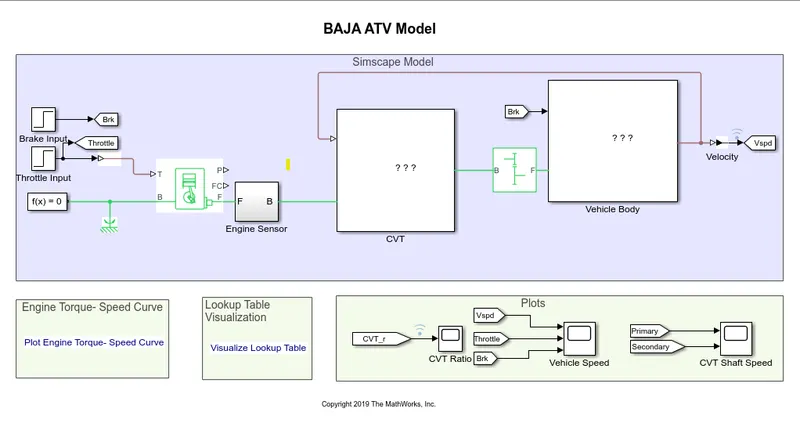
- Model:
- Working:
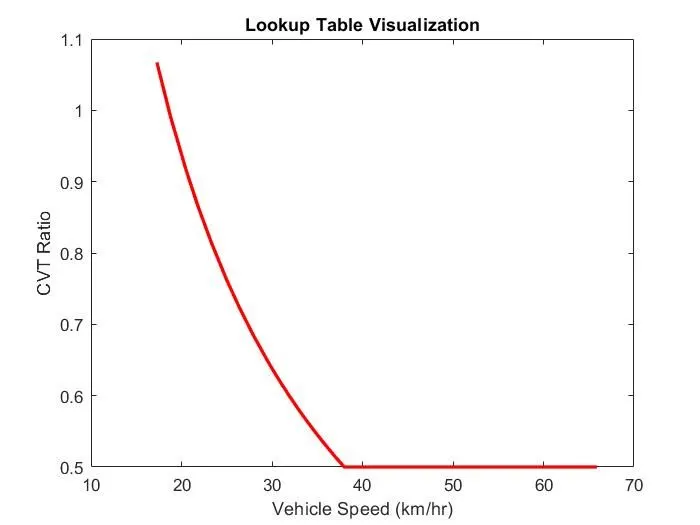
In this study, the CVT gear ratio is provided using a lookup table unlike in studies 1 and 2.
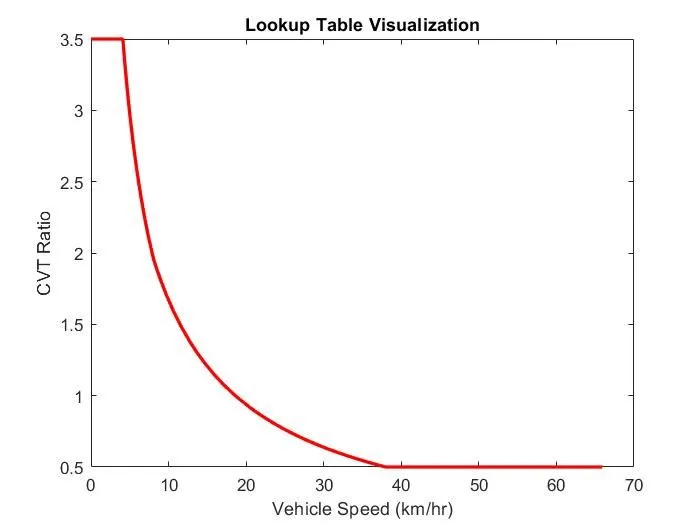
An array of data known as a lookup table approximates a mathematical function by mapping input values to output values. A lookup operation obtains the relevant output values from the table given a set of input values. Using interpolation, extrapolation, or rounding, Simulink can approximate an output value if the lookup table does not explicitly define the input values.
The process of estimating values that lie between known data points is known as interpolation. A method for guessing values outside the range of known data points is called extrapolation. By changing a value's digits in accordance with a known rule, rounding is the process of approximating a value.
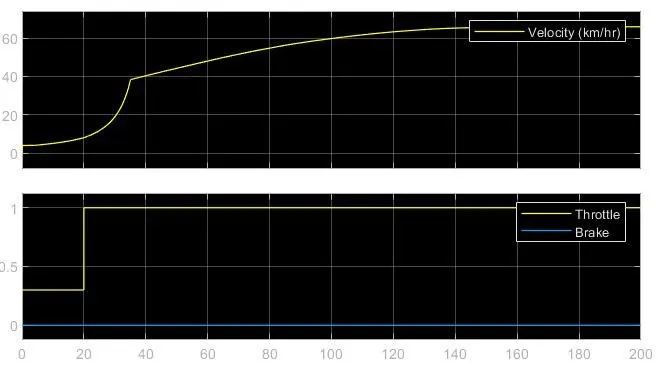
The step time, which is based on run time and varies correspondingly, provides the brake and throttle input. utilizing a gear ratio lookup table that serves as the CVT's input, works in accordance with the input gear ratio, and produces the output. This technique is particularly efficient since it makes it simple to increase engine speed and velocity while avoiding exceptional torque at a particular speed. When the input is provided through a lookup table, it operates as a closed loop. The Simulink uses a lookup table to acquire the input value and then calculates the outcome based on the input values for the gear ratio. As velocity is taken into account for both the input and output, the gear ratio ranges from 3.5 to 0.5. The maximum speed attained was roughly 67 kmph.
CVT Gear Ratio:
Lookup Table Visualization:
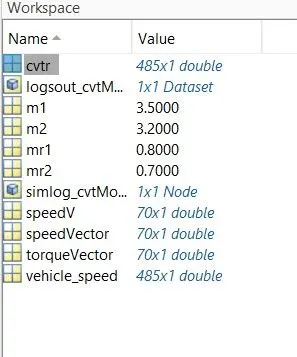
Workspace:
- Results:
Vehicle speed:
Engine RPM:
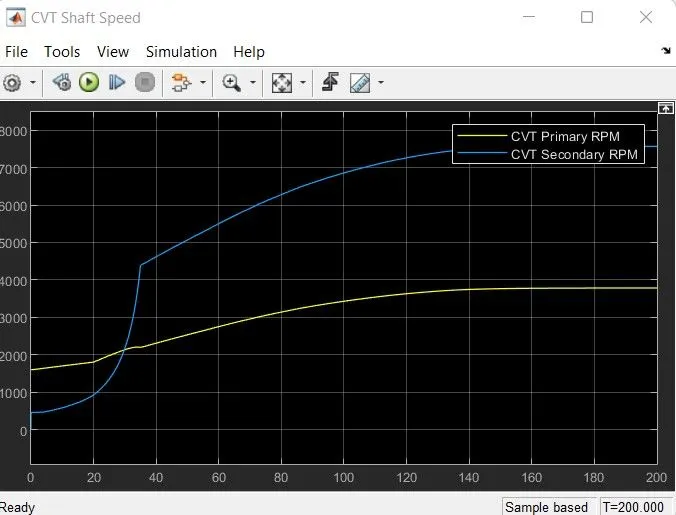
CVT shaft speed:
STUDY 4: Simulink Simulation of Baja ATV model with CVT using Lookup Table with a dashboard.
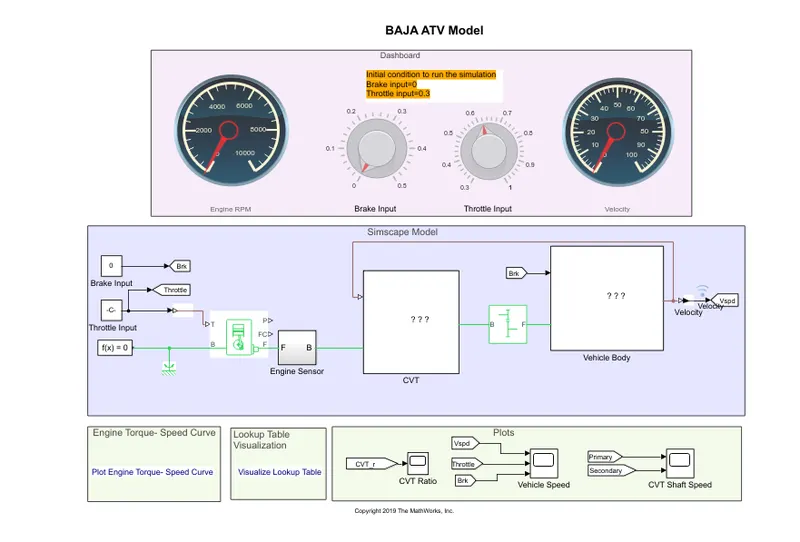
- Model: The figure below shows the model of BAJA ATV with a dashboard using the lookup table.
- Working:
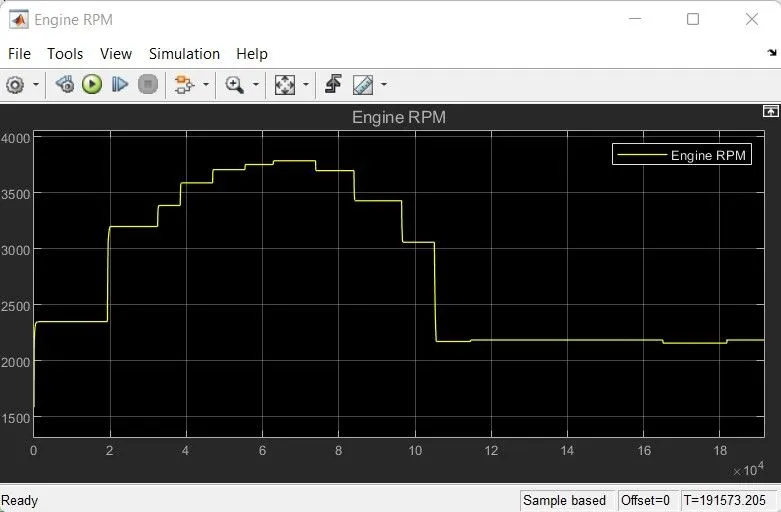
All the blocks and subsystems are the same as in study 3, however, using the dashboard. The primary goal of employing a dashboard is to analyze the results of changing the brake and throttle inputs, which reveal changes in the engine's velocity and speed.
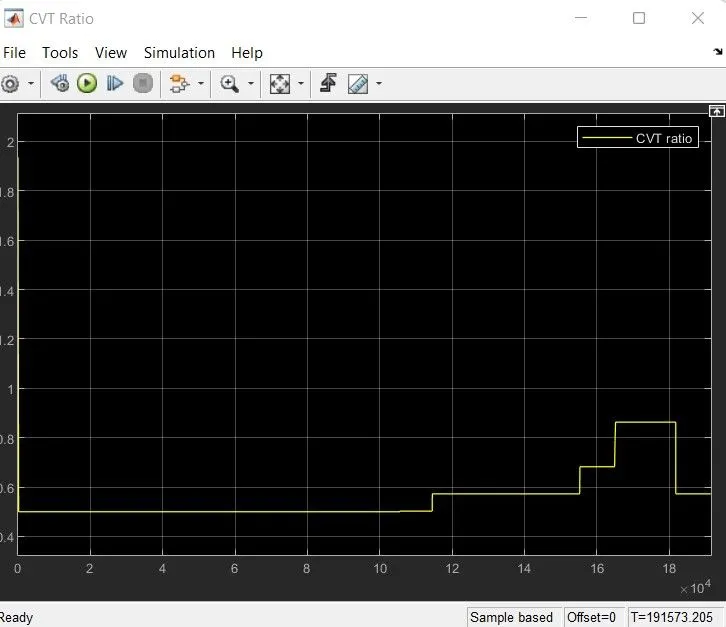
CVT Gear Ratio:
Lookup Table Visualization:
- Result:
Vehicle Speed:
Engine RPM:
CVT Shaft Speed:
CONCLUSION:
Hence, the 4 different models of BAJA ATV WITH CVT have been studied and the outputs are recorded. The Vehicle velocity and shaft RPM with respect to variation in throttle and brake are studied.