Project-1: Powertrain for aircraft in runways
1. Search and list out the total weight of various types of aircrafts.
Technical terms of weight:
- Manufacture’s empty weight
- Zero fuel weight
- Operating empty weight
- Payload
- Maximum takeoff weight
- Regulated takeoff weight
- Maximum landing weight
- Maximum ramp weight
- Aircraft gross weight
Aircraft Classifications:
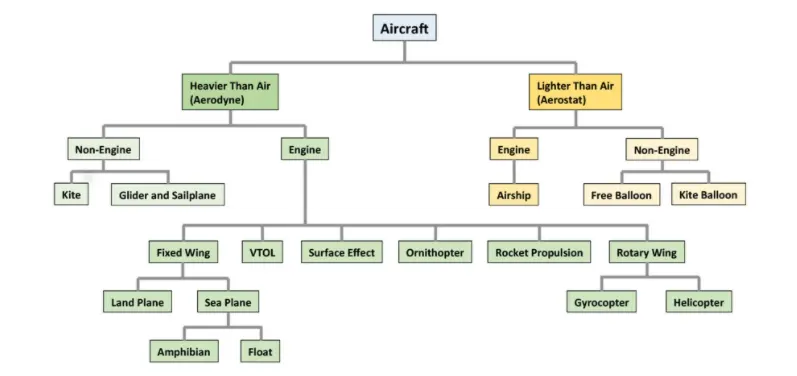
LIGHTER THAN AIR:
- Airships⇒ 10,000 kg
- Ballon⇒ 3,410 kg
HEAVIER THAN AIR:
- Gliders⇒ 500 kg
- Helicopters⇒ 6,000 kg - 20,000 kg
- Landplane of commercial and cargo⇒ 80,000 kg - 1,65,000 kg
- UAV⇒ 10 kg- 600 kg
_______________________________________________________________________________________
2. Is there any difference between ground speed and air speed?
Ground speed is the airplane’s speed relative to the surface of the Earth
Air speed its speed relative to the air it is flying in
As mentioned above, true airspeed is simply the speed at which an aircraft is moving relative to the air it is flying in. As such, it’s also the speed at which the air is flowing around the aircraft’s wings.
Ground speed, on the other hand, is the aircraft’s speed relative to the ground. One thing that should be noted here is that it’s horizontal rather than vertical speed – an aircraft climbing completely vertically would have a ground speed of zero.
In other words, while airspeed is what determines whether there is enough airflow around an aircraft to make it fly, ground speed is what determines how fast an aircraft will get to its destination.
_______________________________________________________________________________________
3. Why is it not recommended to use aircraft engine power to move it on the ground at Airport?
Aircraft have no power wheels. so the forward-thrusting and taxing is done engine power.
Most case forwarding by engine power is done and it cannot reverse so taxing is one by another vehicle.
High engine thrust during maintenance activity can cause considerable damage to airplanes and other elements in the airport environment.
The reason are,
- To save the fuel & cost.
- To improve fuel efficiency.
- The tractor driver can see more clearly than the pilot while operating the plane in the airport.
- For the safety operation in airports the aircraft engines are not powered because the aircraft engines are highly powered, It might lose control.
- Large sound produced by the aircraft gives the unpleasant atmosphere for the passenger in the airport.
_______________________________________________________________________________________
4.How does an aircraft get pushed to the runway when it's ready to take off?
Pushback is an airport procedure during which an aircraft is pushed backwards away from an airport gate by external power. Pushbacks are carried out by special, low-profile vehicles called pushback tractors or tugs.
An airplane uses tugs or tractors for moving from one place on an airport to another; for example, when moving from a hangar to the runway. The process is known as towing.
The tractors are attached to the nose wheel of the plane by the tow bar.
New technologies like pilot controlled tugs, electric motors placed on plane landing gear for reducing fuel and noise.
_______________________________________________________________________________________
5. Learn about take off power, tyre design, rolling resistance, tyre pressure, brake forces when landing.
Take off power:
Takeoff is the phase of flight in which an aerospace vehicle leaves the ground and becomes airborne.
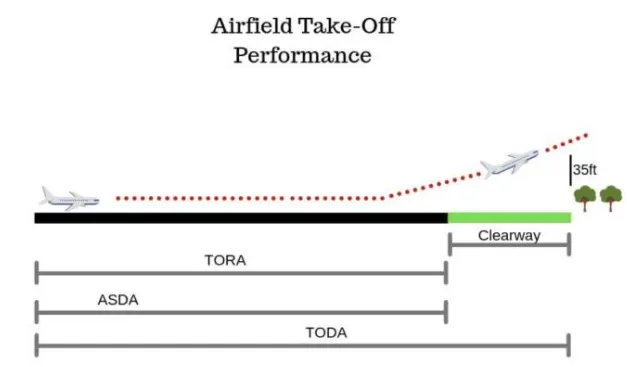
Take-Off Run Available (TORA)
Takeoff Distance Available (TODA)
Accelerate-Stop Distance Available (ASDA)
In order to operate within the TODA, the takeoff speeds must be as slow as possible. This is why flaps and slats are used on take off. They increase the lift generated by the wing, allowing the aircraft to get airborne at a slower speed.
Before every takeoff, the pilots must calculate the speeds, flap setting and engine power required to takeoff safely. This includes the engine failure scenario.
The amount of power that an engine is allowed to produce for a limited period of time for takeoff. The use of takeoff power is usually limited to 5 min for reciprocating engines and up to 2½ min for gas turbine engines. This may not always be the case. Specifically, with respect to reciprocating engines, it is the brake horsepower developed under standard, sea-level conditions and under the maximum conditions of the crankshaft rotational speed and the engine manifold pressure approved for the normal take-off. It is limited in continuous use to the period of time shown in the approved engine specifications. With respect to gas turbine engines, it is the thrust developed under static conditions at a specified altitude and atmospheric conditions of the rotor shaft rotational speed and gas temperature approved for the normal takeoff. It is limited in continuous use to the period of time shown in the approved engine specifications.
Tyre design:
When it comes to safety, tyres are one of the most important components of aircraft. They help to absorb the shock of landing and provide cushioning. It also provides the necessary traction for braking and stopping of an aircraft.
An aircraft tyre is designed to withstand extremely heavy loads while landing, take off, taxing, and parking. The number of wheels required for aircraft increases with the weight of the aircraft, as the weight of the aeroplane needs to be distributed more evenly.
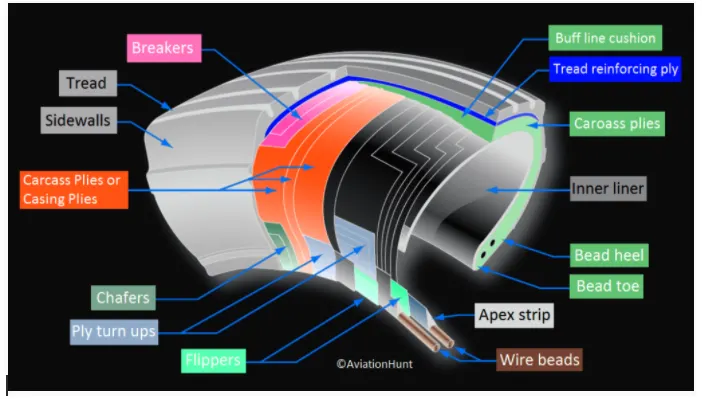
Carcass plies are used to form the tire. They are sometimes called casing plies. An aircraft tyre is constructed for the purpose it serves.
- They support the weight of an aircraft while it is on the ground.
- It also provides the necessary traction for braking and stopping of an aeroplane.
- Tyre also helps to absorb the shock of landing and provide cushioning the roughness of takeoff, roll-out, and taxi operations.
Unlike an automobile or truck tyre, it does not have to carry a load for a long period of continuous operation. However, an aircraft tyre absorbs the high impact loads of landing, and also it’s operating at high speeds for a short time when required.
Rolling Resistance:
When you press down on the accelerator in your vehicle, you are essentially transferring energy—in the form of gas or electricity, depending on your automobile, through the engine and other systems in your vehicle. That results in your tyres turning and enough momentum being built up to move your automobile. To accomplish this, though, your vehicle must overcome a lot of different factors that can make it resistant to forward movement. One of those factors is the tyres’ rolling resistance.
Tyre rolling resistance is the energy that your vehicle needs to send to your tires to maintain movement at a consistent speed over a surface. In other words, it is the effort required to keep a tyre rolling. The main contributor to rolling resistance is the process known as hysteresis. Hysteresis is essentially the energy loss that occurs as a tyre rolls through its footprint. The energy loss must be overcome by the vehicle’s engine, which results in wasted fuel.
Tyre pressure:
Aircraft tires generally operate at high pressures, up to 200 psi (14 bar; 1,400 kPa) for airliners, and even higher for business jets. The main landing gear on the Concorde was typically inflated to 232 psi (16.0 bar), whilst its tail bumper gear tires were as high as 294 psi (20.3 bar).
Brake forces when landing:
Stopping a 200-tonne aircraft landing at 180 mph requires a lot of braking force.\
When the aircraft is landing, brakes alone are not enough to bring the airplane to a safely controlled standstill though. To slow down as quickly as possible and to maximize the function of the wheel brakes, jet airplanes also commonly use thrust reversers and flaps. These systems are engaged after the wheels of the airplane touch the runway during landing.
To land the aircraft brake is applied and simultaneously flaps directions are changed and reverse thrust is produced.
_______________________________________________________________________________________
6. With necessary assumptions, calculate the force and power required to push / pull an aircraft by a towing vehicle.
Weight of aircraft :1,00,000 kg
Frontal area of aircraft :125 m2
Speed of the towing tug :20 kmph
Co-efficient on rolling resistance :0.03
Coefficient of drag :0.02
Radius of tyre :0.65 m2
Gear ratio :10
Using the values the force and power of the motor is calculated by excel calculator
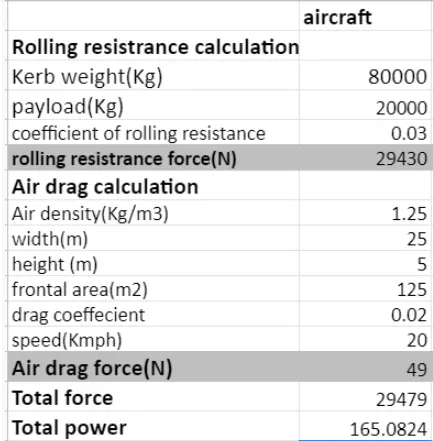
Total torque=(F*r)/G
r=0.65; G=10
Total torque =1916.135 KN
Total force =29479 KN
https://drive.google.com/file/d/1d8i3hHQxd07HPceLsFvZggK1Z1sGH729/view?usp=sharing
______________________________________________________________________________________
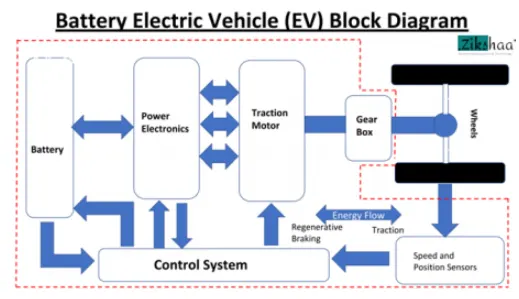
7. Design an electric powertrain with a type of motor, it’s power rating, and energy requirement to fulfill aircraft towing applications. Estimate the duty cycle range to control the aircraft speed from zero to highest. Make all required assumptions. Prepare a table of assumed parameters. Draw a block diagram of powertrain.
Weight of aircraft :1,00,000 kg
Frontal area of aircraft :125 m2
Speed of the towing tug :20 kmph
Co-efficient on rolling resistance :0.03
Coefficient of drag :0.02
Radius of tyre :0.65 m2
Gear ratio :10
Run time of tug :15min
Force needed : 29.4kN
Motor Power needed : 163.7KW
Motor Torque needed : 1.7kN
Energy for 15min : 41kJ/h
Battery pack needed :0.0113888889KW
Speed range : 0-20 kmph
Let’s select induction motor with the following specification for towing application
200kW (268HP) at 400V x 50Hz 3ph.
Power Factor is 0.89 when mains connected at 50Hz.
Efficiency 95%
Duty cycle=(output power/input power)*100
=(163.7/200)*100
=81.8%
We can control the aircraft from 0 to full speed by the duty cycle of 0-81.8%
_____________________________________________________________________________________