Powertrain requirements for electric Aircraft TUG
AIM:
To study aircraft power requirements for moving on the ground.
OBJECTIVES:
To answer the following questions
- Search and list out the total weight of various types of aircraft.
- Is there any difference between ground speed and airspeed?
- Why is it not recommended to use aircraft engine power to move it on the ground at the Airport?
- How an aircraft is pushed to the runway when it's ready to take off?
- Learn about take-off power, tyre design, rolling resistance, tyre pressure, brake forces when landing.
- With necessary assumptions, calculate the force and power required to push/pull an aircraft by a towing vehicle.
7. Design an electric powertrain with the type of motor, it’s power rating, and energy required to fulfil aircraft towing application. Estimate the duty cycle range to control the aircraft speed from zero to highest. Make all required assumptions. Prepare a table of assumed parameters. Draw a block diagram of the powertrain.
SOLUTION:
- Search and list out the total weight of various types of aircraft.
The Federal Aviation Administration of the United States classifies aircraft according to their weight in the following classes
Weight class is assigned by APO130 standard based on the TFMS observed aircraft codes. There are 6 categories -- (A) Heavy, (B) B757, (C) Large Jet, (D) Large Commuter, (E) Medium, (F) Small.
(A) Heavy: Any aircraft weighing more than 255,000 lb (127.5 tons) such as the Boeing 747 or the Airbus A340;
(B) B757: Boeing 757 all series;
(C) Large Jet: Large jet aircraft weighing more than 41,000(20.5 tons) and up to 255,000 lbs (127.5 tons) such as the Boeing 737 or the Airbus A320;
(D) Large Commuter: Large non-jet aircraft (such as the Aerospatiale/Alenia ATR-42 and the Saab SF 340), and small regional jets (such as the Bombardier Canadair Regional Jet), weighing more than 41,000 lbs (20.5 tons) and up to 255,000 lbs(127.5 tons);
(E) Medium: Small commuter aircraft including business jets weighing more than 12,500 lbs (6.25 tons)up to 41,000 lbs (20.5 tons)such as the Embraer 120 or the Learjet 35; and
(F) Small: Small, single, or twin-engine aircraft weighing 12,500 lbs (6.25 tons) or less such as the Beech 90 or the Cessna Caravan.
Source: FAA REGULATIONS - Is there any difference between ground speed and airspeed?
Wind Speed
For a reference point picked on the ground, the air moves relative to the reference point at the wind speed. Notice that the wind speed is a vector quantity and has both a magnitude and a direction. The direction is important. A 20 mph wind from the west is different from a 20 mph wind from the east. The wind has components in all three primary directions (north-south, east-west, and up-down). In this figure, we are considering only velocities along the aircraft's flight path. A positive velocity is defined to be in the direction of the aircraft's motion. We are neglecting crosswinds, which occur perpendicular to the flight path but parallel to the ground, and updrafts and downdrafts, which occur perpendicular to the ground.
Ground Speed
For a reference point picked on the ground, the aircraft moves relative to the reference point at the ground speed. Ground speed is also a vector quantity so a comparison of the ground speed to the wind speed must be done according to rules for vector comparisons.
Airspeed
The important quantity in the generation of lift is the relative velocity between the object and the air, which is called the airspeed. Airspeed cannot be directly measured from a ground position but must be computed from the ground speed and the wind speed. Airspeed is the vector difference between ground speed and wind speed.
Airspeed = Ground Speed - Wind Speed
On a perfectly still day, the airspeed is equal to the ground speed. But if the wind is blowing in the same direction that the aircraft is moving, the airspeed will be less than the ground speed.
Source: NASA: Relative Velocity - Why is it not recommended to use aircraft engine power to move it on the ground at the Airport?
We are assuming passenger commuter aircraft and large airliners. Aircraft move using their own engine power all the time on the airport apron and taxiways under their own power to go towards runways and after landing taxi to their assigned gate.
The only time they use external assistance is to pushback from the gate. Large turbofan aircraft need help to reverse via a pushback tractor. The engines are turned on after the pushback is complete and the aircraft can move forward under Its own power.
To be accurate, some aircraft can reverse using a variable pitch prop or thrust reversing on turbofans but generally reversing is done via pushback tractors. Blasting jet reversers blows debris In the crowded gate area creating foreign object damage hazard for adjacent aircraft, gate equipment or terminal waiting area glass windows.
A pushback truck lifts the front wheel of the aircraft, their role in most airports is to move the aircraft away from the parking spot on to the taxiways. Here the truck is removed and when all platform staff is out of the way the engines are started one by one. From here on the aircraft moves on its own power to the runway. In the aircraft, you will hear the engine spinning up when power is demanded for acceleration. - How an aircraft is pushed to the runway when it's ready to take off?
Commercial aircraft are pushed back using a push back tractor. A pushback tractor used to move large aircraft tends to weigh up to 54 tonnes (119,000 pounds) and has a drawbar pull of 334 kN (75,000 lbf). An increased level of visibility can also be achieved, as the driver’s cabin can often be raised during the reversing process, whilst it can usually be lowered to ensure that it fits underneath aircraft, too.
Overall, there are two different kinds of pushback tractor available; conventional and towbarless (TBL).
A tow bar is used within conventional tugs in order to connect the tug to the nose landing gear of the aircraft, whereas towbarless (TBL) tractors have the capability of scooping up the nose landing gear, lifting it off the ground in the process, meaning that there is no need for a towbar.
Source: Pushback Tractor - Learn about take-off power, tyre design, rolling resistance, tyre pressure, brake forces when landing.
take-off power: For light aircraft, usually full power is used during takeoff. Large transport category (airliner) aircraft may use a reduced power for takeoff, where less than full power is applied in order to prolong engine life, reduce maintenance costs and reduce noise emissions. In some emergency cases, the power used can then be increased to increase the aircraft's performance. The nose is raised to a nominal 5°–15° nose-up pitch attitude to increase lift from the wings and effect liftoff. For most aircraft, attempting a takeoff without a pitch-up would require cruise speeds while still on the runway.
Fixed-wing aircraft designed for high-speed operation (such as commercial jet aircraft) have difficulty generating enough lift at the low speeds encountered during takeoff. These are therefore fitted with high-lift devices, often including slats and usually, flaps, which increase the camber and often area of the wing, making it more effective at low speed, thus creating more lift. These are deployed from the wing before takeoff and retracted during the climb. They can also be deployed at other times, such as before landing.
Aircraft tyre design:Carcass plies are used to form the tire. They are sometimes called casing plies. An aircraft tyre is constructed for the purpose it serves.
- They support the weight of an aircraft while it is on the ground.
- It also provides the necessary traction for braking and stopping of an aeroplane.
- Tyre also helps to absorb the shock of landing and provide cushioning the roughness of takeoff, roll-out, and taxi operations.
Unlike an automobile or truck tyre, it does not have to carry a load for a long period of continuous operation. However, an aircraft tyre absorbs the high impact loads of landing, and also it’s operating at high speeds for a short time when required.
some technical aspects of tire construction areRetreading – Retreading is methods of restoring a worn tyre by renewing the tread area or by renewing the tread area plus one or both sidewalls. Repairs are included in the tyre retreading process.
Load Rating – Load rating is the maximum permissible load at a specified inflation pressure.
Ply Rating – Ply Rating is used to identify the maximum recommended load rating and inflation pressure for a specified tyre. It is an index of tyre strength.
Speed Rating – The speed rating is the maximum takeoff speed to which the tyre has been tested.
Skid Depth – Skid depth is the distance between the tread surface and the deepest groove as measured in the mould.
Aircraft tyres must have an approved speed and load rating and have sufficient clearance when retracted through landing gear to allow for tyre growth. Tyre growth is the increase in the size of the tyre due to centrifugal forces at high speed.
Tube or tubeless?
Tubeless tyres are more advantageous over tube-type. There is no longer the use of tube-type tyre in recent aviation. Nowadays all airliners are using tubeless tyres. Tubeless that are meant to be used without a tube has the word TUBELESS on the sidewall of the tyre.Radial or Bias?
Almost all airliners are using Radial tyre. Bias is an older design, and it’s mainly used for road vehicles. Radial tyres have the word RADIAL on the sidewall. Radial tires are more expensive than bias-ply tyres. Radial tires are in demand because of their lower life cycle cost and long term value.
Conductive: aircraft tires are made conductive to dissipate (ground) any static charge that may have developed on the aircraft
Rolling Resistance: The calculation of rolling resistance of aircraft tires is a long and arduous process, The value of rolling resistance I have taken is 0.035, this is applicable to most large aircraft. This value was obtained from a research paper, the link to which I have attached below.
Tyre Pressure: Aircraft tires generally operate at high pressures, up to 200 psi (14 bar; 1,400 kPa) for airliners, and even higher for business jets. The main landing gear on the Concorde was typically inflated to 232 psi (16.0 bar), whilst its tail bumper gear tires were as high as 294 psi (20.3 bar).
Brake force when landing: Stopping a 200-tonne aircraft landing at 180 mph requires a lot of braking force. To do this, the 787 has one brake unit on each of the eight wheels on the main gear assembly. On other aircraft types, the brake units are powered by the hydraulics system. An electrical signal is sent from the flight deck to hydraulic actuators near the main landing gear. Here, hydraulic fluid at 3,000 pounds per square inch is used to force the brake unit against the wheel, thus slowing it down.
Sources:Take-off power
aircraft Tyre construction
aircraft braking
Rolling Resistance calculation - With necessary assumptions, calculate the force and power required to push/pull an aircraft by a towing vehicle.
The calculations were done using an excel sheet, this is shown below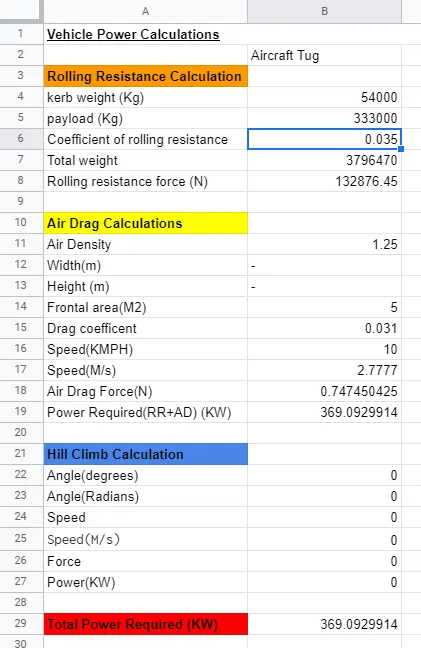
The total force required =132876.5 N
Total power required= 369KW - The electric powertrain for a pushback tractor.
assumptions for powertrain design
aircraft weight 333000 kg Aircraft tug 54000 kg rolling resistance coefficient 0.035 aircraft drag coefficient 0.031 Frontal area 5 m^2 tire pressure 200 psi towing speed 10 kmph towing time 4 mins pushback tug wheel radius 0.6m
The total force required =132876.5 N
Total power required= 369KW
Torque required T=F*r= 132876.5*0.6 =79725.9 Nm
Total energy required = P*time = 369*4*60/3600= 24.6 kWhr
A bldc can be used for the above purpose with appropriate gear ratio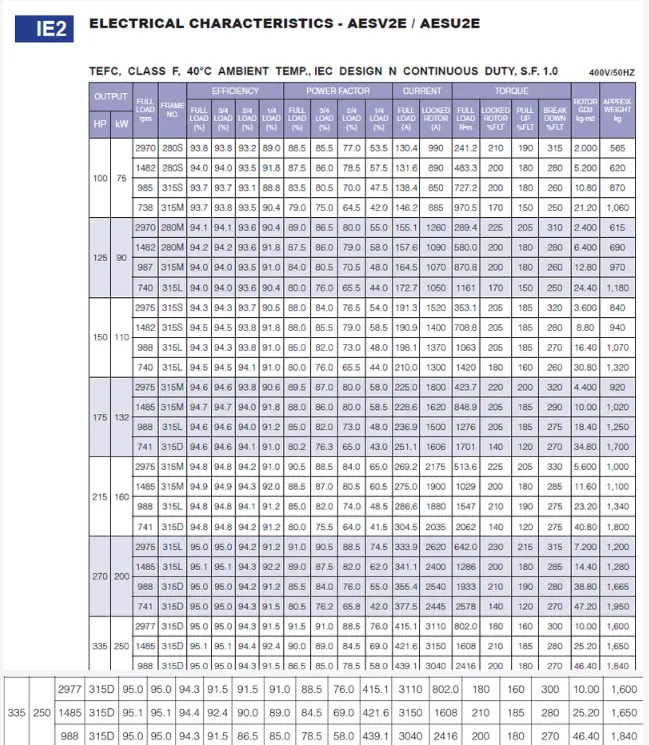
CONCLUSION:
The requirements for a pushback tractor were understood