Project-1: Powertrain for aircraft in runways
Part A:
Ans 1: Below is the list of some 100 numbers of Aircraft in three main category; Heavy, Medium and Light.
Here, MTOW means Maximum Take off weight in kg and MLW is the maximum landing weight in tonnes.
| Type | MTOW in kg | MLW in tonnes | ICAO Category |
| Antonov An-225 | 6,40,000 | 591.7 | Heavy |
| Scaled Composites Model 351 Stratolaunch | 589,670 [1] | Heavy | |
| Airbus A380-800[2][3][4] | 5,75,000 | 394 | Heavy |
| Boeing 747-8F | 4,47,700 | 346.091 | Heavy |
| Boeing 747-8 | 4,43,613 | 306.175 | Heavy |
| Boeing 747-400ER | 4,12,770 | 295.742 | Heavy |
| Antonov An-124-100M | 4,05,060 | 330 | Heavy |
| Boeing 747-400 | 3,96,900 | 295.742 | Heavy |
| Lockheed C-5 Galaxy[5][6][7] | 3,81,000 | 288.417 | Heavy |
| Boeing 747-200[8] | 3,77,840 | 285.7 | Heavy |
| Boeing 747-300[8] | 3,77,840 | 260.32 | Heavy |
| Airbus A340-500[9] | 3,71,950 | 240 | Heavy |
| Airbus A340-600[9] | 3,67,400 | 256 | Heavy |
| Boeing 777F | 3,47,800 | 260.816 | Heavy |
| Boeing 747-100[8] | 3,40,200 | 265.3 | Heavy |
| Airbus A350-1000 | 3,08,000 | 233.5 | Heavy |
| Boeing 777-300 | 2,99,370 | 237.683 | Heavy |
| Airbus A340-300[9][10] | 2,76,700 | 190 | Heavy |
| Airbus A350-900 | 2,70,000 | 175 | Heavy |
| Ilyushin Il-96M | 2,70,000 | 195.04 | Heavy |
| Boeing 787-9[11] | 2,54,000 | 192.777 | Heavy |
| Boeing 787-10[11] | 2,54,000 | 201.849 | Heavy |
| Airbus A340-200[9][12] | 2,53,500 | 181 | Heavy |
| Airbus A330-900 | 2,51,000 | 191 | Heavy |
| Ilyushin IL-96-300 | 2,50,000 | 175 | Heavy |
| Airbus A330-300[13][14] | 2,42,000 | 185 | Heavy |
| Airbus A330-200[13][14] | 2,42,000 | 180 | Heavy |
| Lockheed L-1011-500 | 2,31,300 | 166.92 | Heavy |
| Boeing 787-8[11] | 2,28,000 | 172.365 | Heavy |
| Lockheed L-1011-200 | 2,11,400 | Heavy | |
| Ilyushin IL-86 | 2,08,000 | 175 | Heavy |
| Boeing 767-400ER | 2,04,000 | 158.758 | Heavy |
| Airbus A300-600R[15] | 1,92,000 | 140 | Heavy |
| Boeing 767-300ER | 1,87,000 | 136.08 | Heavy |
| Concorde | 1,85,000 | 111.1 | Heavy |
| Airbus A300-600[15] | 1,63,000 | 138 | Heavy |
| Boeing 767-300 | 1,59,000 | 136.078 | Heavy |
| Airbus A310-300[15] | 1,57,000 | 124 | Heavy |
| Vickers VC10 | 1,52,000 | 151.9 | Heavy |
| Boeing 707-320B[16] | 1,51,000 | 97.5 | Heavy |
| Douglas DC-8-61 | 1,47,000 | Heavy | |
| Airbus A310-200[15] | 1,42,000 | 123 | Heavy |
| Airbus A400M | 1,41,000 | 122 | Heavy |
| Douglas DC-8-51 | 1,25,000 | Medium | |
| Boeing 757-300 | 1,24,000 | 101.6 | Medium |
| Boeing 707-120B[16] | 1,17,000 | 86.3 | Medium |
| Boeing 757-200 | 1,16,000 | 89.9 | Medium |
| Boeing 720B[17] | 1,06,000 | 79.5 | Medium |
| Boeing 720[17] | 1,04,000 | 79.5 | Medium |
| Tupolev Tu-154M | 1,04,000 | 80 | Medium |
| Tupolev Tu-204SM | 1,04,000 | 87.5 | Medium |
| Convair 880 | 87,500 | Medium | |
| Boeing 737-900 | 85,000 | 66.36 | Medium |
| Boeing 737-900ER | 85,000 | 71.35 | Medium |
| Boeing 727-200 Advanced[18] | 84,000 | 70.1 | Medium |
| Airbus A321-100[19] | 83,000 | 77.8 | Medium |
| Boeing 737-800 | 79,000 | 65.32 | Medium |
| Boeing 727-200[18] | 78,000 | 68.1 | Medium |
| McDonnell-Douglas MD-83 | 73,000 | 63.28 | Medium |
| Boeing 727-100[18] | 72,500 | 62.4 | Medium |
| Boeing 727-100C[18] | 72,500 | 62.4 | Medium |
| McDonnell-Douglas MD-90-30 | 71,000 | 64.41 | Medium |
| de Havilland Comet 4 | 70,700 | Medium | |
| Boeing 737-700 | 70,000 | 58.06 | Medium |
| Airbus A320-100[19] | 68,000 | 66 | Medium |
| Boeing 737-400 | 68,000 | 54.9 | Medium |
| de Havilland Comet 3 | 68,000 | Medium | |
| Boeing 377 | 67,000 | Medium | |
| Boeing 737-600 | 66,000 | 54.66 | Medium |
| Airbus A220-300 | 65,000 | 57.61 | Medium |
| Hawker Siddeley Trident 2E | 65,000 | Medium | |
| Airbus A319[19] | 64,000 | 62.5 | Medium |
| Boeing 737-300 | 63,000 | 51.7 | Medium |
| Boeing 737-500 | 60,000 | 49.9 | Medium |
| Airbus A220-100 | 59,000 | 50.8 | Medium |
| Airbus A318[19] | 59,000 | 57.5 | Medium |
| Boeing 717-200HGW | 55,000 | 47.174 | Medium |
| Douglas DC-7 | 55,000 | Medium | |
| de Havilland Comet 2 | 54,000 | Medium | |
| Boeing 717-200BGW | 50,000 | 46.265 | Medium |
| de Havilland Comet 1 | 50,000 | Medium | |
| Douglas DC-6A | 48,600 | Medium | |
| Douglas DC-6B | 48,500 | Medium | |
| Embraer 190[20] | 48,000 | 43 | Medium |
| Embraer 175[21] | 37,500 | 32.8 | Medium |
| Bombardier CRJ900[22] | 36,500 | 33.345 | Medium |
| Embraer 170[23] | 36,000 | 32.8 | Medium |
| Bombardier CRJ700 | 33,000 | 30.39 | Medium |
| Douglas DC-4 | 33,000 | Medium | |
| Vickers Viscount 800 | 30,400 | Medium | |
| Bombardier Q400 | 28,000 | 28.01 | Medium |
| Bombardier CRJ200 | 23,000 | 21.319 | Medium |
| ATR 72-600 | 22,800 | 22.35 | Medium |
| Embraer ERJ 145 | 22,000 | 19.3 | Medium |
| ATR 42-500 | 18,600 | 18.3 | Medium |
| Saab 340 | 13,150 | 12.93 | Medium |
| Embraer 120 Brasilia | 11,500 | 11.25 | Medium |
| BAe Jetstream 41 | 10,890 | 10.57 | Medium |
| de Havilland Hercules | 7,000 | Medium | |
| Embraer Phenom 100 | 4,800 | 4.43 | Light |
Ans 2: Yes, there is a difference between Ground speed and Air speed which can be explained by understanding the meaning of these two speeds.
Ground Speed: It is the horizontal speed of an aircraft relative to the earth surface. It determines how fast an aircraft is.
Air Speed: It is the relative velocity between the aircraft and the air. It is also the speed at which the air is flowing around the aircrafts wings when aircraft is not moving.
Airspeed is the vector difference between the ground speed and wind speed.
Airspeed = Ground Speed - Wind speed
For example, if the wind is not flowing on any day, the airspeed will become equal to the ground speed. But if the wind is blowing in the same direction as that of the aircraft is moving, the airspeed will be less than the ground speed.
Ans 3: Sometimes at Airport, it is required to run the aircraft systems whether electrical or mechnical on ground for maintenance or ground check purpose before flight. This is done mainly by Ground power unit(GPU) or Auxilliary Power Unit(APU) but not through Aircraft Engine Power. This is mainly due to various safety concerns.
It is avoided to run high power engine on ground to remove the risks such as loss of control by pilot or any other misfailure which may damage to nearby Aircraft or the same Aircraft itself or may cause injury to ground support personnel who may be in relatively close proximity to the aircraft.
Another reason is that the extensive noise arises from the engine power is also dangerous for humans and other living things around the vicinity.
Ans 4: In aviation, pushed to runway or pushback is an airport procedure during which an aircraft is pushed backwards away/to from an airport gate by external power. Pushbacks are carried out by special, low-power vehicles called pushback tractors or tugs.
The traditional method of allowing the ground vehicle to move an aircraft is to attach it to the aircraft nose landing gear by means of a towbar.
Once the pushback is completed, the towbar is disconnected, and bypass pin is removed. The ground support will show the bypass pin to the pilots to make it clear that it has been removed. The pushback is then completed, and the aircraft can taxi forward by its own power.
Ans 5: i) Take off power is the total power required by an aircraft for taking off. This includes the power required to maintain Kinetic Energy and also for PE required for Lift off. For take off an engine produces the required power for a limited period of time. The use of takeoff power is usually limited to 5 min for reciprocating engines and up to 2½ min for gas turbine engines. Just before take off, the nose of the Aircraft is raised to a nominal 5°–15° to increase lift from the wings and effect lift off and thereby reducing overall power requirement for take off. For most aircraft, attempting a takeoff without a pitch-up would require cruise speeds while still on the runway.
ii) Tyre Design: Tyres are one of the most important components of aircraft. They help to absorb the shock of landing and provide cushioning. It also provides the necessary traction for braking and stopping of an aircraft.
An aircraft tyre is designed to withstand extremely heavy loads while landing, take off, taxing, and parking. The number of wheels required for aircraft increases with the weight of the aircraft, as the weight of the aeroplane needs to be distributed more evenly.
Carcass plies are used to form the tire. They are sometimes called casing plies. An aircraft tyre is constructed for the purpose it serves.
a) They support the weight of an aircraft while it is on the ground.
b) It also provides the necessary traction for braking and stopping of an aeroplane.
c) Tyre also helps to absorb the shock of landing and provide cushioning the roughness of takeoff, roll-out, and taxi operations.
Unlike an automobile or truck tyre, it does not have to carry a load for a long period of continuous operation. However, an aircraft tyre absorbs the high impact loads of landing, and also it’s operating at high speeds for a short time when required.
Aircraft tyres may be Radial or Bias. Almost all airliners are using Radial tyre. Bias is an older design, and it’s mainly used for road vehicles. Radial tyres have the word RADIAL on the sidewall. Radial tyres are more expensive than bias-ply tyres. Radial tires are mostly used because of their lower life cycle cost and long term value.
iii) Rolling Resistance is the resistance offered by the tyres against motion of vehicle/aircraft. The rolling resistance is produced during take off/landing in the runway.
The significant factors affecting rolling resistance are as follows
a) Load, b) Wheel diameter, c) Tread material/hardness, d) Floor material/finish, and e) Floor conditions (roughness, cleanliness, slope, etc.).
Rolling resistance force of an aircraft = Coefficient of rolling resistance × (Weight of Aircraft - Lift force)
i.e, Fr = µr × (W - FL)
iv) Tyre Pressure: Aircraft tyres are usually inflated with Nitrogen to minimize expansion and contraction from extreme changes in ambient temperature and pressure experienced during flight. The reason behind using Nitrogen is that Dry nitrogen expands at the same rate as other dry atmospheric gases (normal air is about 80% nitrogen), but common compressed air sources may contain moisture, which increases the expansion rate with temperature.
Aircraft tyres generally operate at high pressures, up to 200psi(14bar, 1400kPa) for airliners and even higher for business jets. Tests of airliner aircrat tyres have shown that they are able to sustain pressures of maximum 800psi(55bar, 5500kPa) before bursting. During the tests the tyres have to be filled with water to prevent the test room being blown by the energy that would be released by a gas when tyre bursts.
The main landing gear on the Concorde was typically inflated to 232 psi (16.0 bar), whilst its tail bumper gear tires were as high as 294 psi (20.3 bar). The high pressure and weight load on the Concorde tyres were a significant factor in the loss of Air France flight 4590
v) Brake Forces when Landing: Aircrafts highly rely on a braking system to safely land on runways. At crusing altitude, most commercial airplanes fly at a speed of roughly 500 to 600mph. When landing, however they reduces their speed. A typical 747, for instance, has a landing speed of about 160 to 170mph. And upon touching the runway, aircrafts must quickly apply brake until they come to complete stop. The AIrcraft Braking procedure consists of two parts; Wing spoilers and Disc brakes.
Wing spoilers are extendable flaps on the ends of aircrafts wings. Pilots raises the spoilers to decelerate the airplane as it approches the runway. And even while on the run way, piots will typically leave the wing spoilers raised. Raised wing spoilers create drag, which essentially slows down the aircraft so that it is able to brake more quickly.
In addition to wing spoilers, aircraft's use disc brakes. Aircraft disc brakes are similar to the braking system in automobiles. They consist of a pain of calipers that, when engaged, squeeze pads against the rotors of an aircraft's landing gear.
Part B:
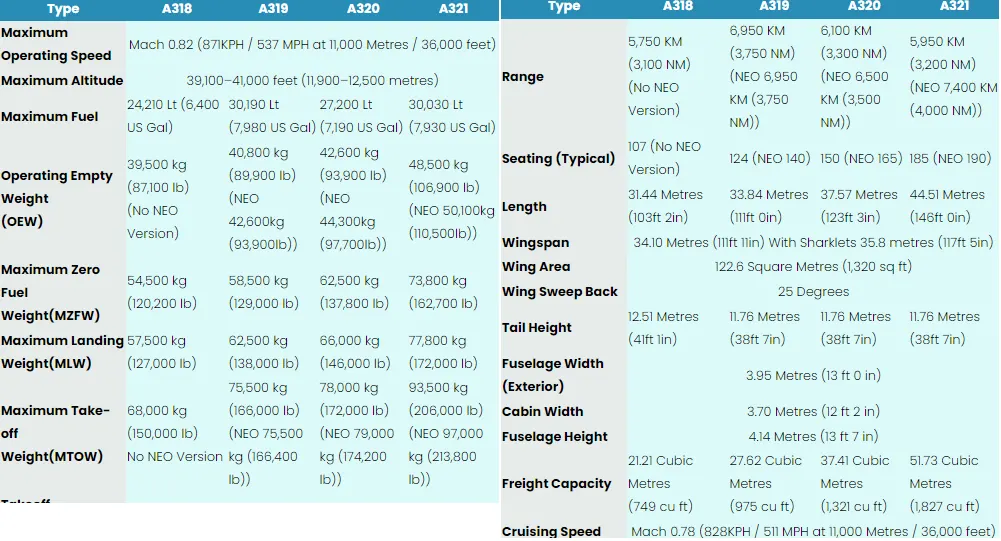
Ans 6 a: For the calculation of towing force and power, Airbus 320 Aircraft is choosen with towbar details as given below
| Model | QDZ5051TQYQ | ||
| Engine | Model | Phaser100T | |
| Overall dimension(L×W×H)mm | 5488×2158×1719 | ||
| Wheelbase | 2050mm | ||
| Track | 1702mm | ||
| Curb weight | 4860 | ||
| Maximum traction (kN) | High shift | 16 | |
| Low shift | 37 | ||
| Max. Speeds (km/h) | High shift | 49 | |
| Low shift | 15 | ||
| Min. stable speed (km/h) | High shift | ≤1 | |
| Low shift | ≤1 | ||
| Minimum turning diameter (m) | ≤10 | ||
| Height of traction bolt (mm) | Front traction bolt | 649/733 | |
| Rear traction bolt | 481/817 | ||
| Driving type | All time 4wd | ||
| Steering type | Hydraulic type front wheel steering | ||
| Used for | BOEING 737 / AIRBUS A320 | ||
An Airbus A320 has a total wing surface area of 122.6m^2 and a drag coefficient of 0.0872 and the drag coefficient of towing vehicle is assumed 0.6.
=>> Taking the values of Aircraft A320, the specifications are,
Mass = 174,200kg
Height = 11.76m, Width = 35.86m
Frontal area A = Height × Width = 11.76×35.86 = 422m⊃2; appx.
Drag coefficient Cd = 0.0872
Air density ρ = 1.225kg/m⊃3;
=>> Taking the values of towing vehicle QDZ5051TQYQ,
Mass = 4860kg
Height = 1.7 m, Width = 2.2m
Frontal area A = Height × Width = 1.7×2.2 = 3.74m⊃2;
Drag coefficient Cd = 0.6
Air density ρ = 1.225kg/m⊃3;
Assumption: i) Coefficient of rolling resistance between tyre and road for both Aircraft and Towtruck is assumed as 0.02.
ii) Optimum Speed of towing is assumed to be v = 10 m/s.
iii) Hill climbing force and acceleration force is neglected.
Total Rolling resistance force of an aircraft and truck is calculated as
=> Frr = µrr × m × g = 0.02*(174200+4860)*9.8 = 35096N appx.
Total Air drag force of an aircraft and towing truck is calculated as
=> Fad = 1/2 × ρ×A×Cd×v⊃2; = 1/2 x 1.225 x [(422x0.0872)+(3.74x0.6)] x 10^2
= 2391N
Hence, The total force required to develop by towing truck to pull aircraft and its own weight at the speed of 10m/s
is 35096+2391 = 37487N.
Total Power required to be developed by Towtruck is calculated as Pt = Ft × v
Pt = 37487 × 10 = 375kW appx
Result: Total force required to push / pull an aircraft by a towing vehicle is 37487 N.
Total power required to push / pull an aircraft by a towing vehicle is 375 kW appx.
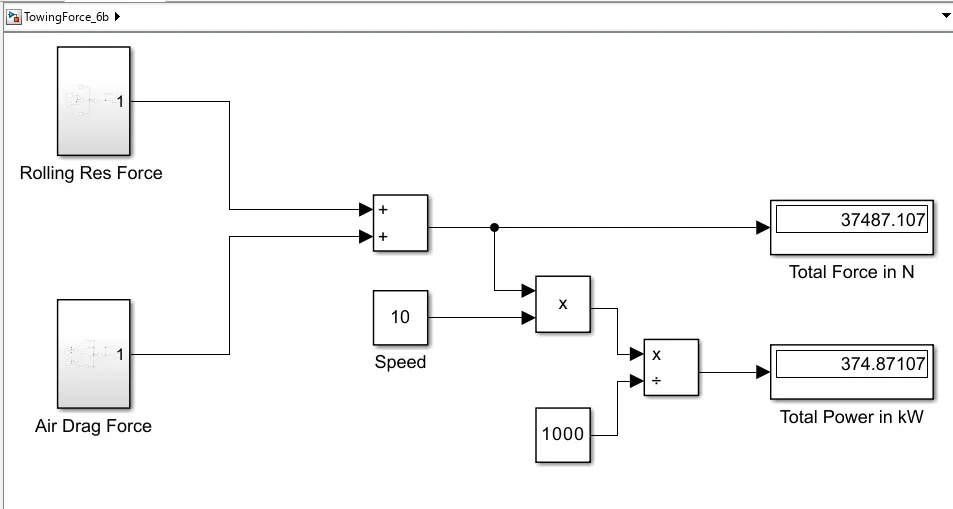
Ans 6b: The model is created in Simulink to calculate mathematically the force and power required for pushing/pulling the Aircraft by Towtruck and is shown below:
Here, the subsystems are created to calculate the Rolling resistance and Air drag force seperately is shown below
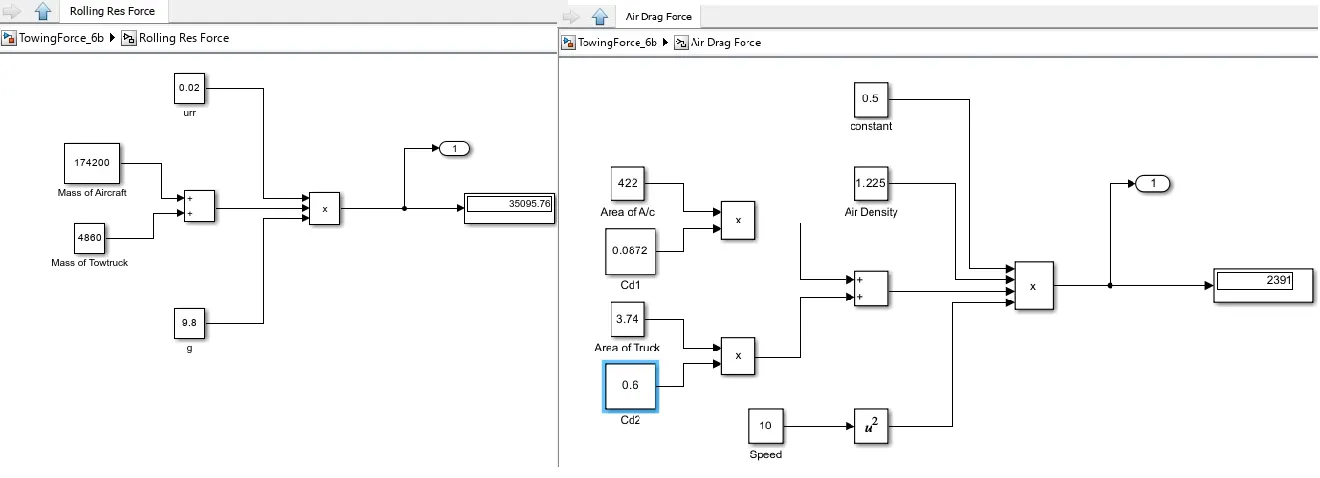
Result: The Simulink model results matches with the calculation in Solutions 6a.
Ans 7a: From the previous question, we have calculated the power required from towing vehicle to push/pull an aircraft with respect to assumed speed of 10m/s. Now we calculate below the energy required for the vehicle to tow the aircraft for lets say 15minutes.
=> Energy = Power × Time
Towing Time is assumed as 15 minutes. It is 0.25hrs.
So, Energy = 374.87 × 0.25 = 93.72kWh
Thus the energy required for the above calculated required power for 15 minutes is 93.72kWh.
Next, we will calculate the input power to the motor to find the duty cycle of the towing vehicle.
Assuming motor efficiency as 85%,
Input Power = 374.87/0.85 = 441kW
Estimation of Duty Cycle range to control the speed of towing vehicle from 0 to 10m/s using DC7 powertrain block in Simulink:
The following table represents the Assumed parameters:
PARAMETER VALUES
Aircraft
Mass 174200kg
Drag coefficient 0.0265
Towing vehicle
Mass 4860kg
Drag coefficient 0.6
Tyre size 0.56m
Air density 1.225kg/m^3
Speed 10m/s
Speed in RPM (10/0.56)*(30/pi) = 170rpm
Coefficient of rolling resistance 0.02
Efficiency of Motor 85%
Run time 15min
Load torque is calculated as T=P/w = Pxr/v
= 374870 x 0.56/10 = 20993Nm
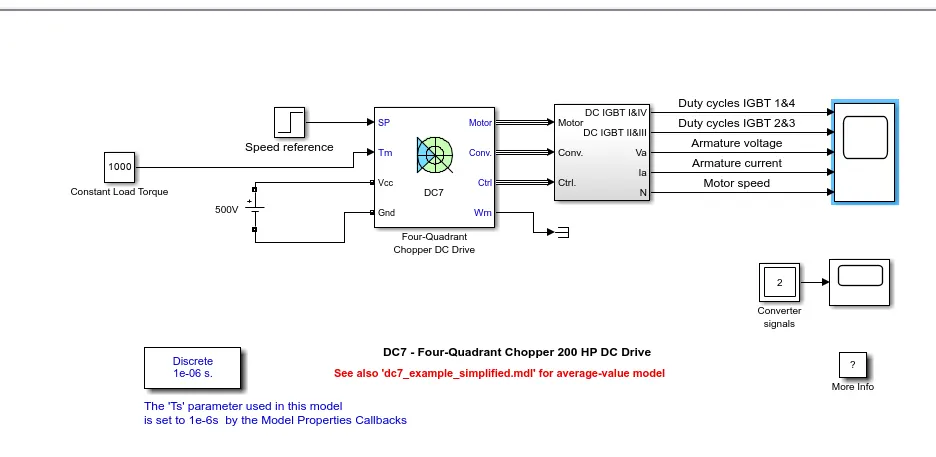
The following figure represents the Block diagram of Powertrain:
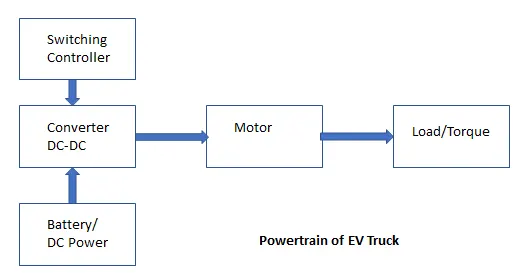
Now, lets design an electric powertrain with type of motor, its power rating and energy requirement to fulfill aircraft towing applications in simulink by using the standard DC7 block.
Model Paramters: DC7 model utilises 200HP systems equivalent to 149.14kW. Here the drive requirement is 441kW which is almost 3 times. This powertrain cannot meet the required load torque requirement of 20993Nm and hence it is simulated for 1000Nm constant load torque with speed from 0 to 10m/s or 170rpm after 1s.
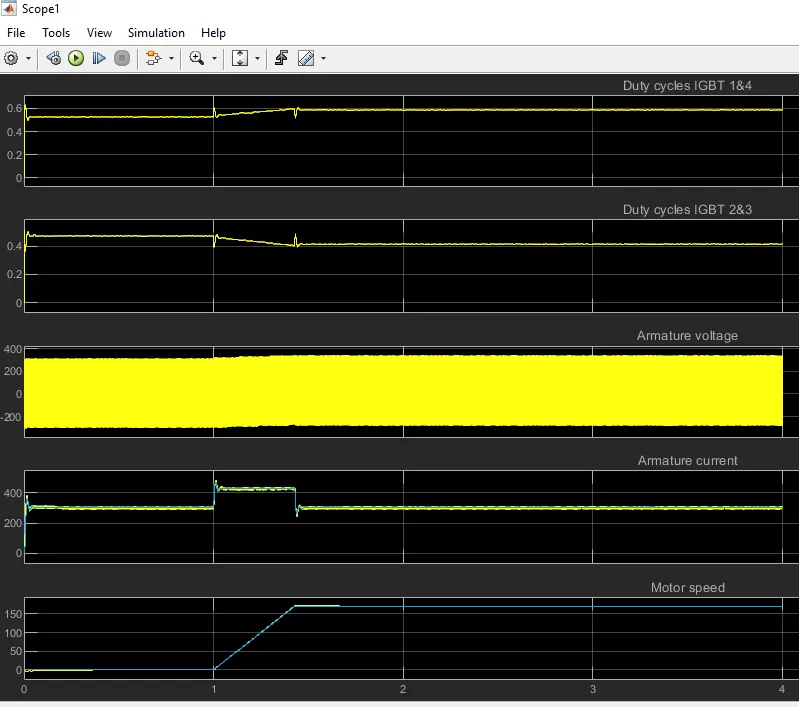
Result: The result obtained as follows:
The duty cycle is estimated as 0.6 for switch 1 and 4 and 0.4 for switch 2 and 3.
Motor armature current is drawn as 300A to achieve this requirements.
Ans 7b: An excel sheet with the parameters assumed, and calculated the required values is shown below and also attached.