Project-1: Powertrain for aircraft in runways
(1) Search and list out the total weight of various types of aircrafts.
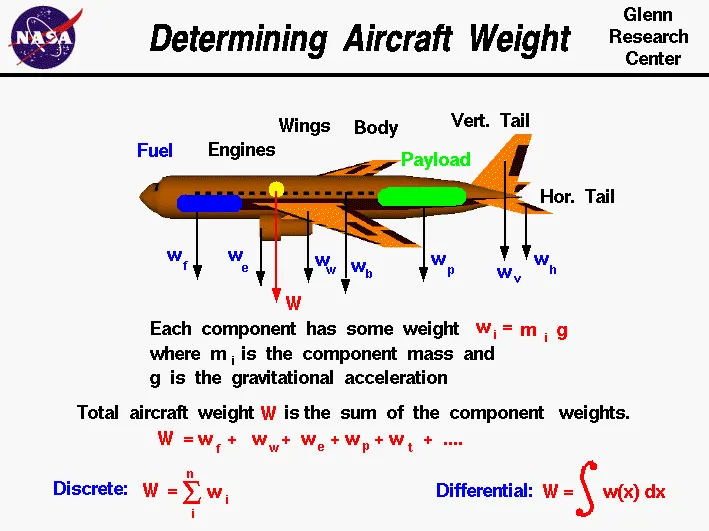
The different terms represent different weights or masses. For each flight, the weights are taken into account for several reasons.
Prerequisites:
- Weight of a male person = 88kg(avg)
- Weight of a female person = 70kg(avg)
- Weight of a children (2-12)years = 35kg(avg)
- Weight of cabin crew = 75kg (including 3kg of crew baggage)avg
- Weight of fuel in aircraft can be approximated as approx 12000kgs for 4000km by an narrow body aircraft (A-320)
- Payload - Passengers, Cargo, Mail, Baggage.(mainly).
Aircraft authorised gross weight limits are laid down in the Aircraft manuals(AFM). Those limits may be equal to or lower than the structural design weight limits. The authorised weight limits are choose by the airine and they are referred to as the purchased weights. An operator may purchase a certified weight below maximum design weights because many of the airport operating fees are based on the aircraft AFM maximum allowable weight values. An aircraft purchase is, typically a function of the certified weight purchased. An AFm will often include,
A brief description about these is below:
Manufacturer's empty Weight(MEW)
Also called Manufacturer's Weight Empty (MWE) or Licensed Empty Weight
It is the weight of the aircraft "as built" and includes the weight of the structure, power plant, furnishings, installations, systems and other equipment that are considered an integral part of an aircraft.
Zero-fual weight (ZFW)
This is the total weight of the airplane and all its contents (including unusable fuel), but excluding the total weight of the usable fuel on board.
As a flight progresses and fuel is consumed, the total weight of the airplane reduces, but the ZFW remains constant.
Maximum zero fuel weight (MZFW) is the maximum weight allowed before usable fuel and other specified usable agents (engine injection fluid, and other consumable propulsion agents) are loaded.
Operating empty weight (OEW) (Roughly equivalent to basic empty weight on light aircraft)
It is the basic weight of an aircraft including the crew, all fluids necessary for operation such as engine oil, engine coolant, water, unusable fuel and all operator items and equipment required for flight but excluding usable fuel and the payload.
Payload.
It is the carrying capacity of an aircraft. It includes cargo, people, extra fuel. In the case of a commercial airliner, it may refer only to revenue-generating cargo or paying passengers.
Maximum takeoff weight (MTOW)
This is the maximum weight at which the pilot of the aircraft is allowed to attempt to take off.
Regulated takeoff weight (RTOW)
Depending on different factors (e.g. flap setting, altitude, air temperature, length of runway), RTOW or maximum permissible takeoff weight varies for each takeoff. It can never be higher than MTOW.
Maximum landing weight(MLW)
This maximum weight at which an aircraft is permitted to land.
The following image depicts takeoff weight components.
| Type of Aircraft | MTOW [kg] | MLW [tonnes] |
|---|---|---|
| Antonov An-225 | 640,000 | 591.7 |
| Scaled Composites Model 351 Stratolaunch | 589,670 | |
| Airbus A380-800[1][2][3] | 575,000 | 394 |
| Boeing 747-8F | 447,700 | 346.091 |
| Boeing 747-8 | 443,613 | 306.175 |
| Boeing 747-400ER | 412,770 | 295.742 |
| Antonov An-124-100M | 405,060 | 330 |
| Boeing 747-400 | 396,900 | 295.742 |
| Lockheed C-5 Galaxy[4][5][6] | 381,000 | 288.417 |
| Boeing 747-200[7] | 377,840 | 285.700 |
| Boeing 747-300[7] | 377,840 | 260.320 |
| Airbus A340-500[8] | 371,950 | 240 |
| Airbus A340-600[8] | 367,400 | 256 |
| Boeing 777F | 347,800 | 260.816 |
| Boeing 777-300ER | 351,800 | 251.29 |
| Boeing 777-200LR | 347,450 | 223.168 |
| Boeing 747-100[7] | 340,200 | 265.300 |
| Airbus A350-1000 | 308,000 | 233.5 |
| Boeing 777-300 | 299,370 | 237.683 |
| Boeing 777-200ER | 297,550 | 213.00 |
| Airbus A340-300[8][9] | 276,700 | 190 |
| McDonnell Douglas MD-11 | 273,300 | 185 |
| Airbus A350-900 | 270,000 | 175 |
| Ilyushin Il-96M | 270,000 | 195.04 |
| McDonnell Douglas DC-10 | 256,280 | 183 |
2. Is there any difference between ground speed and air speed?
Airspeed is the vector difference between the ground speed and the wind speed. On a perfectly still day, the airspeed is equal to the ground speed. But if the wind is blowing in the same direction that the aircraft is moving, the airspeed will be less than the ground speed.
Air Speed of an Aircraft is defined as the speed at which the aircraft is moving relative to the air it is flying in. I.E. we can say the speed at which the air is flowing around the aircraft's wings.
Where ground speed on the other hand, is the aircraft’s speed relative to ground, the important thing here is that ground speed is the horizontal speed rather than vertical speed- an aircraft climbing completely vertical would have a ground speed of zero.
Yes there is lot of difference between ground speed and airspeed.
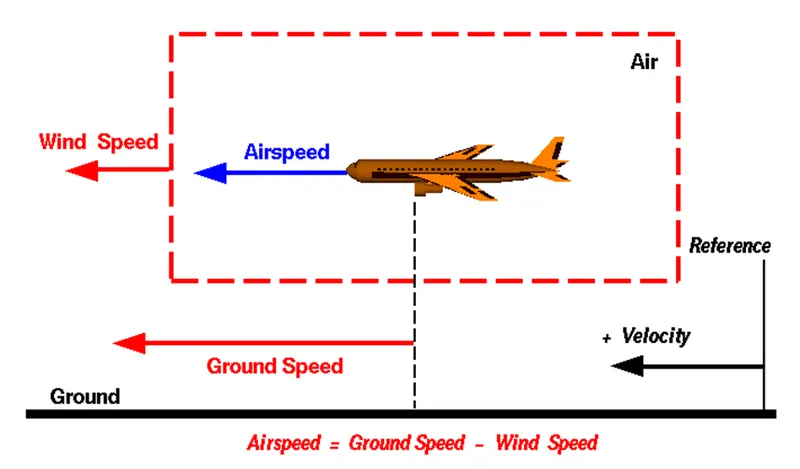
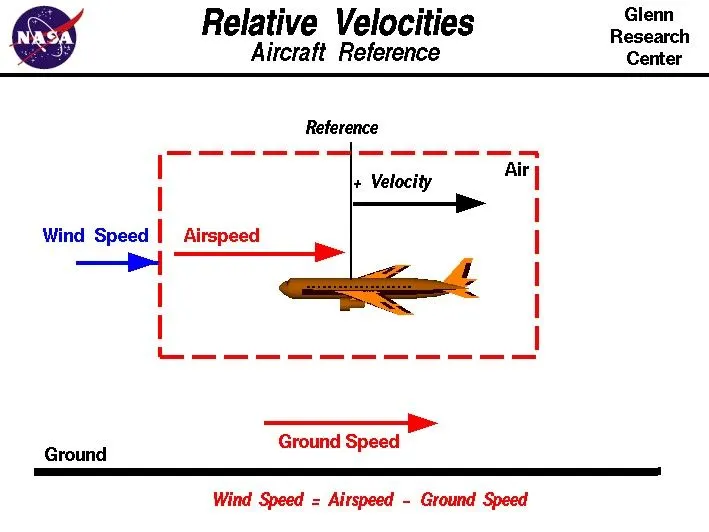
Relation between ground and airspeed:
The relationship between airspeed and ground speed is fairly simple. Ground speed is simply the sum of airspeed and wind speed
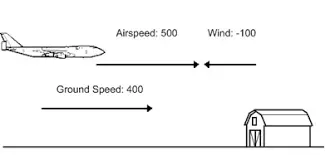
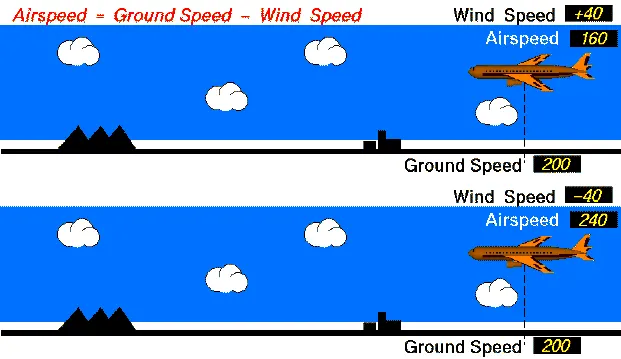
If the aircraft is flying in the same direction as the wind is blowing, the aircraft experiences tailwind, and its ground speed is higher than its airspeed. On the other hand, if the wind is blowing against the direction the aircraft is traveling in, the aircraft experiences a headwind, and its ground speed is lower than its airspeed.
(3) Why is it not recommended to use aircraft engine power to move it on the ground at Airport?
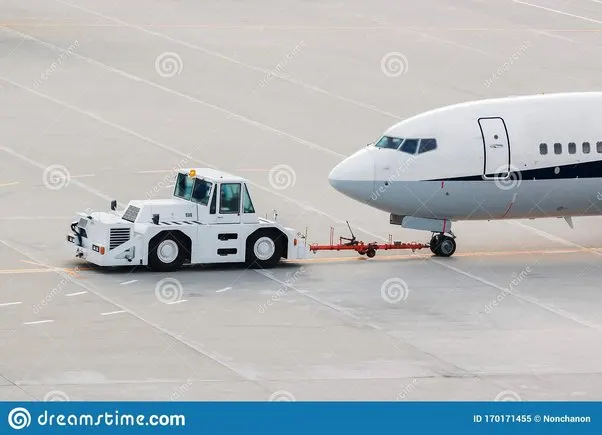
- When an aircraft's engine is activated, the thrust can create a high-speed wind that can easily cause damage to the airport terminal, surrounding ground vehicles, jetway, baggage and most importantly, ground personnel.
- But the thrust produced resulting jet blast might cause damage to the terminal building or equipment. Engines close to the ground may also blow sand and debris forward and then suck them into the engine, causing damage to the engine. A pushback is therefore the preferred method to move the aircraft away from the gate.
- Generally most of the airplane can move itself in reverse manner by making use of reverse thrust technology.But in most of the practical it is not possible because when airplanes start using reverse thrust it will consume lot of fuels as well as causes lot of noise and also hazardous for the people working near by.
- To solve this kind of issue we use a towing vehicle which helps to tow the vehicle in reverse dierection and it eill be tugged until it reaches a safe place and from there onwards airplane will move by itself for further take off.
(4) How an aircraft is pushed to runway when its ready to take off?
Pushback is when an aircraft is pushed backwards away from the airport gate by vehicles called tugs or tractors. Closer to departure, an aircraft tug will park right in front of the nose wheel. The tug might be directly attached to the plane's nose gear with a tow bar, or could be a “wheel-lift” tug.
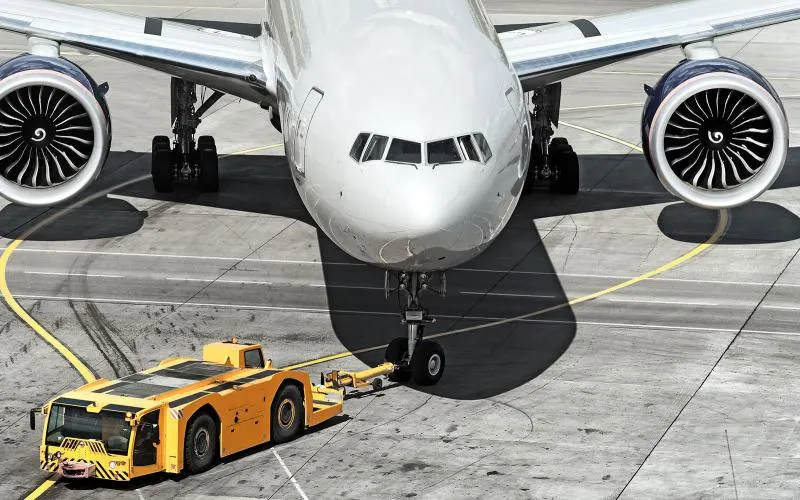
Pushback:- Pushback is when an aircraft is pushed backwards away from the airport gate by vehicles called tugs or tractors.Closer to departure, an aircraft tug will park right in front of the nose wheel.The tug might be directly attached to the plane's nose gear with a tow bar, or could be a "wheel-lift" tug. These tugs cradle the nose gear, then lift it up before moving the plane. That gives the tug driver control over the plane's direction during pushback.New taxi technologies are appearing, like pilot-controlled tugs, and electric motors mounted to the plane's landing gear. Both promise to save fuel, and reduce airport noise.
Towing of Aircraft :- Movement of large aircraft about the airport, flight line, and hangar is usually accomplished by towing with a tow tractor (sometimes called a “tug”).In the case of small aircraft, some moving is accomplished by hand pushing on the correct areas of the aircraft. Aircraft may also be taxied about the flight line but usually only by certain qualified personnel.Towing aircraft can be a hazardous operation, causing damage to the aircraft and injury to personnel, if done recklessly or carelessly. This article outline the general procedure for towing aircraft. However, specific instructions for each model of aircraft are detailed in the manufacturer’s maintenance instructions and are to be followed in all instances.
Taxiing
Taxiing is the controlled movement of the airplane under its own power while on the surface. Since an airplane is moved under its own power between a parking area and the runway, the pilot must thoroughly understand and be proficient in taxi procedures.
Taxiing (rarely spelled taxying) is the movement of an aircraft on the ground, under its own power, in contrast to towing or pushback where the aircraft is moved by a tug. ... An airplane uses taxiways to taxi from one place on an airport to another; for example, when moving from a hangar to the runway.
(5) Learn about take off power, tyre design, rolling resistance, tyre pressure, brake forces when landing.
Take off Power:-
Take off is the phase of the flight where the airplane leaves the ground and becomes airborne. For aircrafts travelling vertically, this is known as liftoff. For light weight aircraft, usually full power is used for take off. For heavies aircrafts like passenger planes, full engine power is not used for take off, This will increase the life of engine, reduce maintanence cost and decreases the noise. In some emergency cases, the power used can then be increased to increase the aircraft's performance.
Power Requirement to Keep a Jet Aircraft in the Air
The total energy of an aircraft flying in the atmosphere can be calculated using equation,
E = ½ m v2+ mgh
However, the engines mounted onto the wings of the plane are required to provide additional energy per time, power, in order to keep the aircraft flying at a constant altitude and speed. This extra power needed to overcome the drag acting on the airplane and is calculated using
P = (dh/dt) m g
where (dh/dt) is the decent speed required to keep the plane's speed constant if the engines fail.
- Takeoff and Climb :
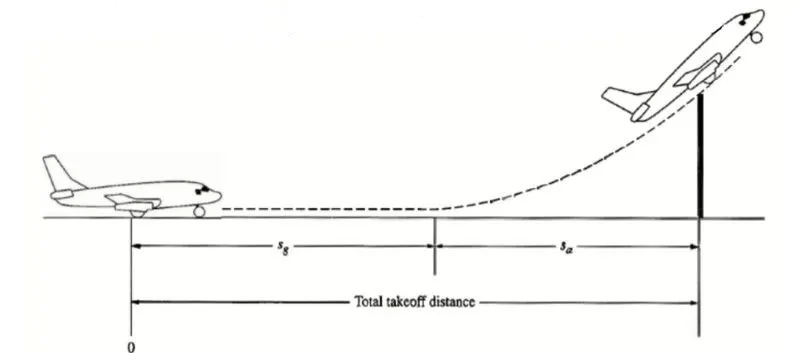
When ready for takeoff, and cleared by Air Trafic Control to proceed, the pilot or first officer of an aircraft releases the brakes and advances the throttle to increase engine power to accelerate down the runway.
Once aligned on the runway, steering the aircraft is normally accomplished by using foot pedals that manipulate the nose wheel until the speed is sufficient enough that wind rushing by the rudder on the aircraft tail makes nose wheel steering unnecessary.
As the aircraft gains speed, air passes faster and faster over its wings and lift is created. Instruments onboard the aircraft display this airspeed, which equals not only the speed of the plane relative to the ground, but also the speed of any wind that may be blowing toward the aircraft (aircraft normally take off headed into the wind). When the airspeed reaches a certain predetermined point known as rotation speed, the pilot manipulates panels on the tail of the aircraft to rotate the nose of the plane upward. This creates even stronger lift and the plane leaves the ground.
Rotation speed, abbreviated VR, is one of three important airspeed settings calculated before every flight.
The others are V1 - the speed beyond which a safe stop on a runway is no longer possible; and V2 - the minimum speed needed to keep a plane flying should an engine fail after the aircraft surpasses V1. Some of the factors affecting VR and V2 are the weight of the aircraft, the air temperature and the altitude of the airport. The heavier the aircraft, the more lift, and thus speed is needed to get it off the ground. Aircraft also need to go faster to y on a hot day than on a cool day. Hot air is less dense than cool air and less density produces less lift for the same speed.
Similarly, the higher the altitude, the less dense the air. Aircraft need more speed to leave the ground at a place like Denver than at a place like New York, with all other factors such as weight being equal. Some of these factors also are important in calculating V1, although the key factor is the length of the runway that is being used.
Most large jets leave the ground at about 160 miles per hour and initially climb at an angle in excess of 15 degrees. The angle of a plane's wings to the air owing around them is extremely important to maintaining lift. If the so-called angle of attack is too severe, the ow of air around the wings becomes disrupted and the plane loses lift.
To make an aircraft more aerodynamically effcient, the wheels on which an aircraft rolls when it is on the ground are retracted into a cavity in the belly of the plane after it is airborne. There is less drag (wind resistance), and an aircraft can fly faster when its landing gear is retracted.
- Tyre design :=>
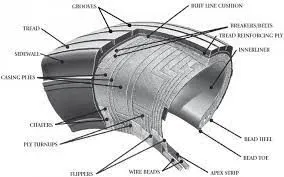
When it comes to safety, tyres are one of the most important components of aircraft. They help to absorb the shock of landing and provide cushioning. It also provides the necessary traction for braking and stopping of an aircraft.
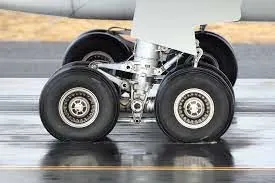
An aircraft tyre is designed to withstand extremely heavy loads while landing, take off, taxing, and parking. The number of wheels required for aircraft increases with the weight of the aircraft, as the weight of the aeroplane needs to be distributed more evenly.
- rolling resistance
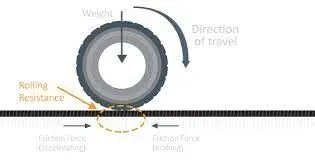
The force that resists the motion of a body rolling on a surface is called the rolling resistance or the rolling friction.
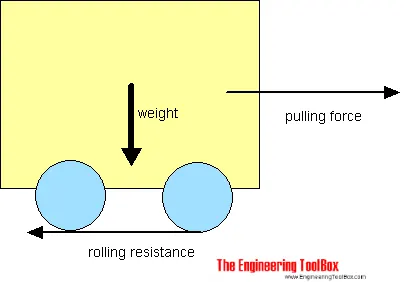
The rolling resistance can be expressed by the generic equation
Fr = c W (1)
where
Fr = rolling resistance or rolling friction (N, lbf)
c = rolling resistance coefficient - dimensionless (coefficient of rolling friction - CRF)
W = m ag
= normal force - or wIght t - of the body (N, lbf)
m = mass of body (kg, lb)
ag = acceleration of gravity (9.81 m/s2, 32.174 ft/s2)
Note that the rolling resistance coefficient - c - is influenced by different variables like wheel design, rolling surface, wheel dimensions and more.
The rolling resistance can alternatively be expressed as
Fr = cl W / r (2)
where
cl = rolling resistance coefficient - dimension length (coefficient of rolling friction) (mm, in)
r = radius of wheel (mm, in)
Rolling Friction Coefficients
Some typical rolling coefficients:
| Rolling Resistance Coefficient | ||
|---|---|---|
| c | cl (mm) | |
| 0.001 - 0.002 | 0.5 | railroad steel wheels on steel rails |
| 0.001 | bicycle tire on wooden track | |
| 0.002 - 0.005 | low resistance tubeless tires | |
| 0.002 | bicycle tire on concrete | |
| 0.004 | bicycle tire on asphalt road | |
| 0.005 | dirty tram rails | |
| 0.006 - 0.01 | truck tire on asphalt | |
| 0.008 | bicycle tire on rough paved road | |
| 0.01 - 0.015 | ordinary car tires on concrete, new asphalt, cobbles small new | |
| 0.02 | car tires on tar or asphalt | |
| 0.02 | car tires on gravel - rolled new | |
| 0.03 | car tires on cobbles - large worn | |
| 0.04 - 0.08 | car tire on solid sand, gravel loose worn, soil medium hard | |
| 0.2 - 0.4 | car tire on loose sand | |
Rolling Coefficients Cars
The rolling coefficients for air filled tires on dry roads can be estimated
c = 0.005 + (1 / p) (0.01 + 0.0095 (v / 100)2) (3)
where
c = rolling coefficient
p = tire pressure (bar)
v = velocity (km/h)
Example - Wheel Pressure & Rolling Resistance Coefficient
The standard wheel pressure in a Tesla Model 3 is 2.9 bar (42 psi). The rolling friction coefficient at 90 km/h (56 mph) can be calculated from (3) as
c = 0.005 + (1 / (2.9 bar)) (0.01 + 0.0095 ((90 km/h) / 100)2)
= 0.011
Increasing the pressure to 3.5 bar reduces the rolling resitance coefficient to
c = 0.005 + (1 / (3.5 bar)) (0.01 + 0.0095 ((90 km/h) / 100)2)
= 0.010
- or
((0.011 - 0.10) / 0.011) 100% = 9%
Example - The Rolling Resistance of a Car on Asphalt
The rolling resistance for all four wheels in a car with total weight 1500 kg on asphalt with rolling friction coefficient 0.03 can be estimated with the generic equation 1 as
Fr = 0.03 (1500 kg) (9.81 m/s2)
= 441 N
= 0.44 kN
- compare car rolling resistance with car air resistance (drag)
The rolling resistance for one wheel can be calculated as
Fr = 0.03 (1500 kg / 4) (9.81 m/s2)
= 110 N
= 0.11 kN
Tyre pressure
An aircraft tire or tyre is designed to withstand extremely heavy loads for short durations.The number of tires required for aircraft increases with the weight of the aircraft, as the weight of the airplane needs to be distributed more evenly. Aircraft tire tread patterns are designed to facilitate stability in high crosswind conditions, to channel water away to prevent hydroplaning, and for braking effect.
Aircraft tires also include fusible plugs (which are assembled on the inside of the wheels), designed to melt at a certain temperature. Tires often overheat if maximum braking is applied during an aborted takeoff or an emergency landing. The fuses provide a safer failure mode that prevents tire explosions by deflating in a controlled manner, thus minimizing damage to aircraft and objects in the surrounding environment.Inflation :
Each of the twelve Boeing 777-300ER main tires is inflated to 220 psi (15 bar; 1,500 kPa), weighs 120 kg (260 lb), has a diameter of 134 cm (53 in) and is changed every 300 cycles while the brakes are changed every 2000 cycles.Aircraft tires generally operate at high pressures, Inflation up to 200 psi (14 bar; 1,400 kPa) for airliners, and even higher for business jets.
Tests of airliner aircraft tires have shown that they are able to sustain pressures of maximum 800 psi (55 bar; 5,500 kPa) before bursting.
Aircraft tires are usually inflated with nitrogen to minimize expansion and contraction from extreme changes in ambient temperature and pressure experienced during flight.
Brake forces and landing=>
Bringing at aircraft down to the runway from 37,000 feet is only part of the challenge. It’s not over until the aircraft is safely parked at its gate. In order to do this, pilots have a number of systems available to slow the aircraft down, even in a blizzard on a snowcovered runway.
The 787 braking system:
Stopping a 200-tonne aircraft landing at 180 mph requires a lot of braking force. To do this, the 787 has one brake unit on each of the eight wheels on the main gear assembly.
On other aircraft types, the brake units are powered by the hydraulics system. An electrical signal is sent from the flight deck to hydraulic actuators near the main landing gear. Here, hydraulic fluid at 3,000 pound per square inch is used to force the brake unit against the wheel, thus slowing it down.Electric brakes
The brake system on the 787 Dreamliner is controlled by the pilots pressing the tops of the rudder pedals under their feet, demanding the rate of braking which they require. This sends an electronic signal to the Left and Right Brake System Control Units (BSCUs).Anti-skid protection
When landing on slippery runways, there’s a chance that the wheels may start to skid as the brakes are applied. To stop this from happening and to maintain maximum effective braking, each wheel has anti-skid protection.Autobrake
Pressing on the brakes is pretty straight forward when taxiing in a straight line at low speed. However, when we’re landing in strong winds, it can be a little tricky. We need to use our feet on the rudder pedals to line the nose of the aircraft up with the runway centerline at the last moment. Then, whilst holding that position, slide our feet up to press the toe brakes. Really not very easy when moving at 160 mph.6. A. With necessary assumptions, calculate the force and power required to push / pull an aircraft by a towing vehicle.
B. Develop the model for the calculated force and power using Simulink.
Let us Assume:
Weight of the Aircraft (Boeing 747-8) = 447,700kg
Rolling Resistance Coefficient of an aircraft tire = 0.004
Wight of the Tugs Tractor = 50000kg
Rolling Resistance Coefficient of Towing Vehicle = 0.0035
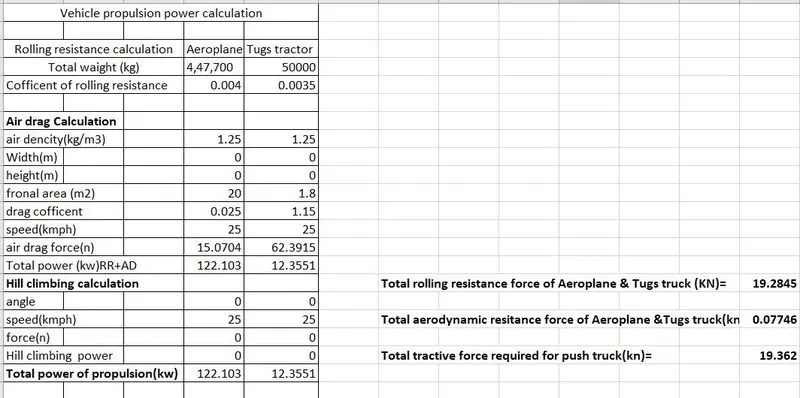
Then,Rolling Resistance Force of Tugs Tractor =FRR = CRR x weight = .0035*50,000*9.81 =1,716.75 N
Rolling Resistance Force of aircraft =FRR = CRR x weight =.004*50,000*9.81 =17,567.748 NTotal Rolling Resistance Force = Rolling Resistance Force of aircraft + Tugs Tractor = 17.567+ 1.71675
Total Rolling Resistance Force = 19.28 KNThe Aerodynamic Drag is given by,
rho= Density of Air Medium
A = Frontal Area Of the Vehicle which strike the Air
V = Velocity with the vehicle moves
Cd= Coefficient of Dragwhich varies different shapes of the frontal area.
Calculation:Let us assume
The Velocity of the Aircraft while Towing = 25 KMPH = 6.944 m/s
Density of Air medium = 1.25 kg/m3
The Frontal area of the Aircraft = 20 m2The Frontal area of the Aircraft = 1.8 m2
The Coefficient of Drag of the Aircraft = 0.025The Coefficient of Drag of the Tugs tractor = 1.15
Air drag force = 0.5*rho*A*V^2*Cd
The Air Drag Force of the Aircraft = .5*1.25*20*(6.944^2)*.025 = 15.07 NThe Air Drag Force of the Tugs Tractor = .5*1.25*1.8*(6.944^2)*1.15 = 62.38 N
Total Aerodynamic Drag Force = Air Drag Force of the Aircraft + Air Drag Force of the Tugs Tractor = 15.07 N + 62.38 N
Total Aerodynamic Drag Force = 77.45 NTherefore the total force that the motor needs to overcome = Total Rolling Resistance Force + Total Aerodynamic Drag Force = 19.28 + .07745 (KN) = 19.362 KN
Thus Total Force that the Motor needs to overcome in order to push/pull the Aircraft = 19.362 KN
The Power Required-
The power required by the motor is given by the velocity with which the towing operation takes place.
The average speed of push/pull = 25 kmph = 6.9444 m/s
Power required by the motor = Total Force*Velocity = 19.362*6.9444
Power Required by The Motor = 134 KW
7. A. Design an electric powertrain with type of motor, it’s power rating, and energy requirement to fulfill aircraft towing application in Simulink. Estimate the duty cycle range to control the aircraft speed from zero to highest. Make all required assumptions. Prepare a table of assumed parameters. Draw a block diagram of powertrain.
(Hint :DC7 Block)
B. Also, Design the parameters in excel sheet.
The parameters assumed for designing this vehicle :
1. Weight of the Aircraft =447,700 kg
2. Weight of the Towing Tractor =50,000 kg
3. Rolling Resistance Coefficient of Aircraft = 0.004
4. Rolling Resistance Coefficient of Towing Tractor = 0.0035
5. The velocity of the Aircraft while Towing =6.944 m/s
6. Density of Air medium(rho) =1.25 kg/m^3
7. The Frontal area of the Aircraft =20 m^2
8. The Coefficient of Drag of the Aircraft =0.025
9. Towing Tractor Gear ratio(G- for high torque output) = 11
10. Towing Tractor tyre radus(r) =0.5 m
11. Operational time of the Towing for one cycle =.25 Hour(15min)
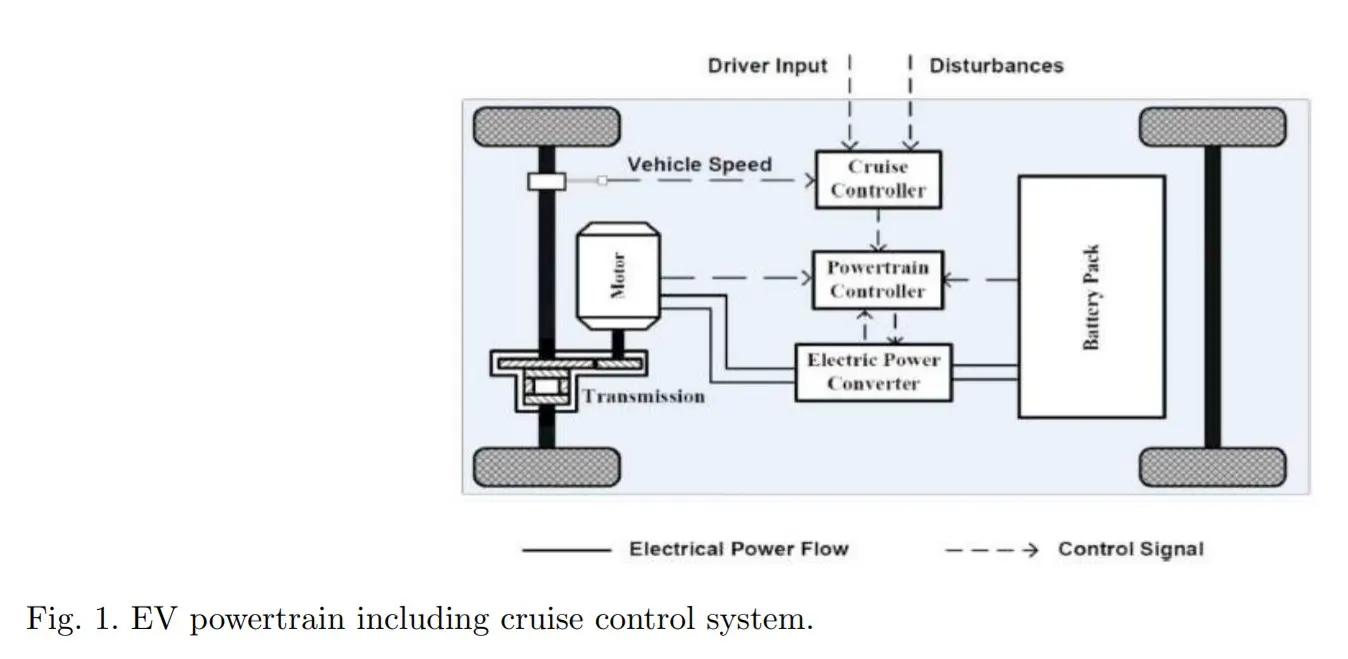
12. Power converters used Bidirectional DC-DC Boost Converter
As we have The Total Force that the Motor needs to overcome in order to push/pull the Aircraft = 19.362 KN
We have , F(Tractive)=T*(G/r)
Thus T = F(Tractive)*(r/G)
= 19362 * (.5/11)
= 880.090 Nm
So, Required power(P) = F * V
= 19.362* 6.944
=134 KW
Required Energy(E) for towing application based on the assumed time, that is E = P * t
= 134 (kw)* (.25hr)
= 33.5 KWh
Therefore the battery must be able to store the energy 33.5 KWH and should deliver the energy throughout the run time in order for the motor to produce the 880.09 Nm of torque . Thus the storage of energy in batteries with high performance Ultracapacitors are selected to fulfill the required power deliver.
Here we are using the BLDC Motor as it gives a good constant torque, work efficiently and also gets cooled by conduction and requires no additional cooling mechanism.
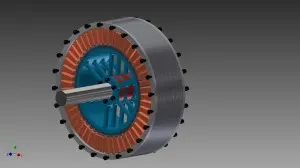
Motor Design :
- So let us assume a 45 KW DC Brushless motor :
- Nominal Power: 45KW
- Nominal Voltage: 230v
- Nominal current:200A
- Winding configuration : Delta
- RPM: 2600
- Construction : 48 slot, 40 Magnets Neodymium
- Lamination Grade M330
- Cooling : Glycol
- Weight: 17Kg
- Copper weight ~ 2.7kg
Windings:
- Can be : delta or Star ( WYE)
- Delta connection will give you higher power per cooper amount, higher RPM, higher current, lower phase voltage.
- STAR will give you lower RPM, higher torque (1,73 more than dela) , higher the voltage, lower the current.
- Can be: concentrated or fractional slot type.
- If there are concentrated can be: LRK, distributed LRK etc.
From the above motor design :
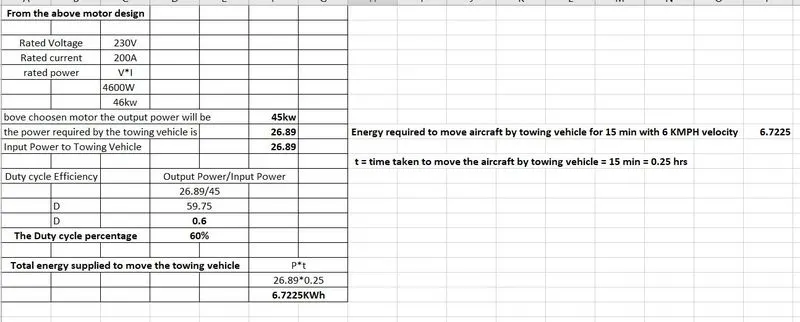
Rated Voltage = 230
Rated current = 200 Amps
Rated power = V*I = 230*200 = 46000W = 46 KW
So from the above choosen motor the output power will be 45 KW and the power required by the towing vehicle is 26.89 KW
Input Power to Towing Vehicle = 26.89 KW
Total Power(Rated) can be supplied = 45 KW
Duty cycle Efficiency = Output Power/Input Power
D = 26.89/45
D = 59.75 = 0.60
The Duty cycle percentage = 60%
Total energy supplied to move the towing vehicle = Power input to Tow * time taken to move the aircraft by Towing vehicle
E = P*time(t)
P = 26.89 KW
t = time taken to move the aircraft by towing vehicle = 15 min = 0.25 hrs
E = 26.89*0.25
E = 6.7225 KWh
Energy required to move aircraft by towing vehicle for 15 min with 6 KMPH velocity = 6.7225 KWh
CONCLUSION :
- Listed out the various types and weights of aircrafts.
- Given the difference between ground speed and air speed.
- Given the reasons why aircraft engine is not propelled to move on the ground before it is taken into runway.
- Explained how aircraft is pushed to runway when its ready to take off.
- Learned about take off power, tyre design, rolling resistance, tyre pressure, brake forces when landing.
- Calculated the force and power required to push / pull an aircraft by a towing vehicle.
- Designed the electric vehicle powertrain with motor rating, duty cycle with which motor is controlled using controller and also energy, power, Torque is calculated to move the aircraft with the Towing Vehicle.