Powertrain for aircraft in runways
OBJECTIVE-1:
To explain, list out the total weight of various types of aircrafts.
The various types of aircraft are:
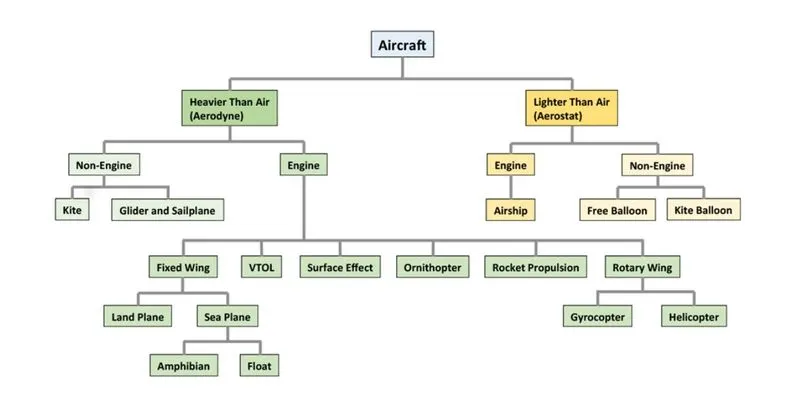
The above picture shows the various types of aircraft let’s see the weight of the aircraft one by one
LIGHTER THAN AIR:
|
Aircraft category |
gross weight |
picture |
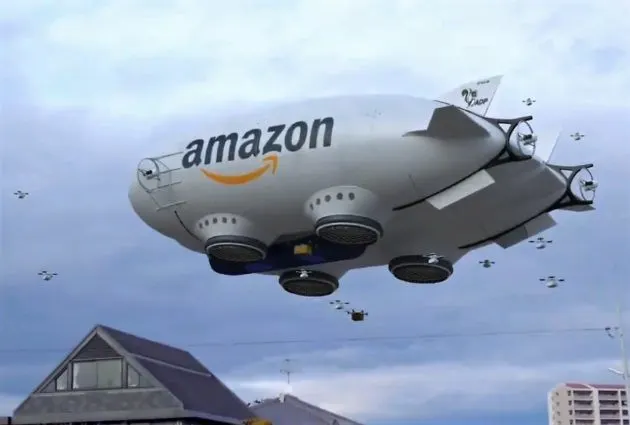
Airship |
10,000 kg |
 |
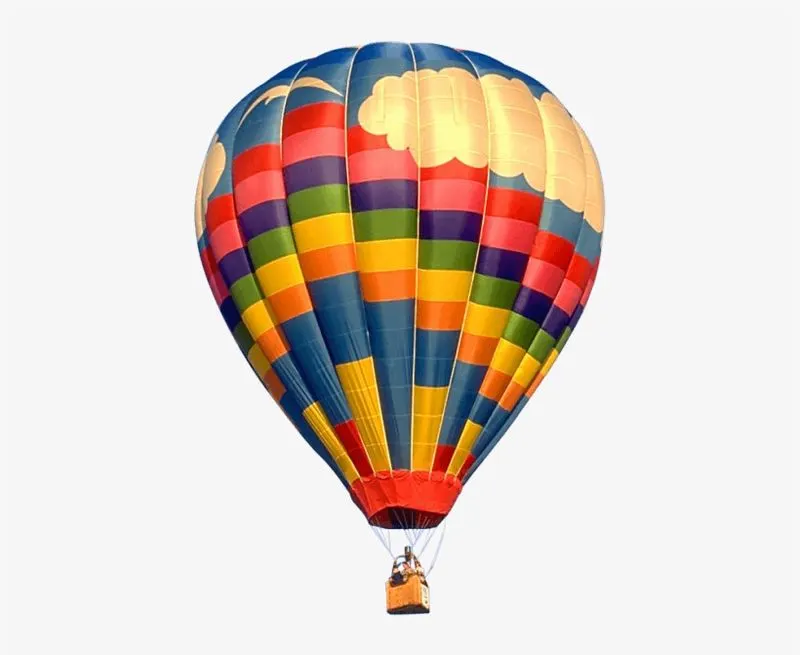
Ballon |
3,410kg |
 |
HEAVIER THAN AIR:
|
Aircraft category |
gross weight |
picture |
|
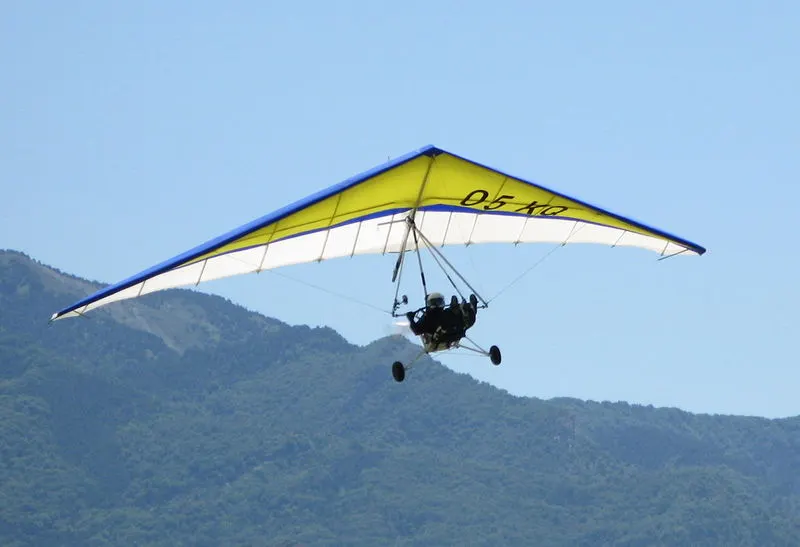
Glider (ElectraFlyer-ULS) |
190kg |
 |
|
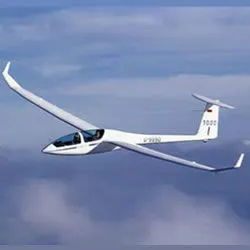
Sailplane (ASH 30 Mi) |
630kg |
 |
|
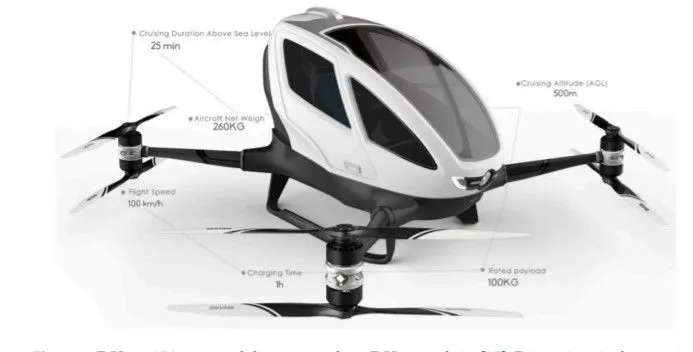
Electric VTOL (e-Hang 184) |
260kg |
 |
|
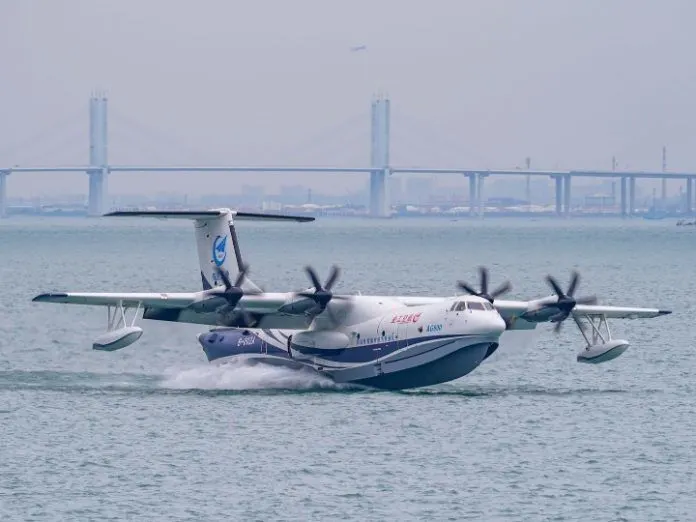
Amphibian (AG600) |
53.5ton |
 |
|
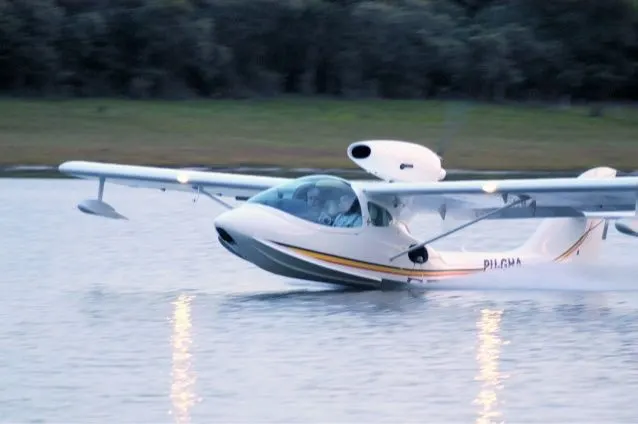
Float plane (Seamax M 22) |
650kg |
 |
|
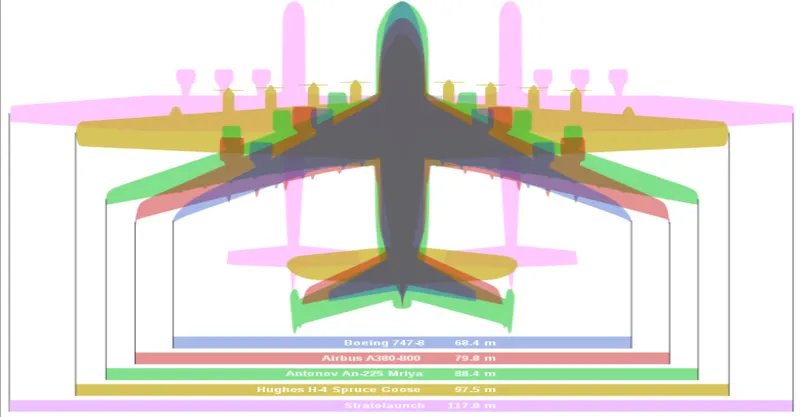
Landplane of commercial and cargo (Airbus A380-800,Antonov An-225 Mriya,Boeing 747,Hughes H-4,Hercules,Stratolaunch) |
80,000-1,65,000kg |
 |
|
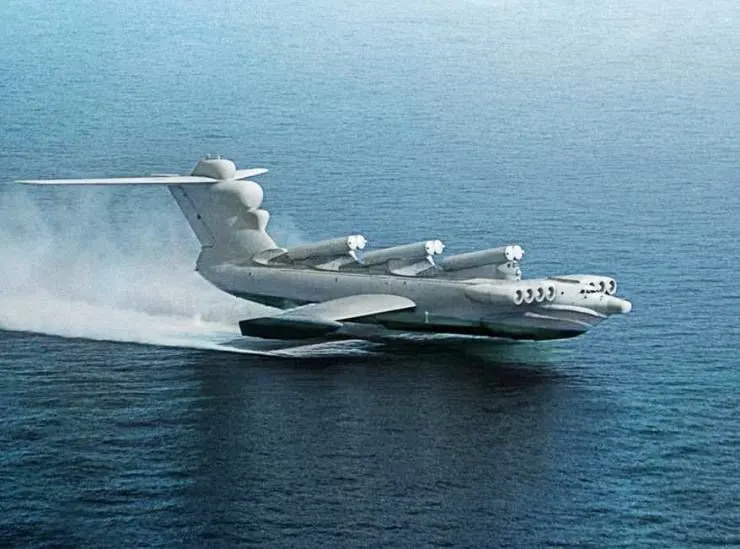
Surface effect vehicle (The LUN) |
400ton |
 |
|
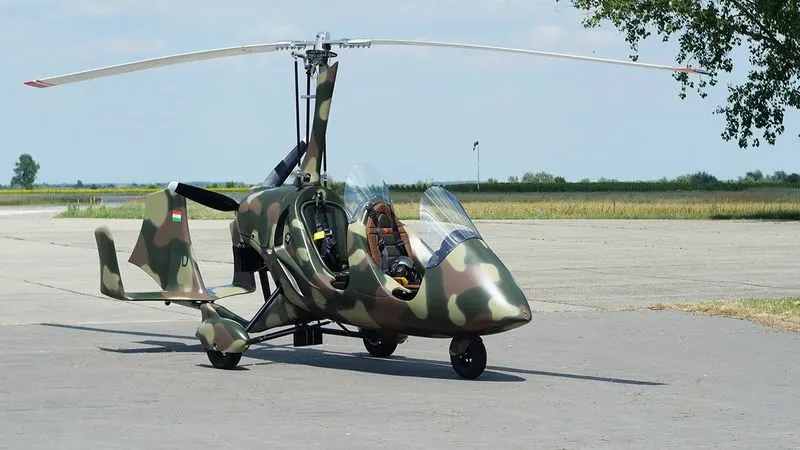
Gyrocopter (Gyro SC-200) |
560kg |
 |
|
Helicopter (Bell 206) |
1474kg |
 |
-------------------------------------------------------------------------------------------------------------------------------------------------------------------------------------------
OBJECTIVE-2:
Is there any difference between ground speed and air speed ?
YES, there are differences in ground speed and air speed.
Ground speed:
Ground speed is the constant speed produced by the plane in the runway for its take off.
Air speed:
The speed needed to take off is relative to the motion of air speed.The ground speed for the take off of the plane is determined by the air speed.
- The headwind will reduce the ground speed for the take off.
- The tailwind will increase the ground speed for the take off.
The formula for the Air speed is given by :
Airspeed =Ground speed - Wind speed
-------------------------------------------------------------------------------------------------------------------------------------------------------------------------------------------
OBJECTIVE-3:
Why is it not recommended to use aircraft engine power to move it on the ground at Airport?
Aircraft have no power wheels.so the forward thrusting and taxing is done engine power.
The pushback operation from the gate is done by the tractor.
Reasons
- To save the fuel & cost for the aeroplane company.
- To improve fuel efficiency.
- The tractor driver can see more clearly than the pilot while operating the plane in the airport.
- For the safety operation in airports the aircraft engines are not powered because the aircraft engines are highly powered,it might lose control .
- Large sound produced by the aircraft gives the unpleasant atmosphere for the passenger in the airport.
-------------------------------------------------------------------------------------------------------------------------------------------------------------------------------------------
OBJECTIVE-4:
How does an aircraft get pushed to the runway when it's ready to take off?
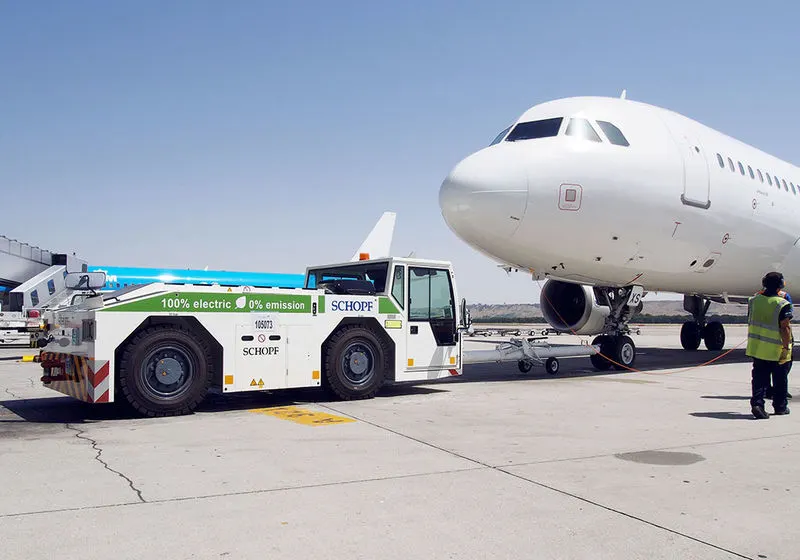
An airplane uses tugs or tractors for moving from one place on an airport to another; for example, when moving from a hangar to the runway.(process known as towing)
The tractors are attached to the nose wheel of the plane by the tow bar.
New technologies like pilot controlled tugs,electric motors placed on plane landing gear for reducing fuel and noise.
-------------------------------------------------------------------------------------------------------------------------------------------------------------------------------------------
OBJECTIVE-5:
To explain about take off power, tyre design,rolling resistance,tyre pressure,brake forces when landing.
Take off power:
Takeoff is the phase of flight in which an aerospace vehicle leaves the ground and becomes airborne.
The takeoff speed is usually dependent on the aircraft weight; the heavier the weight, the greater the speed needed, & also determined by the length of runway and slope of the runway and any peculiar conditions, such as obstacles off the end of the runway.
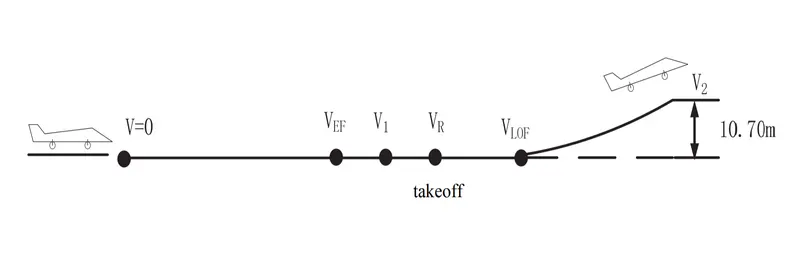
Distance between vo to v2 is the length of the runway ;VEF is Engine failure speed ;1. Vr is rotation speed ; Vlof is lift-off speed ; V2 is takeoff safety speed.
For the safety reason the aircraft runway should have the necessary length,when the rejection of takeoff is carried out between Vef-V1.
Tyre design:
Tyre design should meet the cool running, heat-resistant materials and the tire service requirements ,support the weight of the aircraft and provide the necessary traction for braking and stopping ,and absorb road shocks. Tire prototypes are put through rigorous tests that simulate cycles of landings, take-offs, and taxi operations. It is only after the tires pass all mandatory tests and meet the requirements of the aircraft manufacturer and authorities that the tires are put into production.
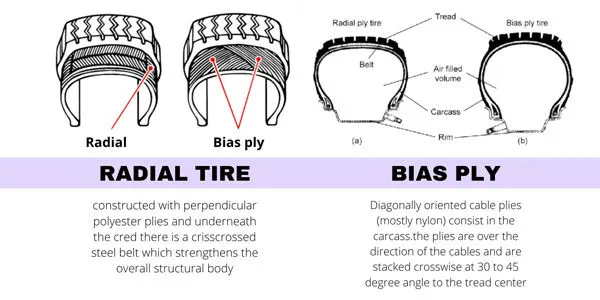
Two types of tires are used in aircraft applications — bias-ply tires and radial tires. Although both types of tires share some similarities in design, there are differences that need to be noted.
Tyre pressure:
Aircraft tires generally operate at high pressures.The tyre pressure depends on the weight of the plane and number of tires it has, but generally the cold pressure is between 200 and 300+ psi for airliners, and even higher for business jets
The main landing gear on the Concorde was typically inflated to 232 psi (16.0 bar), whilst its tail bumper gear tires were as high as 294 psi (20.3 bar)
Rolling resistance:
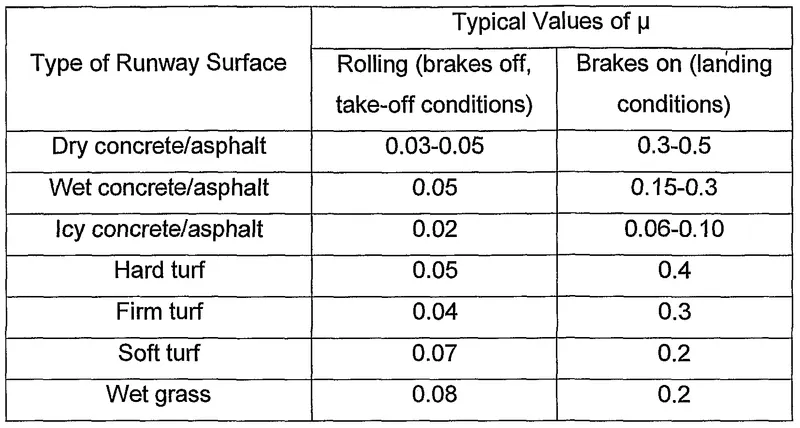
Tire rolling resistance is the energy that your vehicle requires to keep a tire rolling. Rolling resistance on the tires are good for grip , but bad for fuel economy, tire life and road noise.
The rolling resistance of aircraft tyres depends on the rolling resistance coefficient,weight of plane and radius of tyre.
Low rolling resistance tires help save energy by requiring less rolling effort which helps improve fuel efficiency. This minimizes friction, which means less energy is expended and less fuel is consumed.
Brake forces when landing:
In order to stop the 200 tons of aircraft the braking force is necessary.
Airplanes have disc brakes similar to the ones on your car, albeit in a more heavy duty form. These disc brakes alone are not enough to bring the airplane to a safely controlled standstill though. To slow down as quickly as possible and to maximize the function of the wheel brakes, jet airplanes also commonly use thrust reversers and flaps. These systems are engaged after the wheels of the airplane touch the runway during landing.
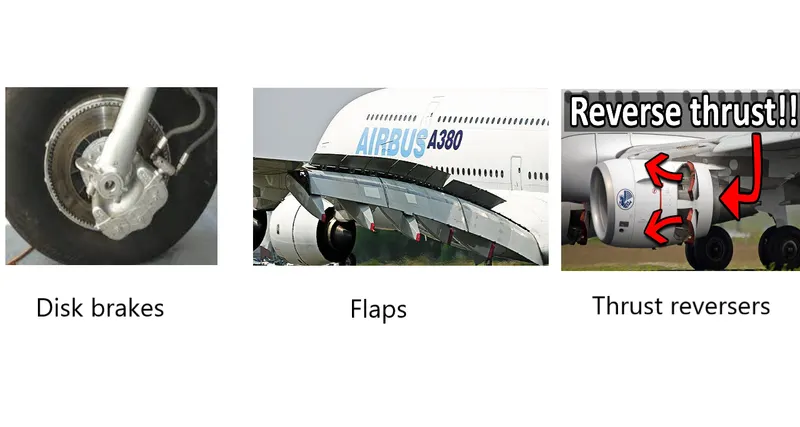
1.Disk brakes:
Modern airplanes use disc brakes. The disc rotates as the turning wheel assembly rotates, but when brakes are applied, a stationary caliper resists the rotation by causing friction against the disc.
It all depends on the size, weight, and the landing speed of the aircraft. Although there are a lot of types of brakes, single brakes, dual brakes, and multiple brakes.
- Flaps and Thrust reversers brakes:
Flaps which are located on the end of the wings. They function to reduce the aerodynamic lift and increase the drag.These flaps are an important factor in the braking system because, without them, the friction of the wheels will not be enough for efficient braking.
The second system, the reversers, are located in the engines and can be activated, so the exhaust of the engine is redirected forward, as opposed to backward. These reversers also help in reducing the amount of stress the wheels have to tolerate, and results in braking.
-------------------------------------------------------------------------------------------------------------------------------------------------------------------------------------------
OBJECTIVE-6:
Let’s calculate the force and power required to push / pull an aircraft by a towing vehicle.
Assumption data
Weight of aircraft :1,00,000 kg
Frontal area of aircraft :125 m2
Speed of the towing tug :20 kmph
Co-efficient on rolling resistance :0.03
Coefficient of drag :0.02
Radius of tyre :0.65 m2
Gear ratio :11
Using the values the force and power of the motor is calculated by excel calculator
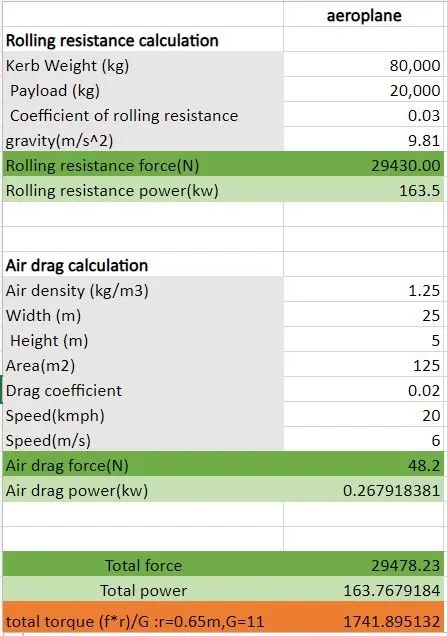
From the calculation we can estimate the force and power requirements of the towing vehicle
Needed force of 29.4kN
Needed power of 163.7KW
Needed torque of 1.7kN
Excel calculator link:
https://drive.google.com/file/d/13P1uWF0BUmrZNw8UIb3J5GZN3KQWQbt2/view?usp=sharing
-------------------------------------------------------------------------------------------------------------------------------------------------------------------------------------------
OBJECTIVE-7:
To Design an electric powertrain with a type of motor, it’s power rating, and energy requirement to fulfill aircraft towing applications.. Make all required assumptions. Prepare a table of assumed parameters.
|
Weight of aircraft :1,00,000 kg Frontal area of aircraft :125 m2 Speed of the towing tug :20 kmph Co-efficient on rolling resistance :0.03 Coefficient of drag :0.02 Radius of tyre :0.65 m2 Gear ratio :11 |
Run time of tug :15min Force needed : 29.4kN Motor Power needed : 163.7KW Motor Torque needed : 1.7kN Energy for 15min : 41kJ/h Battery pack needed :0.0113888889KW Speed range : 0-20 kmph |
Let’s select induction motor with the following specification for towing application
200kW (268HP) at 400V x 50Hz 3ph.
Power Factor is 0.89 when mains connected at 50Hz.
Efficiency 95%
The selected motor has higher specification than required torque and power.
To Estimate the duty cycle range to control the aircraft speed from zero to highest
With the above induction motor specification lets estimate the duty cycle.
Duty cycle=output power/input power*100
=(163.7/200)*100
=81.8%
We can control the aircraft from 0 to full speed by the duty cycle of 0-81.8%
To Draw a block diagram of powertrain.
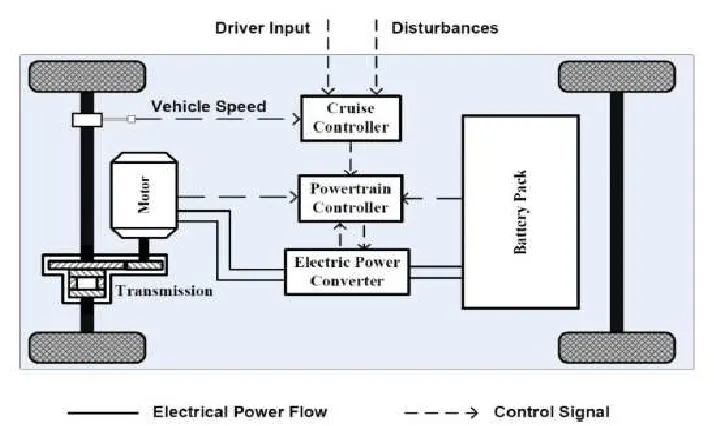
-------------------------------------------------------------------------------------------------------------------------------------------------------------------------------------------