Project-1: Powertrain for aircraft in runways
Part - A
- Search and list out the total weight of various types of aircrafts.
The Aircraft gross weight (also known as the all-up weight and abbreviated AUW) is the total aircraft weight at any moment during the flight or ground operation.
- An aircraft's gross weight will decrease during a flight due to fuel and oil consumption. An aircraft's gross weight may also vary during a flight due to payload dropping or in-flight refueling.
- At the moment of releasing its brakes, the gross weight of an aircraft is equal to its takeoff weight. During the flight, an aircraft's gross weight is referred to as the enroute weight or in-flight weight.
- An aircraft's gross weight is limited by several weight restrictions to avoid overloading its structure or to avoid unacceptable performance or handling qualities while in operation.
- Aircraft gross weight limits are established during an aircraft's design and certification period and are laid down in the aircraft's type certificate and manufacturer specification documents.
- The absolute maximum weight capabilities of a given aircraft are referred to as the structural weight limits. The structural weight limits are based on the aircraft maximum structural capability and define the envelope for the CG charts (both maximum weight and CG limits).
- An aircraft's structural weight capability is typically a function of when the aircraft was manufactured, and in some cases, old aircraft can have their structural weight capability increased by structural modifications.
Maximum Design Taxi Weight (MDTW)
The maximum design taxi weight (also known as the maximum design ramp weight (MDRW)) is the maximum weight certificated for aircraft manoeuvring on the ground (taxiing or towing) as limited by aircraft strength and airworthiness requirements.
Maximum Design Takeoff Weight (MDTOW)
Is the maximum certificated design weight when the brakes are released for takeoff and is the greatest weight for which compliance with the relevant structural and engineering requirements has been demonstrated by the manufacturer.
Maximum Design Landing Weight (MDLW)
The maximum certificated design weight at which the aircraft meets the appropriate landing certification requirements. It generally depends on the landing gear strength or the landing impact loads on certain parts of the wing structure.
The MDLW must not exceed the MDTOW.
The maximum landing weight is typically designed for 10 feet per second (600 feet per minute) sink rate at touch down with no structural damage.
Maximum Design Zero-fuel Weight (MDZFW)
The maximum certificated design weight of the aircraft less all usable fuel and other specified usable agents (engine injection fluid, and other consumable propulsion agents). It is the maximum weight permitted before usable fuel and other specified usable fluids are loaded in specified sections of the airplane. The MDZFW is limited by strength and airworthiness requirements. At this weight, the subsequent addition of fuel will not result in the aircraft design strength being exceeded. The weight difference between the MDTOW and the MDZFW may be utilized only for the addition of fuel.
Minimum Flight Weight (MFW)
Minimum certificated weight for flight as limited by aircraft strength and airworthiness requirements.
Air-Craft gross weight:
It is the total aircraft weight at any moment during the flight or ground operation. This decreases during flight due to fuel and oil consumption. The gross weight of the vehicle is gives in the maximum takeoff weight of the vehicle. The total weight W of the aircraft is simply the sum of the weight of all of the individual components.
W = w(fuselage) + w(wing) + w(engines) + w(payload) + w(fuel)
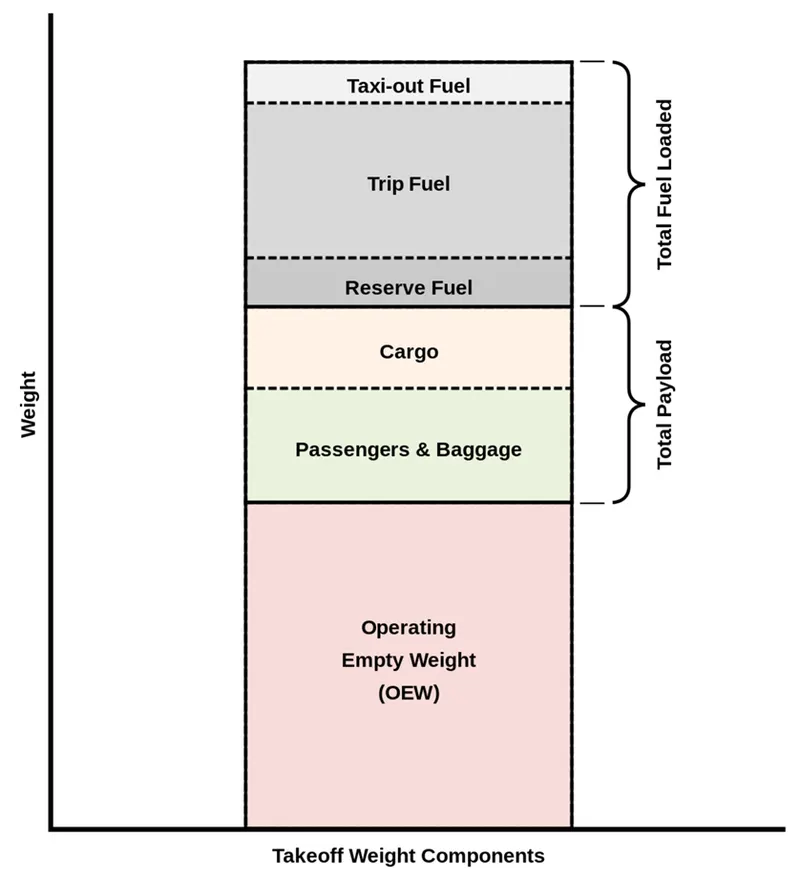
Various type of Aircrafts
- Lighter than Air
- Heavier than Air
Lighter than Air: -
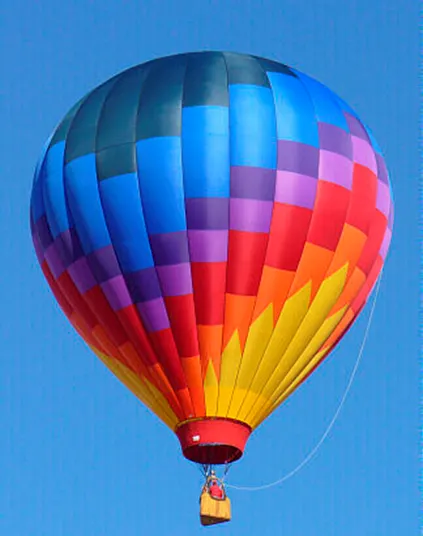
Aircraft such as balloons, nonrigid and dirigibles are designed to contain within their structure a sufficient volume that, when filled with a gas lighter than air (heated air, hydrogen, or helium), displaces the surrounding ambient air and floats, just as a cork does on the water. Balloons are not steerable and drift with the wind.
Hot Air Balloon gross weight = 400kg approx.
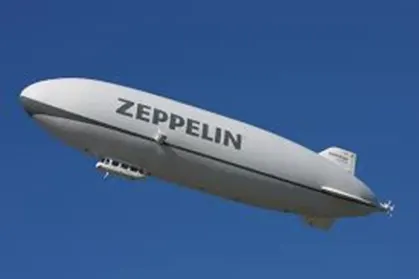
- Airship gross weight = 280000.
Heavier-than-air:
- This type of aircraft must have a power source to provide the thrust necessary to obtain lift. These are usually a flat-surfaced structure, often with a stabilizing “tail,” attached by a bridle to a string that is held in place on the ground. Lift is provided by the reaction of the string-restrained surface to the wind.
- Heavier than air aircraft, or aerodynes, include autogyros, helicopters and gyrocopters, and conventional fixed-wing aircraft (aero planes).
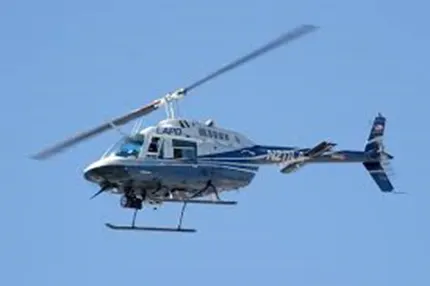
- Helicopters can weigh from 600 lb/275 kg all the way up to 123,400 lb/56,000 kg .
- Another type of unmanned aircraft is the unmanned aerial vehicle (UAV), commonly called drones or sometimes remotely piloted vehicles (RPVs). These aircraft are radio-controlled from the air or the ground and are used for scientific and military purposes.
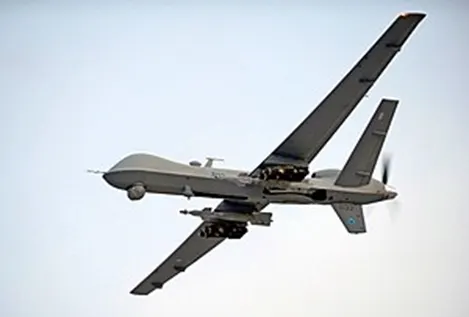
- MQ-9A Reaper gross weight = 4763 kg
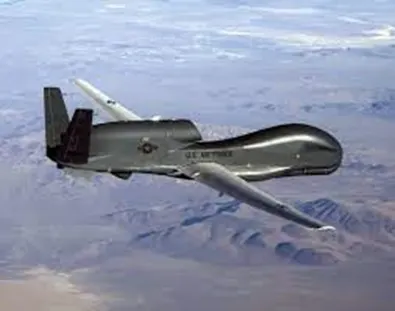
- Typically helicopters weights vary from 270kg to 50000 kgs.
Civil Aircrafts: -
All nonmilitary planes are civil aircraft. These include private and business planes and commercial airliners.
Private aircraft are personal planes used for pleasure flying, often single-engine monoplanes with the nonretractable landing gear. They can be very sophisticated, however, and may include such variants as: “warbirds,” ex-military planes flown for reasons of nostalgia, ranging from primary trainers to large bombers; “homebuilt,” aircraft built from scratch or from kits by the owner and ranging from simple adaptations of Piper Cubs to high-speed, streamlined four-passenger transports; antiques and classics, restored older aircraft flown, like the warbirds, for reasons of affection and nostalgia; and aerobatic planes, designed to be highly maneuverable and to perform in air shows.
Business aircraft are used to generate revenues for their owners and include everything from small single-engine aircraft used for pilot training or to transport small packages over short distances to four-engine executive jets that can span continents and oceans. Business planes are used by salespeople, prospectors, farmers, doctors, missionaries, and many others. Their primary purpose is to make the best use of top executives’ time by freeing them from airline schedules and airport operations.They also serve as an executive prerequisite and as a sophisticated inducement for potential customers. Other business aircraft include those used for agricultural operations, traffic reporting, forest-fire fighting, medical evacuation, pipeline surveillance, freight hauling, and many other applications.
- Antanov AN-225 gross weight = 640,000 kg
- Airbus A380-800 gross weight = 575,000 kg
- Boeing 747-800 gross weight = 447,700 kg
- Airbus A340-500 gross weight = 372,000 kg
- Boeing 787-10 gross weight = 254,000 kg
- Boeing 737-900 gross weight = 85,000 kg
- Airbus A320-100 gross weight = 68,000 kg
- Embraer 190 gross weight = 48,000 kg
Fighter Aircraft: -
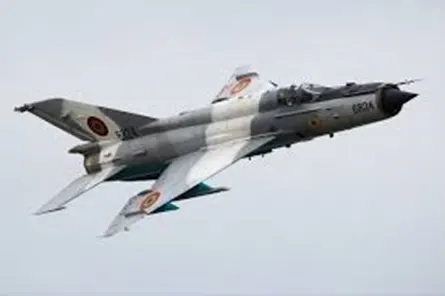
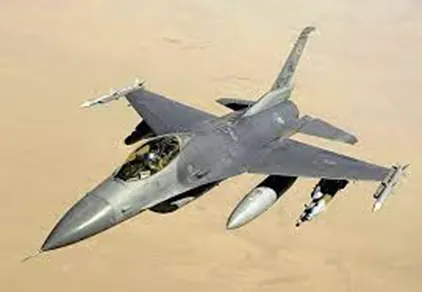
A fighter aircraft, often referred to simply as a fighter, is a military fixed wing aircraft designed primarily for air-to-air combat against other aircraft. The key performance features of a fighter include not only its firepower but also its high speed and maneuverability relative to the target aircraft.
Gross weight = 4000kg to 14000kg
Military transport aircraft: -
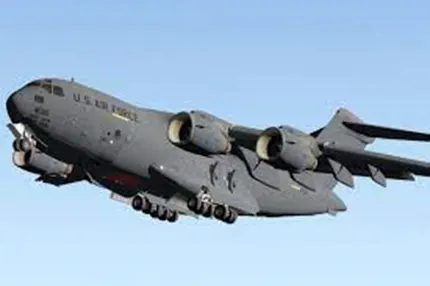
Military transport aircraft or military cargo aircraft are used to airlift troops, weapons and other military equipment to support military operations. Transport aircraft can be used for both strategic and tactical missions, and are often diverted to civil emergency relief missions.
Gross Weight = 250,000 kgs
Aerobatic Planes: -
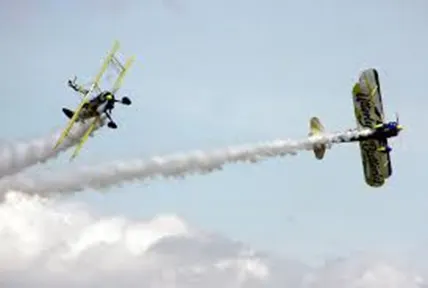
An aerobatic aircraft is an aerodyne (a heavier-than-air aircraft) used in aerobatics, both for flight exhibitions and aerobatic competitions.
Gross Weight = 800 kgs
2. Is there any difference between ground speed and air speed?
Yes, there are many differences between ground speed and air speed.
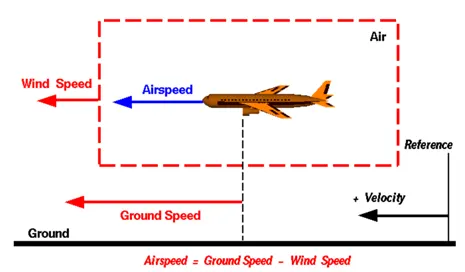
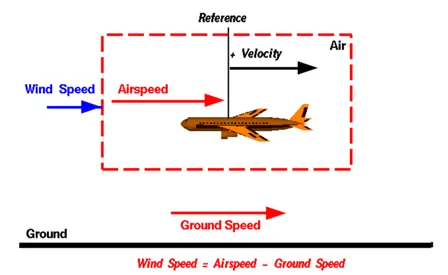
Ground speed: -
Ground speed is the airplane’s speed relative to the surface of the Earth.
An aircraft heading vertically would have a ground speed of zero. Ground speed can be determined by the vector sum of the aircraft's true airspeed and the current wind speed and direction; a headwind subtracts from the ground speed, while a tailwind adds to it. Winds at other angles to the heading will have components of either headwind or tailwind as well as a crosswind component.
Wind speed: -
For a reference point picked on the ground, the air moves relative to the reference point at the wind speed. A positive velocity is defined to be in the direction of the aircraft's motion. We are neglecting cross winds, which occur perpendicular to the flight path but parallel to the ground, and updrafts and downdrafts, which occur perpendicular to the ground.
Air speed: -
The important quantity in the generation of lift is the relative velocity between the object and the air, which is called the airspeed. Airspeed cannot be directly measured from a ground position but must be computed from the ground speed and the wind speed. Airspeed is the vector difference between ground speed and wind speed.
- The aircraft usually operates on land as well as in air and so we need to study their speed differences in-ground and in air
- The ground speed and the airspeed usually change based on the wind component.
- If we consider that there is no wind component then, ground speed = airspeed
- If the wind is blowing in the tail direction of the aircraft, then, (airspeed > ground speed) so, airspeed = ground speed+ wind component.
- If the wind is blowing in the head direction of the aircraft, then, (airspeed < ground speed) so, airspeed ground speed - wind component.
- Also, gravity plays a major role in increasing the aircraft's speed while it is descending.
- Here wind speed is the vector difference between ground and airspeed. On a particular day, the wind speed may be zero and it is equal to the ground speed.
- If the measured airspeed is greater than the observed ground speed the wind speed becomes positive.
3. Why is it not recommended to use aircraft engine power to move it on the ground at Airport?
- For movement on the ground the aircraft uses its own engine power, which is called taxing. Although many aircrafts are capable of moving in backward using reverse thrust, as result the jet blast or prop wash might cause damage to the terminal building or equipment. Engine close to ground may also blow sand and debris forward and then suck them into the engine, causing damage to the engine.
- Therefore, there are pushback trucks in the airport. A pushback truck lifts the front wheel of the aircraft, their role in most airports is to move the aircraft away from the parking spot on to the taxiways, . which is called Towing.
- Unwanted consequences mainly arising from the unintended movement of the aircraft during engine running.
- Effectively a loss of control can happen, especially during high power engine running. Damage can occur to the aircraft itself, other aircraft nearby or to airside structures.
- There is a risk of injury to ground support personnel who may be in relatively close proximity to the aircraft.
- It is easier for truck driver to see the surroundings better than the pilot sitting in the cockpit with limited window. The pushback driver knows the airport better than the pilot.
- It also saves fuel. virgin Atlantic had proposed a new system in which pushback truck will move the aircraft all the way to runway to save fuel and reduce impact of environment.
- The plane engines are very loud. When more than one plane will add up their sound, than it will not be pleasant for passengers and others near airport.
4.. How an aircraft is pushed to runway when its ready to take off?
Taxiing
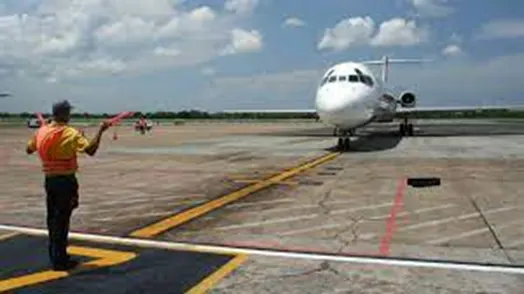
Taxiing is the movement of an aircraft on the ground, under its own power, in contrast to towing or push-back where the aircraft is moved by a tug. The aircraft usually moves on wheels, but the term also includes aircraft with skis or floats. An airplane uses taxiways to taxi from one place on an airport to another; for example, when moving from a hangar to the runway. The term "taxiing" is not used for the accelerating run along a runway prior to takeoff, or the decelerating run immediately after landing, which is called the takeoff roll and landing rollout, respectively.
Towing
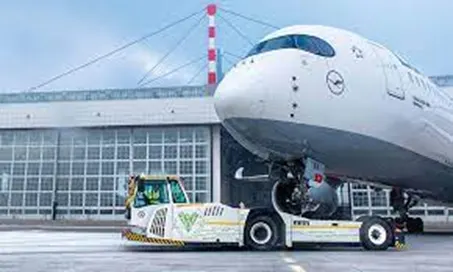
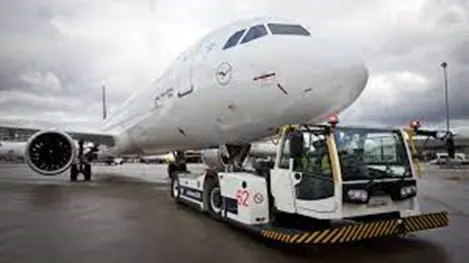
The forward movement of an aircraft, usually with engines off, using the power of a specialized ground vehicle attached to or supporting the nose landing gear. It may occur for the movement of both in service and out of service aircraft.
Before the aircraft to be towed is moved, a qualified person must be in the flight deck to operate the brakes in case the tow bar fails or becomes unhooked. The aircraft can then be stopped, preventing possible damage.
Towing aircraft can be a hazardous operation, causing damage to the aircraft and injury to personnel, if done recklessly or carelessly. The aircraft can then be stopped, preventing possible damage. Some types of tow bars available for general use can be used for many types of towing operations.
5. Learn about take off power, tyre design, rolling resistance, tyre pressure, brake forces when landing.
Takeoff Power: -
Takeoff is the phase of flight in which an aerospace vehicle leaves the ground and becomes airborne.
For aircraft that take off horizontally, this usually involves starting with a transition from moving along the ground on a runway. For balloons, helicopters, and some specialized fixed-wing aircraft (VTOL aircraft such as the Harrier), no runway is needed. Takeoff is the opposite of landing. Take off performance can be predicted using a simple measure of the acceleration of the aircraft along the runway based on force equilibrium. The forces involved will be,
T – Thrust of propulsion system pushing aircraft along runway.
D – Aerodynamic Drag of vehicle resisting the aircraft motion.
F – Rolling resistance friction due to the contact of wheels or skids on the ground.
During take-off run the imbalance in these forces will produce an acceleration along the runway,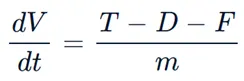
where dV/dt is the acceleration along the runway and m is the mass of the vehicle.
The procedure for take-off will be that the vehicle will accelerate until it reaches a safe initial flying speed. The pilot can then rotate the vehicle to an attitude to produce climb lift and it will ascend from the ground. The determination of this safe flying speed or rotation speed, VR, is a critical factor in determining take-off performance.
Take-off rules vary slightly depending on the aircraft category. Small commuter aircraft should be considered as meeting FAR 23 rules, transport category aircraft should comply with FAR 25 rules.
Small commuter aircraft:
For safety reasons VR is usually determined as being 1.1 × VSTALL or 1.05 × VMIN CONTROL
whichever is greater. Stall speed, VSTALL, is the lowest speed that the aircraft can be flown before the airflow starts to separate from wings as the angle of attack becomes too great. The wing is assumed in this case to be in take-off configuration or "clean".
It can be calculated based on knowledge of the aircraft take-off configuration and hence the maximum achievable lift coefficient CL (max). As shown in the previous section, to maintain level flight the lift produced must equal the weight, hence the stall speed can be calculated as,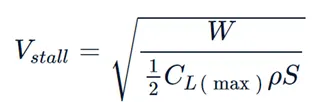
Minimum control speed, VMC is a more complex calculation and requires knowledge of the stall characteristics of the tailplane and elevator. For conventional aircraft there is only a small difference between VR calculations based on stall speed or minimum control speed.
Thrust: - The thrust of gas turbine or turbofan engines will be relatively constant during take-off. A good assumption is to use the manufacturer's values for maximum static thrust for take-off calculations.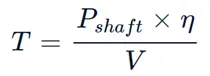
It is critical to correctly estimate the propeller efficiency for the particular aircraft velocity along the runway. At V=0 the efficiency is 0 so the above equation makes no sense. At V=VR the efficiency will be in the range 50% to 80% depending on the type of propeller system used and the thrust value at this point will be easy to obtain. In practice, the thrust obtained throughout the take-off roll is roughly constant so this end point value is a good approximation from V=0 to V=VR.
Drag: -The resistance to motion due to the air viscosity will give a drag of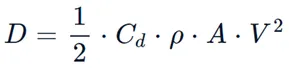
where CD can be considered constant,
Although Drag Coefficient is constant, Drag will increase in proportion to the square of velocity.
Tyre Design of aircrafts :
When it comes to safety, tyres are one of the most important components of aircraft. They help to absorb the shock of landing and provide cushioning. It also provides the necessary traction for braking and stopping of an aircraft.
An aircraft tyre is designed to withstand extremely heavy loads while landing, take off, taxing and parking. The number of wheels required for aircraft increases with the weight of the aircraft, as the weight of the aero plane needs to be distributed more evenly. Carcass plies are used to form the tire. They are sometimes called casing plies. An aircraft tyre is constructed for the purpose it serves.
Unlike an automobile or truck tyre, it does not have to carry a load for a long period of continuous operation. However, an aircraft tyre absorbs the high impact loads of landing and also, it’s operating at high speeds for a short time when required.
Aircraft Tyre Construction
Retreading – Retreading is methods of restoring a worn tyre by renewing the tread area or by renewing the tread area plus one or both sidewalls. Repairs are included in the tyre retreading process.
Load Rating – Load rating is the maximum permissible load at a specified inflation pressure.
Ply Rating – Ply Rating is used to identify the maximum recommended load rating and inflation pressure for a specified tyre. It is an index of tyre strength.
Speed Rating – The speed rating is the maximum takeoff speed to which the tyre has been tested.
Skid Depth – Skid depth is the distance between the tread surface and the deepest groove as measured in the mold.
Aircraft tyres must have an approved speed and load rating and have sufficient clearance when retracted through landing gear to allow for tyre growth. Tyre growth is the increase in the size of the tyre due to centrifugal forces at high speed.
Rolling Resistance: -
Rolling resistance is the force resisting the motion when a body (such as ball, tyre or wheel) rolls on a surface. Rolling resistance can be seen in the aircraft when the aircraft takes-off from the runway & while landing at the runway with the help of their wheels.
Rolling resistance can be expressed as
Where,
- Frr is the Rolling resistance(N)
- μrr is coefficient of rolling resistance.
m is mass (kg)
g is acceleration due to gravity = 9.81m/s^2
Tyre Pressure: -
Aircraft tyres operate at such high extremes of pressure, load, and speed, their care and service is critically important. The most important action an operator can take to prevent tyre-related events is to maintain proper tire inflation pressure. Failure to keep aircraft tires properly inflated can lead to very serious consequences. One relatively easy way to help avoid those consequences is to check tire pressures regularly and service them as necessary. Following these three actions is a good way to make sure you get the most value out of your tires and contribute to the safe operation of your aircraft.
Aircraft tires are usually inflated with nitrogen to minimize expansion and contraction from extreme changes in ambient temperature and pressure experienced during flight. Dry nitrogen expands at the same rate as other dry atmospheric gases (normal air is about 80% nitrogen). but common compressed air sources may contain moisture, which increases the expansion rate with temperature.
Also, the use of an inert gas for tire inflation eliminates the possibility of tire explosion.
Relation to Rolling Resistance and Tire Pressure:
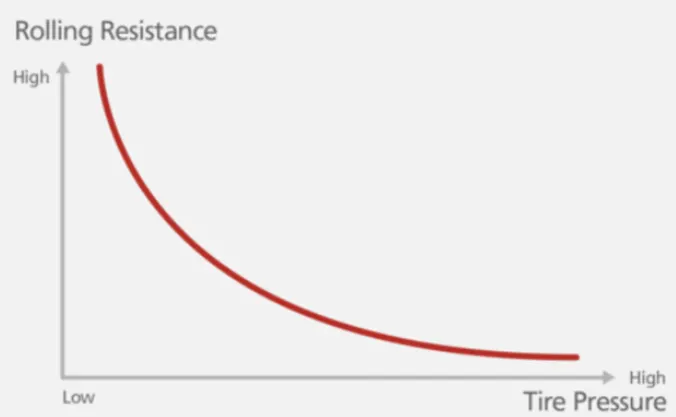
Rolling resistance and Tire pressure are inversely proportional.
Brake forces when landing: -
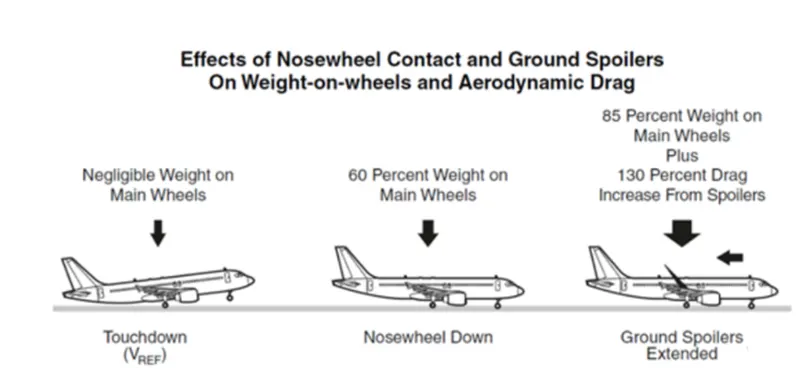
VREF is reference landing speed
Following braking devices are used to decelerate the aircraft -
- Spoilers.
- Wheel Brakes (Including Anti-Skid systems & Auto-Brake systems).
- Reverse Thrust
Spoilers:
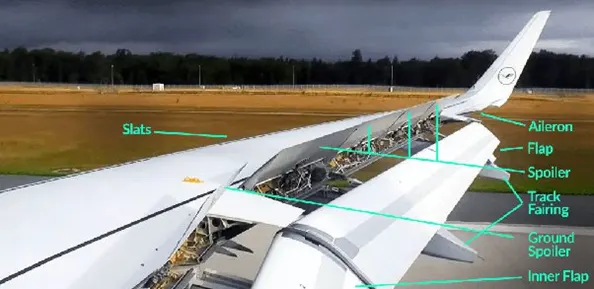
The mechanical deflection of parts of the wing upper surface by increasing aerodynamic drag on the moving aircraft. This can be achieved by raising upper wing surface panels called ground spoilers or by operation of a tail cone 'clamshell' type air brake and also by increasing the effective downward load on the landing gear and thereby increasing the efficiency of wheel braking.
Wheel Brakes: -
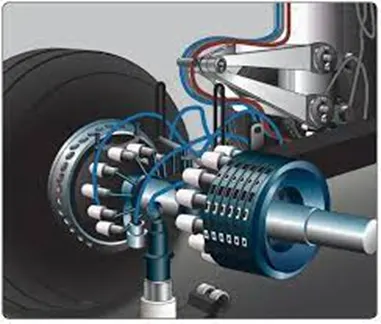
To be effective, braking action at any speed depends upon sufficient friction existing between the tires and the runway surface achieved through freely rotating wheels.
Anti-skid system: - When landing on slippery runways, there's a chance that the wheels may start to skid as the brakes are applied. To stop this from happening and to maintain maximum effective braking, each wheel has anti-skid protection.Using a variety of sources to determine the aircraft speed, the brake units know how fast the wheels should be spinning. If that speed drops significantly, it's because the current brake pressure on that wheel is too great and the wheel is just skidding over the surface.
In this situation, the anti-skid system automatically reduces the braking on that wheel to a point where the skid stops before reapplying the pressure.
Reverse Thrust: -
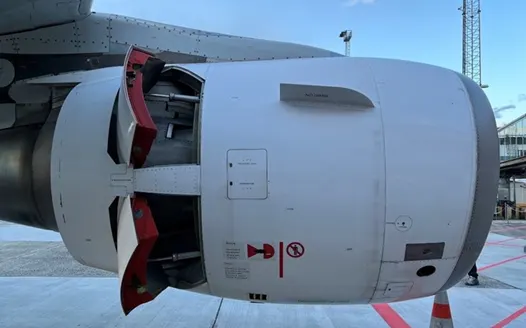
Thrust reversers provide a deceleration for ce that is independent of runway condition. Thrust reverser efficiency is higher at high airspeed therefore. Traversers must be selected as early as possible after touchdown.
Thrust reversers should be returned after reverse idle at low airspeed to prevent engine stall or foreign object damage.
Part - B
- A). With necessary assumptions, calculate the force and power required to push / pull an aircraft by a towing vehicle.
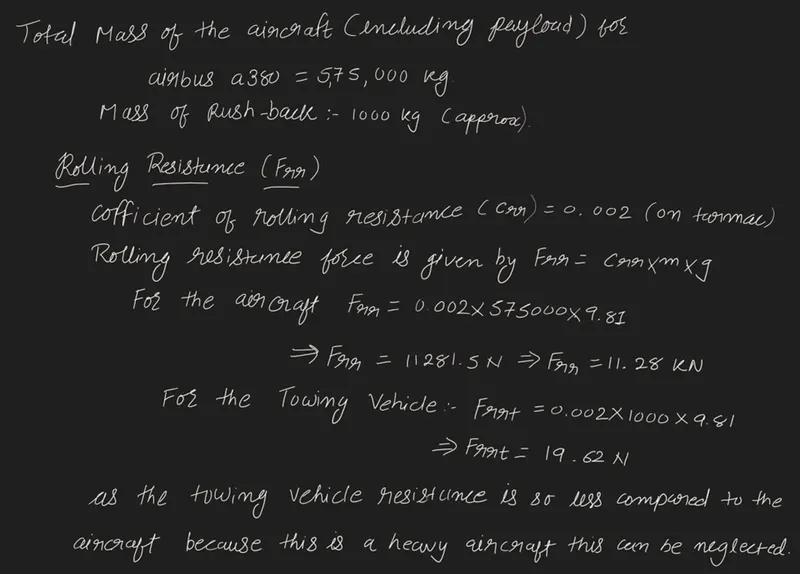
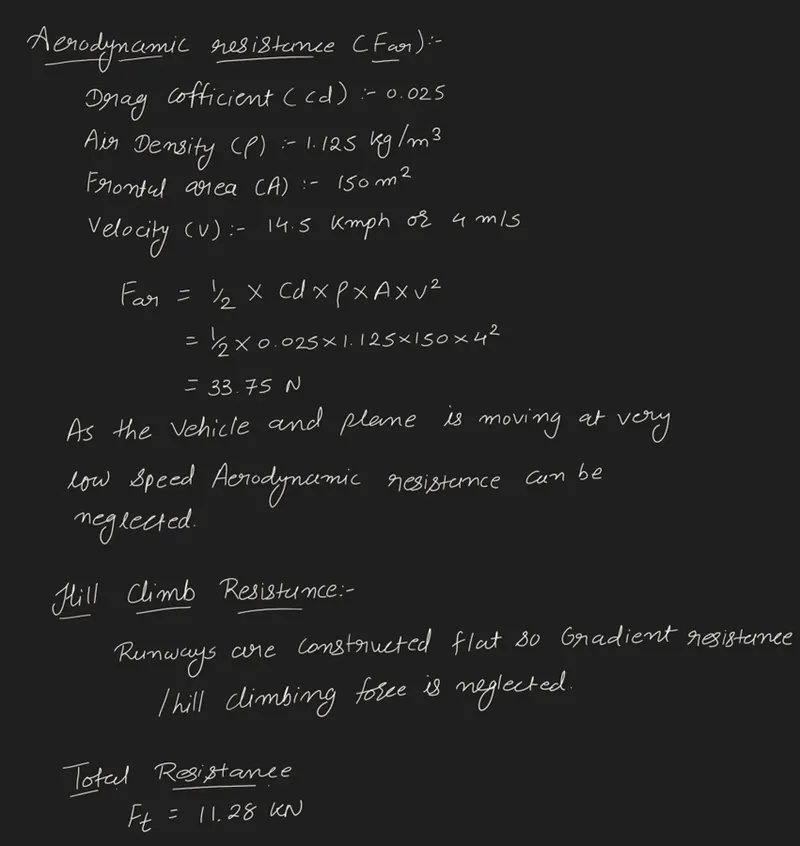
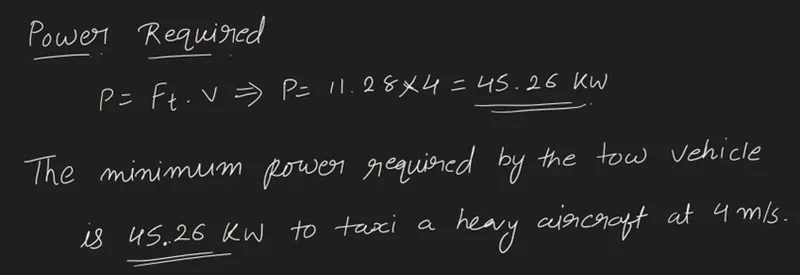
B). Develop the model for the calculated force and power using Simulink.
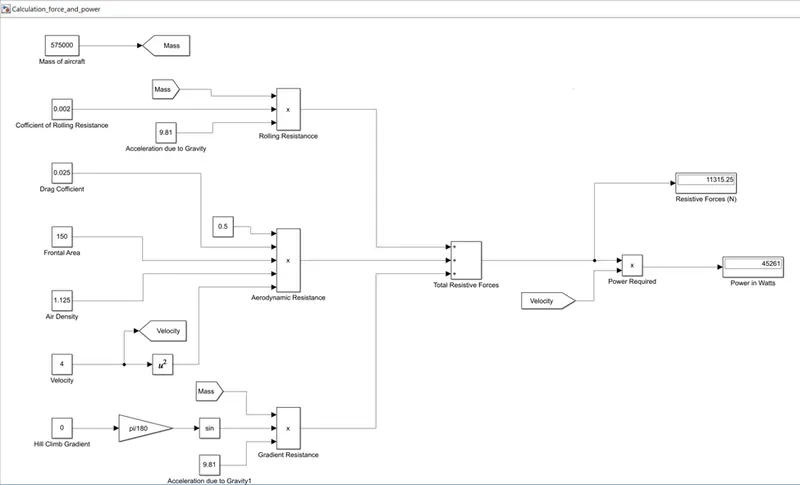
Block use: -
- Constant Block use for different value like Mass of aircraft, coefficient of rolling resistance, Drag coefficient, Frontal area, Air density and velocity.
- Product Block use for calculation for different resistance force like Rolling resistance, Aerodynamic resistance and Gradient resistance.
- Goto Block and From Block use for Mass and velocity.
- Addition Block use for find total resistance forces.
- Display Block use for the output to be visualized.
- Square Block
- Gain Block
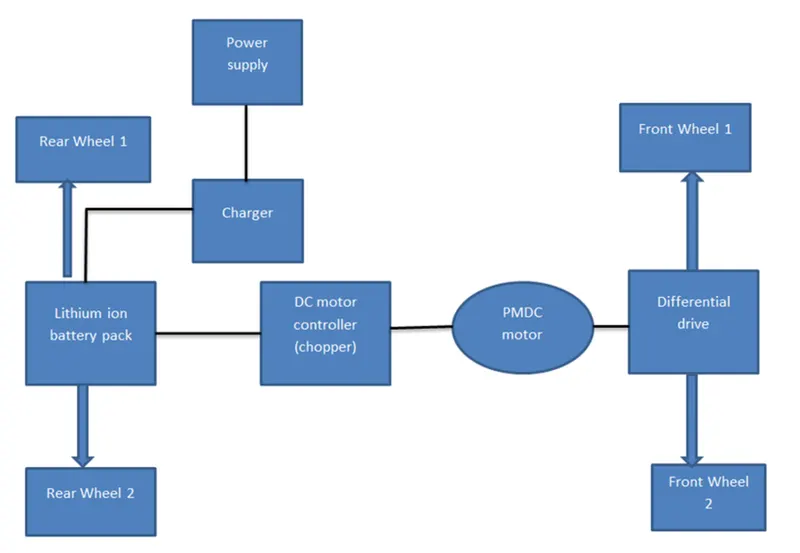
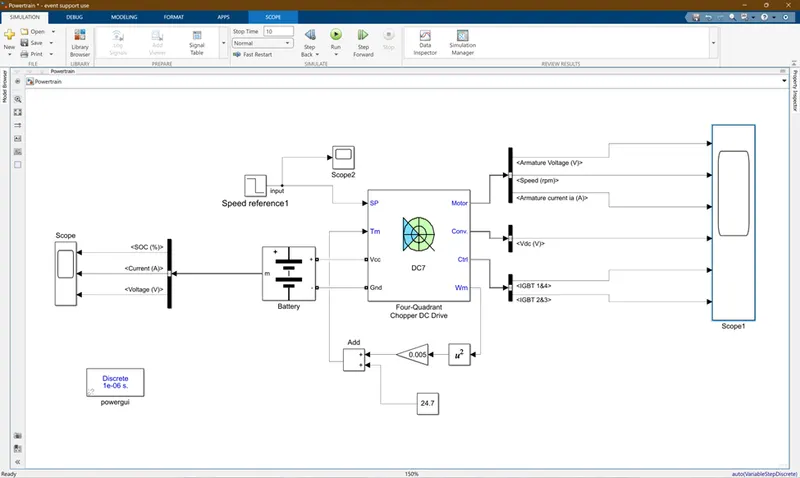
7. A). Design an electric powertrain with type of motor, it’s power rating, and energy requirement to fulfill aircraft towing application in Simulink. Estimate the duty cycle range to control the aircraft speed from zero to highest. Make all required assumptions. Prepare a table of assumed parameters. Draw a block diagram of powertrain.
Assumption for Powertrain Design
The Power required by the aircraft is 45.26 KW.
Consider following motor specification.
|
Voltage |
400-800V |
|
Peak Power |
60-70KW |
|
RPM |
1500-4000 |
|
Torque |
300Nm |
Consider 60 KW as continuous power, so the voltage will be 400V
Assume Battery power is considered to be 550V.
Now, calculating duty cycle
Duty cycle is given by = Vo / Vs,
where Vo = motor required voltage
Vs = battery voltage
D = 400 / 550 = 0.7272
Due to the resistance of FET and inductance.
Correction factor is considered to be 90%
As there is 10% loss, the voltage demanded by the motor should be 10% more than required
d = 0.7272 (1 + 0.1) = 0.799 = 0.8
Assumed Parameter
|
Mass of aircraft |
575000 kg |
|
Mass of the push back truck |
1000 kg |
|
Coefficient of Rolloing Resistance |
0.002 |
|
Drag Coefficient |
0.025 |
|
Air density |
1.125 kg/m^3 |
|
Frontal Area |
150 m^2 |
|
Velocity |
4 m/s |
|
Up-Hill Gradient |
0 deg |
|
Battery voltage |
550 V |
|
Correction Factor |
0.8 |
Based on the calculations done in 6A.
Force required to push/pull the aircraft =19.508 KN
Power required =135.478 kw
Let us assume,
The Radius of the Tyre for the Tug - 25inches =0.635m
Gear ratio=8
Transmission Efficiency (nt) =87%
Motor Efficiency (nm)=95%
then, Torque required for the wheels (Tw)=Total Force *Radius in meters
=19.508 *0.635
=12.387KNm
Motor Torque-Wheel = torque/(Gear ratio*(nt))
=12.387/(8*0.87)
=1.778KNm
For nm =95%. The required motor Torque (Tm)= 1.778/0.95 1.871 kNm
Similarly. The total power required by the motor considering all the efficiencies (Pt) =135.478/(0.87*0.95)=163.917Kw
Let us assume the towing operation was done for 15 minutes (0.25Hrs) duration.
Then, Total Energy consumed = 163.917* 0.25 =40.98 KWh
If we consider the battery capacity=220 kw is used by the towing vehicle then. The duty cycle range to control the speed from O to max speed (3m/s) is given as
Duty Cycle (d)= (Required Power)/ (Rated power) = 163.917/220=0.75
Therefore the controller will be able to provide a duty cycle ranging from 0 to 75% in order to control the towing speed.
Block Diagram
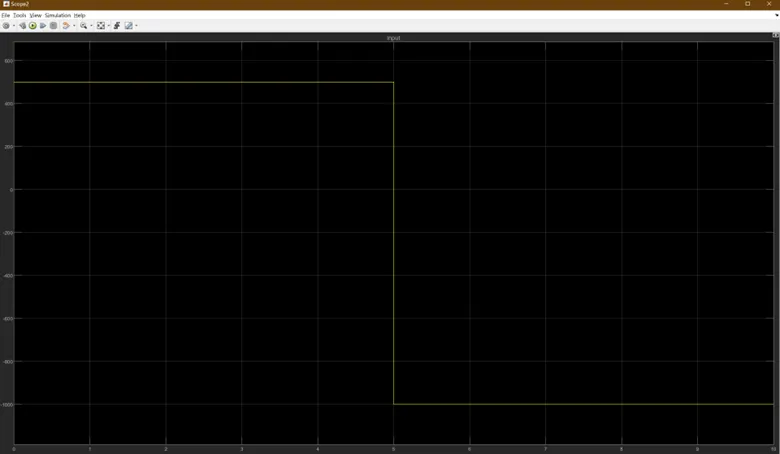
For the input signal we are using step block and its input vale is 500 and having 0.75 duty cycle ratio. as shown below.
Result: -
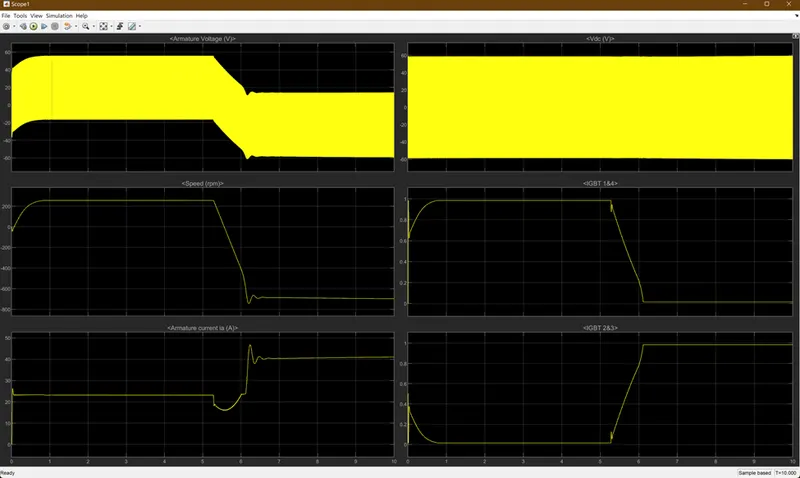
Motor Output: -
From the above module is simulated and motor output parameters of armature voltage and speed and armature current are shown below.
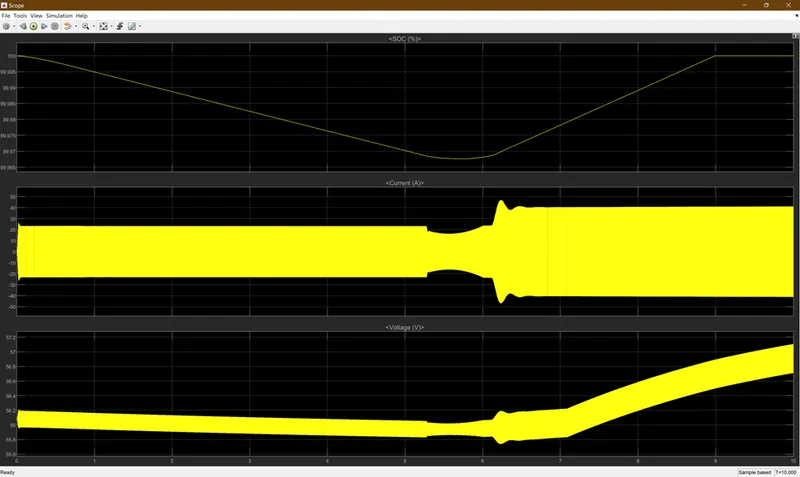
Battery Output: -
From this graph we are plots results of battery performance parameters are soc, battery current and battery voltage characteristics are shown below.
B).Also, Design the parameters in excel sheet.
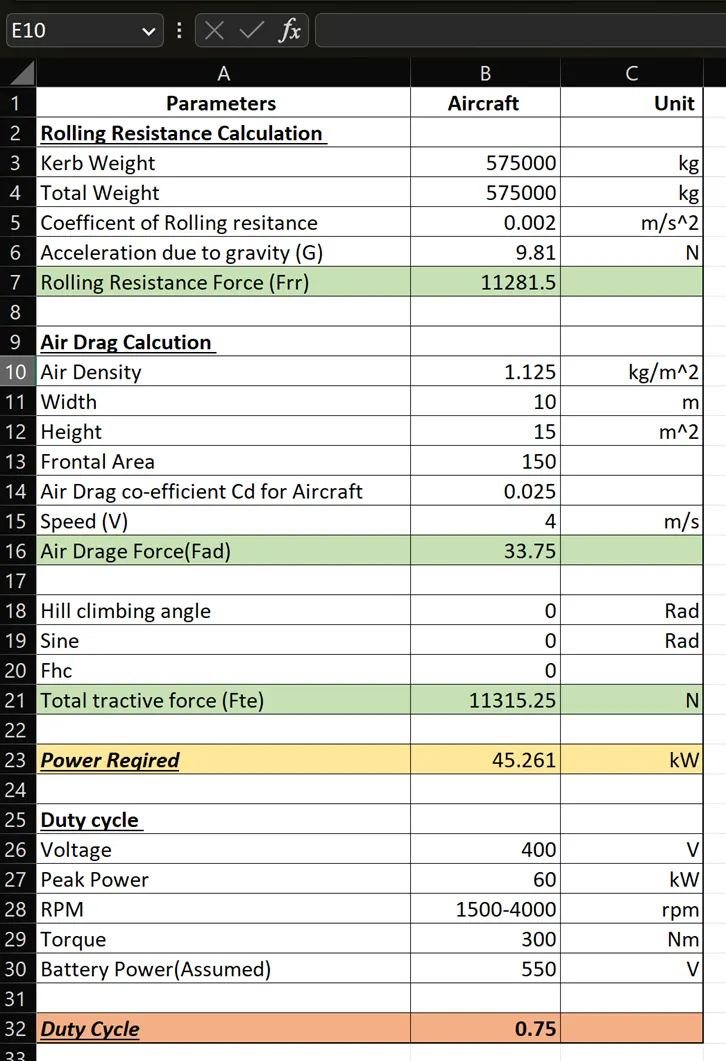
Excel sheet: - https://docs.google.com/spreadsheets/d/1jlu71F9BoiVuMBv2QHDzM2bXQWYJbcQH/edit?usp=sharing&ouid=108387349640963561095&rtpof=true&sd=true