Project-1: Powertrain for aircraft in runways
Part A Solution :
1) Answer 1:
The aircraft itself is a big giagantic system you could say & it's having different parameters which affets it's weight.Let's go through some brief information regarding to Aircraft weight depending parameters.
Every aircraft has a maximum weight that is provided by the manufacturer. This number is not to be exceeded for any aircraft used privately or commercially.In order to determine the actual weight of the aircraft, you must add the empty weight of the plane + fuel weight + passenger weight + baggage weight. This number cannot be above the maximum allowable
weight limit of the aircraft.
Passenger weights are determined by the actual weight of people on board. In the example of commercial airliners, there is no way to know the actual person weight of each person on board, so they use an average weight which is based on gender, age, time of year
and also allows for carry on baggage they may be bringing.
It can be really confusing when looking at the numbers to determine the actual aircraft weight and what it all means.There are a few different terms you need to know.
I would like to mention here some basic Terminology regarding to set weight limits of an aircraft as follow..
OEW( Operating Empty Weight) :OEW is is the weight of the aircraft as it sits empty without fuel, passengers or luggage but it does include all necessary fluids for operation. (oil, coolant, water, hydraulic fluid, etc)
MTOW or Maximum takeoff weight(MTOW) : MTOW is the maximum weight of the aircraft to safely takeoff considering structural or other limits. As mentioned, the maximum weight that any aircraft can be at the time of takeoff is MTOW.
This is calculated by taking OEW + Fuel + Passengers + Luggage – Fuel for taxi to runway = MTOW. as it is maximum take off weightso this is the threshold weight when aircraft is in air...
Aircraft Useful Load :This is the weight that a pilot can place in the aircraft. Take the MGTW figure and subtract the AEW and this is the total useful load that can be placed into the aircraft. This is the fuel, crew, passengers, and cargo. The bigger the load, the more useful the aircraft can be to its customers!Usually, the passengers and their cargo need to go as they are the ones doing the work, so fuel has to be reduced. Instead of filling the aircraft fuel tank up to 100%, I can only fill it to around 60% to keep the aircraft under its MGTW.
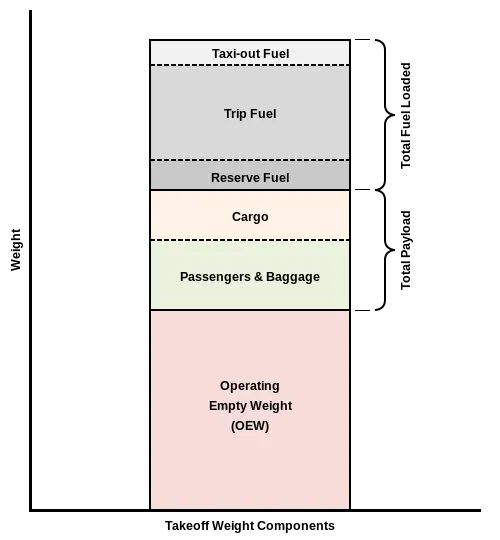
With so many variables involved, each aircraft is different and therefore will have different weights. Each aircraft will have its own OEW and depending on the payload, will have a different MTOW.
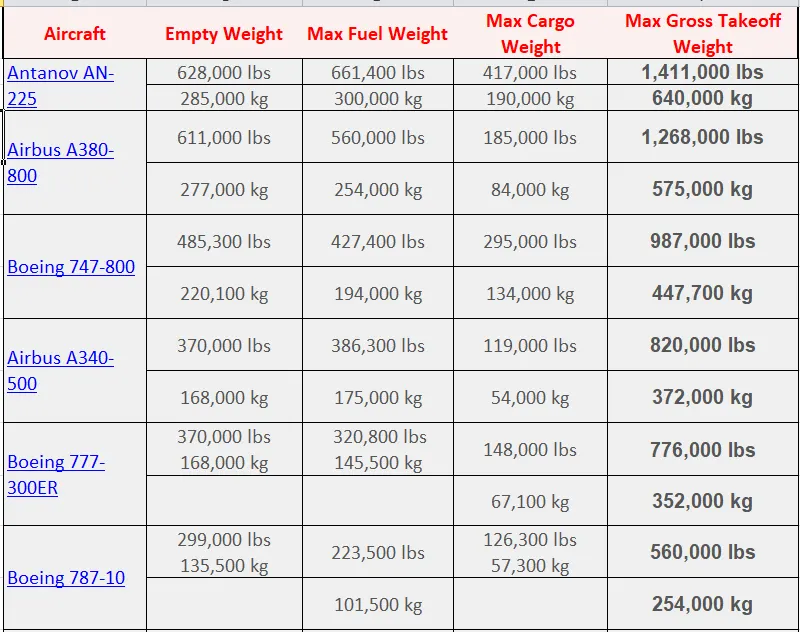
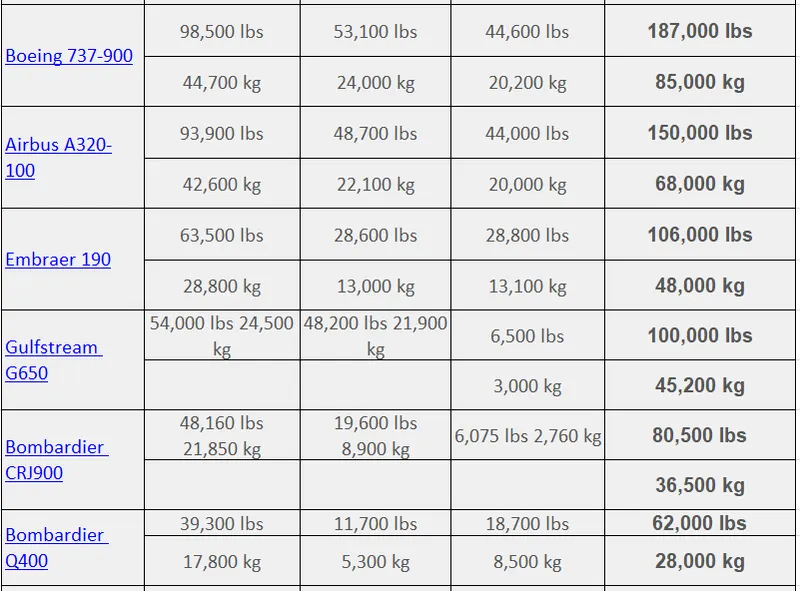
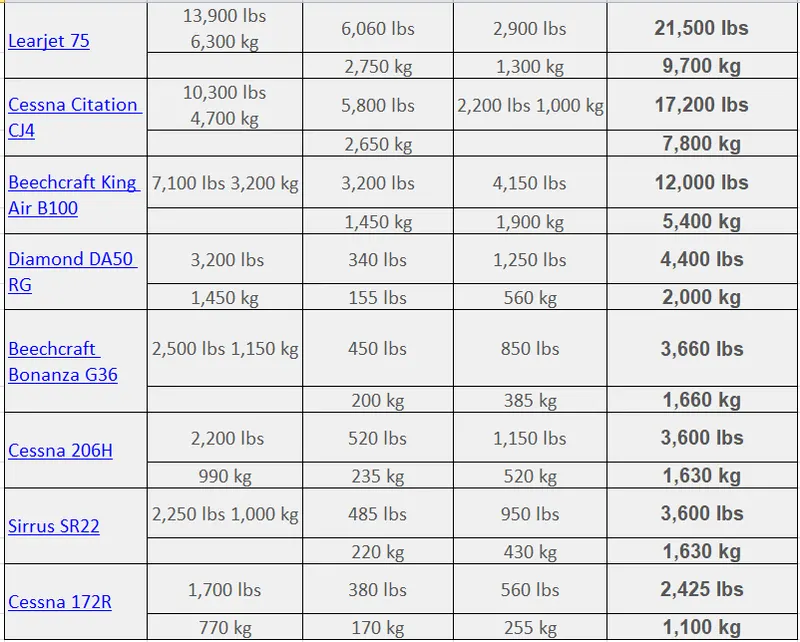
Here beneath I have attached some of Aircrafts weights with/Without loads...
2) Answer 2 :
There is significant difference between Ground speed & Air speed of Aircraft or anyobject that moves in air.Let's first understand both in brief.
Ground speed: This is the speed of moving object/vehicle/Aircraft with respect to ground as reference.If aircraft is travelling in air whate
True Air Speed(TAS):It is the speed of Object/Airplane in the air getting by adding the wind speed in Ground Speed.If the wind speed is in the direction of Air craft forward propulsion than
the True Air speed becomes higher than ground speed.Vice-versa if the wind speed is in the opposite direction of the Aircraft forward propulsion side than
the TAS becomes less than ground speed. It can be understood in better way by following example...
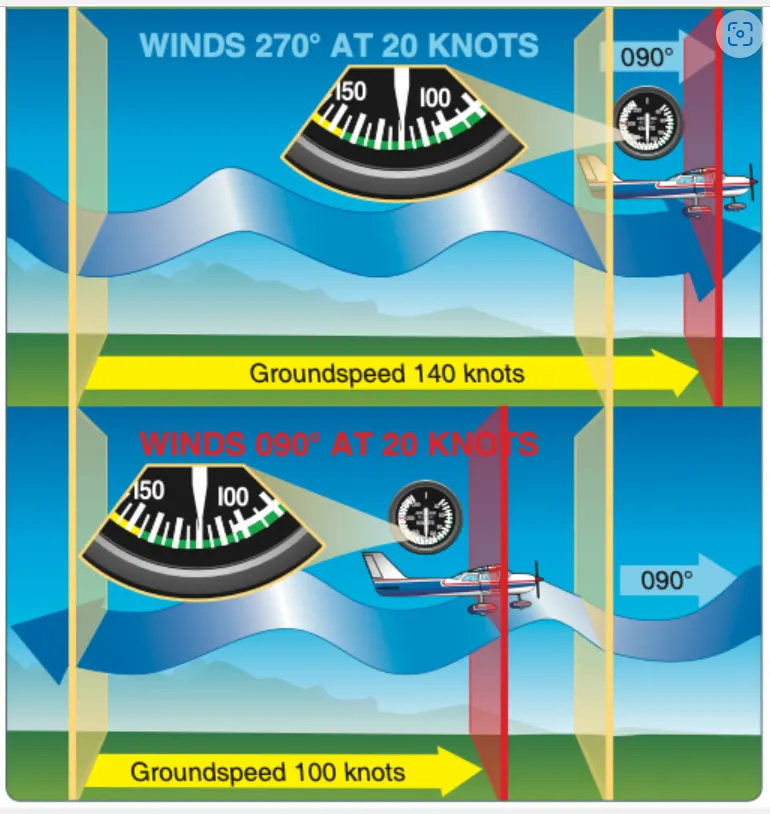
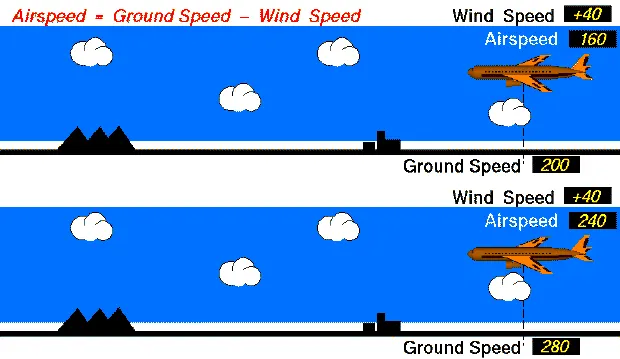


In picture the (KNOT) is the unit used to define speed for Aviation & Marine system.
1 knot = 1.85 Km/hr
Also note here that the Speed matters for aircraft in terms of how much distance travelled is Ground speed,because at the end we want to identify how much actual distance travelled from one place to another with respect to Earth's surface.So yes, For aircrafts there is difference in ground speed & Air Speed On the basis of Wind speed direction ( HeadWind Or Tailwind ) the speed of aircraft in the air his higher/lower than Ground speed.
3) Answer 3:
The total energy required for an aircraft to thrust in atmosphere can be calculated by following equation,
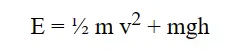
Where, E = Total energy required by Aircraft
m = Mass of the Aircraft including Lagguage + passaners + Fuel
v = Speed of the Aircraft in the Atmosphere
g = Gravitational Acceleration
h = Hight ( Altitude ) of Aircraft from ground
Taking Example of Boeing 747-800as an aircraft and putting the values in the above equation.I have taken parameter values as per below,
Maximum take off weight(MTOW) = 447700 kg
Aircraft Altitude (hight) = 10200 m
Aircraft Speed = 225 m/sec
Gravitational Acceleration = 9.81 m/sec^2
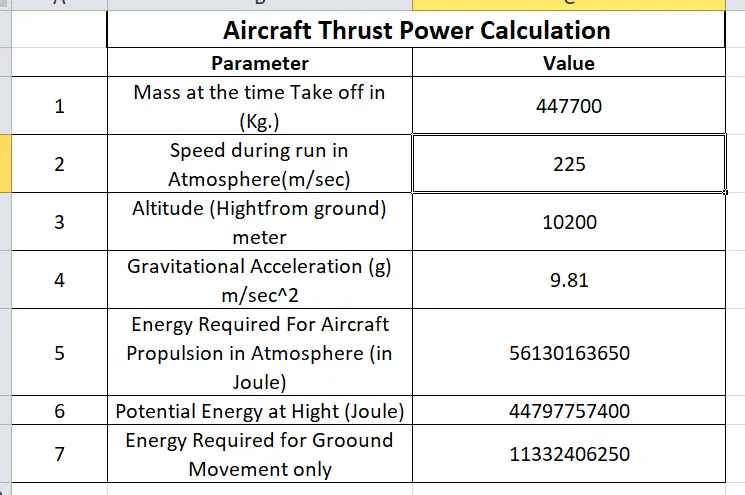
From above calculation we can say that to move the aircraft on ground it needs 20% energy of total energy required compared to move Aircraft in Air. To turn on the aircraft engine for this much less energy requirement to move the Plane on ground is not advisable due to hugh fuel consumption. Also even if we turn on the engine than it will operate at very less efficiency. The high power generation can also produce huge jerk on plane due to which can damage the sensitive parts of Cockpit as a result we will have huge financial loss.That's why to move the Aircraft from airport to runway it is not advisable to use aircraft engine power.
4) Answer :
Lift is the force which is directly opposition of the weight of the plane.In the balanced condition the forces which acting on the Aircraft is shown below.As lift is directly in opposition of weight to lift the aircraft from ground we have to increase the lifting force compared to its weight as shown in below figure.Lifting force is being generated by moving object in fluid flow.here in aircraft case the air is fluid.This lifting force is vector quantity. i.e. having both magnitude & direction both. Lifting force acts through the centre of pressure & its resultant direction is perpendicular to the fluid flow.
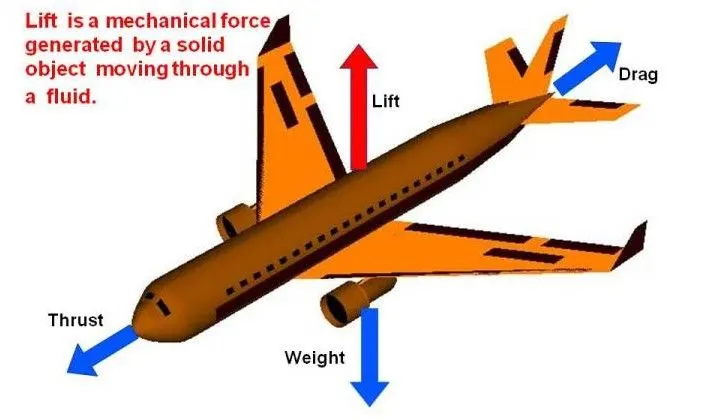
( When Lifting force needed)
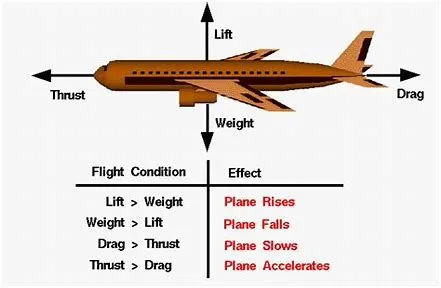
(For Aircraft movement in Air )
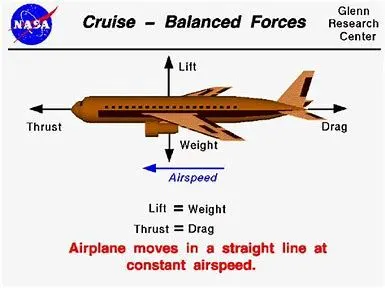
(During balanced condition)
During the takeoff, the airplane lifts off the runway due to the wings generating lift. For this lift to be generated, it must speed up because with speed,the lift increases. The formula for lift is as follows:
L = Cl x ½ x rho x v^2 x A
where,
Cl = Co-efficient of lift
rho = Air Density
v = True Air Speed of the aircraft
A = Area used to develop lifting force
This lifting force is being generated by turning the moving fluid flow(air).The air flow is turned in one direction & the lifting force generated in opposing direction of the opposing direction of turned fluid direction.(i.e) In our case it is turned from thrust side to upward side & against weight of aircraft lift force generated.This fluid turned with the help of aircraft wing.Lift is Mechanical force generated by interaction & contact of fluid & solid body. Also the motion is very necessary between object and fluid.
So in conclusion we can say that Fluid & Motion are very imooprtant elements to generate Lifting force of Aircraft against weight/Gravitational force.
5) Answer 5 :
(1) Take off Power
The take can be defined in words as take‑off includes the ground run from zero ground speed to the point where the wheels leave the ground,plus the distance required to clear a 50 foot obstacle.We will concern ourselves only with the ground run portion of the take‑off run, knowing that we can find the distance to clear a 50 foot obstacle from our climb equations.The first step in the calculation of the ground run needed for take‑off is an examination of the forces on the aircraft. In addition to the lift, drag, thrust and weight, we must now consider the ground friction and the “Resultant” force of the ground in supporting all or part of the weight of the aircraft.These are shown in the figure below.
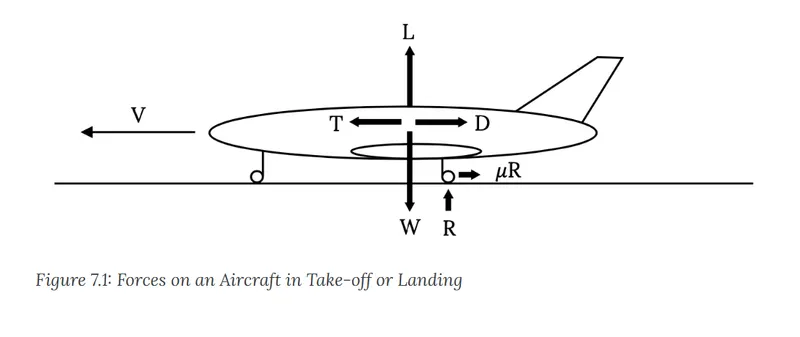
The coefficient of friction will depend on the ground surface and braking friction.
Here, L = Lifting Force
W = Wight/Gravitational Force
T = Thrust/Proppulsive Force nedded to take off plane
D = Air-drage force
R = Rolling Resistance force
Adding vertical forces,
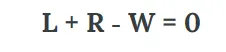 .............(1)
Adding the Horizontal forces,
 ...............(2)
The equation which relates the necessary take of power with all forces acting on the Aircraft,
 ........(3)
This much amount of force we must have to accelerate the Aircraft with dv/dt acceleration &(w/g) of weight.
where, m = mass of the aircraft
dv/dt = Required acceleration for producing propulsive force in forward direction.
`mu` = Rolling resistance co-efficient
To get the power required we have to multiply obtained force with velocity which we want as....
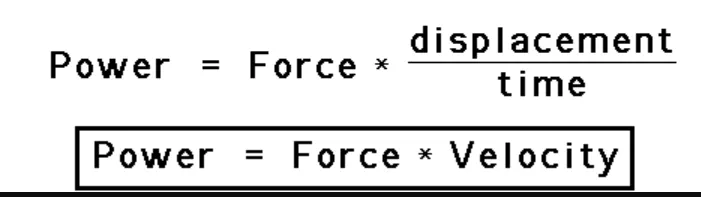
This power would be The total power needed for the propulsion of Aircraft.
(2) Tyre Design :
When it comes to safety, tyres are one of the most important components of aircraft. They help to absorb the shock of landing and provide cushioning. It also provides the necessary traction for braking and stopping of an aircraft. An aircraft tyre is designed to withstand extremely heavy loads while landing, take off, taxing, and parking.The number of wheels required for aircraft increases with the weight of the aircraft, as the weight of the
aeroplane needs to be distributed more evenly.
A Boeing 737NG & 737MAX uses 6 wheels, Boeing 787 uses 10 wheels, Boeing 777 uses 14 wheels and Airbus A380 uses 22 wheels. Aircraft tyres work under extreme conditions, carrying up to 340 tons and accelerating at over 250 km/hour at takeoff, in addition to enduring varied environmental stress when in flight and taxiing.
Here in below pictures the detail of tyre width,thickness & dimension identification is shown.also the different kind of layers & how the look alike is also depicted.In this perticular project we are limiting ourselves with tyre dimension regarding details only we are not supposed to delve deeper in matrial used in it.
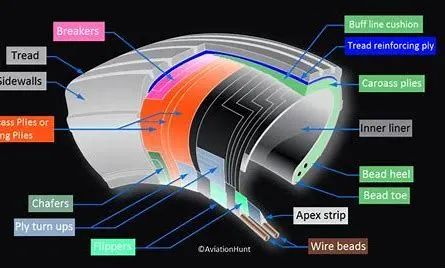
(Different layers of an aircraft tyre)
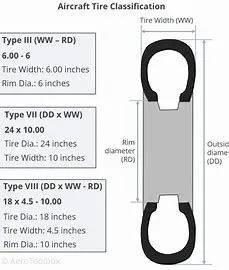
(method used to depict tyre dimension)
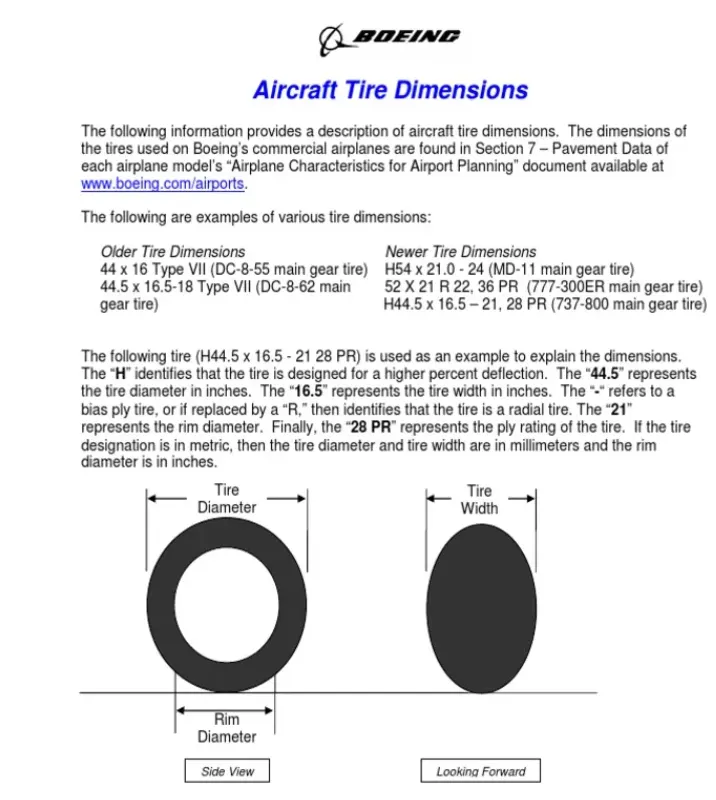
(An example for tyre dimension identification)
(3) Rolling Resistance of An Aircraft:
The friction between aircraft and runway will be proportional to the normal force exerted by the aircraft on the runway.The normal force will be the difference between Weight of aircraft and Lifting force.
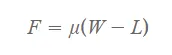
Here, F= Rolling resistance force
`mu`= Rolling resistance co-efficient
W = Weight of the Aircraft ( this force = Mass*Gravitational acceleration)
L = Lifting force of an aircraft
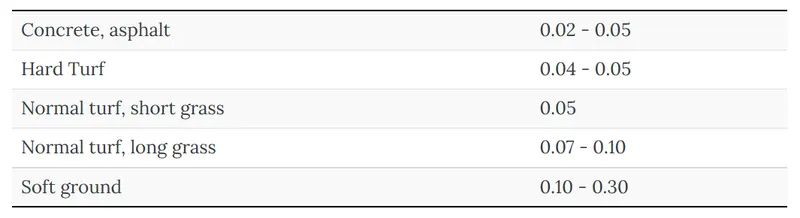
The rolling resistance force depends on the value of `mu`, for different kind of aircraft runways the value of rolling resistance co-efficient choosen from below.
Pilots are taught to do several things to reduce the role of ground friction on the take‑off roll. Usually, the use of flaps is recommended to increase the lift coefficient and, if the airplane has a tricycle type of landing gear (nose wheel and two main wheels), the pilot is taught to keep the nose up, which will both reduce the friction on that wheel and give a higher angle of attack and lift coefficient.
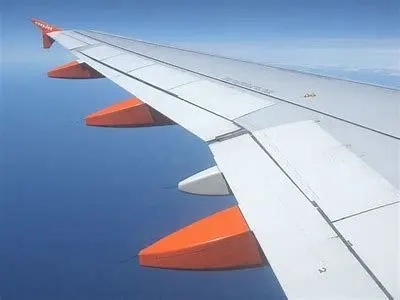
(flap of an aircraft)
(4) Tyre pressure:
An aircraft tire or tyre is designed to withstand extremely heavy loads for short durations.The number of tires required for aircraft increases with the weight of the aircraft, as the weight of theairplane needs to be distributed more evenly.
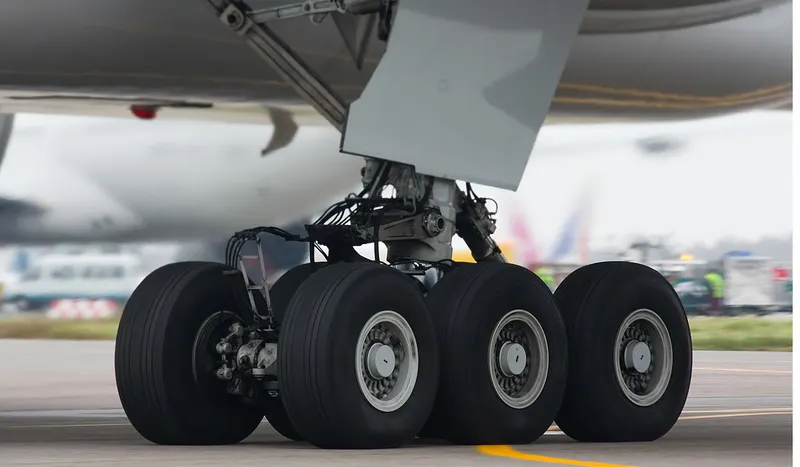
Each of the twelve Boeing 777-300ER main tires is inflated to 220 psi (15 bar; 1,500 kPa), weighs 120 kg (260 lb),has a diameter of 134 cm (53 in) and is changed every 300 cycles while the brakes are changed every 2000 cycles. Aircraft tires generally operate at high pressures, up to 200 psi (14 bar; 1,400 kPa) for airliners, and even higher for business jets. The main landing gear on the Concorde was typically inflated to 232 psi (16.0 bar), whilst its tail bumper gear tires were as high as 294 psi (20.3 bar). The high pressure and weight load on the Concorde tyres were a significant factor in the loss of Air France Flight 4590.
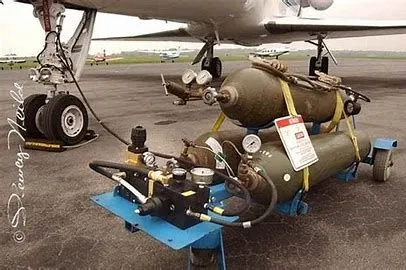
Aircraft tires are usually inflated with nitrogen to minimize expansion and contraction from extreme changes in ambient temperature and pressure experienced during flight.Dry nitrogen expands at the same rate as other dry atmospheric gases (normal air is about 80% nitrogen), but common compressed air sources may contain moisture, which increases the expansion rate with temperature.
(5) Brake power of an aircraft :
For calculation of braking force required by an aircraft let's assume som basic element values which needs for calcultion of brake power.
Landing weight = take off weight = W kg
Landing distance = X distance in meters
Speed of An Aircraft ( Aborted take off condition) = V m/sec
Deceleration of the Aircraft can be found by as
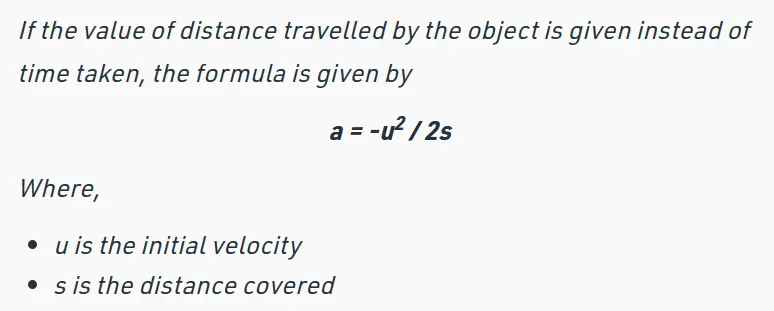
fro above equation , if we are getting the deceleration value = A (m/sec^2)
Mass of the Aircraft = Weight of air craft/gravitational Acceleration (Kg)
Force for Braking = Mass * Deceleration
From the value of force & velocity at the initial of braking would give us Power of Braking,as
PART (B)
Question (6) A. Answer Force required by a towing vehivle:
For Calculating This Tractive force consider the following image which depicts all forces associated with aircraft,
We are interested here in finding Tractive force in Forward propulsive direction so this force would be..
Here,
W = Wight of an aircraft
T = Thrust/Proppulsive Force nedded to take off plane
D = Air-drage force
R = Rolling Resistance force
`mu` = Rolling resistance co-efficient
dv/dt = Acceleration of an aircraft
The Rolling resistance for an aircraft define as :The force to move an airplane on an absolute flat runwaywith no wind at constant low speed is equal to the rolling resistance between the plane and the runway.
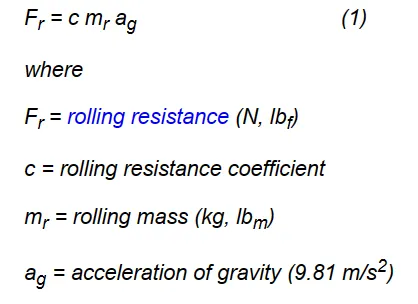
The value of rolling resistance co-efficient varies for different kind of runway surface as below,
Drag force can be found out as ,
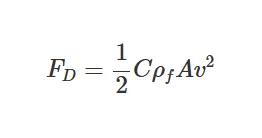
Where,
C is the drag coefficient, which is dimensionless with values depending upon the shape of the object.For example, C = 0.47 for a sphere and C = 0.82 for a long cylinder)
ρf is the density of the fluid.
v is the velocity of the object.
A is the projected cross-sectional area of the object in a direction perpendicular to the object’s motion.
Let's take an example here , Choosing an air-craft and all necessary assupmtion for Calculation of Force & Power required by an aircraft
for traction at airport.
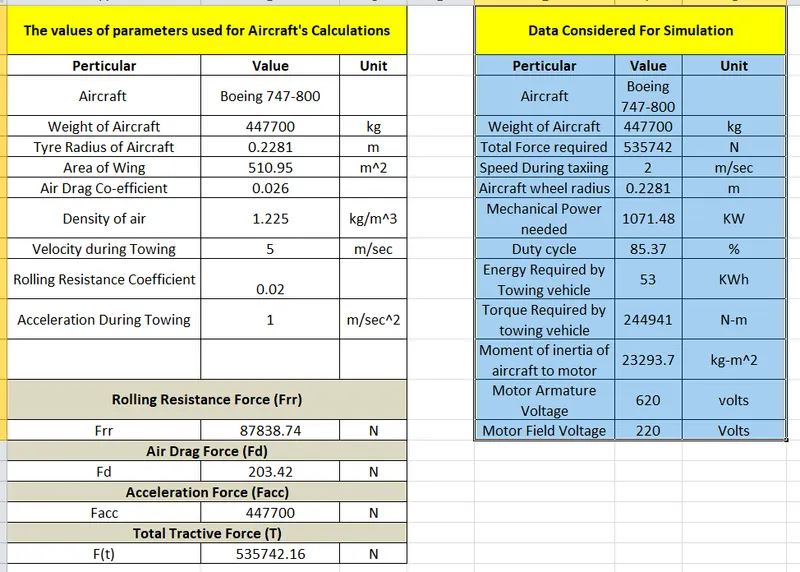
Aircraft = Boeing 787-800 with maximum take-off weight = 447700 kg.
Area of wing = 510.95 m^2
air drag coefficient = 0.026
density of air = 1.225 Kg/m^3
velocity during towing = 5 m/sec
Rolling resistance coefficient = 0.02
& we want to have from rest to 5 (m/sec) speed in 8 seconds so the acceleration force would be,
a = (v2 - v1)/t = 5/5 = 1 (m/sec^2)
So the Rolling resistance would be,
Frr = 0.02*447700*9.81
= 87838.74 N ...........................(1)
Drag force would be ,
Fd = 0.5*0.026*1.225*510.95*5^2
= 203.42 N..............................(2)
The acceleration force = m*dv/dt
= 447700*1
= 447700 N.........(3)
from above formula The tractive force would be Frr+Fd+Facc
T = 447700 + 203.42 + 87838.74
= 535742.16 N........................(4)
Above force is the total force needed to accelerate the plane from rest to given speed.
The power required for this force = T*velocity
= 535742.16*5
=2678710.8 (kg-m^2/sec^3)
=26.7871 * 10^5 Watt
Question (6)-B Answer
Simulink Model for above calculated Example of an Aircraft
I have taken the parameters value as per above problem.First I have found the individual force & to get total tractive force added all of them.Power is calculated by multiplying the total tractive force & velocity needed.
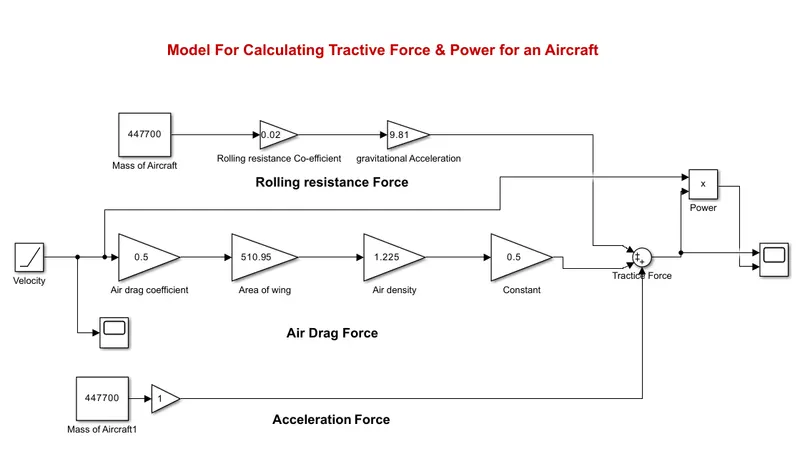
(Disclaimer: Here in the drag force calculation I have taken velocity as continuously varying
also in formula it is in square but I have taken it as a ramp input for convenience & plotting
purpose.)
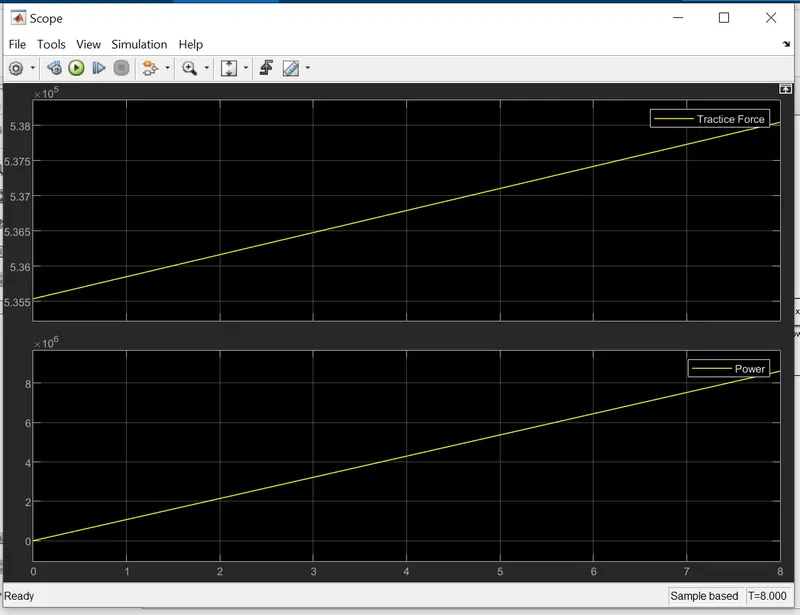
The Output waveform for the model as per below which confirms the calculated Tractive force & Power.
Question (7)-A Answer
For Designig powertrain for an aircraft we need to calculate the total amount of mechanical
power required to move it and according to that we have to select the Motor required to run the system.
Aircraft = Boeing 787-800
Maximum Take off weight = 447700 Kg
Total Force required by it (F)= 535742.16 N (taken from above calculated example)
considering the speed reqiured during taxiing (v) = 2 m/sec
Aircraft wheel radius = 9 inches = 0.2281 meter
So mechanical power would Pm = F*v
= 535742.16*2
= 1071484.32 Watt
= 1071.48 KW
So we need a motor with rating of 1071.48 KW or near by it.After surfing internet I got the
specification matching to it..
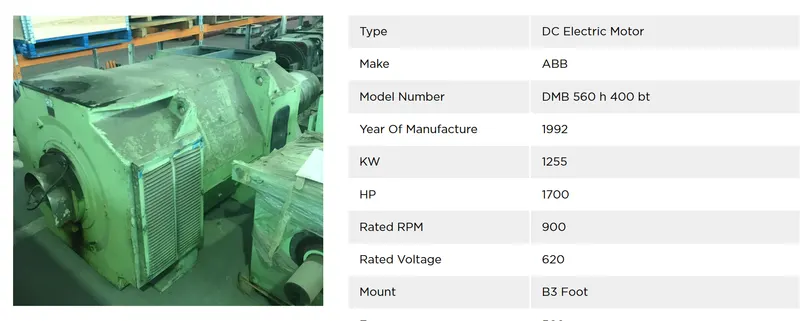
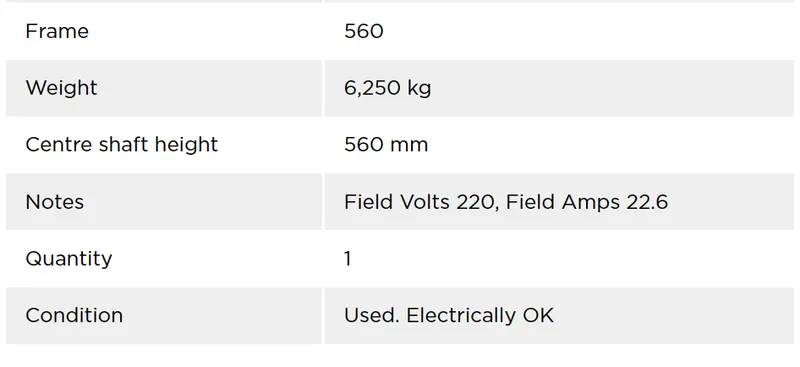
So the duty cycle would be = Output Power/Input Power
= 1071.48/1255
= 85.37 %
The Energy required by an aircraft for towing application= Power*time
= 1071.48KW*(180)/3600
= 53 KWh
Here time considered = 3 minutes for towing
Torque required by aircraft with 18 ich diameter = Force*wheel radius
= 535742.16*0.4572
= 244941.31 N-m
The moment of inertia of Aircraft = Mass*(Aircraft tyre radius)^2
= 447700*(0.2281)^2
= 23293.65 Kg-m^2
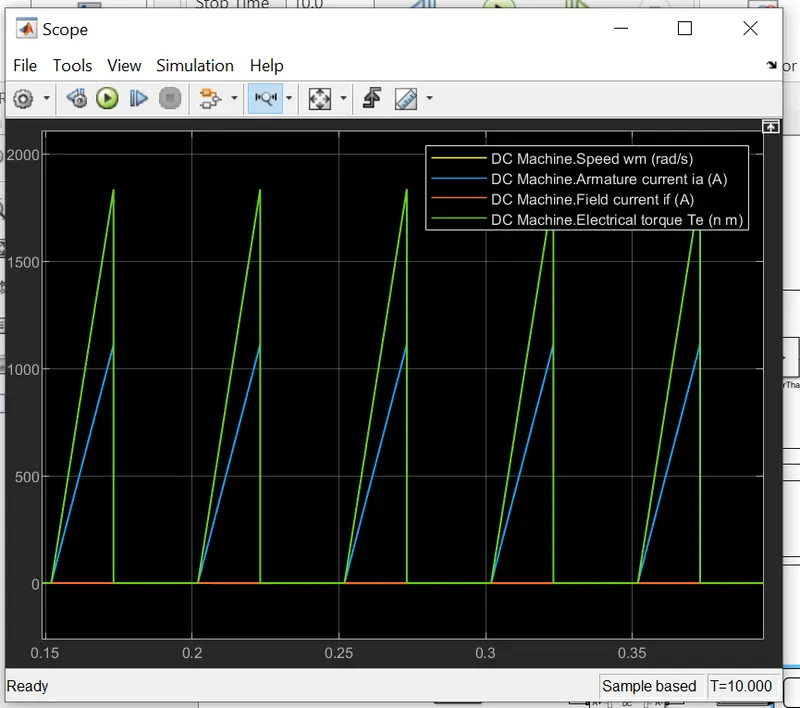
As I have taken 1255 KW DC BLDC motor so the required power is less than Motor rating with 85% Duty cycle,620 V of DC supply to Armature, 220 V supply to field & with moment of inertia of 93583.55 kg-m^2.I have used a power converter with sigle switch to control voltage in positive side only.The simulink model & its output is as per shown below....
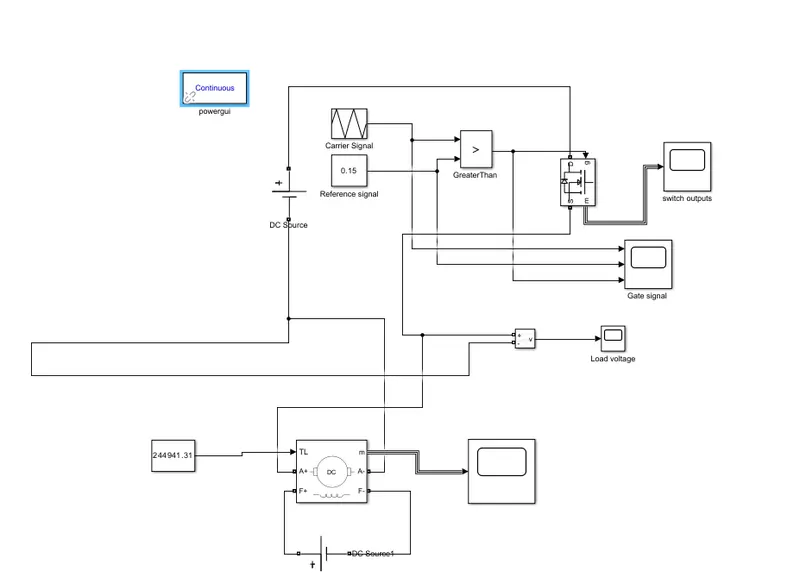
Output of Motor Drive
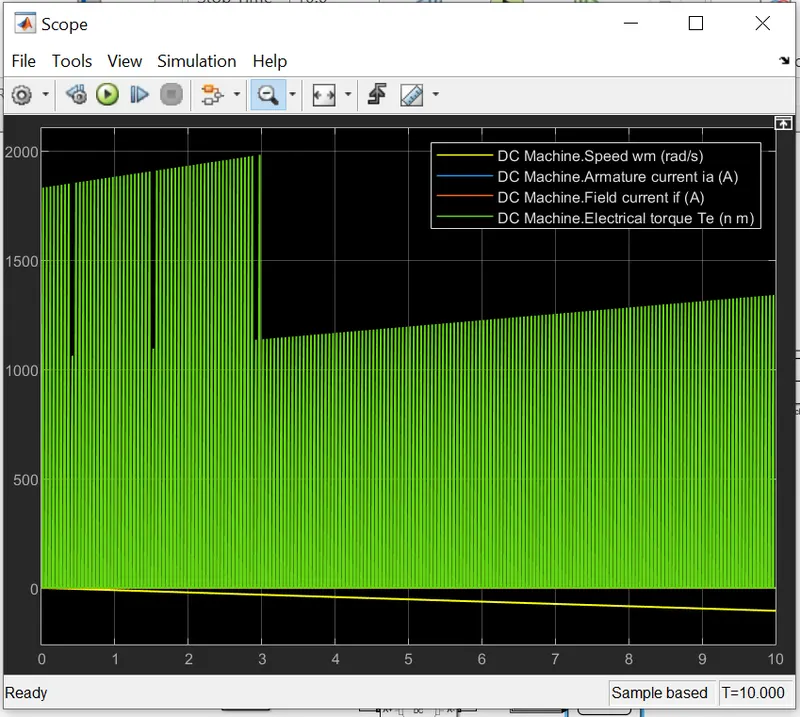
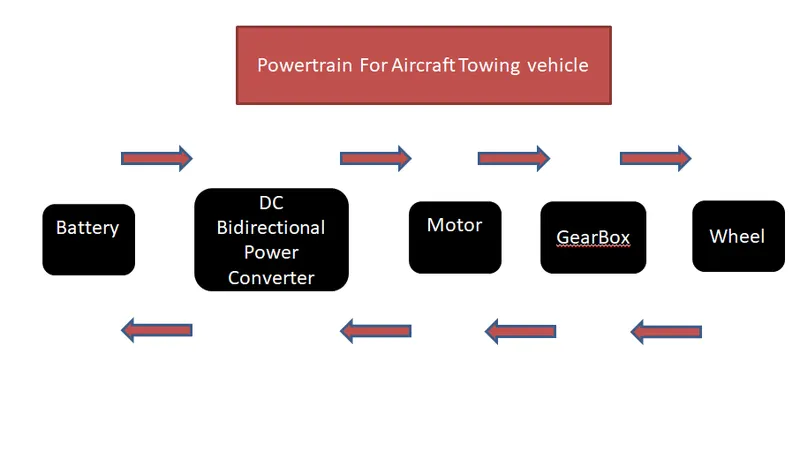
Block Diagram For control Strategy:
Question 7 (B) Here in below I have depicted all the parameters that has taken for calculation..