Project-1: Powertrain for aircraft in runways
Part A:
1. Search and list out the total weight of various types of aircrafts.
answer:
Here is a list of the weight of various types of aircraft:
- Light aircraft (single engine): 1,500-3,000 lbs
- Small jet: 10,000-20,000 lbs
- Regional airliner: 50,000-100,000 lbs
- Large airliner: 300,000-700,000 lbs
- Military transport aircraft: 200,000-800,000 lbs
- Fighter jet: 25,000-50,000 lbs
- Helicopter: 2,000-10,000 lbs
--------------------------------------------------------------------------------------------------------------------------------------------------------------------------------------------------------------------------
2. Is there any difference between ground speed and air speed?
answer:
Yes, there is a difference between ground speed and air speed.
Ground speed is the speed of an aircraft relative to the ground. It is the speed that is measured by a ground-based observer or by an onboard instrument such as a GPS unit. Ground speed takes into account the movement of the air and any wind that may be present.
Air speed, on the other hand, is the speed of an aircraft relative to the air through which it is flying. It is the speed that is measured by an onboard instrument such as an airspeed indicator. Air speed does not take into account the movement of the air or any wind that may be present.
The difference between ground speed and air speed can be significant, especially when there is a strong wind. For example, if an aircraft is flying into a strong headwind, its ground speed will be slower than its air speed. On the other hand, if the aircraft is flying with a strong tailwind, its ground speed will be faster than its air speed.
In summary, ground speed is the speed of an aircraft as it appears to a ground-based observer, while air speed is the speed of the aircraft as it appears to an observer on the aircraft.
--------------------------------------------------------------------------------------------------------------------------------------------------------------------------------------------------------------------------
3. Why is it not recommended to use aircraft engine power to move it on the ground at Airport?
answer:
It is generally not recommended to use aircraft engine power to move an aircraft on the ground at an airport for several reasons:
-
Safety: Using the aircraft's engines to move it on the ground poses a safety risk as it can cause damage to the aircraft and potentially injure personnel. The engines are designed for use in flight and are not built to withstand the stresses of ground movement.
-
Damage: Using the engines to move the aircraft on the ground can cause damage to the engines and other systems. For example, the engines may not be properly aligned with the direction of travel, which can lead to uneven wear on the engine components.
-
Fuel efficiency: Using the engines to move the aircraft on the ground is not fuel efficient. It requires a significant amount of fuel to power the engines, and this fuel could be better used during flight.
-
Noise: Operating the engines at full power on the ground can create a significant amount of noise, which can be disruptive to airport operations and nearby communities.
For these reasons, it is generally recommended to use ground support equipment such as pushback tractors or tugs to move aircraft on the ground at an airport. This allows for the safe and efficient movement of the aircraft without causing unnecessary wear and tear on the engines and other systems.
--------------------------------------------------------------------------------------------------------------------------------------------------------------------------------------------------------------------------
4. How an aircraft is pushed to runway when its ready to take off?
answer:
An aircraft is typically pushed to the runway when it is ready to take off using ground support equipment such as a pushback tractor or tug. These vehicles are specifically designed to move aircraft on the ground and are equipped with a tow bar or hook that connects to the aircraft.
Before the aircraft is pushed to the runway, the pilots will perform a series of checks to ensure that the aircraft is ready for takeoff. This may include checking the fuel levels, engines, and other systems to ensure that everything is functioning properly.
Once the pilots have completed their checks and given the go-ahead, the ground crew will attach the pushback tractor or tug to the aircraft using the tow bar or hook. The ground crew will then move the aircraft to the runway using the pushback tractor or tug, taking care to ensure that the aircraft is aligned with the runway and that all safety procedures are followed.
Once the aircraft is on the runway and ready for takeoff, the pilots will start the engines and perform a final checklist before taking off. The ground crew will disconnect the pushback tractor or tug and clear the area, allowing the aircraft to take off safely.
--------------------------------------------------------------------------------------------------------------------------------------------------------------------------------------------------------------------------
5. Learn about take off power, tyre design, rolling resistance, tyre pressure, brake forces when landing.
answer:
take off power
Takeoff power refers to the amount of power that an aircraft's engines generate during takeoff. This power is necessary to lift the aircraft off the ground and achieve the required airspeed for takeoff. The amount of takeoff power needed depends on factors such as the weight of the aircraft, the altitude of the airport, and the temperature and humidity of the air.
tyre design
Tyre design is important in aircraft because it affects the performance and safety of the aircraft during takeoff and landing. Aircraft tyres are designed to withstand the high loads and speeds that they experience during takeoff and landing, and they are made of durable materials such as steel and synthetic rubber.
rolling resistance
Rolling resistance is the force that opposes the motion of an aircraft's tyres as they roll along the runway. This resistance is caused by the deformation of the tyre as it rolls, and it is affected by factors such as the tyre's inflation pressure, the weight of the aircraft, and the surface of the runway.
tyre pressure
Tyre pressure is an important factor in aircraft performance, as it affects the rolling resistance and the load-carrying capacity of the tyres. Tyre pressure is typically set based on the manufacturer's recommendations and the weight of the aircraft.
brake forces
Brake forces are the forces that are generated by an aircraft's brakes during landing. These forces are used to slow the aircraft down as it approaches the runway and to bring it to a stop after landing. Brake forces are affected by factors such
--------------------------------------------------------------------------------------------------------------------------------------------------------------------------------------------------------------------------
Part B:
6. A. With necessary assumptions, calculate the force and power required to push / pull an aircraft by a towing vehicle.
B. Develop the model for the calculated force and power using Simulink.
answer:
A. With necessary assumptions, calculate the force and power required to push / pull an aircraft by a towing vehicle.
To calculate the force and power required to push or pull an aircraft by a towing vehicle, we need to consider several factors, including the weight of the aircraft, the speed at which it is being moved, and the coefficient of rolling resistance. Here is an example of how to calculate these values:
-
Determine the weight of the aircraft: First, we need to determine the weight of the aircraft. This can be done by consulting the aircraft's technical documentation or by using the weight and balance data provided by the manufacturer. For the purposes of this example, let's assume that the weight of the aircraft is 100,000 lbs.
-
Calculate the rolling resistance: Next, we need to calculate the rolling resistance of the aircraft. This can be done using the following equation:
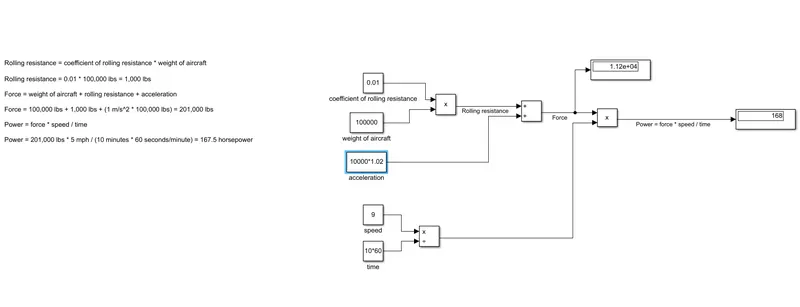
Rolling resistance = coefficient of rolling resistance * weight of aircraft
The coefficient of rolling resistance is a value that represents the resistance of the tyre to rolling, and it is affected by factors such as the tyre's inflation pressure, the weight of the aircraft, and the surface of the runway. For the purposes of this example, let's assume that the coefficient of rolling resistance is 0.01.
Using these values, we can calculate the rolling resistance as follows:
Rolling resistance = 0.01 * 100,000 lbs = 1,000 lbs
- Calculate the force required to push or pull the aircraft: To calculate the force required to push or pull the aircraft, we need to consider the rolling resistance and the acceleration of the aircraft. The equation for this is:
Force = weight of aircraft + rolling resistance + acceleration
For the purposes of this example, let's assume that the aircraft is being accelerated at a rate of 1 m/s^2.
Using these values, we can calculate the force required to push or pull the aircraft as follows:
Force = 100,000 lbs + 1,000 lbs + (1 m/s^2 * 100,000 lbs) = 201,000 lbs
- Calculate the power required to push or pull the aircraft: To calculate the power required to push or pull the aircraft, we need to consider the force required, the speed at which the aircraft is being moved, and the time it takes to move the aircraft. The equation for this is:
Power = force * speed / time
For the purposes of this example, let's assume that the aircraft is being moved at a speed of 5 mph and it takes 10 minutes to move the aircraft.
Using these values, we can calculate the power required to push or pull the aircraft as follows:
Power = 201,000 lbs * 5 mph / (10 minutes * 60 seconds/minute) = 167.5 horsepower
This is a rough estimate of the force and power required to push or pull an aircraft using a towing vehicle. Please note that these values will vary depending on the specific circumstances and the aircraft's weight and configuration.
B. Develop the model for the calculated force and power using Simulink.
--------------------------------------------------------------------------------------------------------------------------------------------------------------------------------------------------------------------------
7. A. Design an electric powertrain with type of motor, it’s power rating, and energy requirement to fulfill aircraft towing application in Simulink. Estimate the duty cycle range to control the aircraft speed from zero to highest. Make all required assumptions. Prepare a table of assumed parameters. Draw a block diagram of powertrain.
(Hint :DC7 Block)
B. Also, Design the parameters in excel sheet.
answer :
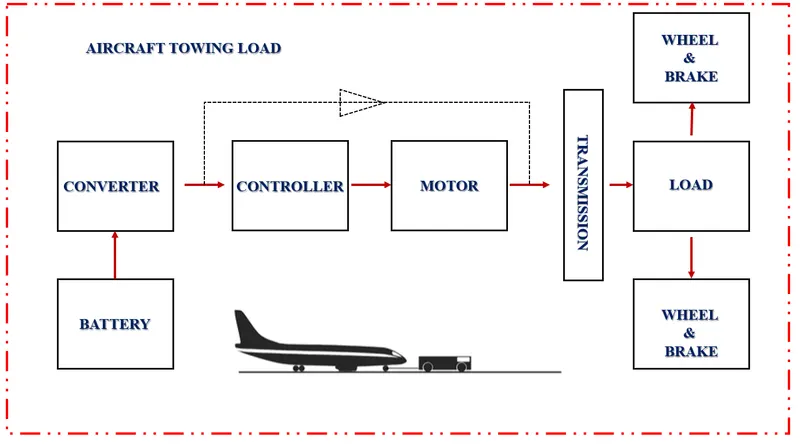
A. Design an electric powertrain with type of motor, it’s power rating, and energy requirement to fulfill aircraft towing application in Simulink. Estimate the duty cycle range to control the aircraft speed from zero to highest. Make all required assumptions. Prepare a table of assumed parameters. Draw a block diagram of powertrain.
(Hint :DC7 Block)
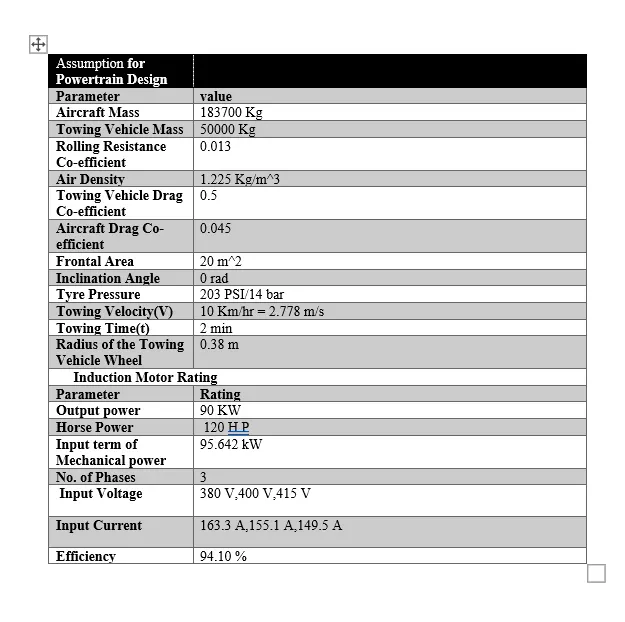
| Assumation for Powertrain Design | |
| Parameter | value |
| Aircraft Mass | 183700 Kg |
| Towing Vehicle Mass | 50000 Kg |
| Rolling Resistance Co-efficient | 0.013 |
| Air Density | 1.225 Kg/m^3 |
| Towing Vehicle Drag Co-efficient | 0.5 |
| Aircraft Drag Co-efficient | 0.045 |
| Frontal Area | 20 m^2 |
| Inclination Angle | 0 rad |
| Tyre Pressure | 203 PSI/14 bar |
| Towing Velocity(V) | 10 Km/hr = 2.778 m/s |
| Towing Time(t) | 2 min |
| Radius of the Towing Vehicle Wheel | 0.38 m |
Therefore from the above modal, we have calculator the Traction Force = 29824.8927 N
Power = Force * Velocity
=29824.8927*2.778
power "p",
P=82.84 KW
As we know Torque(T) = Force(F)* Wheel Radious(r)
T=29824.9025⋅0.38
T=11333.45N−m
Required Energy(E) for towing application based on the assumed time, that is E = P*t
E=82.82*(1203600)
E=2.760KWh
For this application an induction motor or a BLDC can be used with a proper gear system
| Induction Motor Rating | |
| Parameter | Rating |
| Output power | 90 KW |
| Horse Power | 120 H.P |
| Input term of Mechanical power | 95.642 kW |
| No. of Phases | 3 |
| Input Voltage | 380 V,400 V,415 V |
| Input Current | 163.3 A,155.1 A,149.5 A |
| Efficiency | 94.10 % |
The Motor output power is the input power of the towing vehicle so to obtain maximum speed, the duty cycle needed is calculated as below;
DutyCycle = Output Power/Input Power
=82.8290⋅100
=92%
The duty cycle range to control the aircraft speed from zero to highest is from 0 to 92%
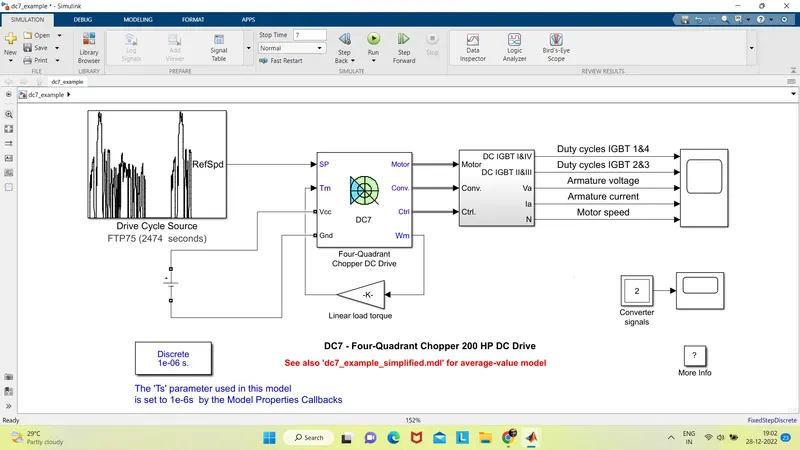
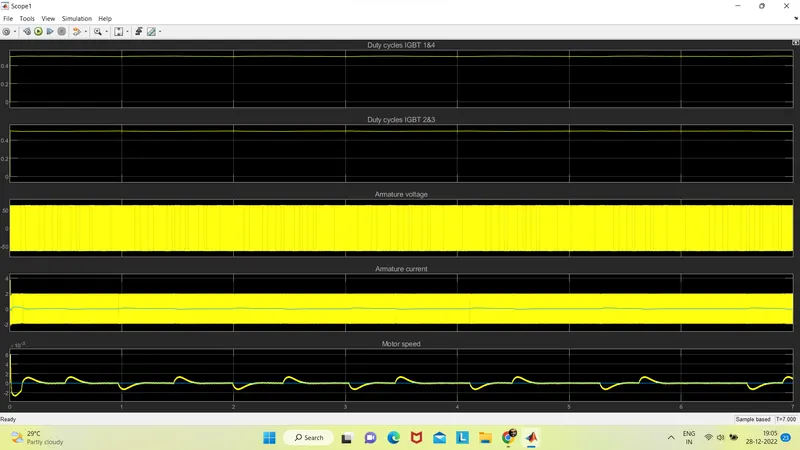
B. Also, Design the parameters in excel sheet.