Project-1: Powertrain for aircraft in runways
Part A:
1. Search and list out the total weight of various types of aircrafts
ANS:
The aircraft gross weight is the total aircraft weight at any moment during the flight or ground operation.An aircraft's gross weight will decrease during a flight due to fuel and oil consumption and as well as payload dropping
and here i am sharing some fo aircraft weights and other details giive below link
MTOW-Maximum Take off weight
MLW-Maximum Landing Weight
|
Type |
MTOW [kg] |
MLW [tons] |
|
640,000 |
591.7 |
|
|
589,670 |
||
|
575,000 |
394 |
|
|
447,700 |
346.091 |
|
|
443,613 |
306.175 |
|
|
412,770 |
295.742 |
|
|
Antonov An-124-100M |
405,060 |
330 |
|
396,900 |
295.742 |
|
|
381,000 |
288.417 |
|
|
377,840 |
285.700 |
|
|
377,840 |
260.320 |
|
|
371,950 |
240 |
|
|
367,400 |
256 |
|
|
347,800 |
260.816 |
|
|
351,800 |
251.29 |
|
|
347,450 |
223.168 |
|
|
340,200 |
265.300 |
|
|
308,000 |
233.5 |
|
|
299,370 |
237.683 |
|
|
297,550 |
213.00 |
|
|
276,700 |
190 |
|
|
273,300 |
185 |
|
|
270,000 |
175 |
|
|
270,000 |
195.04 |
|
|
256,280 |
183 |
|
|
254,000 |
192.777 |
|
|
254,000 |
201.849 |
|
|
253,500 |
181 |
|
|
250,000 |
175 |
|
|
242,000 |
185 |
|
|
242,000 |
180 |
|
|
231,300 |
166.92 |
|
|
228,000 |
172.365 |
Manufatures empty weight:
the weight includes the weight of aircraft of the entire flight with its intergal working parts,but excludes baggage ,passenger and fuels is Manufatures or empty weight
the wieght includes total weight of aeroplanes including unuseable fuels but excludes total weight of useable fuel at board is zero fuel weight.
-the weight is load carrying capacity of an aircraft which includes passenger ,cargo and fuels,But if it is in the case of cargo flight it determines the total load of logistics weight of the container which it needs to transport. is called payload weight.
Maximum take off weight:This is the maximum weight at which the aircraft would be made to takeoff .
Regulated take off weight:
this weight is Depending on different factors i.e flap setting,altitude,lenght of runway,RTOW varies for each take off,but can never be high for MTOW.
Maximum landing weight is maximum weight at which an aircraft is permitted to land.
the maximum weight used for manuevering (towing) aircraft on the ground is called Maximum Ramp weight
................................................................................................................................................................................
2. Is there any difference between ground speed and air speed?
ANS; before going to difference betwwen ground and air speed lets know about wind speed and how it effact on aircraft speed
For a reference point picked on the ground, the air moves relative to the reference point at the wind speed. Notice that the wind speed is a vector quantity and has both a magnitude and a direction. Direction is important
Ground Speed
a.For a reference point picked on the ground, the aircraft moves relative to the reference point at the ground speed.
b.Ground speed is also a vector quantity.
c.They are the airplane speed which is related to the ground.
d.They are the calculated by summing up the airspeed and windspeed.
Air speed:
a.It refers to the speed which is relative to air it is flying in.
b.They determine whether there is enough airflow around an aircraft to make it lift.
c.They are independent of ground speed.
d.The important quantity in the generation of lift is the relative velocity between the object and the air, which is called the airspeed.
Airspeed = Ground Speed - Wind Speed
For example taking wind speed as 30 km/hr and runway is east-west runway the wind blowing towards west and the flight runs at 200 km/hr the wind speed acting in the west and the flight takes off east then the
Airspeed=Groundspeed(200)- Wind Speed(-30) =230 km/hr
here '-30' for wind is in opposite direction
If the planes runs towards west along the wind blowing direction then
the Airspeed=Groundspeed(200) - Wind Speed(30)=170 km/hr
Hence there is a difference between ground speed and air speed.
3. Why is it not recommended to use aircraft engine power to move it on the ground at Airport?
ANS:
When modern jet engines are operated at rated thrust levels, the exhaust wake can exceed 375 mi/h (325 kn or 603 km/h) immediately aft of the engine exhaust nozzle. This exhaust flow field extends aft in a rapidly expanding cone, with portions of the flow field contacting and extending aft along the pavement surface
most of the airplane can move itself in reverse manner by making use of reverse thrust technology.But in most of the practical it is not possible because when airplanes start using reverse thrust it will consume lot of fuels as well as causes lot of noise and also hazardous for the people working near by and The another for not using reverse thrust is that the jet blast can cause damage to terminal buildings or its equipments.
so towing vehicles are used toreverse dierection and it eill be tugged until it reaches a safe place and from there onwards airplane will move by itself for further take off.
4. How an aircraft is pushed to runway when its ready to take off?
Ans:
the movement of an aircraft on the ground, under its own power, in contrast to towing or push-back where the aircraft is moved by a tug is taxiing
The power for taxiing comes from the engines itself. If it is a propeller powered aircraft, the propeller provides thrust and pulls the aircraft, like it would in air. If it is a jet engine, the exhaust air that comes out of the engine creates a forward force due to Newton's third law and moves the airplane.
Airplanes have engines, and they can use them to move forward along the ground. So they push themselves to the runway.
It is true that most of the time, a small vehicle is needed to push the larger commercial airplanes backwards away from the terminal building, because even if a plane can reverse it’s thrust, it’s not always safe to hit the buildings with that reverse thrust. So the little trucks push the bigger planes back away from the buildings, but after that, the planes can apply a small amount of engine power to roll forward just as all airplanes can.Aircraft push themselves to the runway.
Airliners have nose wheel steering, controlled by a cockpit control called a tiller.
Some large airplanes with multi wheel main gears have a tendency to scrub the tyres on the tarmac when nose wheel is steered. To counter this problem, an automatic main gear steering is inbuilt in the aircraft. This makes the main gears turn the opposite direction to that of the nose wheel, greatly decreasing the wear on the tyres.
Small general aviation aircraft uses the rudder for turns during taxi. They don't have a separate control for nose wheel. In such airplanes, to make tighter turns
5. Learn about take off power, tyre design, rolling resistance, tyre pressure, brake forces when landing.
Ans:s
the phase of the flight in which an aeroplane leaves ground and becomes airbone is known as takeoff.
power is given durong take off for the lighter aircrapt and to reduce the maintenace cost and to inrease the life span of engine for the large cargo carriers aircraft make use of less power during take off inorder ,reduce maintenance cost ,reduce engine heat and also for a smooth take off flight.
During take off on the runway the imbalance froce will cause an acceleration along the runway and it is given by the formula:
`dv/dt = T − D − F m`
here
T=Thrust froce pushes
D=Drag force resist the forward motion of the aircraft.
F=Rolling resistance force
Tyre design of an aircraft:
An aircraft tyre are deisgned to withstand extreme heavy loads by absording shocks during and there by providing cushioning effect.
-The number of tires required for an aircraft depends on the total weight of aircraft as the weight needs to be distributed evenly.
-Aircraft tyre are designed to facillitate stability in high crosswind condition,to chanalize the water away for preventing skidding and helps to give a good braking effect.
An aircraft tyre is designed to withstand extremely heavy loads while landing, take off, taxing and parking. The number of wheels required for aircraft increases with the weight of the aircraft, as the weight of the aeroplane needs to be distributed more evenly.
Retreading – Retreading is methods of restoring a worn tyre by renewing the tread area or by renewing the tread area plus one or both sidewalls. Repairs are included in the tyre retreading process.
Load Rating – Load rating is the maximum permissible load at a specified inflation pressure.
Ply Rating – Ply Rating is used to identify the maximum recommended load rating and inflation pressure for a specified tyre. It is an index of tyre strength.
Speed Rating – The speed rating is the maximum takeoff speed to which the tyre has been tested.
Skid Depth – Skid depth is the distance between the tread surface and the deepest groove as measured in the mould.
Tyre Pressure :
Car tyres aren’t just unsafe when they’re old and worn out – you need to ensure you know what tyre pressure you have in your tyres when you drive it because there are critical safety and economic implications.
Car tyre pressure is a measurement of how much air is in your pneumatic tyre, and ensures the tyres wear evenly and maintain the correct level of grip on the road surface. This is commonly expressed as PSI, or pounds-per-square-inch.
Braking an aircraft is a challenging job for most of the pilots especially during landing in a rainy and cross wind environment.
-Inorder to encounter this kinds of problem pilots usually make use of spoilers and reverse thust method inorder to have a safe landing so that the energy required to apply brakes on tires can be reduced and henceforth they do not skid.
-Now there is method which determines the brake force for aircrafts and they are as follows:
k=1/2mv^2=1/2mv^2,
where m= mass of aircraft and v=velocity of aircraft.A typical commercial landing speed will range between 150 to 165 MPH.And for passenger flight it is about 166 to 172mph
6.. With necessary assumptions, calculate the force and power required to push / pull an aircraft by a towing vehicle.
The force to move an air plane on an absolute flat runway with no wind at constant low speed is equal to the rolling resistance between the plane and the tarmac.
The rolling resistance for the air plane can be given as
Fr = c mr ag ...............................1
here,
Fr = rolling resistance
c = rolling resistance coefficient
mr = rolling mass
ag = acceleration of gravity consider as 9.8
The friction force for the puller can be calculated to
Ff = μ W
= μ mf ag.....................................................2
here
Ff = frictional force (N, lb)
μ = friction coefficient
W = weight (N, lbf)
mf = friction mass (kg)
The drag force acting on the tow will be :
The drag force D exerted on a body traveling though a fluid is given by
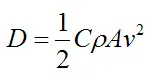
C is the drag coefficient, which can vary along with the speed of the body. But typical values range from 0.4 to 1.0 for different fluids
ρ is the density of the fluid through which the body is moving
v is the speed of the body relative to the fluid
Now the tractive force or the pulling force required by the tow will be
Pulling force = Drag force + friction force + Rolling resistance force
Now let us consider aircrafts with the following specifications :
Now as we have seen that various kinds of planes have different weights ,the amount of pulling force also will be different .Therefore we will consider a range of weight :
Range of weight = 200 kgs - 250000 kgs '
The towing speed considered is 5 m/s
Area range : 50 - 100 m^2
Coefficient of rolling resistance : 0.02
Coefficient of friction : 0.01
Now we use a script from matlab which will help us calculate the pulling force required :
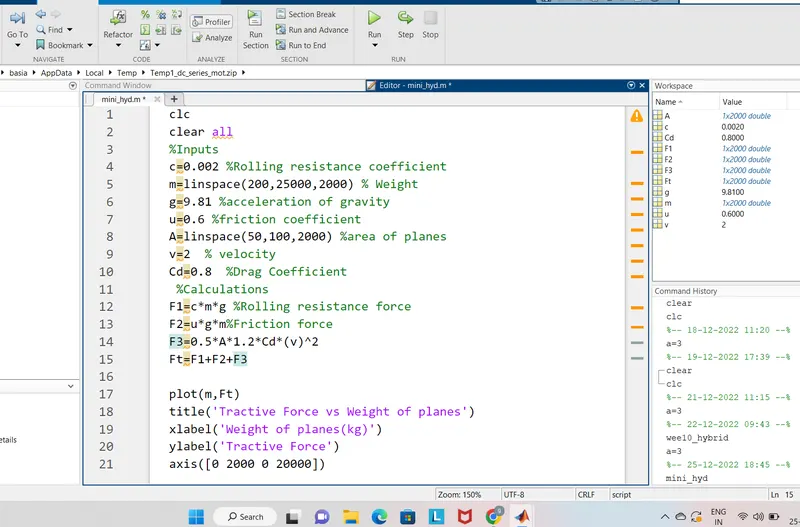
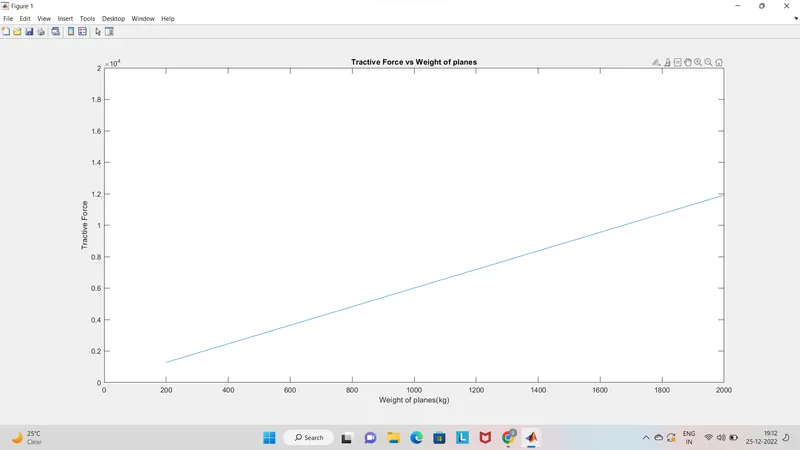
result show in below fig