Project-1: Powertrain for aircraft in runways
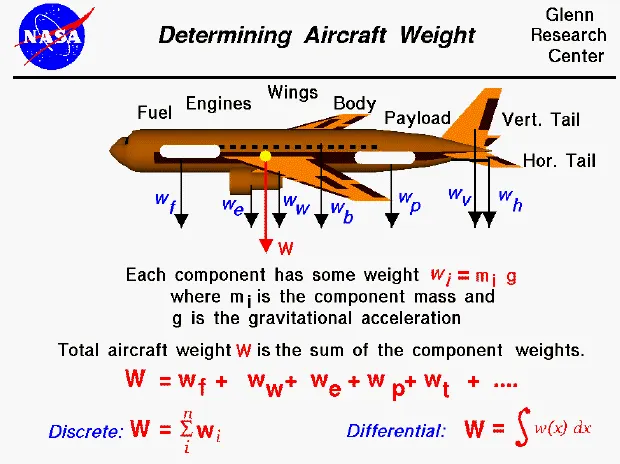
1. Search and list out the total weight of various types of aircrafts.
| Aircraft | Empty Weight | Max Fuel Weight | Max Cargo Weight | Max Gross Takeoff Weight |
|---|---|---|---|---|
| Antanov AN-225 | 628,000 lbs 285,000 kg |
661,400 lbs 300,000 kg |
417,000 lbs 190,000 kg |
1,411,000 lbs 640,000 kg |
| Airbus A380-800 | 611,000 lbs 277,000 kg |
560,000 lbs 254,000 kg |
185,000 lbs 84,000 kg |
1,268,000 lbs 575,000 kg |
| Boeing 747-800 | 485,300 lbs 220,100 kg |
427,400 lbs 194,000 kg |
295,000 lbs 134,000 kg |
987,000 lbs 447,700 kg |
| Airbus A340-500 | 370,000 lbs 168,000 kg |
386,300 lbs 175,000 kg |
119,000 lbs 54,000 kg |
820,000 lbs 372,000 kg |
| Boeing 777-300ER | 370,000 lbs 168,000 kg | 320,800 lbs 145,500 kg | 148,000 lbs 67,100 kg |
776,000 lbs 352,000 kg |
| Boeing 787-10 | 299,000 lbs 135,500 kg | 223,500 lbs 101,500 kg |
126,300 lbs 57,300 kg | 560,000 lbs 254,000 kg |
| Boeing 737-900 | 98,500 lbs 44,700 kg |
53,100 lbs 24,000 kg |
44,600 lbs 20,200 kg |
187,000 lbs 85,000 kg |
| Airbus A320-100 | 93,900 lbs 42,600 kg |
48,700 lbs 22,100 kg |
44,000 lbs 20,000 kg |
150,000 lbs 68,000 kg |
| Embraer 190 | 63,500 lbs 28,800 kg |
28,600 lbs 13,000 kg |
28,800 lbs 13,100 kg |
106,000 lbs 48,000 kg |
| Gulfstream G650 | 54,000 lbs 24,500 kg | 48,200 lbs 21,900 kg | 6,500 lbs 3,000 kg |
100,000 lbs 45,200 kg |
| Bombardier CRJ900 | 48,160 lbs 21,850 kg | 19,600 lbs 8,900 kg | 6,075 lbs 2,760 kg | 80,500 lbs 36,500 kg |
| Bombardier Q400 | 39,300 lbs 17,800 kg |
11,700 lbs 5,300 kg |
18,700 lbs 8,500 kg |
62,000 lbs 28,000 kg |
| Learjet 75 | 13,900 lbs 6,300 kg | 6,060 lbs 2,750 kg |
2,900 lbs 1,300 kg |
21,500 lbs 9,700 kg |
| Cessna Citation CJ4 | 10,300 lbs 4,700 kg | 5,800 lbs 2,650 kg |
2,200 lbs 1,000 kg | 17,200 lbs 7,800 kg |
| Beechcraft King Air B100 | 7,100 lbs 3,200 kg | 3,200 lbs 1,450 kg |
4,150 lbs 1,900 kg |
12,000 lbs 5,400 kg |
| Diamond DA50 RG | 3,200 lbs 1,450 kg |
340 lbs 155 lbs |
1,250 lbs 560 kg |
4,400 lbs 2,000 kg |
| Beechcraft Bonanza G36 | 2,500 lbs 1,150 kg | 450 lbs 200 kg |
850 lbs 385 kg |
3,660 lbs 1,660 kg |
| Cessna 206H | 2,200 lbs 990 kg |
520 lbs 235 kg |
1,150 lbs 520 kg |
3,600 lbs 1,630 kg |
| Sirrus SR22 | 2,250 lbs 1,000 kg | 485 lbs 220 kg |
950 lbs 430 kg |
3,600 lbs 1,630 kg |
| Cessna 172R | 1,700 lbs 770 kg |
380 lbs 170 kg |
560 lbs 255 kg |
2,425 lbs 1,100 kg |
2. Is there any difference between ground speed and air speed?
ANSWER:
GROUND SPEED: Ground speed is the airplane’s speed relative to the surface of the Earth. One thing that should be noted here is that it’s its horizontal rather than vertical speed – an aircraft climbing completely vertically would have a ground speed of zero.Ground speed is what determines how fast an aircraft will get to its destination.Ground speed is simply the sum of airspeed and wind speed.
AIR SPEED:Airspeed is the speed relative to the air it is flying in. Airspeed is what determines whether there is enough airflow around an aircraft to make it fly.Airspeed is the speed relative to the air it is flying in.
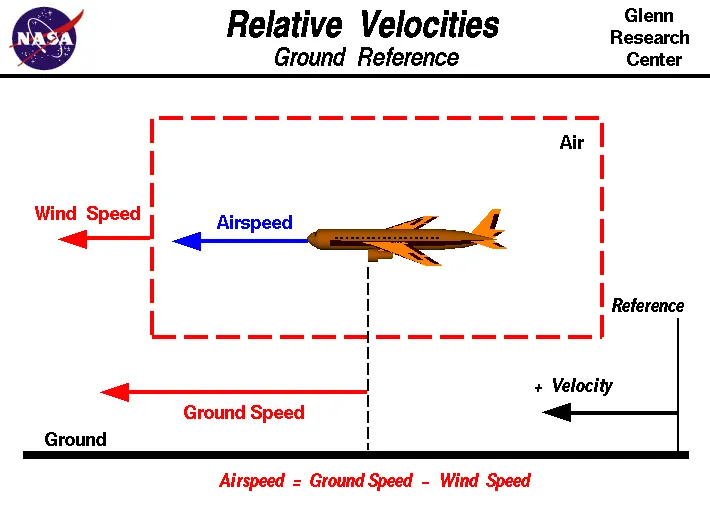
Winds Effect on Ground Speed:The relationship between airspeed and ground speed is fairly simple. Ground speed is simply the sum of airspeed and wind speed.If the aircraft is flying in the same direction as the wind is blowing, the aircraft experiences tailwind, and its ground speed is higher than its airspeed. On the other hand, if the wind is blowing against the direction the aircraft is traveling in, the aircraft experiences headwind, and its ground speed is lower than its airspeed.
3. Why is it not recommended to use aircraft engine power to move it on the ground at Airport?
ANSWER;One of the main reason why aircraft engine is not recommend to move it at the airport is 'Engine Thrust Hazards in the Airport Environment'.
Consider a boeing aircraft,Boeing commercial airplanes are equipped with engines rated from 18,000 to nearly 100,000 lb of thrust. Such thrust levels provide for safe takeoff, flight, and landing over a wide range of temperatures, altitudes, gross weights, and payload conditions. However, the exhaust wake from these engines can pose hazards in commercial airport environments. Operators and airport authorities must carefully consider these hazards and the resulting potential for injury to people and damage to or caused by baggage carts, service vehicles, airport infrastructure, and other airplanes.Also,High engine thrust during maintenance activity can cause considerable damage to airplanes and other elements in the airport environment.
Thats why towing equipments are necessary at airports.
AIRCRAFT TOWING:Aircraft towing is an essential part of daily operations at airports worldwide. There's no question that the safest way to move an aircraft on the ground is through the use of aircraft towing equipment. Without aircraft towing equipment, airports open themselves up to the possibility of dangerous accidents that can jeopardize the safety of ground crews, passengers and the aircraft itself.Pilots and airlines rely on aircraft tugs to perform towing and pushback operations for commercial, private and military aircraft with general ease. The traction design incorporated into aircraft towing equipment means safe movement and stops, even on snow and ice.
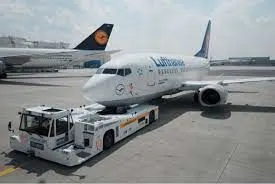
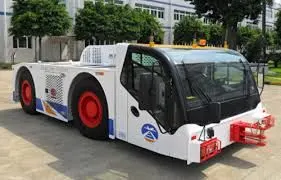
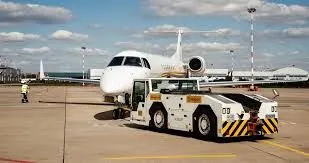
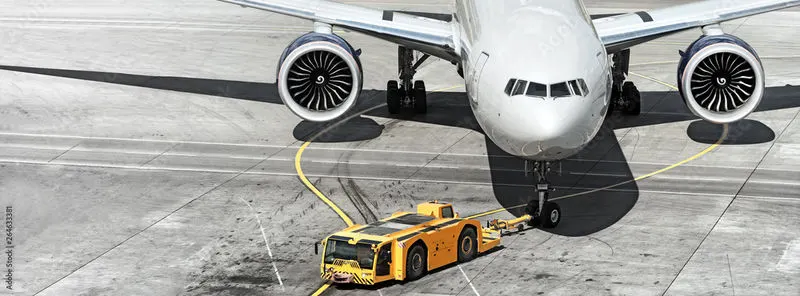
FOLOWING ARE THE REASONS FOR TOWING:
a.Aircraft engine can create hazardous condition.
b.Aircraft towing is easier for maintenance purposes.
c.Pilots have limited visibility from the flight deck:Pilots do not have a clear view of the rear from the flight deck and thus rely on aircraft towing equipment for ground pushback when needed. Once the aircraft is perfectly positioned and far from the terminal tow-in gate and other vehicles, the airport tug is disconnected and the aircraft can use its engines and steering to move to the runway for takeoff.
d.The tight confines of the terminal tow-in gate combined with the restricted view of the pilots generally always require a tow in order to arrive safely and on time.
e.Pushback tugs for the aircraft are required for going in reverse.
Too much fuel is wasted while taxing:By using jet engines as an aircraft’s primary thrust for taxiing, airlines are expending huge amounts of jet fuel while still on the ground, which could be much better used for flying. With the Cost of Fuel being their single biggest expense, many airlines plan to adopt electric taxiing to save fuel and reduce environmental impacts.
4. How an aircraft is pushed to runway when its ready to take off?
ANSWER: let us understand this by taking an example of 200-ton Airliner;
How Aircraft Moves:Most aircrafts can't reverse,the obvious problem with parking facing the terminal is that in order to get to the runway,aircraft needs to move backward off the stand first.Unfortunately, aircraft are unable to do this as they don't have a reverse gear.In order to get round this problem, aircrafts needs assitance of a pushback tug.
Pushback Tugs:The little engines that could.
For smaller aircraft, the pushback tug doesn't require a massive amount of power. They utilize the weight of the tug, sometimes up to 60 tons, to ensure that the wheels don't just spin on the tarmac. "The small ones have enough power to push and tow an aircraft up to a 757."The functionality is pretty simple.They connect a tow-bar at the aircraft first, then at the tug."It takes skill to push an aircraft back using these types of tug. You have two steering axis here at the nose gear and at the tug where the tow-bar is connected.However, with bigger aircraft, tug designers ran into a problem. Even with a 60-ton tug, there isn't enough weight to stop the tug wheels spinning. To get round this problem, they needed something to weigh the tug down. Something like the weight of a 560-ton A380.
"The Goldhofer AST-1X is the Godfather of all tugs because at 32 tons, its 16-liter 700 HP engine is enough to push all heavies easily. We use that tug for 767 up to A380."
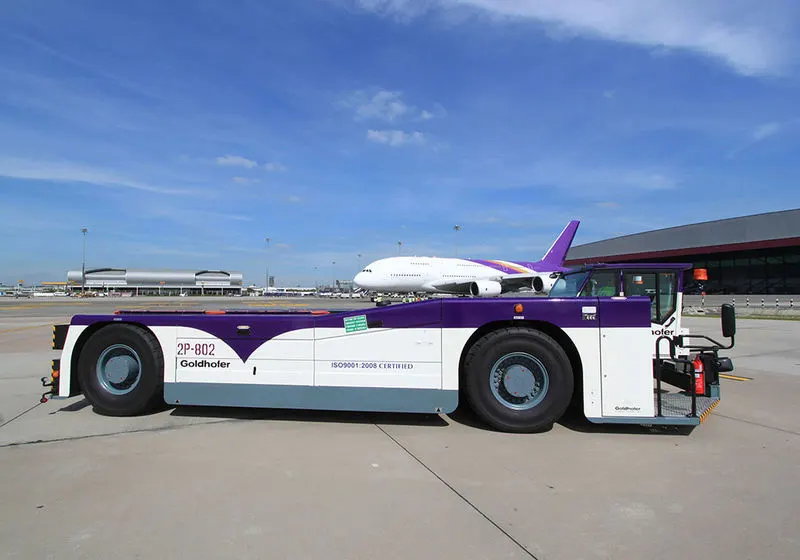
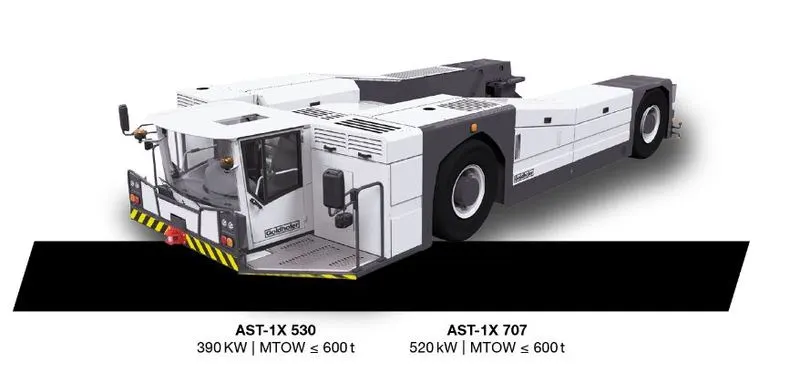
Engine Provides the thrust:Once the tug has disconnected and the engines are running, the pilots call ATC for their clearance to taxi to the departure runway. They will then be issued with a series of taxiways, which will eventually take them to the departure point. At smaller airports, this may just be one taxiway. At larger airfields it could be a number of taxiways, broken up into segments to give way to other aircraft. It's worth noting that aircraft don't 'taxi down the runway'. They taxi on taxiways, hence the name, taxiway. (Sometimes aircraft do have to taxi on the runway, but this is relatively infrequent.
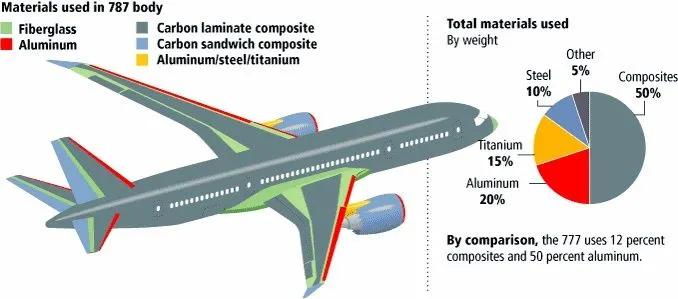
Steering system:Once moving, pilots need to be able to steer the aircraft around corners. With a wingspan of 60.1 meters, the 787-8 is wider than it is long. The pilot's eye level is 5.5 meters above the ground, and this creates a 14-meter blind spot ahead of the aircraft. So, accurate taxiing is essential.This is done through two different sets of controls. Limited steering is possible using the rudder pedals, which sit underneath the pilot's feet.
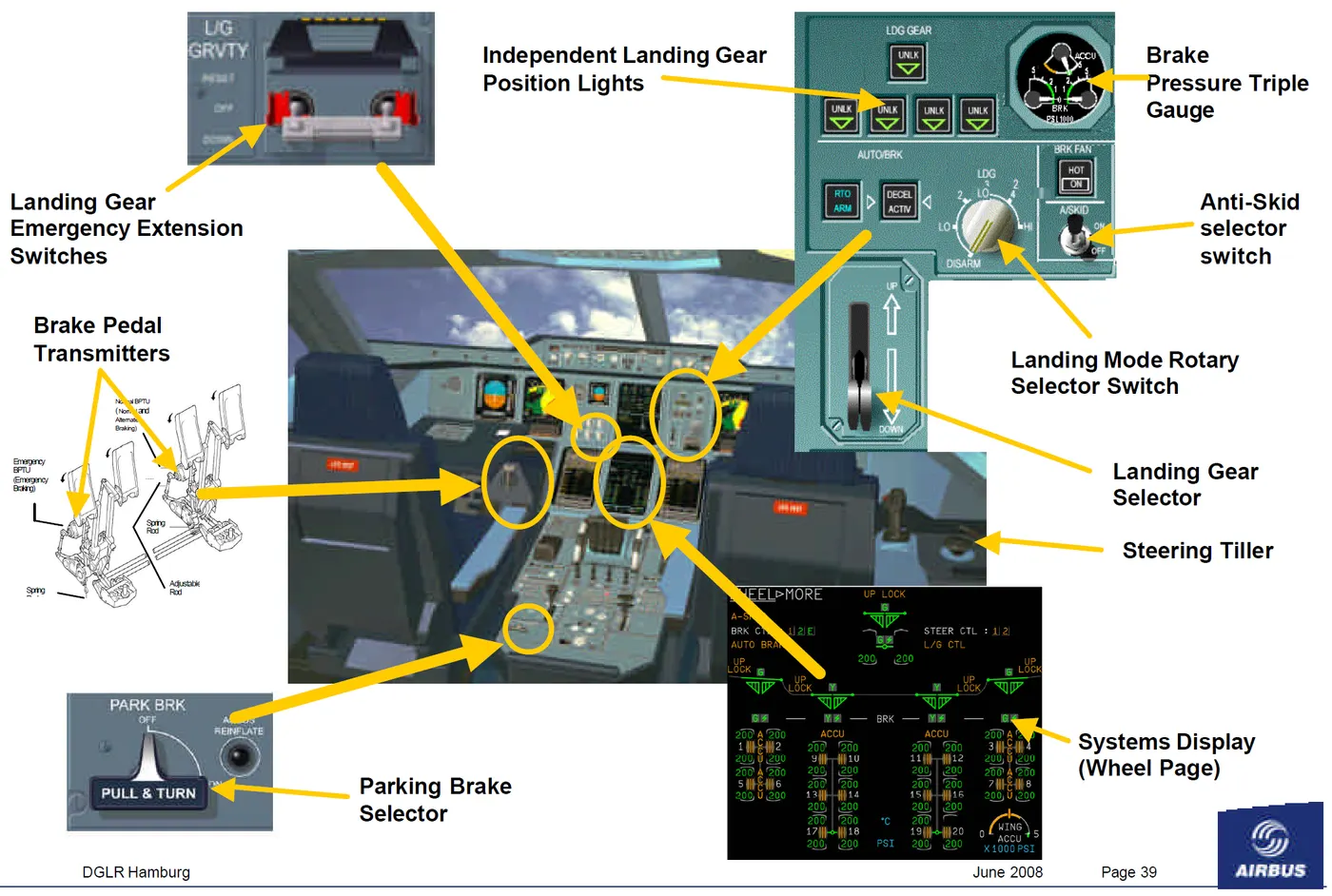
Unlike in our car, the pedals under our feet have very little to do with acceleration and a lot to do with braking and steering. These primarily control the rudder on the tail (mainly used in crosswind landings) and also control the brakes. However, the main source of steering comes from the nosewheel steering tiller, which can turn the nose wheel up to 70 degrees.
The braking system:Getting moving is no good unless you can bring the aircraft safely to a stop. To do this, each wheel on the main landing gear has a brake unit. On most aircraft, the brakes are powered by the hydraulics system.However, on the 787 Dreamliner, the eight main wheel brakes are electrically powered .This means that the aircraft then produces fewer CO2 emissions due to the lower weight — 111 kilograms for each 787-9 aircraft. The simplified system also benefits engineers as the procedure to replace a brake unit is much quicker and easier.Being such a safety critical part of the aircraft, the braking system has to work well under all conditions. This includes situations where a brake unit isn't working.During the testing stage of the aircraft, engineers put them through a punishing process.
5. Learn about take off power, tyre design, rolling resistance, tyre pressure, brake forces when landing.
ANSWER: TAKE OFF POWER;
Takeoff is the phase of flight in which an aerospace vehicle leaves the ground and becomes airborne. For aircraft traveling vertically, this is known as liftoff.
Take off is the phase of flight in which an aerospace vehicle leaves the ground and becomes airborne. The amount of power that an engine is allowed to produce for a limited period of time for takeoff is termed as Takeoff power. The use of takeoff power is usually limited to 5 min for reciprocating engines and up to 2½ min for gas turbine engines.
TYRE DESIGN:When it comes to safety, tyres are one of the most important components of aircraft. They help to absorb the shock of landing and provide cushioning. It also provides the necessary traction for braking and stopping of an aircraft.
An aircraft tyre is designed to withstand extremely heavy loads while landing, take off, taxing, and parking. The number of wheels required for aircraft increases with the weight of the aircraft, as the weight of the aeroplane needs to be distributed more evenly.
A Boeing 737NG & 737MAX uses 6 wheels, Boeing 787 uses 10 wheels, Boeing 777 uses 14 wheels and Airbus A380 uses 22 wheels. Aircraft tyres work under extreme conditions, carrying up to 340 tons and accelerating at over 250 km/hour at takeoff, in addition to enduring varied environmental stress when in flight and taxiing.
Design and construction of aircraft tyre:Carcass plies are used to form the tire. They are sometimes called casing plies. An aircraft tyre is constructed for the purpose it serves.
- They support the weight of an aircraft while it is on the ground.
- It also provides the necessary traction for braking and stopping of an aeroplane.
- Tyre also helps to absorb the shock of landing and provide cushioning the roughness of takeoff, roll-out, and taxi operations.
Unlike an automobile or truck tyre, it does not have to carry a load for a long period of continuous operation. However, an aircraft tyre absorbs the high impact loads of landing, and also it’s operating at high speeds for a short time when required.
Some technical aspects of the tyre:
a.Retreading:Retreading is methods of restoring a worn tyre by renewing the tread area or by renewing the tread area plus one or both sidewalls. Repairs are included in the tyre retreading process.
b.Load rating: Load rating is the maximum permissible load at a specified inflation pressure.
c.Ply Rating is used to identify the maximum recommended load rating and inflation pressure for a specified tyre. It is an index of tyre strength
d.Speed rating: The speed rating is the maximum takeoff speed to which the tyre has been tested.
e.Skid depth: Skid depth is the distance between the tread surface and the deepest groove as measured in the mould.
Aircraft tyres must have an approved speed and load rating and have sufficient clearance when retracted through landing gear to allow for tyre growth. Tyre growth is the increase in the size of the tyre due to centrifugal forces at high speed.
Aircraft tyres may be Tube-type of Tubeless:Tubeless tyres are more advantageous over tube-type. There is no longer the use of tube-type tyre in recent aviation. Nowadays all airliners are using tubeless tyres. Tubeless that are meant to be used without a tube has the word TUBELESS on the sidewall of the tyre.
Aircraft tyres may be Radial or Bias:Almost all airliners are using Radial tyre. Bias is an older design, and it’s mainly used for road vehicles. Radial tyres have the word RADIAL on the sidewall. Radial tires are more expensive than bias-ply tyres. Radial tires are in demand because of their lower life cycle cost and long term value.
Radial tires have an advantage over the bias-ply tire in terms of reducing heat better.
Conductive nature of aircraft tyres:Aircraft tyres are manufactured with tread rubber with conducting compounds to permit earthing of static charges.In early days when tyres were not sufficiently conductive, aircraft used to have a conductive strip hanging down from the axle of the landing gear. Upon landing, this strip would be the first part of the aircraft to touch the earth. This discharges any static electricity accumulated on the outer surfaces of the aircraft. Now you don’t see them anymore.
There are three major forces which may effect the tyre performance:
- Centrifugal force.
- Heat generation.
- Tensile, Compression and Shear Forces.
Rolling resistance:The force that resists the motion of a body rolling on a surface is called the rolling resistance or the rolling friction.
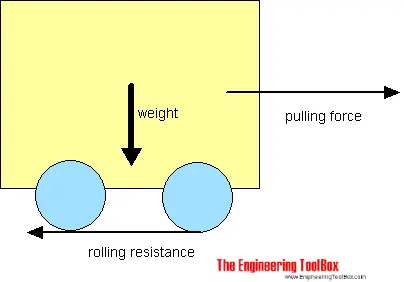
The rolling resistance can be expressed by the generic equation
Fr = c W (1)
where
Fr = rolling resistance or rolling friction (N, lbf)
c = rolling resistance coefficient - dimensionless (coefficient of rolling friction - CRF)
W = m ag
= normal force - or weight - of the body (N, lbf)
m = mass of body (kg, lb)
ag = acceleration of gravity (9.81 m/s2, 32.174 ft/s2)
The rolling resistance can alternatively be expressed as
Fr = cl W / r (2)
where
cl = rolling resistance coefficient - dimension length (coefficient of rolling friction) (mm, in)
r = radius of wheel (mm, in)
Tyre pressure:
Automobile tyres are pressurized to around 30-40 psi. If large aircraft tyres were filled with 35 psi, they would be flat under the weight!!
Large aircraft tyre pressures are ridiculously high. A Boeing 767-300 main wheel is inflated to 205 psi.The high pressure supports the tyre’s maximum rated load of 51,000 lbs (approx 24000 kgs).
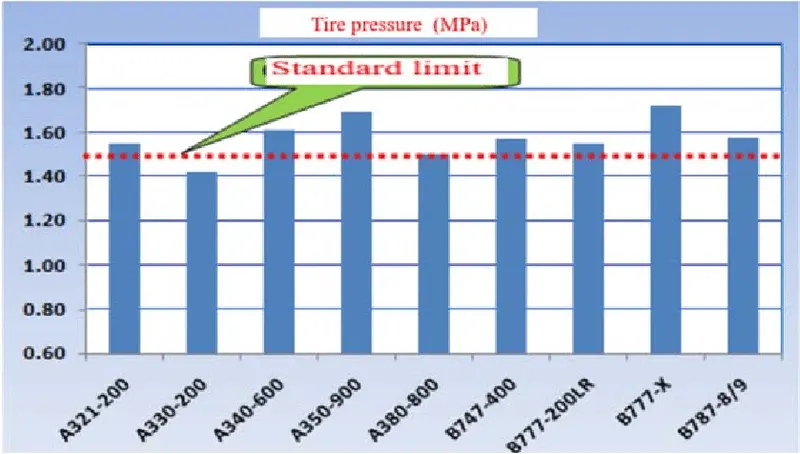
Brake forces when landing:Forces and moments that act on aircraft landing gear wheels are effects of gravitational acceleration, as well as surface reactions. These reactions are easily obtainable on paved runways, but difficulties arise when an airplane operates on unpaved, grassy, or gravel surfaces.Brakes provide this critical stopping function during landings to enable airplanes to stop within the length of the runway. They also stop aircraft during rejected takeoff events, in which an attempted takeoff is canceled as the airplane is rolling down the runway before it lifts off from the ground due to engine failure, tire blowout, other system failure or direction from air traffic control.
The most common type of brake used on aircraft is the disc brake.Disc brakes function by exploiting friction between rotating and stationary discs inside the brake.
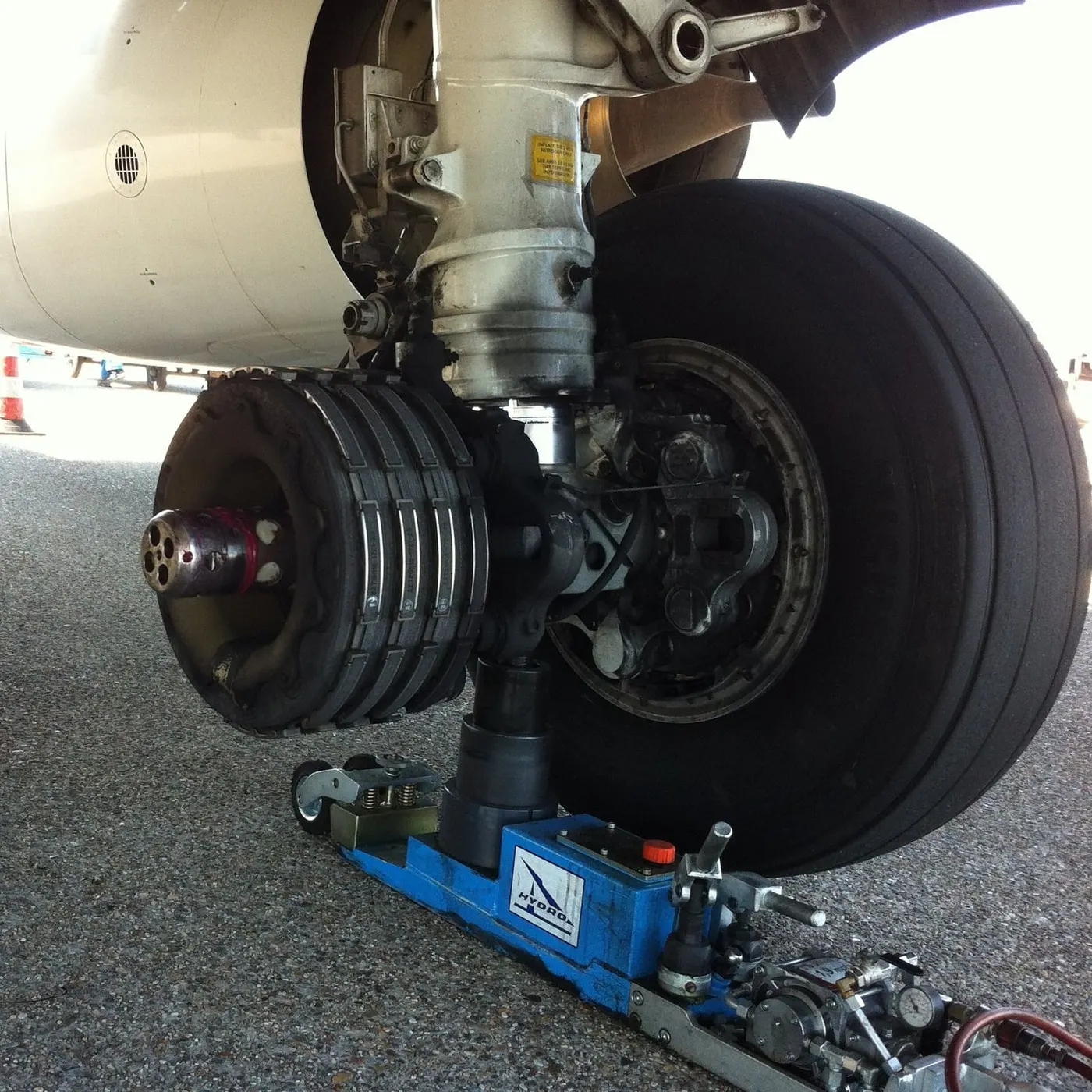
A brake assembly on a Boeing 737NG main landing gear, visible after removal of one the wheels.
6. A. With necessary assumptions, calculate the force and power required to push / pull an aircraft by a towing vehicle.
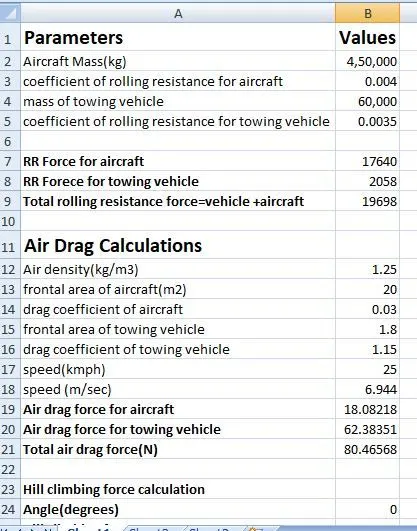
ANSWER:Aircraft parameters towing vehicle parameters
mass = 450000 kg mass = 60000kg
coefiicient of rolling resistance = 0.004 coefficient of rolling resistance = 0.0035
Frr1 = 17640 N Frr2 = 2058
Total rolling resistance force = Frr1+Frr2 = 17640+2058
=19698 N
Air drag calculations: airdensity (rho)= 1.25
Vehicle speed in kmph = 25
sped in m/sec = 6.944
Frontal area of aircraft(A1) = 20m2
frontal area of towing vehicle(A2) = 1.8m2
Drag coefficient of aircraft(Cd1) = 0.03
Drag coefficient of towing vehicle(Cd2) = 1.15
airdrag force for aircraft= 0.5*rho*A1*speed^2*Cd1= 18.08 N
airdrag force for towing vehicle= 0.5*rho*A2*speed^2*Cd2 = 62.3 N
total airdrag force,Fad = 18.08+62.3 = 80.38
total tractive force = Frr+Fad = 19698+80.38= 19778.38 N
power required by motor or total power in KW = (19778.38*6.944)/1000 = 137.3.
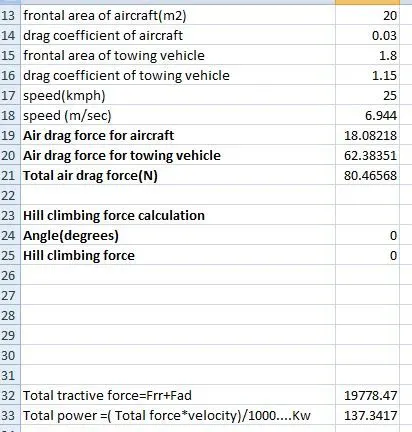
Due to Runway driving conditions, Hill climbing force is assumed as zero.
B. Develop the model for the calculated force and power using Simulink.
ANSWER: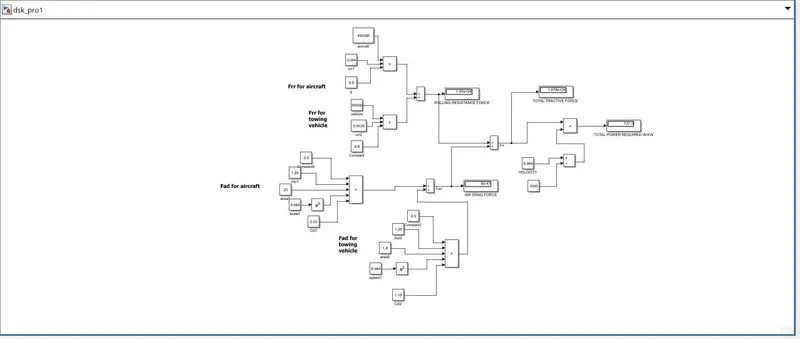
The power required to push or pull an aircraft by a towing vehicle has been calculated in simulink and the result found to be same.
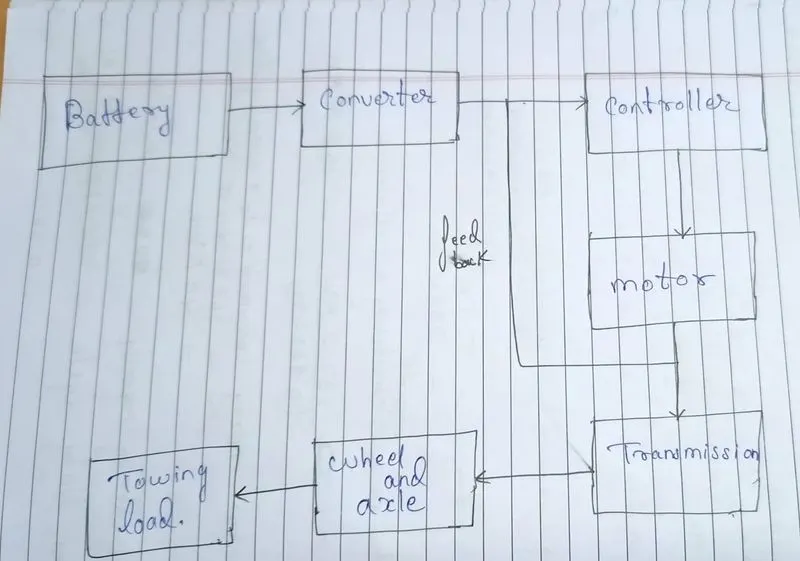
7. A. Design an electric powertrain with type of motor, it’s power rating, and energy requirement to fulfill aircraft towing application in Simulink. Estimate the duty cycle range to control the aircraft speed from zero to highest. Make all required assumptions. Prepare a table of assumed parameters. Draw a block diagram of powertrain.
ANSWER;Taking parameters from question no 6
total power = 137.2kW
TOTAL FORCE = 19770 N
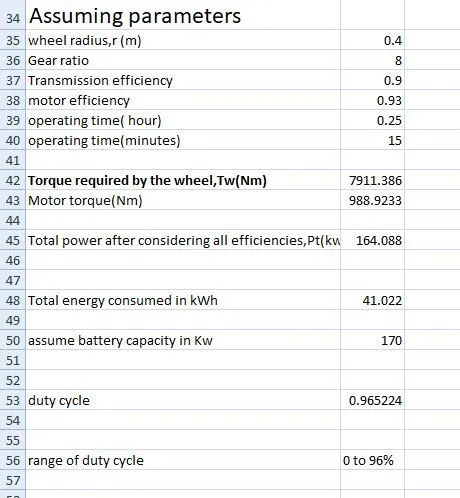
Assuming parameters;
radius of tire,r in m = 0.4 m
gear ratio,G = 8
tranmission efficiency = 90%
motor efficiency = 93%
operatig time(hours) = 0.25 hour or 15 minutes
Torque required by wheel,Tw = F*r = 19770*0.4 =7908 Nm
Motor torque = Tw/G = 988.5Nm
Total power required considering all efficiencies
Pt = 13702/(0.93*0.90) = 163.91
Total energy consumed = Pt*operating time = 163.91*0.25 = 40kWh
assuming battery capacity as 170 kW = INPUT POWER
Then duty cycle = output power/input power = Pt/170 = 163.91/170
= 0.96
therefore range of duty cycle is 0 to 96%
Block diagram of powertrain:
B. Also, Design the parameters in excel sheet.