Project-1: Powertrain for aircraft in runways
Part-A
1. The aircraft gross weight is the total aircraft weight at any moment during the flight or ground operation.
For each flight, different weights are taken into account for several reasons.
Manufacturer's empty weight (MEW)
It is the weight of the aircraft "as built" and includes the weight of the structure, power plant, furnishings, installations, systems and other equipment that are considered an integral part of an aircraft. This excludes any baggage, passengers, or usable fuel.
Zero-fuel weight (ZFW)
This is the total weight of the airplane excluding the total weight of the usable fuel on board. As a flight progresses and fuel is consumed, the total weight of the airplane reduces, but the ZFW remains constant.
Operating empty weight (OEW)
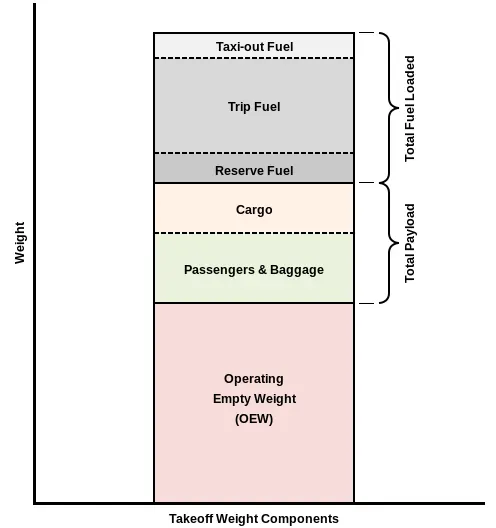
It is the basic weight of an aircraft including the crew, all fluids necessary for operation such as engine oil, engine coolant, water, unusable fuel and all operator items and equipment required for flight but excluding usable fuel and the payload.
It is the carrying capacity of an aircraft. It includes cargo, people, extra fuel. In the case of a commercial airliner, it may refer only to revenue-generating cargo or paying passengers.
Maximum takeoff weight (MTOW)
This is the maximum weight at which the pilot of the aircraft is allowed to attempt to take off.
Regulated takeoff weight (RTOW)
Depending on different factors (e.g. flap setting, altitude, air temperature, length of runway), RTOW or maximum permissible takeoff weight varies for each takeoff. It can never be higher than MTOW.
Maximum landing weight (MLW)
This maximum weight at which an aircraft is permitted to land.
The following image depicts take-off weight components.
2.Is there any difference between ground speed and air speed?
Yes. ground speed and air speed are different.
Airspeed or real airspeed is an airplane's speed relative to the air it is flying in, whereas ground speed is an airplane's speed relative to the Earth's surface.Airspeed is also the speed at which the air is flowing around the aircraft’s wings.
Ground speed, on the other hand, is the aircraft’s speed relative to the ground. It is horizontal rather than vertical speed. Airspeed determines whether there is enough airflow around an aircraft to make it fly and ground speed is what determines how fast an aircraft get to its destination.
3.
The thrust produced when an aircraft's engine starts up can easily damage the airport terminal, nearby ground vehicles, the jetway, luggage, and most critically, ground employees. When pulling a huge aircraft, it's especially crucial to limit engine use because of how dangerously harmful their more potent thrust capabilities might be. Engine power can readily launch any loose objects into the air, convert even the smallest dust particles into dangerous projectiles, and produce debris that can harm multi-million dollar engines. In addition, aircraft engines use a lot of fuel and produce a lot of noise that can be dangerous for those on the ground. Therefore, using a pushback tug rather than operating the engines is more cost-effective and secure.
4.
Pushback, in the context of aviation, is an airport process in which an aircraft is propelled by external force away from an airport gate. Pushback tractors or tugs are specialised, low-profile vehicles used to perform pushbacks.
Although many aeroplanes are capable of using reverese thrust to propel themselves backwards on the ground, the jetblast or propwash may harm the terminal structure or its equipment. Engine damage can also result from engines that are close to the ground blowing sand and other debris ahead before being sucked into the engine. Therefore, pushing the plane back is the technique to get it out from under the gate.
In order to facilitate ground movement on taxiways, pushbacks at busy aerodromes are typically subject to ground control clearance. When the pushback is ready to begin, the pilot communicates with the tractor driver. Near the nose gear, a headset might be connected for communication.The pushback tractor driver controls the aircraft's steering instead of the pilots because they are unable to see what is behind the aircraft. The nose gear may temporarily be disconnected from the aircraft's usual steering mechanism by installing a bypass pin into it, depending on the kind of aircraft and airline policy.
The towbar is disconnected and any bypass pins are taken out when the pushback is finished. To demonstrate to the pilots that the bypass pin has been removed, the ground handler will display it to them. The aeroplane can then taxi ahead using its own power after the pushback is finished.
5.
TAKE OFF POWER
The aircraft transitions from being on the ground on a runway to flying in the air during takeoff. The aeroplane is stopped after taxing up to the runway's beginning. To look for engine-related issues, the engines are run at full power. The aircraft is then quickly accelerated until the required speed for takeoff is reached before the pilot releases the brakes. The takeoff speed varies according to the aircraft's weight, air density, and configuration. The distance from sea level and temperature of the atmosphere affect the air density. If the plane must take off, it must do so at the required takeoff speed, which is also influenced by the runway's length and slope.
The speed of takeoff varies with the air's movement. Because there is more air flowing over the wings when there is a headwind, the takeoff speed is substantially lower. The aeroplanes so typically take off against the wind. Typically, side wind is not desirable as it might affect the aircraft's stability. Jetliners typically take off at speeds between 240 and 285 km/h, and this speed is directly inversely proportional to the weight of the aircraft. Some aeroplanes struggle to produce enough lift during takeoff.
TYRE DESIGN
A tyre is a crucial element of an aircraft's safety system. Tires act as a cushion and assist in absorbing the impact of landing. Additionally, it gives the aircraft the traction it needs to halt and brake.The aircraft is built with the ability to resist very heavy weights during takeoff, landing, taxing, and parking. Due to the necessity for a more equitable distribution of weight, the number of wheels needed for an aircraft rises as its weight does.
ROLLING RESISTANCE
Rolling resistance is the force that resists the motion when the body rolls on the surface.
It is represented by,
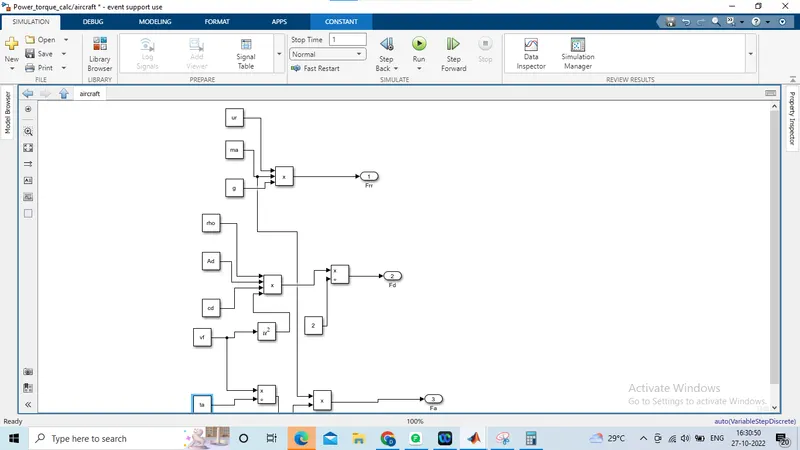
Frr = μr m g
Where ,
Frr = rolling resistance force (N)
μr = coefficient of rolling resistance
m = Total mass of the vehicle (kg)
g = Acceleration due to gravity (m/s2)
TYRE PRESSURE
The design of aircraft tyres allows them to sustain severe loads for brief periods of time. Because the weight of the plane needs to be distributed more equally, the number of tyres needed for an aircraft rises as it gets heavier. The thread pattern of the aircraft tyre is made to be both effective for braking and to help with stability in strong crosswinds.
If the full amount of braking force is used during an emergency landing or aborted takeoff, tyres may become overheated. The fuses offer a safer failure mode that prevents the explosion of tyres by carefully deflating them, hence reducing damage to the aircraft and other objects. Up to 200 psi is the maximum operating pressure for aircraft tyres.
BRAKING FORCES WHEN LANDING
By converting kinetic energy into thermal energy through friction between spinning and stationary discs found in braking assemblies in the wheels, aircraft brakes assist in bringing a moving craft to a halt. These brakes provide crucial stopping friction during landing, allowing the aircraft to come to a halt within the runway's length. The aircraft brakes assist in stopping the vehicle before takeoff in the event of any technical difficulties.
By delivering varying degrees of braking power to the left and right-side brakes, aircraft brakes also stop motion of the aircraft when it is parked, control speed during taxing, and can assist in guiding the aircraft on the ground. Other braking systems, like as thrust reversers, air brakes, and spoilers, cooperate with aircraft brakes to stop a moving object. Thrust reversers are surfaces that are positioned in the course of the engine's jet blasts in order to divert the thrust in a way that complements the motion of the aircraft.
Part B:
6.A. With necessary assumptions, calculate the force and power required to push / pull an aircraft by a towing vehicle.
A towing vehicle is necessary to push/pull the aeroplane from the terminal gate. Towing vehicles need a lot of torque to draw or push an aircraft.
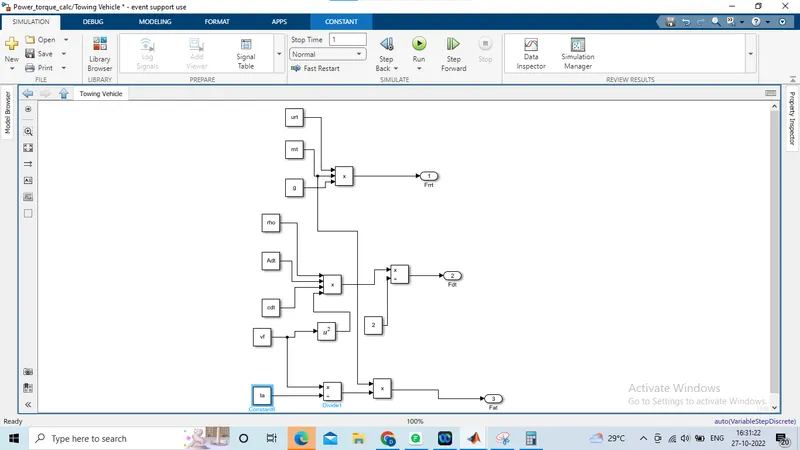
To determine the amount of force and power the towing vehicle needs to push or pull the aircraft, Rolling resistance, Acceleration force and Aerodynamic drag forces are taken into account.
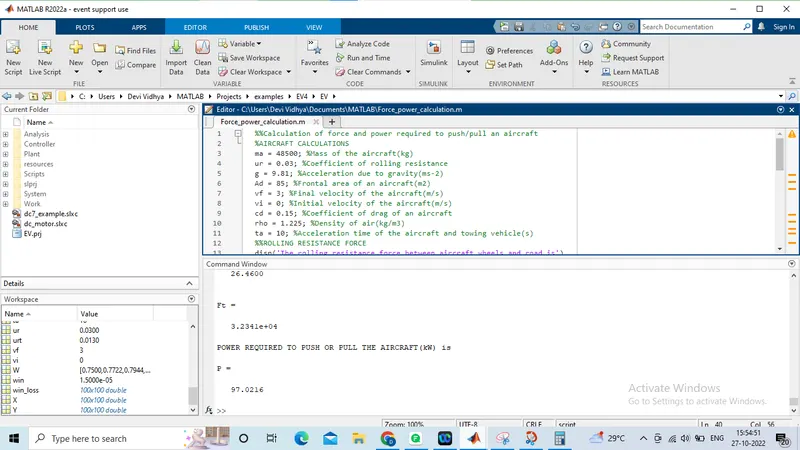
>> Force_power_calculation
The rolling resistance force between aircraft wheels and road is
Frr =
1.4274e+04
The acceleration force of the aircraft is
Fa =
14550
The aerodynamic drag force of the aircraft
Fd =
70.2844
The rolling resistance force of towing vehicle is
Frrt =
1.0202e+03
The acceleration force of the towing vehicle is
Fat =
2400
The aerodynamic drag force of the towing vehicle is
Fdt =
26.4600
Ft =
3.2341e+04
POWER REQUIRED TO PUSH/PULL THE AIRCRAFT(kW) is
P =
97.0216
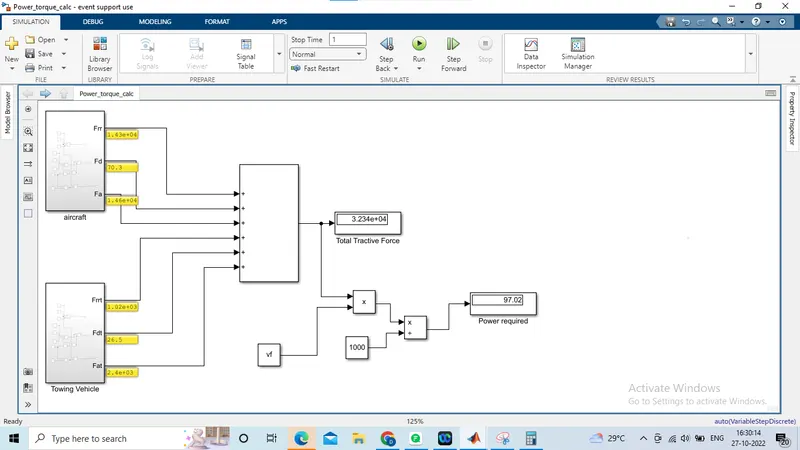
B. Develop the model for the calculated force and power using Simulink.
7. A.
AIRCRAFT PARAMETERS
|
PARAMETERS |
VALUES |
UNITS |
|
Mass of the aircraft |
48500 |
kg |
|
Coefficient of rolling resistance |
0.03 |
-- |
|
Frontal area of the aircraft |
85 |
M2 |
|
Final velocity of the aircraft |
3 |
m/s |
|
Initial velocity of the aircraft |
0 |
m/s |
|
Coefficient of drag of an aircraft |
0.15 |
-- |
|
Acceleration time of the Towing vehicle |
10 |
Seconds |
TOWING VEHICLE PARAMETERS
|
PARAMETERS |
VALUES |
UNITS |
|
Mass of the Towing vehicle |
8000 |
kg |
|
Coefficient of rolling resistance |
0.013 |
-- |
|
Frontal area of the Towing vehicle |
8 |
M2 |
|
Final velocity of the Towing vehicle |
3 |
m/s |
|
Initial velocity of the Towing vehicle |
0 |
m/s |
|
Coefficient of drag of the Towing vehicle |
0.60 |
-- |
|
Acceleration of the Towing vehicle |
10 |
seconds |
|
Gear ratio |
10 |
The towing vehicle must have a total power output of 97.02 KW and a total tractive force of 32341 N to push or pull the aircraft. The towing vehicle's necessary torque is calculated as
Tt = Ft * r /G = 32341* 0.4 / 10= 1293.64 Nm
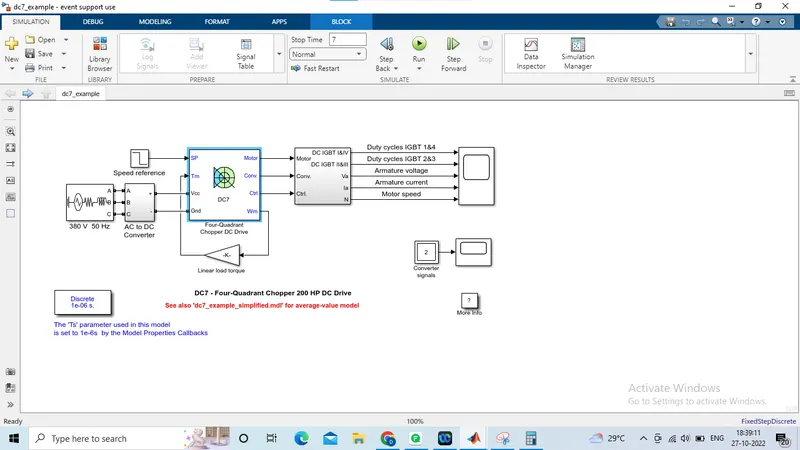
A motor is chosen based on its power rating, and a battery is needed depending on the amount of energy required and the duty cycle range to control the aircraft speed from zero to the highest.
The TECO IE2 electric induction motor is chosen because it meets the vehicle's requirements for power output and torque with a 110 KW output and 1420 Nm of torque at full load.
MOTOR SPECIFICATIONS
Output power – 110 KW, 150 hp
Full load speed – 740 rpm
Full load Efficiency – 94.5%
Full load current – 210A
Full load Torque – 1420 Nm
Rated voltage – 400V/50 Hz
The rated voltage is 400V and the current is assumed to be 280A. So, the input power of the motor is calculated as
Pinput = 400 *280= 112000W=112kW
Poutput=97.02kW
d=97.02/112=86.6%
To calculate the energy required from battery pack for 10 minutes(10*60)
E = Po * t= 97.02 * 600= 58212kJ
E = 58212kJ/3600= 16.17KWH
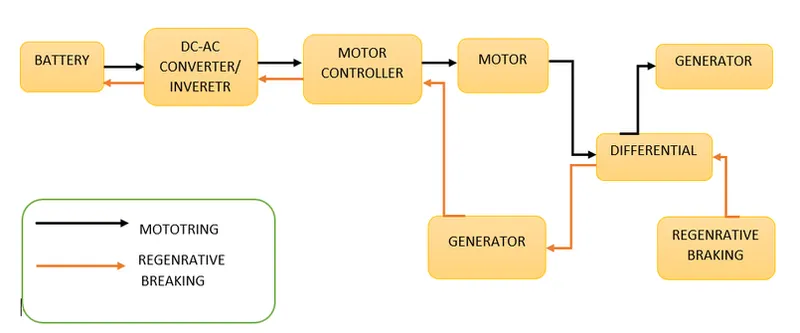
Powertrain model:
Block diagram:
B.
|
Calculation of force and power required to push/pull an aircraft
|
||
| Aircraft | Towing vehicle | |
| Mass | 48500 | 8000 |
| Coefficient of rolling resistance | 0.03 | 0.013 |
| Acceleration due to gravity(ms-2) | 9.81 | 9.81 |
| Frontal area of an aircraft(m2) | 85 | 8 |
| Final velocity of the aircraft(m/s) | 3 | 3 |
| Initial velocity of the aircraft(m/s) | 0 | 0 |
| Coefficient of drag of an aircraft | 0.15 | 0.6 |
| Density of air(kg/m3) | 1.225 | 1.225 |
| Acceleration time (s) | 10 | 10 |
| ROLLING RESISTANCE FORCE | 14273.55 | 1020.24 |
| ACCELERATION FORCE | 14550 | 2400 |
| AERODYNAMIC DRAG FORCE | 70.284375 | 26.46 |
| Total Tractive force(N) | 32340.53438 | |
| Power Required to push/Pull(kW) | 97.02160313 | |
Excel calculation file is attached for reference.