Project-1: Powertrain for aircraft in runways
1. Search and list out the total weight of various types of aircrafts.
| Aircraft | Empty Weight | Max Fuel Weight | Max Cargo Weight | Max Gross Takeoff Weight |
| Antanov AN-225 | 628,000 lbs | 661,400 lbs | 417,000 lbs | 1,411,000 lbs |
| 285,000 kg | 300,000 kg | 190,000 kg | 640,000 kg | |
| Airbus A380-800 | 611,000 lbs | 560,000 lbs | 185,000 lbs | 1,268,000 lbs |
| 277,000 kg | 254,000 kg | 84,000 kg | 575,000 kg | |
| Boeing 747-800 | 485,300 lbs | 427,400 lbs | 295,000 lbs | 987,000 lbs |
| 220,100 kg | 194,000 kg | 134,000 kg | 447,700 kg | |
| Airbus A340-500 | 370,000 lbs | 386,300 lbs | 119,000 lbs | 820,000 lbs |
| 168,000 kg | 175,000 kg | 54,000 kg | 372,000 kg | |
| Boeing 777-300ER | 370,000 lbs 168,000 kg | 320,800 lbs 145,500 kg | 148,000 lbs | 776,000 lbs |
| 67,100 kg | 352,000 kg | |||
| Boeing 787-10 | 299,000 lbs 135,500 kg | 223,500 lbs | 126,300 lbs 57,300 kg | 560,000 lbs |
| 101,500 kg | 254,000 kg | |||
| Boeing 737-900 | 98,500 lbs | 53,100 lbs | 44,600 lbs | 187,000 lbs |
| 44,700 kg | 24,000 kg | 20,200 kg | 85,000 kg | |
| Airbus A320-100 | 93,900 lbs | 48,700 lbs | 44,000 lbs | 150,000 lbs |
| 42,600 kg | 22,100 kg | 20,000 kg | 68,000 kg | |
| Embraer 190 | 63,500 lbs | 28,600 lbs | 28,800 lbs | 106,000 lbs |
| 28,800 kg | 13,000 kg | 13,100 kg | 48,000 kg | |
| Gulfstream G650 | 54,000 lbs 24,500 kg | 48,200 lbs 21,900 kg | 6,500 lbs | 100,000 lbs |
| 3,000 kg | 45,200 kg | |||
| Bombardier CRJ900 | 48,160 lbs 21,850 kg | 19,600 lbs 8,900 kg | 6,075 lbs 2,760 kg | 80,500 lbs |
| 36,500 kg | ||||
| Bombardier Q400 | 39,300 lbs | 11,700 lbs | 18,700 lbs | 62,000 lbs |
| 17,800 kg | 5,300 kg | 8,500 kg | 28,000 kg | |
| Learjet 75 | 13,900 lbs 6,300 kg | 6,060 lbs | 2,900 lbs | 21,500 lbs |
| 2,750 kg | 1,300 kg | 9,700 kg | ||
| Cessna Citation CJ4 | 10,300 lbs 4,700 kg | 5,800 lbs | 2,200 lbs 1,000 kg | 17,200 lbs |
| 2,650 kg | 7,800 kg | |||
| Beechcraft King Air B100 | 7,100 lbs 3,200 kg | 3,200 lbs | 4,150 lbs | 12,000 lbs |
| 1,450 kg | 1,900 kg | 5,400 kg | ||
| Diamond DA50 RG | 3,200 lbs | 340 lbs | 1,250 lbs | 4,400 lbs |
| 1,450 kg | 155 lbs | 560 kg | 2,000 kg | |
| Beechcraft Bonanza G36 | 2,500 lbs 1,150 kg | 450 lbs | 850 lbs | 3,660 lbs |
| 200 kg | 385 kg | 1,660 kg | ||
| Cessna 206H | 2,200 lbs | 520 lbs | 1,150 lbs | 3,600 lbs |
| 990 kg | 235 kg | 520 kg | 1,630 kg | |
| Sirrus SR22 | 2,250 lbs 1,000 kg | 485 lbs | 950 lbs | 3,600 lbs |
| 220 kg | 430 kg | 1,630 kg | ||
| Cessna 172R | 1,700 lbs | 380 lbs | 560 lbs | 2,425 lbs |
| 770 kg | 170 kg | 255 kg | 1,100 kg |
Maximum taxi weight (MTW)
The maximum taxi weight (MTW) (also known as the maximum ramp weight (MRW) is the maximum weight authorized for maneuvering (taxiing or towing) an aircraft on the ground as limited by aircraft strength and airworthiness requirements. It includes the weight of taxi and run-up fuel for the engines and the APU.It is greater than the maximum takeoff weight due to the fuel that will be burned during the taxi and runup operations.The difference between the maximum taxi/ramp weight and the maximum take-off weight (maximum taxi fuel allowance) depends on the size of the aircraft, the number of engines, APU operation, and engines/APU fuel consumption, and is typically assumed for 10 to 15 minutes allowance of taxi and run-up operations.
Maximum takeoff weight (MTOW)
The maximum takeoff weight (also known as the maximum brake-release weight) is the maximum weight authorised at brake release for takeoff, or at the start of the takeoff roll.The maximum takeoff weight is always less than the maximum taxi/ramp weight to allow for fuel burned during taxi by the engines and the APU.In operation, the maximum weight for takeoff may be limited to values less than the maximum takeoff weight due to aircraft performance, environmental conditions, airfield characteristics (takeoff field length, altitude), maximum tire speed and brake energy, obstacle clearances, and/or en route and landing weight requirements.
Maximum landing weight (MLW)
The maximum weight authorised for normal landing of an aircraft.The MLW must not exceed the MTOW.The operation landing weight may be limited to a weight lower than the Maximum Landing Weight by the most restrictive of the following requirements:
- Aircraft performance requirements for a given altitude and temperature
- landing field length requirements,
- approach and landing climb requirements
- Noise requirementsIf the flight has been of short duration, fuel may have to be jettisoned to reduce the landing weight.Overweight landings require a structural inspection or evaluation of the touch-down loads before the next aircraft operation.
Maximum zero-fuel weight (MZFW)
The maximum permissible weight of the aircraft less all usable fuel and other specified usable agents (engine injection fluid, and other consumable propulsion agents). It is the maximum weight permitted before usable fuel and other specified usable fluids are loaded in specified sections of the airplane.
2. Is there any difference between ground speed and air speed?
Ground Speed:-
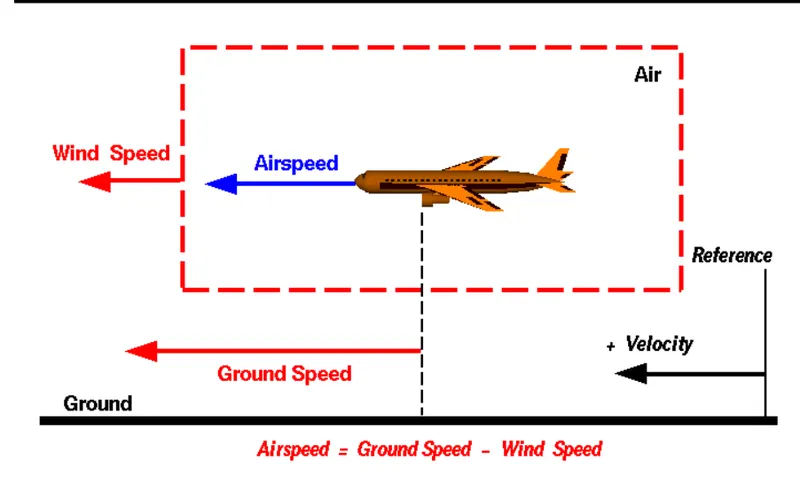
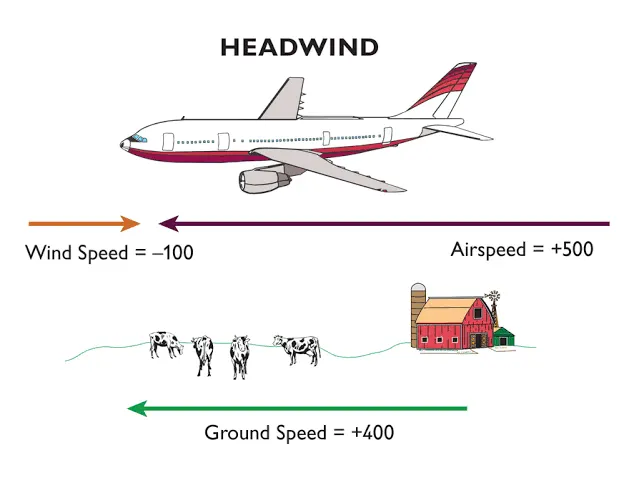
For a reference point picked on the ground, the aircraft moves relative to the reference point at the ground speed. Ground speed is also a vector quantity so a comparison of the ground speed to the wind speed must be done according to rules for vector comparision.
Air speed:-
The important quantity in the generation of lift is the relative velocity between the object and the air, which is called the airspeed. Airspeed cannot be directly measured from a ground position, but must be computed from the ground speed and the wind speed. Airspeed is the between the ground vector difference and speed and the wind speed.
Airspeed = Ground Speed - Wind Speed
On a perfectly still day, the airspeed is equal to the ground speed. But if the wind is blowing in the same direction that the aircraft is moving, the airspeed will be less than the ground speed.
3. Why is it not recommended to use aircraft engine power to move it on the ground at Airport?
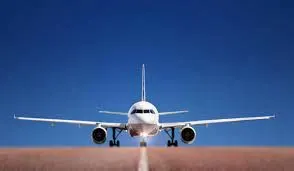
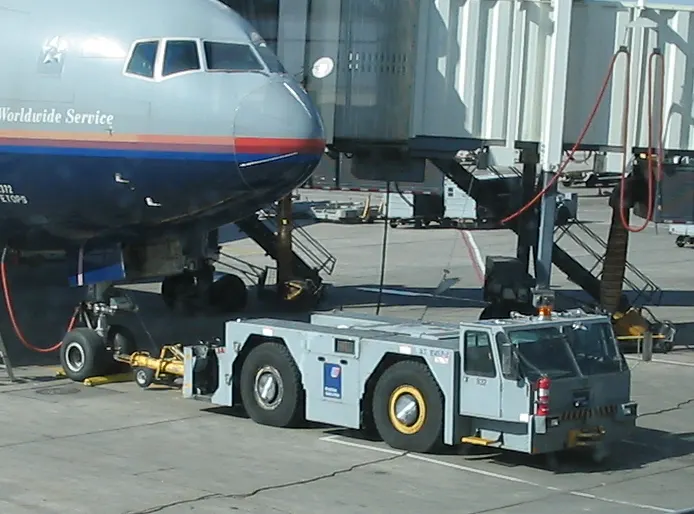
Pilots do not have a clear view of the rear from the flight deck and thus rely on aircraft towing equipment for ground pushback when needed. Once the aircraft is perfectly positioned and far from the terminal tow-in gate and other vehicles, the airport tug is disconnected and the aircraft can use its engines and steering to move to the runway for takeoff.
4. How an aircraft is pushed to runway when its ready to take off?
5. Learn about take off power, tyre design, rolling resistance, tyre pressure, brake forces when landing.
Take off power :-
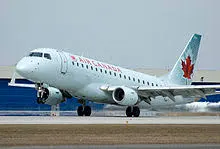
On take-off, in order to position the aircraft to a safe height away from terrain and obstacles (i.e. a flight path of maximum height and minimum ground distance desired), the engine thrust is set to a high ‘take-off power’ setting (although this is not necessarily full power) and the aircraft attitude is pitched up to maintain a specific speed (usually in the region of V2 + 15kts). Once the ‘safe height’ is reached the engine thrust can therefore be reduced to a more appropriate (i.e. efficient) setting and the aircraft flight path can be changed to a more appropriate (i.e. efficient) flight path.
Tyre Design:-
When it comes to safety, tyres are one of the most important components of aircraft. They help to absorb the shock of landing and provide cushioning. It also provides the necessary traction for braking and stopping of an aircraft.An aircraft tyre is designed to withstand extremely heavy loads while landing, take off, taxing, and parking. The number of wheels required for aircraft increases with the weight of the aircraft, as the weight of the aeroplane needs to be distributed more evenly.
Following the aircrafts using the wheels:-
A Boeing 737NG & 737MAX uses 6 wheels, Boeing 787 uses 10 wheels, Boeing 777 using 14 wheels and The Airbus A380 use the 22 wheels. Aircraft tiers work under extreme conditions, carrying up to 340 tons and acceleration at over 250 km/hour at takeoff, in addition to enduring varied environmental stress when in the flight and taxing.
The carcass ply is comprised of thin textile fiber cables that are bonded into the rubber. These fiber cables are largely responsible for determining the strength of the tire.
- They support the weight of an aircraft while it is on the ground.
- It also provides the necessary traction for braking and stopping of an aeroplane.
- Tyre also helps to absorb the shock of landing and provide cushioning the roughness of takeoff, roll-out, and taxi operations.
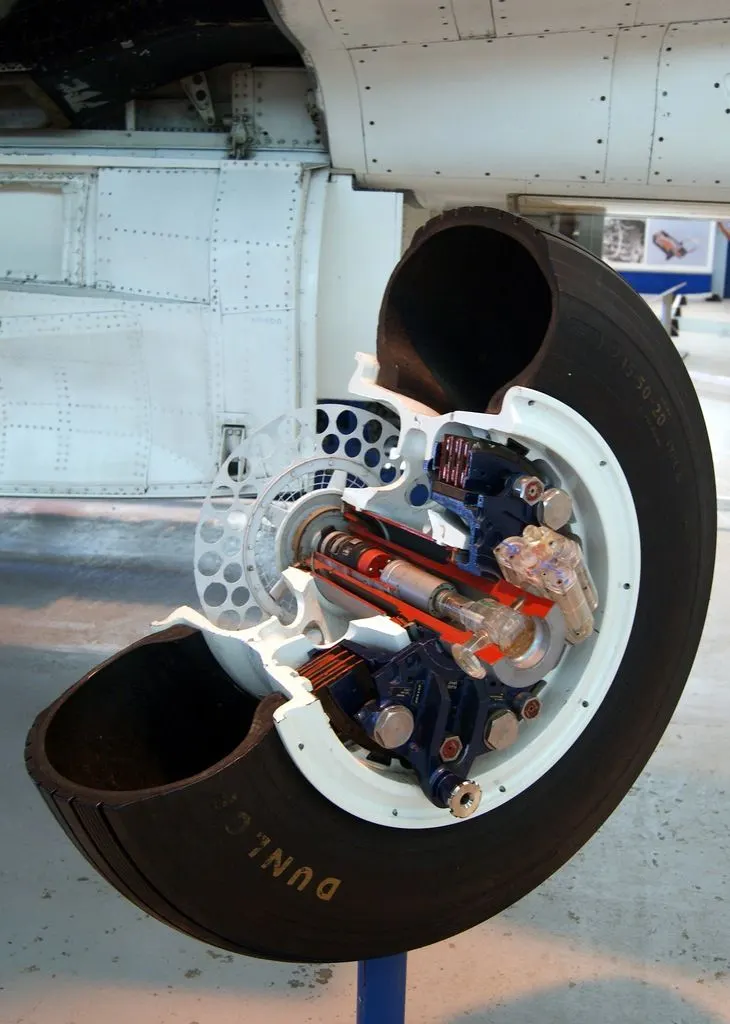
some of the techincal asspects of the air craft tyre :
Retreading – Retreading is methods of restoring a worn tyre by renewing the tread area or by renewing the tread area plus one or both sidewalls. Repairs are included in the tyre retreading process.
Load Rating – Load rating is the maximum permissible load at a specified inflation pressure.
Ply Rating – Ply Rating is used to identify the maximum recommended load rating and inflation pressure for a specified tyre. It is an index of tyre strength.
Speed Rating – The speed rating is the maximum takeoff speed to which the tyre has been tested.
Skid Depth – Skid depth is the distance between the tread surface and the deepest groove as measured in the mould.
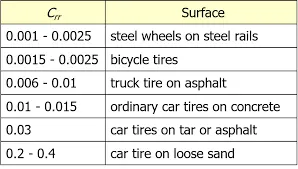
Rolling resistance, sometimes called rolling friction or rolling drag, is the force resisting the motion when a body (such as a ball, tire, or wheel) rolls on a surface. It is mainly caused by non-elastic effects; that is, not all the energy needed for deformation (or movement) of the wheel, roadbed, etc., is recovered when the pressure is removed. Two forms of this are hysteresis losses (see below), and permanent (plastic) deformation of the object or the surface (e.g., soil). Note that the slippage between the wheel and the surface also results in energy dissipation. Although some researchers have included this term in rolling resistance, some suggest that this dissipation term should be treated separately from rolling resistance because it is due to the applied torque to the wheel and the resultant slip between the wheel and ground, which is called slip loss or slip resistance. In addition, only the so-called slip resistance involves friction, therefore the name "rolling friction" is to an extent a misnomer.
The "rolling resistance coefficient" is defined by the following equation:

where
 = Rolling resistance force
 = dimensionless rolling resistance coefficient or coefficient of rolling friction (CRF)
- N = Normal force, the force perpendicular to the surface on which the wheel is rolling.
Tyre Pressure:-
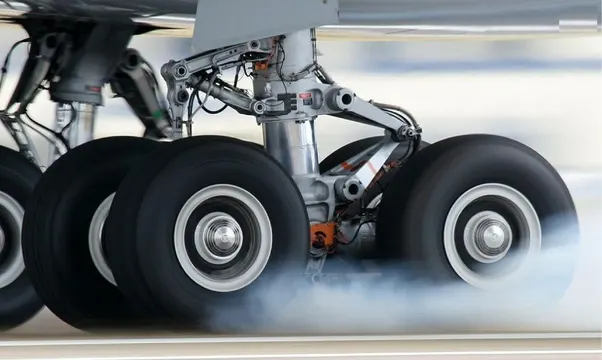
Depends on the weight of the plane and number of tires it has, but generally the cold pressure is between 200 and 300+ psi.They are rubber, like a car tire but specially formulated to stay flexible at -60 Deg F at altitude. They are still very cold after descent to touchdown.They are almost all radial tires but without steel belts. Kevlar is used as they do not have to withstand the road hazards a car tire does. The main landing gear on the Concorde was typically inflated to 232 psi (16.0 bar), whilst its tail bumper gear tires were as high as 294 psi (20.3 bar).
Brake Forces when landing:-
Stopping a 200-tonne aircraft landing at 180 mph requires a lot of braking force. To do this, the 787 has one brake unit on each of the eight wheels on the main gear assembly. On other aircraft types, the brake units are powered by the hydraulics system. An electrical signal is sent from the flight deck to hydraulic actuators near the main landing gear. Here, hydraulic fluid at 3,000 pound per square inch is used to force the brake unit against the wheel, thus slowing it down.
6. A. With necessary assumptions, calculate the force and power required to push / pull an aircraft by a towing vehicle.
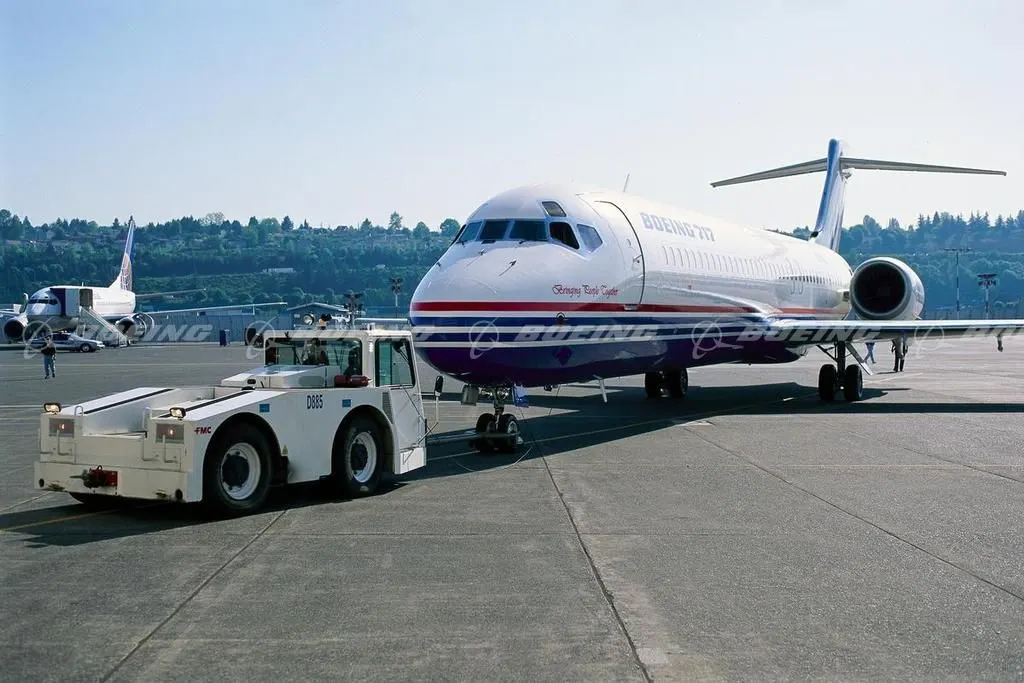
The forces required to push/ pull an aircraft by a towing are rolling resistance force and areodynamic drag force.
1)Rolling resistance force:- As we have discussed in part-A 5c. It is the force resisting the motion when a body (such as a ball, tire, or wheel) rolls on a surface. Its governing equation is given as
F= *m*g
where,
= Rolling resistance coefficient
m= Mass of the body
g= acceleration due to gravity
2)Aerodynamic Drag Force:-
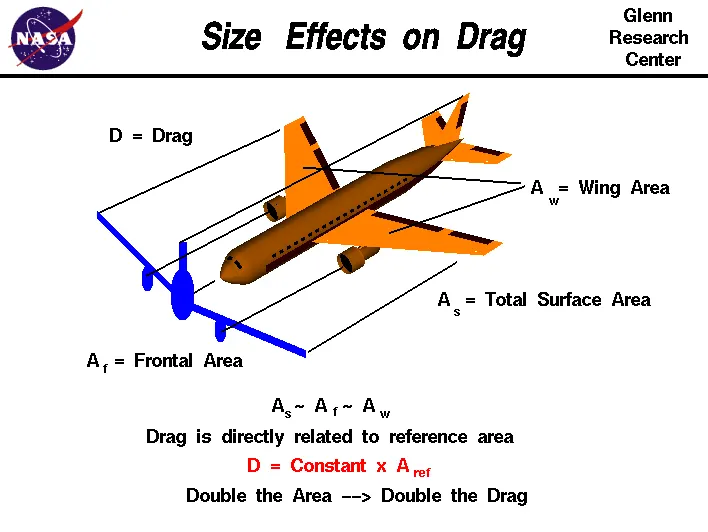
Drag is the aerodynamic force that opposes an aircraft's motion through the air. Drag is generated by every part of the airplane (even the engines!). Drag is a mechanical force.
The governing equation of these force is given as following:

where,
 = drag force
 = mass density of the air
 = flow velocity relative to the object
 = drag coefficient
 = reference area
Calculation:-
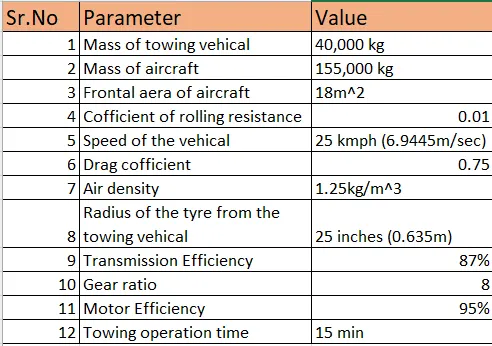
let us assume that,
Mass of Towing Vehicle= 40,000kg
Mass of aircraft = 155,000kg
Total mass (m)= 40,000+155,000 =195,000kg
Frontal Area of the aircraft (A) =18 m2
Speed of the vehicle ( ) =25Kmph
converting it into m/sec
= 25*(1000/3600)=6.9445m/sec
Drag coefficient (Cd) =0.75
Air density ( ) =1.25Kg/m3
Calculating Rolling resistance Force (Frr) = *m*g
= 0.01*195,000*9.8
= 19,110N
Calculating Aerodynamic Drag Force (Fd)=0.5* * Cd*A* v^2
=0.5*1.25*18*0.75*(6.9445)2
=406.907N
Therefore the total Force required to push/pull the aircrcraft by the towing vehicle (F) = Frr+ Fd
= 19,110+ 406.907
= 19,516.9075 N
Calculating the power (p) = Force*Velocity
= 19516.9075* 6.9445
=135.535kW
B. Develop the model for the calculated force and power using Simulink.
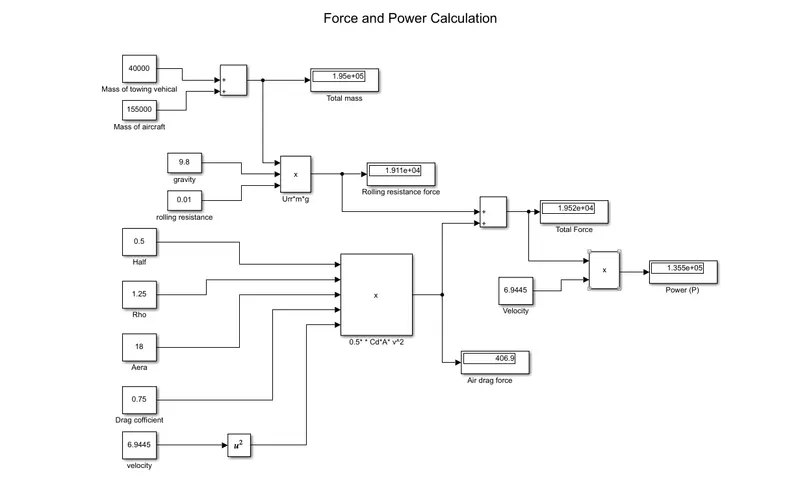
To Calculating the total force and power following steps has been follows:-
1. Take the constant, product, sum, display, square block.
2. To calculate the rolling resistance by using product block the multiply the rolling resistance mass and gravity.
3. To calculating air drag force by using the product block multiply the 1/2, rho, aera, drag cofficient, and using square block obtained the air drag force.
4. To calculate the total force by using the sum block add both the forces.
5. Then to calculate the power by using product block, mulitply the total force and velocity.
7. A. Design an electric powertrain with type of motor, it’s power rating, and energy requirement to fulfill aircraft towing application in Simulink. Estimate the duty cycle range to control the aircraft speed from zero to highest. Make all required assumptions. Prepare a table of assumed parameters. Draw a block diagram of powertrain.
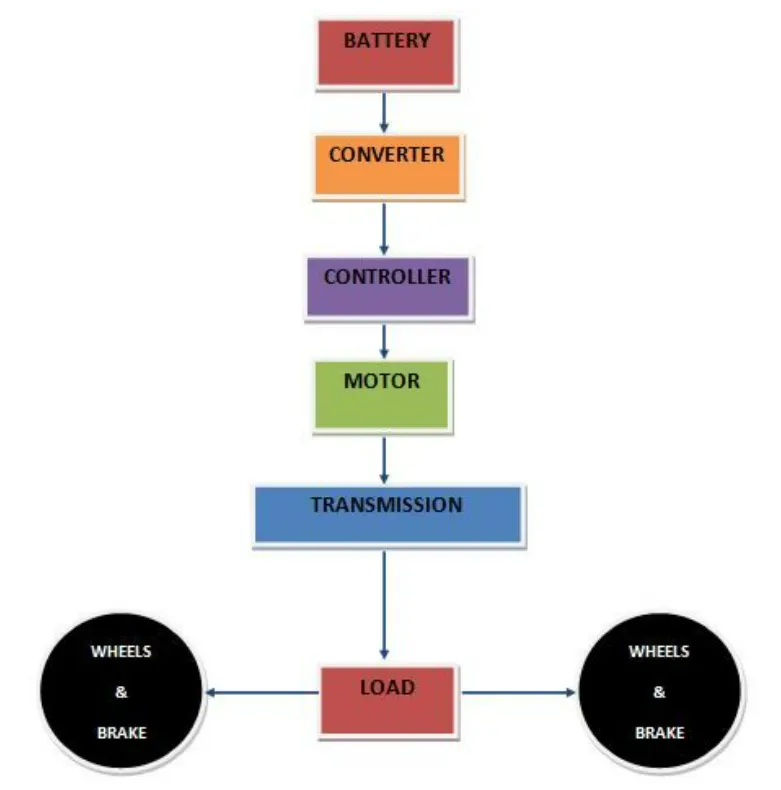
Based on the calculations done in 6A.
Force required to push/pull the aircraft =19.516 KN
Power required =135.535 kw
Let us assume,
The Radius of the Tyre for the Tug - 25inches =0.635m
Gear ratio=8
Transmission Effeciency (nt) =87%
Motor Efficiency (nm)=95%
then,
Torque required for the wheels (Tw)=Total Force *Radius in meters
=19.516 *0.635
=12.393KNm
Motor Torque-Wheel torque/(Gear ratio'nt)
=12.393/(8 *0.87)
=1.78KNm
For nm =95%. The required motor Torque (Tm)= 1.78/0.95 =1.873 kNm
Similarly. The total power required by the motor considering all the efficiencies (Pt) = 135.535/(0.87*0.95)=163.986Kw
Let us assume the towing operation was done for a 15 minutes (0.25Hrs) duration.
Then, Total Energy consumed = 163.986* 0.25=40.99 KWh
If we consider the battery capacity=220 kw is used by the towing vehicle then. The duty cycle range to control the speed from O to max speed (3m/s) is given as
Duty Cycle (d)= (Required Power)/ (Rated power)= 163.986/220 =0.74
Therefore the controller will be able to provide a duty cycle ranging from 0 to 74% in order to control the towing speed.
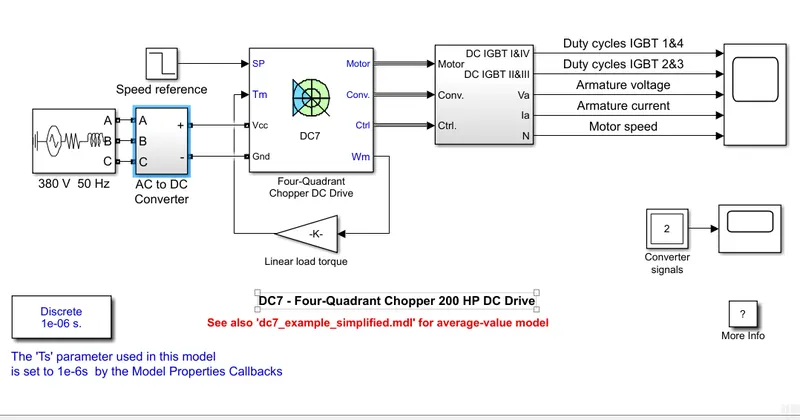
Below fig shows the simulik design of the powertrain
Graph for the required result
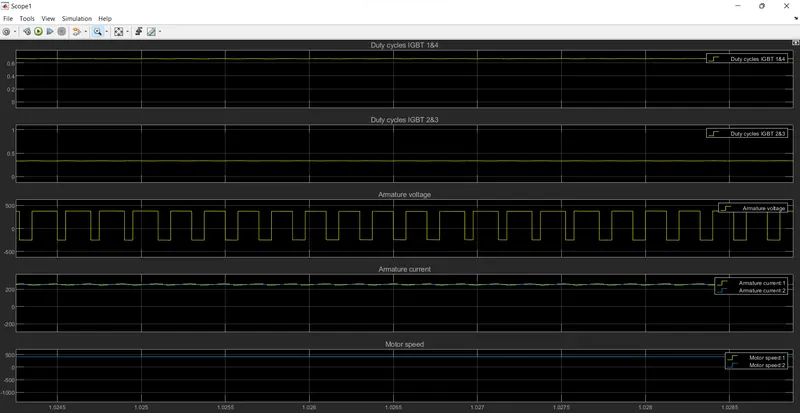
here above the graph shows the Motor speed of the vehical, igbt current which within range and the duty cycle.
B. Also, Design the parameters in excel sheet.