Project-1: Powertrain for aircraft in runways
PART A:
1. Search and list out the total weight of various types of aircrafts.
|
S.No. |
AIRCRAFT | Aircraft Empty Weight(AEW) ,Kg | Aircraft Useful Load(Fuel+Cargo+Passenger),kg | Maximum Gross Take-off Weight, kg |
| 1. | Airbus A380-800 | 277000 | 298000 | 575000 |
| 2. | Boeing-747-800 | 220100 | 227600 |
447700 |
| 3. | Airbus A340-500 | 168000 | 204000 | 372000 |
| 4. | Boeing 787-10 | 135500 | 118500 | 254000 |
| 5. | Airbus A320-100 | 42600 | 25400 | 68000 |
| 6. | Embraer190 | 28800 | 19200 | 48000 |
| 7. | Learjet75 | 6300 | 3400 | 9700 |
| 8. | Sirrus SR22 | 1000 | 630 | 1630 |
| 9. | Cessna17R | 770 | 330 | 1100 |
2. Is there any difference between ground speed and air speed?
Yes, ground speed and air speed both are different terminologies, but there is effect of airflow on the ground speed.
If the aircraft is flying in the same direction as the wind is blowing, ground speed will be higher than its airspeed.
If the aircraft is flying in the opposite direction as the wind is blowing, ground speed will be lower than airspeed.
- Ground Speed: It is the airplane’s speed relative to the surface of the Earth.Ground speed gives the idea about the time taken to reach the destination and horizontal distance covered by the aeroplane with time.
- Air Speed: The speed of airplane relative to the air it is flying in. It’s also the speed at which the air is flowing around the aircraft’s wings. Air speed determines whether there is enough airflow around an aircraft to make it fly.
3.Why is it not recommended to use aircraft engine power to move it on the ground at Airport?
- Generally the forward motion of planes at airport can be achieved by small thrust from propeller but planes do not have reverse gear that's why a towing vehicle is used to pushback planes.
- In case of large planes, it is safe to pull or push the plane always with help of towing vehicle because of high engine thrust can cause considerable damage to airplanes and other elements in the airport environment.
4. How an aircraft is pushed to runway when its ready to take off?
- An aircraft is pushed to runway away from the terminal building by a towing vehicle, the reverse movement can not be possible in planes but when it pushed to runway with the help of towing vehicle,now small engine power can be used for the forward motion.
5. Learn about take off power, tyre design, rolling resistance, tyre pressure, brake forces when landing.
- Take Off Power: The amount of power that an engine is allowed to produce for a limited period of time for takeoff.
- For plane to take off, three controls are to be done:1) Maintaining high speed and engine can provide enough upthrust force which can compensate drag force acting on plane body , 2) Activation of Slats and flaps which helps plane to lift up and 3) Maintaining angle of attack near to 15 degree.
- Elavators are activated upwards to make plane's back down in order to make angle of attack.
- Tyre design: Planes tyres are not a solid but made layer by layer, there are mainly four major parts that any plane tyre comprised: 1)Beads, 2)Carcass plies, 3)Treads, 4)Sidewalls and one more part is added to these tyres that is chins which prevent surface water to spray from tyres into engine.
- Tyres are also reinforced with steel and aluminium in order to bear the overall plane load and also work as shock absorber.
- Beads are wires made up of high carbon steel which makes robust dimension of tyre preventing stretching of tyres from wheel ring. Beads are then filled within rubber as shown above.
- Now comes carcass plies, this is the layers of the nylon, polyster or rayon filled between rubber and there are many such rubber-coated fabric plies which have the cords running radially from bead to bead.
- Treads are the upper most part of tyre made up of rubber, which is made strong enough to bear high pressure, temperature and atmoshperic weather effects.
- Sidewall of tyre help in binding all the tyre frame together. Tyre sidewalls are built to be strong to withstand the pressure.
Rolling Resistance: It is the force resisting the motion of when body rolls on surface.
- The coefficient of rolling resistance is the function of tire material, tire structure, tire inflation pressure,road roughness and tire geometrey ,also affected by absense or presence of liquid on road.
Tyre Pressure:
- An aircraft tire or tyre is designed to withstand extremely heavy loads for short durations. The number of tires required for aircraft increases with the weight of the aircraft.
- Aircraft tire tread patterns are designed to facilitate stability in high crosswind conditions, to channel water away to prevent hydroplanning, and for braking effect.
- Aircraft tyre pressure varies from 30 psi to 250 psi depending upon the maximum gross weight of aircraft.
- Aircraft tyres include Fusing plugs designed to melt at a certain temperature.
- Tires often overheat if maximum braking is applied during an aborted takeoff or an emergency landing.The fuses provide a safer failure mode that prevents tire explosions by deflating in a controlled manner.
Brake force:
- Spoilers and thrust reverser are used to slow down the speed of plane while landing.
- Then brakes are applied through rudder pedal which is connected with hydraulic system installed at main landing gears of plane.
- Presurised fluid is applied by hydraulic system to the carbon discs mounted on planes tyre, in addition to this accumulator or pneumatic system is provided in case of failure of hydraulic system.
- Anti skid braking system is achieved by monitoring the speed of both left and right landing gears and comparing it with plane's speed. This can be done by installing techometers at landing gears.
- If there is speed difference found between airplane speed and landing gears the valve of hydraulic pressure pipe is adjusted and brake is released or applied prevent skidding.
Part B:
6. A. With necessary assumptions, calculate the force and power required to push / pull an aircraft by a towing vehicle.
- When plane is at airport towing vehicle is used to push aircraft.
- To move this much heavy airplanes the large amount of force is required, there are mainly two forces which need to overcome to move airplanes: 1) Rolling Resistance force, 2) Airdrag force
- Rolling resistance force can be calculated by; Frr = µrr*m*g, where µrr is coefficient of rolling resistance.
- Coefficient of Rolling resistance varies over different surfaces ,some value are given in table below.
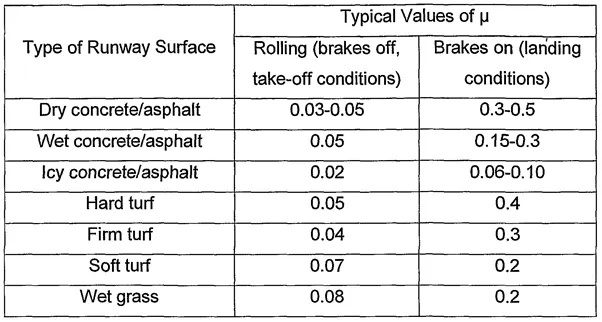
- Airdrag force can be calculated by ; Fad = 0.5*ρ*Cd*A*v^2, where ρ is air density in kg/m^3 Cd is drag coefficient , A is frotal area and v is velocity in m/s.
- Drag coefficient depends on shape and size of the object, velocity and direction of flow, and Mass, viscosity, and compressibility of air.
Let's assume parameters to calculate required force and power to move aircraft at runway:
- Maximum Gross weight of aircraft (Boeing 787-10) = 2,54000 kg.
- Weight of towing vehicle = 40,000 kg.
- Total mass, m = 254000+40000 = 294000 kg.
- Coefficient of rolling resistance, µrr = 0.025
- Drag Coefficient, Cd = 0.56
- Gravitational acceleration, g = 9.81 m/s^2
- Frontal area of aircraft, A = 190 m^2.
- Air density, ρ = 1.25 kg/m^3
- Velocity of vehicle, v = 18kmph or 5 m/s
Frr = µrr*m*g = 0.025*294000*9.81 = 72103.5 N
Fad = 0.5*ρ*Cd*A*v^2 = 0.5*1.25*0.56*190*(5)^2 = 1662.5 N
Hence, total Force required to push/pull the aircraft by the towing vehicle (F) = Frr+Fad = 72103.5 + 1662.5 = 73766 N
Now, calculating power required by towing vehicle to push/pull plane will be: F*v = 73766 * 5 = 368.83 kW
6.B. Develop the model for the calculated force and power using Simulink.
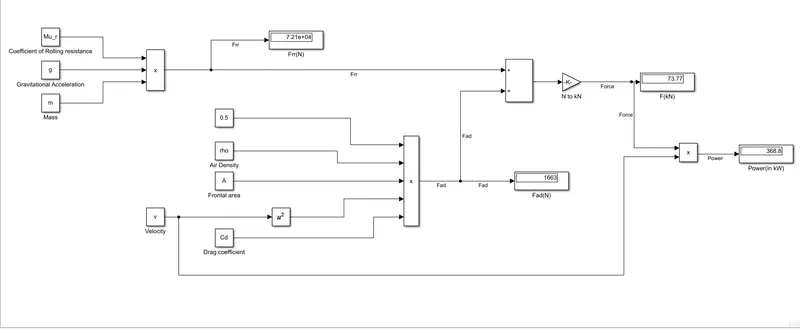
- This model is simply based on mathematical calculations so we require some constant blocks to assign parameters , some product and sum blocks.
- Connecting all parameters as per the equation of Frr and Fad as discussed before.
- And then we will calculate power as per equation, P = F*v.
- Values of all parameters are taken as before and given as an Init File to model.
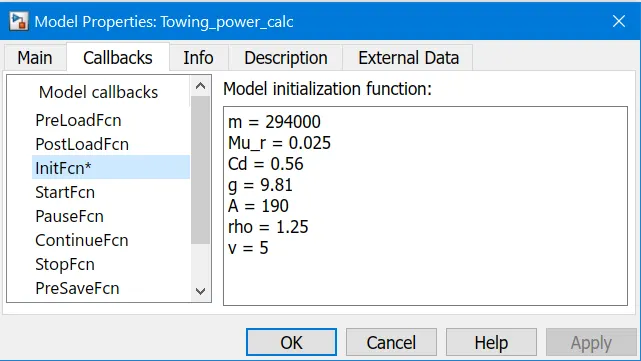
- The model:
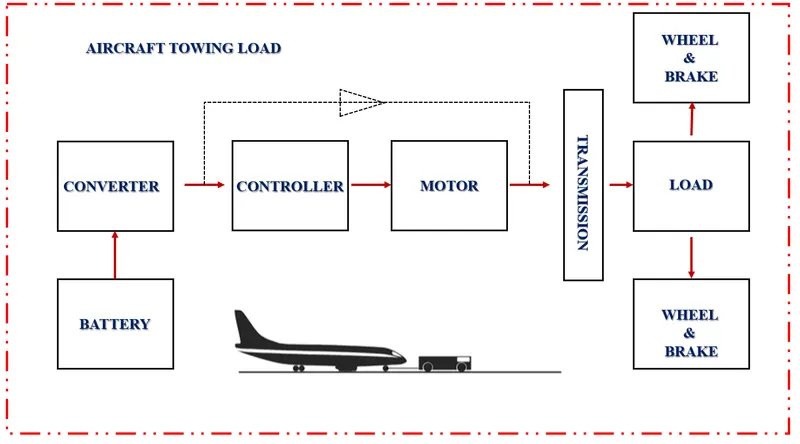
7. A. Design an electric powertrain with type of motor, it’s power rating, and energy requirement to fulfill aircraft towing application in Simulink. Estimate the duty cycle range to control the aircraft speed from zero to highest. Make all required assumptions. Prepare a table of assumed parameters. Draw a block diagram of powertrain.
- List of all assumed parameters for powertrain is given in table below.
S.No. Parameters Value 1 Maximum gross weight of airplane(kg) 254000 2 Towing Tug weight (kg) 40000 3 Coefficient of rolling resistance 0.025 4 Air density(kg/m^3) 1.25 5 Frontal area (m^2) 190 6 Width(m) 10 7 Height(m) 19 8 Drag coefficient 0.56 9 Speed of towing vehicle(kmph) 18 10 Travel time for towing truck(in seconds) 120 11 Tyre radius(m) 0.5 12 Gear ratio 30:1 13 Trasmission efficiency(%) 85 14 Motor efficiency(%) 90 15 Motor output voltage(volts) 450 16 Output power factor 0.86 - Resistance force calulation:Formula used to calculate rolling resistance: Frr = µrr*m*gFormula used to calculate rolling resistance: Fad = 0.5*ρ*Cd*A*v^2
Frr = µrr*m*g = 0.025*294000*9.81 = 72103.5 N
Fad = 0.5*ρ*Cd*A*v^2 = 0.5*1.25*0.56*190*(5)^2 = 1662.5 N
Hence, total Force required to push/pull the aircraft by the towing vehicle (F) = Frr+Fad = 72103.5 + 1662.5 = 73766 N
- Torque calculation:
- Wheel torque = total_force*tyre_radius = 73766 * 0.5 = 36883 N-m.
- Motor torque = Wheel torque/(Gear ratio*transmission efficiency) = 36883/(30*0.85) = 1446.4 Nm.
- Power calculation:
Calculating power required by towing vehicle to push/pull plane will be: F*v = 73766 * 5 = 368.83 kW.
Input power = output power/efficiency = 368.83kW/0.9 = 409.8kW
Motor speed = Output Power / motor torque = 368830/1446.4 = 255 rad/sec = 2436 RPM
Motor current = 368830/(3.14*450*0.86) = 611.3 ampere
Battery voltage = 409811/611.3 = 670.4 volts.
- Duty cycle = motor Output voltage/Battery voltage = 450/611.3 = 0.69
- Energy required = input power*travel time = 409811*120/(1000*3600)= 13.7 kWh.
Ratings of motor:
| Rated Voltage | Rated Power | Rated Speed | Maximum Torque | Output power factor |
| 450V | 400 kW | 2500 RPM | 1500 Nm | 0.86 |
Block diagram of powertrain:
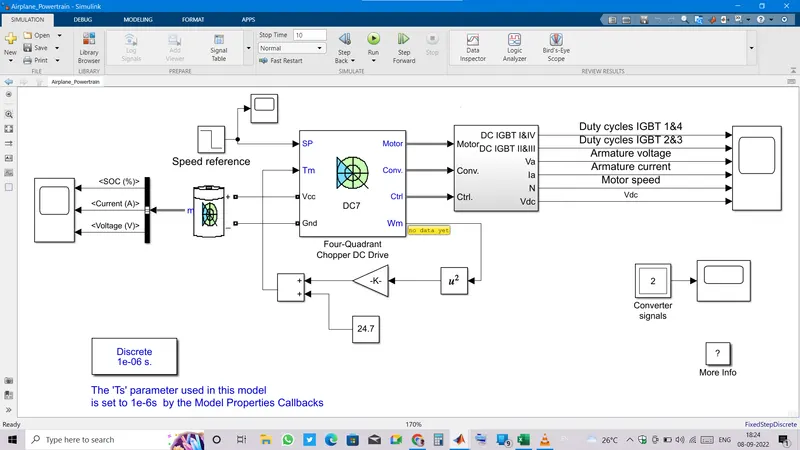
Simulimk Model:
Result plots:
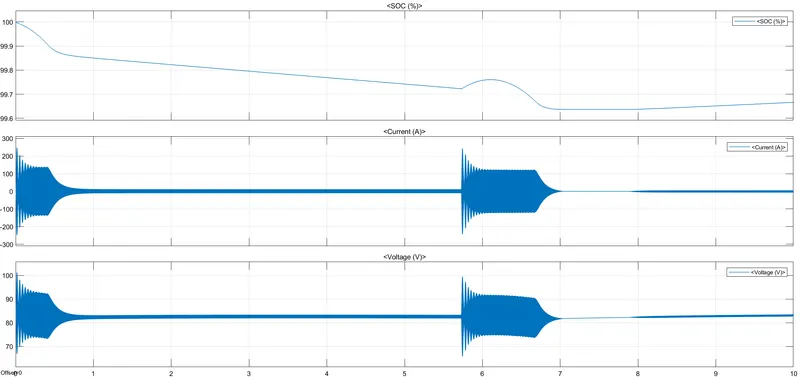
Battery plots:
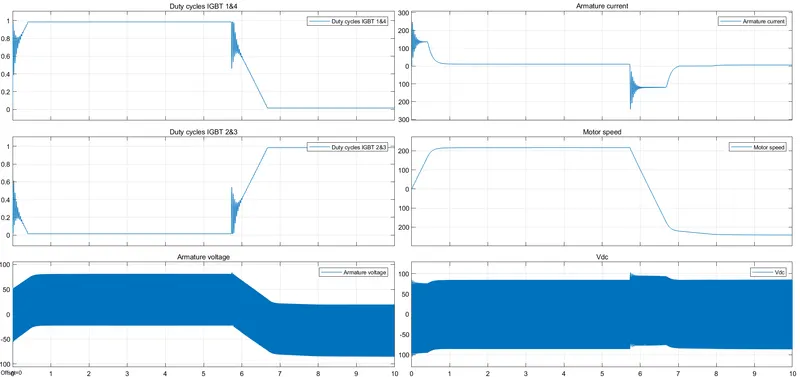
Motor plots:
B). Also, Design the parameters in excel sheet.
- In excel calculation,all the parameter values are taken as same as previously given in table.