Project-1: Powertrain for aircraft in runways
PART A
1) Search and list out the total weight of various types of aircrafts
AIRCRAFTS :
Any vehicle that is manufactured and made to fly in the air is called an aircraft While the aeroplane is the most known, familiar, and popular kind of aircraft we know, other vessels that fly through the air also come in this category.
CLASSIFICATION OF AIRCRAFT :
In most common terms, there are two types of classifications for aircrafts
- aerostats
- aerodynes
AEROSTATS :
Aerostats or lighter than air aircrafts are very more lightweight in weight. These types of light aircraft generally use buoyancy like ships, which helps them float in the air.
Low-density gas such as hydrogen, helium, or hot air balloons is used to fill in the aircraft.
The most common types of aerostats known to us are hot air balloons and sky lanterns.
AERODYNES :
heavier than air or aerodynes, as we understand, is much higher in weight and size. They push the gas or air downwards, which reaction helps to make aircraft upwards. Since these are dynamic through movements in the air, they are called aerodynes
TYPES OF AIR CRAFT IN WORLD :
- Amphibious
- Helicopters
- Multi-Engine Piston
- Biplanes
- Balloons
- Gliders
- Gyroplanes
- Parachutes
- Single Engine Piston Aircraft
- Tricycle Gear Aircraft
- Business Jets
- Taildraggers
- Tiltrotors
- Light-Sport Aircraft
- Turboprops
Amphibious :
maximum takeoff weight is 1,430 lbs.
Exterior Height: 8 ft 1 in; Wing Span: 34 ft 8 in; Length: 23 ft
Helicopters :
helicopters can weigh anywhere from 600 lbs/ 275 kg/ 0.275 tonnes to 123,400 lbs/ 56,000 kg/ 56 tonnes
Helicopters can be classified according to the five following weight categories.
- Ultra-light : Ultra light helicopters weigh up-to 254 lbs/115 kg/ 0.115 tonnes when empty
- Light : Light helicopters have a maximum gross weight up-to 3,500 lbs/1,590 kg/ 1.590 tonnes
- Intermediates: Intermediate helicopters have a maximum gross weight up-to 7,000 lbs/ 3,180 kg/ 3.18 tonnes
- Mediums : Helicopters classified as mediums have a maximum gross weight up-to 12,500 lbs/ 5,670 kg/ 5.67 tonnes
- Heavies : Helicopters known as heavies have a maximum gross weight exceeding 12,500 lbs/ 5,670 kg/ 5.67 tonnes
Multi-Engine Piston :
Multi-engine aircraft that weigh less than 6,000 pounds and with a V S0 airspeed under 61 knots have no minimum performance criteria specified
Biplanes :
Airplanes can weigh between 2,000 pounds (907 kg) for a small Cessna, to upwards of over 1 million pounds (453,592 kg) during takeoff for an Airbus A380.
Balloons :
An average basket normally weighs between 130-180 lbs. Taken together, an average hot air balloon weighs between 280-430 lbs, not including fuel tanks or other equipment. Of course, hot air balloons can be much larger, weighing several thousand pounds.
glider :
The glider was designed by the Waco Aircraft Company. The first aircraft took to the skies in May 1942. In all, over 13,900 CG-4As were delivered. It is one of the largest gliders on the market, with a gross weight of 4197 pounds and a maximum takeoff weight of 8000 pounds.
Parachutes:
The GRS 5/560, the GRS 6/600 SD and the GRS 6/650 SD whole-plane rescue systems are designed for motorized aircraft weighing up to 560 kg, 600 kg and 650 kg, respectively (1,33 lbs; 1,333 lbs and 1,444 lbs). These parachutes are commonly used in light sport aircraft.
Single Engine Piston Aircraft:
single-engine piston engine EFIS Cruise speed: 70 kt - 140 kt Max. take-off weight : 1,000 lb
Tricycle Gear Aircraft:
Find the Empty Weight CG location for the following tricycle gear aircraft. Each main wheel weighs 753 pounds, nose wheel weighs 22 pounds, distance between nose wheel and main wheels is 87.5 inches, nose wheel location is +9.875 inches from the datum, with 1 gallon of hydraulic fluid at –21 inches included in the aircraft weight.
2) Is there any difference between ground speed and air speed?
| S.NO | AIR SPEED |
GROUND SPEED |
| 1 | airspeed is measured relative to the air through which the plane is flying. | Ground speed is measured relative to the Earth below the plane |
| 2 | horizontal distance, for measurement, | airspeed measures only the flow of air around the plane AND The second way of measuring airspeed is calibrated airspeed. |
3) Why is it not recommended to use aircraft engine power to move it on the ground at Airport?
Aircraft can move using their own engine power all the time on the airport apron and taxiways under their own power to go towards runways and after landing taxi to their assigned gate. But the thrust produced resulting jet blast might cause damage to the terminal building or equipment.
4) How an aircraft is pushed to runway when its ready to take off?
A so-called pushback truck reverses the aircraft into taxiing position, pushing it with a towbar attached to the nose-wheel strut. Or, in the most modern versions, by actually lifting the wheel. That speeds up coupling and decoupling. The aircraft taxis to the runway to depart at the agreed time.
5) Learn about take off power, tyre design, rolling resistance, tyre pressure, brake forces when landing.
TAKE OFF POWER :
He takeoff in any aircraft occurs when the airplane leaves the ground and becomes airborne. However, there is a lot more to it than that. There are a number of things which need to be done in advance, and the takeoff itself is split into a few different stages.
Any aircraft, from a small single-engined training airplane to a large passenger carrying airliner. Obviously some of the procedures will be slightly different in aircraft of different sizes and types.
Taxi-ing the aircraft involves moving it along the ground from where it has been parked, up to the start of the runway. During taxi-ing, there are other checks which need to be done, mainly to ensure that the steering on the ground works as it should do
Small aircraft are steered by use of the rudders, with the pilot using his feet on the pedals. The pilot does not use the yoke or stick for this purpose – although it is not unusual to see new trainee pilots attempting to do so! Some aircraft are difficult to steer on the ground, particularly those with a tailwheel. However, there are not that many tailwheel aircraft being flown any more, and most modern aircraft are fairly easy to taxi. Nevertheless, taxi-ing must be done slowly and with care. The wings of an aircraft stick out further than the pilot often expects them to, and accidents during taxi-ing are not that uncommon
As should be clear by now, the takeoff is an important part of flying. It is usually not difficult, but there are many things which can go wrong. So the takeoff should be treated with care and caution to ensure a safe fligh
TYRE DESIGN :
An essential part of aircraft tire design, Finite Element Method (FEM) technology is utilized to predict tire component stress-strain and heat generation characteristics. The tire structure to be analyzed is divided into finite elements, normally triangular or quadrangular
When it comes to safety, tyres are one of the most important components of aircraft. They help to absorb the shock of landing and provide cushioning. It also provides the necessary traction for braking and stopping of an aircraft. An aircraft tyre is designed to withstand extremely heavy loads while landing, take off, taxing, and parking. The number of wheels required for aircraft increases with the weight of the aircraft, as the weight of the aeroplane needs to be distributed more evenly.
A Boeing 737NG & 737MAX uses 6 wheels, Boeing 787 uses 10 wheels, Boeing 777 uses 14 wheels and Airbus A380 uses 22 wheels.
Retreading – Retreading is methods of restoring a worn tyre by renewing the tread area or by renewing the tread area plus one or both sidewalls. Repairs are included in the tyre retreading process.
Load Rating – Load rating is the maximum permissible load at a specified inflation pressure
Ply Rating – Ply Rating is used to identify the maximum recommended load rating and inflation pressure for a specified tyre. It is an index of tyre strength.
Speed Rating – The speed rating is the maximum takeoff speed to which the tyre has been tested.
Skid Depth – Skid depth is the distance between the tread surface and the deepest groove as measured in the mould.
Aircraft tyres must have an approved speed and load rating and have sufficient clearance when retracted through landing gear to allow for tyre growth. Tyre growth is the increase in the size of the tyre due to centrifugal forces at high speed.
Tubeless tyres :
Tubeless tyres are more advantageous over tube-type. There is no longer the use of tube-type tyre in recent aviation. Nowadays all airliners are using tubeless tyres. Tubeless that are meant to be used without a tube has the word TUBELESS on the sidewall of the tyre.
Are avation tyres are conducted?
Yes, Today’s tyres are conductive. Aircraft tyres are manufactured with tread rubber with conducting compounds to permit earthing of static charges.
In early days when tyres were not sufficiently conductive, aircraft used to have a conductive strip hanging down from the axle of the landing gear. Upon landing, this strip would be the first part of the aircraft to touch the earth. This discharges any static electricity accumulated on the outer surfaces of the aircraft. Now you don’t see them anymore.
Aircraft tyre standards :
Each tyre manufacturer produces their own designs of the tyre with different tread patterns, wear patterns, wear limits etc, and in some cases, different names for the same part of the tyre. But all tyres must meet the approved standards before being accepted by the FAA or CAA.
All commercial aircraft tyres approved under FAA Requirement Technical Standard Order (TSO) C62. A TSO is a minimum performance standard for specified materials, parts, and appliances used on civil aircraft.
ROLLING RESISTANCE :
The force to move an airplane on an absolute flat runway with no wind at constant low speed is equal to the rolling resistance between the plane and the tarmac. The rolling resistance for the air plane can be calculated as
Fr = c mr ag
where
Fr = rolling resistance (N, lbf)
c = rolling resistance coefficient
mr = rolling mass (kg, lbm)
ag = acceleration of gravity (9.81 m/s2)
TYRE PRESSURE :
An aircraft tire or tyre is designed to withstand extremely heavy loads for short durations. The number of tires required for aircraft increases with the weight of the aircraft, as the weight of the airplane needs to be distributed more evenly. Aircraft tire tread patterns are designed to facilitate stability in high cross wind conditions, to channel water away to prevent hydroplanning, and for braking effect.
Aircraft tires also include fusible plug (which are assembled on the inside of the wheels), designed to melt at a certain temperature. Tires often overheat if maximum braking is applied during an aborted takeoff or an emergency landing The fuses provide a safer failure mode that prevents tire explosions by deflating in a controlled manner, thus minimizing damage to aircraft and objects in the surrounding environment.
Aircraft tires generally operate at high pressures, up to 200 psi (14 bar; 1,400 kPa) for airliners, and even higher for business jets [citation needed]. The main landing gear on the Concorde was typically inflated to 232 psi (16.0 bar), whilst its tail bumper gear tires were as high as 294 psi (20.3 bar).
pressure test :
Tests of airliner aircraft tires have shown that they are able to sustain pressures of maximum 800 psi (55 bar; 5,500 kPa) before bursting.
During the tests the tires have to be filled with water, to prevent the test room being blown apart by the energy that would be released by a gas when the tire bursts.
Aircraft tires are usually inflated with nitrogen to minimize expansion and contraction from extreme changes in ambient temperature and pressure experienced during flight
ry nitrogen expands at the same rate as other dry atmospheric gases (normal air is about 80% nitrogen), but common compressed air sources may contain moisture, which increases the expansion rate with temperature
BRAKE FORCES WHEN LANDING :
To brake the plane, friction is applied to both sides of the disc using a non-rotating caliper attached to the landing gear flange. The movement of the caliper is initiated by pistons inside it. These pistons, under hydraulic pressure, force the brake pads or linings against the rotating disc when the brake is applied
PART B
6)
A) With necessary assumptions, calculate the force and power required to push / pull an aircraft by a towing vehicle
In assumption
| Kerb weight (kg) | 4000 |
| payload (kg) | 3000 |
| mass(kg) | 7000 |
| gravitiy | 9.8 |
| width(m) | 1 |
| height(m) | 1.5 |
| air density(kg/m^3) | 1.2 |
| drag coefficient | 0.3 |
| coefficient rolling resisitance | 0.002 |
| frontal area (m^2) | 1.5 |
Rolling resistance force:
Frr=Crr⋅m⋅g
Frr=(0.002)⋅(575,000)⋅(9.81)">Frr=(0.002)⋅(7000)⋅(9.81)
Frr=(0.002)⋅(575,000)⋅(9.81)">Frr=(0.002)⋅(7000)⋅(9.81)
Frr=11.2815kN">Frr=0.13734kN
Frr=11.2815kN">Aerodynamic drag force:
Frr=11.2815kN">Far=1/2⋅Cd⋅ρ⋅A⋅v^2
Frr=11.2815kN">Far=1/2*0.3*1.2*1.5*(14.5^2)
Frr=11.2815kN">Far=56.76N
Hill climbing power is less in aircraft
therefore
total power = Fte*v
where ,
Fte = Frr+Far+Fhc
Fte = 0.1373+56.76
Fte = 56.89
Total power = 56.89 * 4m/s
power =227 kw
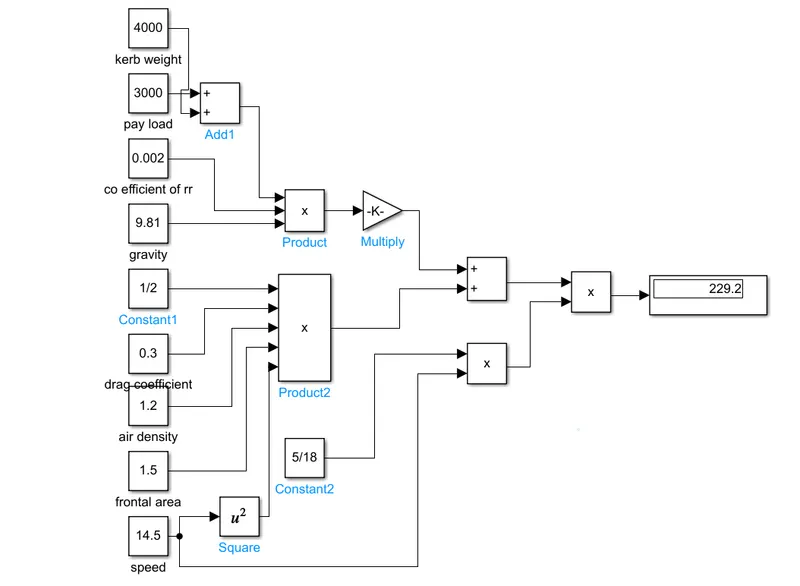
B) Develop the model for the calculated force and power using Simulink.
this is simulink model for above calculation.
7)
A) Design an electric powertrain with type of motor, it’s power rating, and energy requirement to fulfill aircraft towing application in Simulink. Estimate the duty cycle range to control the aircraft speed from zero to highest. Make all required assumptions. Prepare a table of assumed parameters. Draw a block diagram of powertrain.
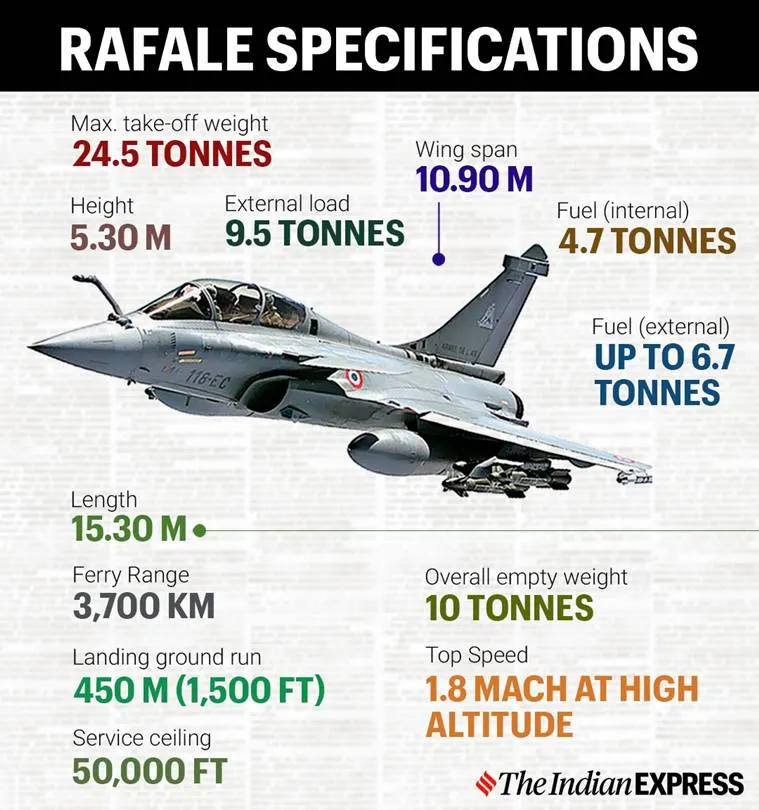
here choosen for rafale aircraft to calculate a power rating,energy and type of motor and duty cycle.
specification of rafale aircraft :
TYPE OF MOTOR :
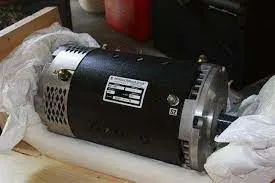
we choose DC motor for the power train
POWER RATING :
input power = output power + losses in machine
let us assume efficiency is 85%
output power = 102.505KW
the output power is taken from Dc motor output.
therefore ,
efficiency = output power / input power
input power = output power / efficiency
= 102.505 / 0.85
input power =120.59 KW
ENERGY CALCULATION :
energy = power * time
=120.59 * 3600
energy = 434124Wh
DUTY CYCLE CALCULATION :
duty cycle = output power /input power
= 102.505 / 120.59
duty cycle = 0.85%
BLOCK DIAGRAM OF POWER TRAIN :
powertrain model :
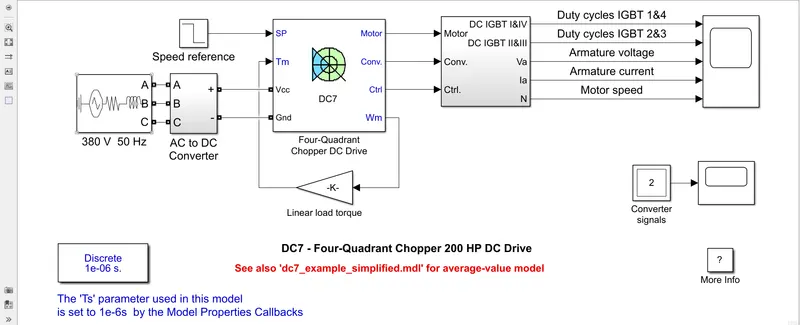
this is model for powertrain and it's used a four-quadrant chopper DC drive
input is 380v AC supply its convert into dc supply using AC to DC converter
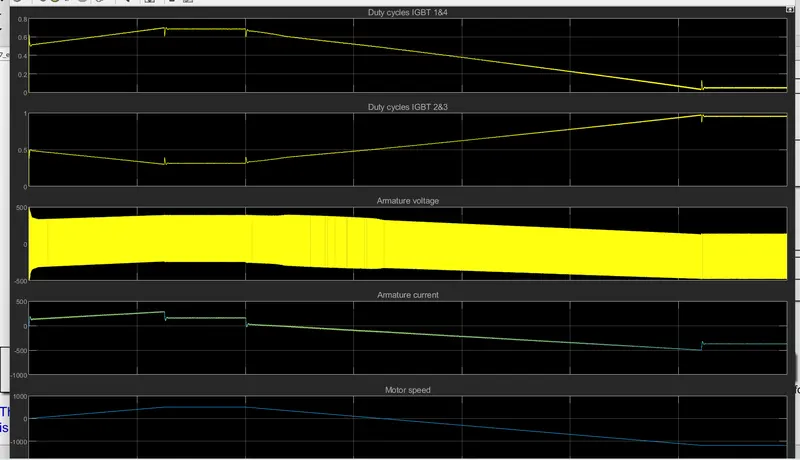
output :
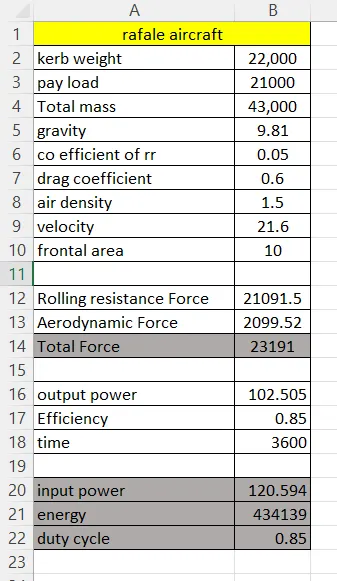
B)Design the parameters in excel sheet.