Project-1: Powertrain for aircraft in runways
Aircraft:
Any vehicle that is manufactured and made to fly in the air is called an aircraft.
One is lighter than air aircrafts, known as aerostats, and the other is heavier than air aircrafts, called aerodynes.
Two classifications of Aircrafts:
1.Aerostats(Lighter than air aircrafts)
2.Aerodynes(Heavier than air aircrafts)
Aerostats (Lighter Than Air):
Aerostats or lighter than air aircrafts are very more lightweight in weight. These types of light aircraft generally use buoyancy like ships, which help them float in the air.
Low-density gas such as hydrogen, helium, or hot air balloons is used to fill in the aircraft. This low-density gas is lighter than air, and hence the name. The most common types of aerostats known to us are hot air balloons and sky lanterns.
Aerodynes (Heavier Than Air):
This is heavier than air or aerodynes, as we understand, is much higher in weight and size.
They push the gas or air downwards; which reaction helps to make aircraft upwards. Since these are dynamic through movements in the air, they are called aerodynes.
Classifications:
1.Fixed wing -which is a aeroplanes where their wings are fixed and the mechanism is to adjusted by the little movement in wings
2. Rotor shaft type which is the helicopter where the rotor rotates in the top side for the movements
The aircraft has:
- Basic Empty Weight (BEW) is the weight of the aircraft "as built" and includes the weight of the structure, power plant, furnishings, installations, systems and other equipment that are considered an integral part of an aircraft before additional operator items are added for operation.
- Dry Operating Wieght (DOW) BEW + Weight of Crew (Pilot + Cabin including their bags) + Pantry
- Operating Weight (OW) DOW + Takeoff fuel (i.e. Ramp Fuel - Taxi fuel)
- Maximum Zero Fuel Weight (MZFW) DOW + Payload (anything put on the aircraft that generates revenue to the company, e.g. passenger, baggage, cargo, mail and fret)
- Maximum Taxi Weight (MTW) MZFW + Ramp fuel
- Maximum Takeoff Weight (MTOW) MZFW + Takeoff fuel, or MTW - Taxi fuel
- Maximum Landing Weight (MLW) MTOW - Trip Fuel
| Aircraft | Empty Weight | Max Fuel Weight | Max Cargo Weight | Max Gross Takeoff Weight |
|---|---|---|---|---|
| Antanov AN-225 | 628,000 lbs 285,000 kg |
661,400 lbs 300,000 kg |
417,000 lbs 190,000 kg |
1,411,000 lbs 640,000 kg |
| Airbus A380-800 | 611,000 lbs 277,000 kg |
560,000 lbs 254,000 kg |
185,000 lbs 84,000 kg |
1,268,000 lbs 575,000 kg |
| Boeing 747-800 | 485,300 lbs 220,100 kg |
427,400 lbs 194,000 kg |
295,000 lbs 134,000 kg |
987,000 lbs 447,700 kg |
| Airbus A340-500 | 370,000 lbs 168,000 kg |
386,300 lbs 175,000 kg |
119,000 lbs 54,000 kg |
820,000 lbs 372,000 kg |
| Boeing 777-300ER | 370,000 lbs 168,000 kg | 320,800 lbs 145,500 kg | 148,000 lbs 67,100 kg |
776,000 lbs 352,000 kg |
| Boeing 787-10 | 299,000 lbs 135,500 kg | 223,500 lbs 101,500 kg |
126,300 lbs 57,300 kg | 560,000 lbs 254,000 kg |
| Boeing 737-900 | 98,500 lbs 44,700 kg |
53,100 lbs 24,000 kg |
44,600 lbs 20,200 kg |
187,000 lbs 85,000 kg |
| Airbus A320-100 | 93,900 lbs 42,600 kg |
48,700 lbs 22,100 kg |
44,000 lbs 20,000 kg |
150,000 lbs 68,000 kg |
| Embraer 190 | 63,500 lbs 28,800 kg |
28,600 lbs 13,000 kg |
28,800 lbs 13,100 kg |
106,000 lbs 48,000 kg |
| Gulfstream G650 | 54,000 lbs 24,500 kg | 48,200 lbs 21,900 kg | 6,500 lbs 3,000 kg |
100,000 lbs 45,200 kg |
| Bombardier CRJ900 | 48,160 lbs 21,850 kg | 19,600 lbs 8,900 kg | 6,075 lbs 2,760 kg | 80,500 lbs 36,500 kg |
| Bombardier Q400 | 39,300 lbs 17,800 kg |
11,700 lbs 5,300 kg |
18,700 lbs 8,500 kg |
62,000 lbs 28,000 kg |
| Learjet 75 | 13,900 lbs 6,300 kg | 6,060 lbs 2,750 kg |
2,900 lbs 1,300 kg |
21,500 lbs 9,700 kg |
| Cessna Citation CJ4 | 10,300 lbs 4,700 kg | 5,800 lbs 2,650 kg |
2,200 lbs 1,000 kg | 17,200 lbs 7,800 kg |
| Beechcraft King Air B100 | 7,100 lbs 3,200 kg | 3,200 lbs 1,450 kg |
4,150 lbs 1,900 kg |
12,000 lbs 5,400 kg |
| Diamond DA50 RG | 3,200 lbs 1,450 kg |
340 lbs 155 lbs |
1,250 lbs 560 kg |
4,400 lbs 2,000 kg |
| Beechcraft Bonanza G36 | 2,500 lbs 1,150 kg | 450 lbs 200 kg |
850 lbs 385 kg |
3,660 lbs 1,660 kg |
| Cessna 206H | 2,200 lbs 990 kg |
520 lbs 235 kg |
1,150 lbs 520 kg |
3,600 lbs 1,630 kg |
| Sirrus SR22 | 2,250 lbs 1,000 kg | 485 lbs 220 kg |
950 lbs 430 kg |
3,600 lbs 1,630 kg |
| Cessna 172R | 1,700 lbs 770 kg |
380 lbs 170 kg |
560 lbs 255 kg |
2,425 lbs 1,100 kg |
These are the different weights of the AIRCRAFT.
2. Is there any difference between ground speed and air speed?
Ground Speed:
While ground speed is the airplane’s speed relative to the surface of the Earth, airspeed – at least
Air speed:
Air speed is its speed relative to the air it is flying in it.
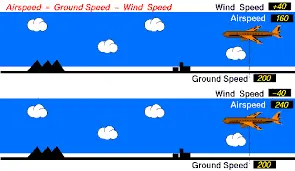
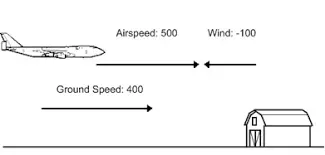
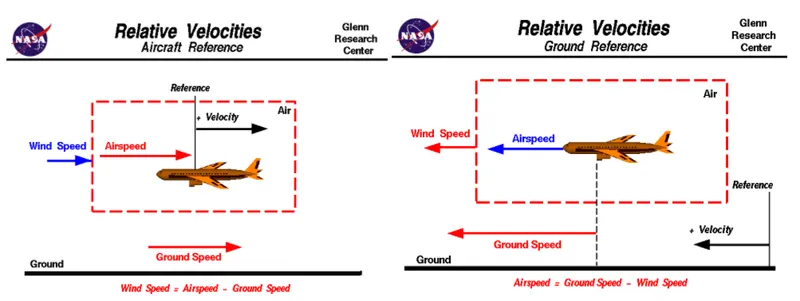
Ground speed is simply the sum of airspeed and wind speed.
If the aircraft is flying in the same direction as the wind is blowing, the aircraft experiences tailwind, and its ground speed is higher than its airspeed.
On the other hand, if the wind is blowing against the direction the aircraft is traveling in, the aircraft experiences headwind, and its ground speed is lower than its airspeed.
Example
Imagine an aircraft that cruises at an airspeed of 500 miles per hour that has to cover a ground distance of 2,000 miles.
If there is no wind at all, then both the aircraft’s airspeed and ground speed would be the same 500 miles per hour, and the aircraft would reach its destination in four hours.
If there was a 100 miles per hour headwind – wind blowing against the aircraft’s direction of travel – the aircraft would still be traveling at an airspeed of 500 miles per hour. However, its ground speed would be just 400 miles per hour (100 miles per hour slower than its airspeed). And as such, it would take the aircraft five hours to reach its destinations.
Finally, if there was a 100 miles per hour tailwind – wind blowing in the same direction as the aircraft’s travel – the aircraft would still be traveling at an airspeed of 500 miles per hour, but its ground speed would be 100 miles faster. And, at 600 miles an hour, the aircraft would reach its destination in just three hours and twenty minutes.
3.Why is it not recommended to use aircraft engine power to move it on the ground at Airport?
By using jet engines as an aircraft’s primary thrust for taxiing, airlines are expending huge amounts of jet fuel while still on the ground, which could be much better used for flying. With the Cost of Fuel being their single biggest expense, many airlines plan to adopt electric taxiing to save fuel and reduce environmental impacts.
Taxiing is the movement of an aircraft on the ground, under its own power, in contrast to towing where the aircraft is moved by a tug. The aircraft usually moves on wheels, but the term also includes aircraft with skis or floats (for water-based travel).
An airplane uses taxiways to taxi from one place on an airport to another; for example, when moving from a hangar to the runway. The term "taxiing" is not used for the accelerating run along a runway prior to takeoff, or the decelerating run immediately after landing, which are called the takeoff roll and landing rollout, respectively.
Why it is not using its own engine to move in grounds?
Actually It does. But while taxiing, the airplane move in a reverse condition as the engine might generate the reverse thrust in it.
Aircraft are unable to do this as they don’t have a reverse gear. In order to get round this problem, we use the assistance of a pushback tug.
And the security reasons also. The engines are turbo engine which will generate more amount of energy for its movement.The aircraft will move in the grounds at the speed of 16 to 20 kmph.So the external vehicle is used instead of own engine.
How an aircraft is pushed to runway when its ready to take off?
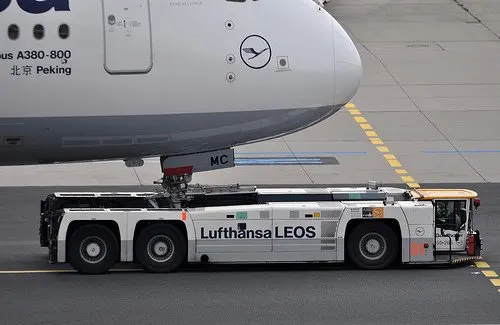
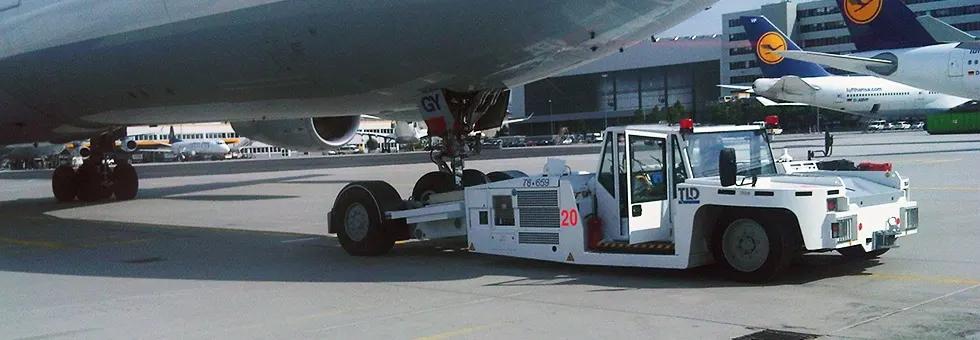
START SMALL – TUGS FOR MOVING LIGHT AIRCRAFT
Look down on yourself. Shoulders… arms… ah, and there it is! The simplest way to move a light-sport aircraft or another small plane: your bare hands. Once in motion, these airplanes can be moved around by hand since they are on wheels. Whoever pushed a car once knows that the force it takes to set such a vehicle in motion is nothing compared to its actual weight. Some propeller planes can even be pulled by their propeller – yeah, it’s strong enough. It holds the plane’s weight in the air, after all.
THE COMMON TOW BAR – A HELPING HAND
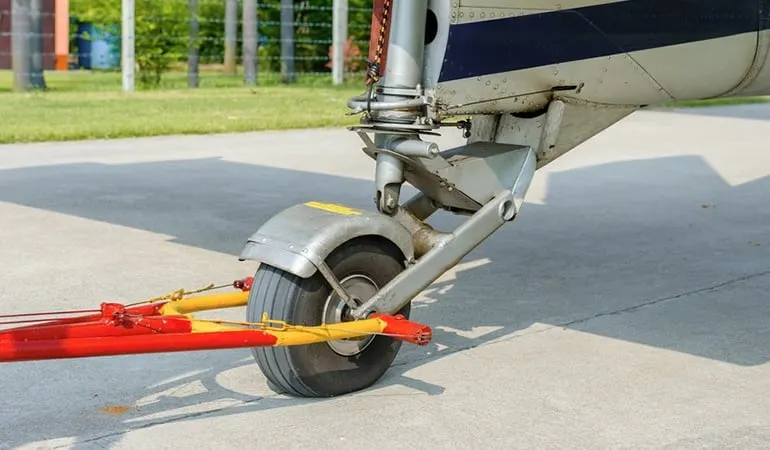
Admittedly, pulling a plane by hand can be a cumbersome procedure. An easy and cheap helper is a simple tow bar. These devices are often made of aluminum and therefore very light. You attach them to either the nose wheel or the tail wheel of your aircraft and obtain a practical handle you can steer the plane with it. Its small size and weight even allows to take such a tow bar along on the flight.
TUG #3: ENGINE POWERED CONVENTIONAL TOW BAR TRACTORS AND TUGS
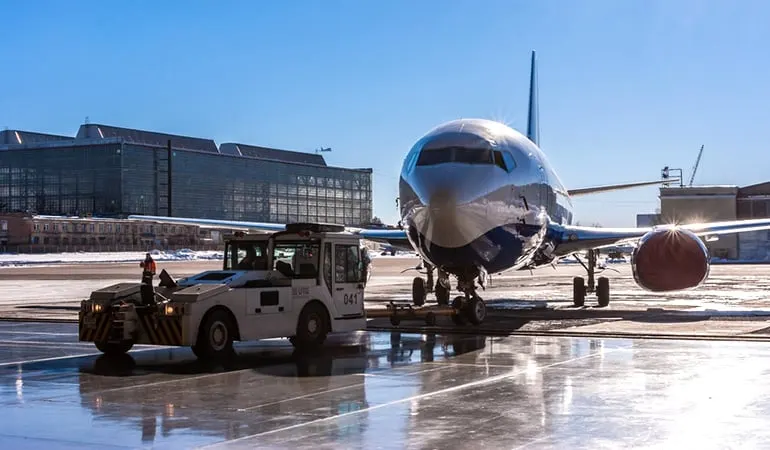
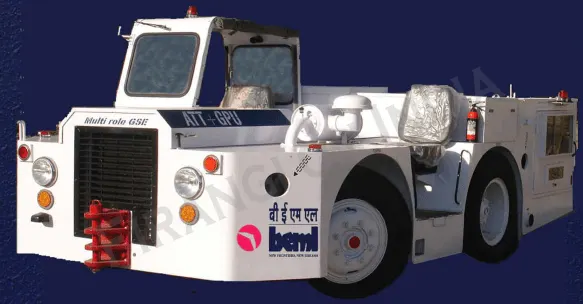
So you have a tow bar, but somehow you still have to do everything with your own manpower. Where’s the fun, right? That’s what people must have thought when they decided that tow bars should have an engine. Ever since tugs and massive tractors with tow bars help pulling aircrafts from A to B. An engine powered vehicle is quite useful, especially when it comes to heavy aircrafts that weigh hundreds of tons.
What used to be a blessing in the flourishing aviation business of the last century has slowly become a relict of an outdated technology, though. Not only does every airplane type require a specific tow bar, taking spontaneous maneuvers off the table. But the mechanics of a tow bar tug are actually pretty much outdated. The cockpit needs to be occupied for every operation and the gross motor skills of tow bar tugs deny clever parking and small turning circles. In aviation time is money, so abandoning your old tow bar tractors can actually save you cash. But for what alternative?
TUG #4: ENGINE POWERED TOWBARLESS TUGS
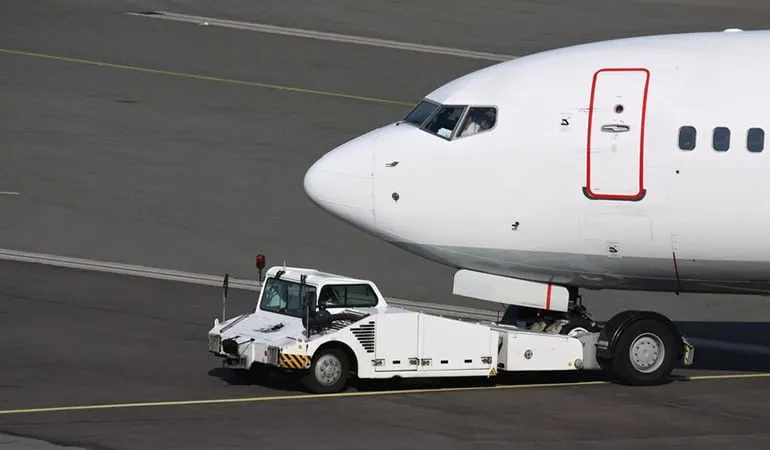
Given these obvious downsides of tow bar tugs it was quite evident that there had to be another solution. That’s why in the 1980s the first towbarless tug was introduced in France. Since then it has taken the world by storm, cutting out conventional tow bar tractors from many scopes of ground support. The wheel of the aircraft is hydraulically picked up, placed and fixated atop of the tug. Therefore one aircraft tug fits a wide range of aircrafts and does no longer rely on an adapter such as a tow bar.
No doubt: A towbarless tug has plenty of advantages over a tow bar tractor. But it is still not the measure of all things, particularly because of two major minuses: the technology and the handling. For one thing using fossil fuels on your GSE is simply a waste of resources and pollutes your working environment. For another thing operating a generic towbarless tug requires multiple people at a time, one of them sitting in the tug steering it. This doesn’t only raise your personnel costs. It comes with a risk for both your employees and the aircrafts and GSE involved, since human errors are more likely, especially with not automated tugs. The consequences could be observed for example in early 2016 when Iron Maiden’s 747-400 was damaged and two workers were injured in a tug collision.
What is the logical consequence to avoid these problems? You guess it…
TUG #5: ELECTRIC TOWBARLESS REMOTE-CONTROLLED AIRCRAFT TUGS – OR SIMPLY MOTOTOK
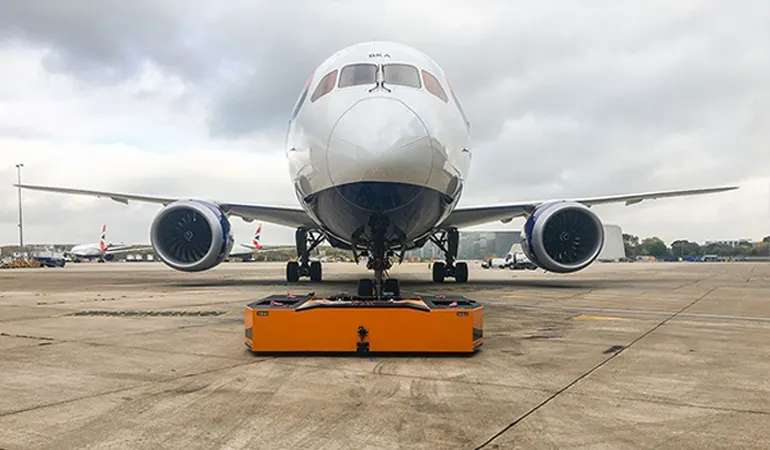
A 2008 study by the Institute for Automotive Engineering (ika) at the RWTH University of Aachen, Germany came to the conclusion that it’s only reasonable to replace diesel tractors with electric tugs – both economically and ecologically. The study assumed that hybrid systems will be the next step. In the same year Mototok decided to jump ahead of its time and released its first all-electric remote-controlled aircraft tug, eliminating all problems mentioned earlier.
5. Learn about take off power, tyre design, rolling resistance, tyre pressure, brake forces when landing.
Take OFF Power:
Takeoff is the phase of flight in which an aircraft goes through a transition from moving along the ground (taxiing) to flying in the air, usually starting on a runway. Usually the engines are run at full power during takeoff. Following the taxi motion, the aircraft stops at the starting line of the runway. Before takeoff, the engines, particularly piston engines, are routinely run up at high power to check for engine-related problems. This makes a consid- erable noise. When the pilot releases the brakes, the aircraft starts accelerating rapidly until the necessary speed for take-off is achieved.
The takeoff speed required varies with air den- sity, aircraft weight, and aircraft configuration (flap and/or slat position, as applicable). Air density is affected by factors such as field ele- vation and air temperature.
Operations with transport category aircraft employ the concept of the takeoff V-Speeds, V1 and V2. These speeds are determined not only by the above factors affecting takeoff perform- ance, but also by the length and slope of the runway. Below V1, in case of critical failures, the takeoff should be aborted; above V1 the pilot continues the takeoff and returns for land- ing. After the co-pilot calls V1, Then, V2 (the safe takeoff speed) is called. This speed must be maintained after an engine failure to meet per- formance targets for rate of climb and angle of climb.
The speeds needed for takeoff are relative to the motion of the air (indicated airspeed). A head wind will reduce the ground speed needed for takeoff, as there is a greater flow of air over the wings. This is why the aircrafts always take off against the wind. Side wind is not preferred as it would disturb the stability of the aircraft. Typical takeoff air speeds for jetliners are in the 130–155 knot range (150–180 mph, 240–285 km/h). For a given aircraft, the takeoff speed is usually directly proportional to the aircraft weight; the heavier the weight, the greater the speed needed. Some aircraft have difficulty generating enough lift at the low speeds encountered during takeoff. These are therefore fitted with high-lift devices, often including slats and usually flaps, which increase the camber of the wing, making it more effective at low speed, thus creating more lift. These have to be deployed from the wing before performing any maneuver.
At the beginning of the climb phase, the wheels are retracted into the aircraft and the undercarriage doors are closed. This operation is audible by the passengers as a noise coming from below the floor.
Tyre:
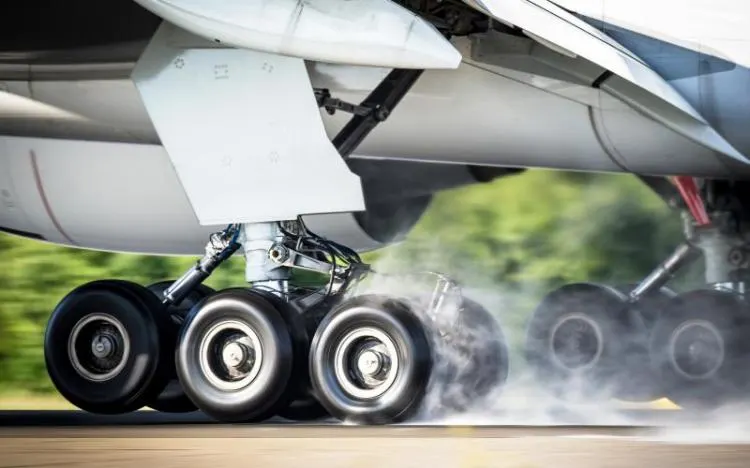
Carcass plies are used to form the tire. They are sometimes called casing plies. An aircraft tyre is constructed for the purpose it serves.
- They support the weight of an aircraft while it is on the ground.
- It also provides the necessary traction for braking and stopping of an aeroplane.
- Tyre also helps to absorb the shock of landing and provide cushioning the roughness of takeoff, roll-out, and taxi operations.
Unlike an automobile or truck tyre, it does not have to carry a load for a long period of continuous operation. However, an aircraft tyre absorbs the high impact loads of landing, and also it’s operating at high speeds for a short time when required.
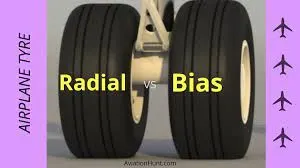
Retreading – Retreading is methods of restoring a worn tyre by renewing the tread area or by renewing the tread area plus one or both sidewalls. Repairs are included in the tyre retreading process.
Load Rating – Load rating is the maximum permissible load at a specified inflation pressure.
Ply Rating – Ply Rating is used to identify the maximum recommended load rating and inflation pressure for a specified tyre. It is an index of tyre strength.
Speed Rating – The speed rating is the maximum takeoff speed to which the tyre has been tested.
Skid Depth – Skid depth is the distance between the tread surface and the deepest groove as measured in the mould.
A carefully thought out pressure maintenance routine will increase the life of the tyre and will reduce the number of wheel changes required.
As all tires can allow a small pressure decrease during normal operations (due to the intense nature of their service life) airplane operators should check tire pressure every 24 hours.
Because putting the right pressure in the tires will always take pressure off the airplane operation.
Rolling Resistance:
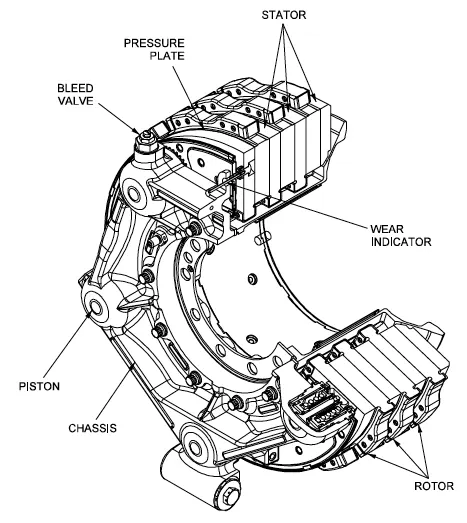
Rolling resistance formula is given as
Fr = c mr ag (1)
where
Fr = rolling resistance (N, lbf)
c = rolling resistance coefficient
mr = rolling mass (kg, lbm)
ag = acceleration of gravity (9.81 m/s2)
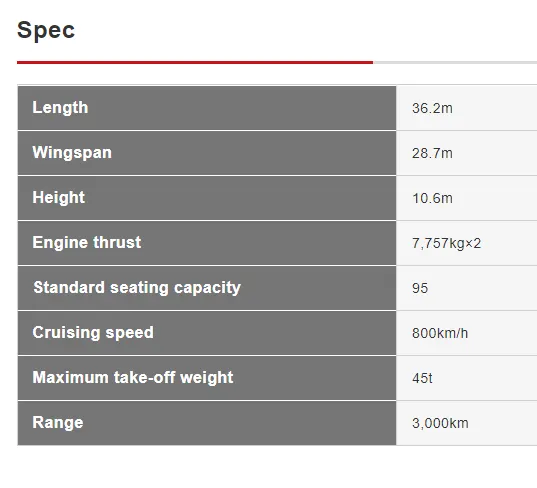
Fr = 0.02 (45000 kg) (9.81 m/s2)
= 8829 N
The friction force for the puller can be calculated to
Ff = μ W
= μ mf ag (2)
where
Ff = frictional force (N, lb)
μ = friction coefficient
W = weight (N, lbf)
mf = friction mass (kg)
mf = (8829 N) / (0.9 (9.81 m/s2))
= 1000 kg
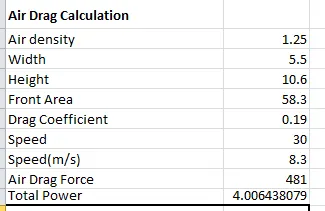
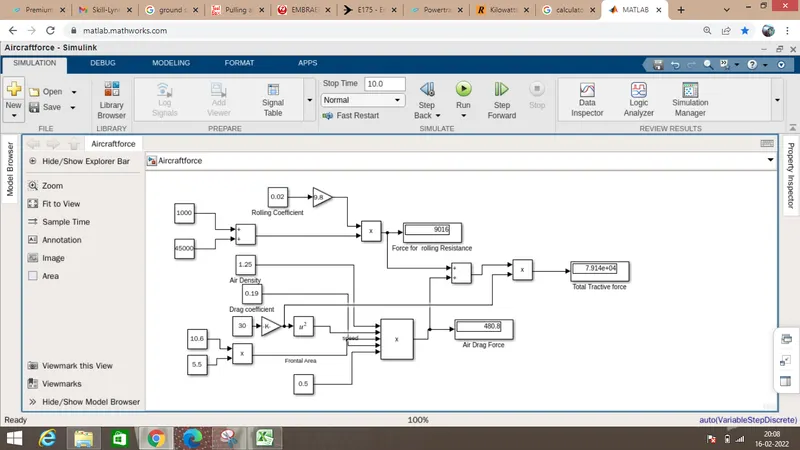
Airdrag force is given as
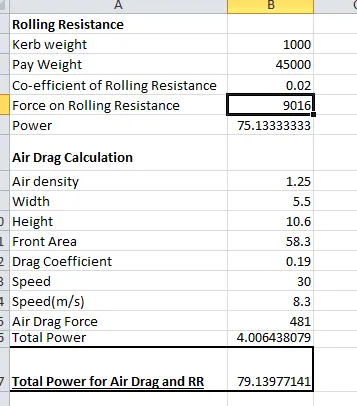
| Kerb weight | 1000 |
| Pay Weight | 45000 |
| Co-efficient of Rolling Resistance | 0.02 |
| Force on Rolling Resistance | 9016 |
| Air density | 1.25 |
| Width | 5.5 |
| Height | 10.6 |
| Front Area | 58.3 |
| Drag Coefficient | 0.19 |
| Speed | 30 |
| Speed(m/s) | 8.3 |
| Air Drag Force | 481 |
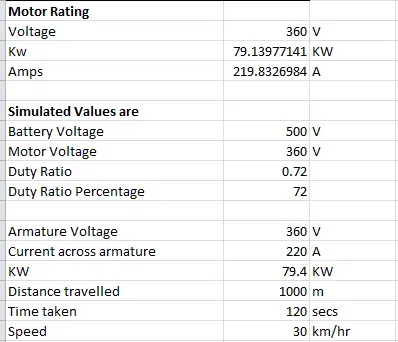
| Total Power for Air Drag and RR | 79.13977141KW |