Project-1: Powertrain for aircraft in runways
Aim: Search and list out the total weight of various types of aircrafts.
Theory:
Aircraft Gross Weight: The aircraft gross weight (also known as the all-up weight and abbreviated AUW) is the total aircraft weight at any moment during the flight or ground operation.
An aircraft's gross weight will decrease during a flight due to fuel and oil consumption. An aircraft's gross weight may also vary during a flight due to payload dropping or in-flight refulling.
At the moment of releasing its brakes, the gross weight of an aircraft is equal to its takeoff weight. During flight, an aircraft's gross weight is referred to as the en-route weight or in-flight weight.
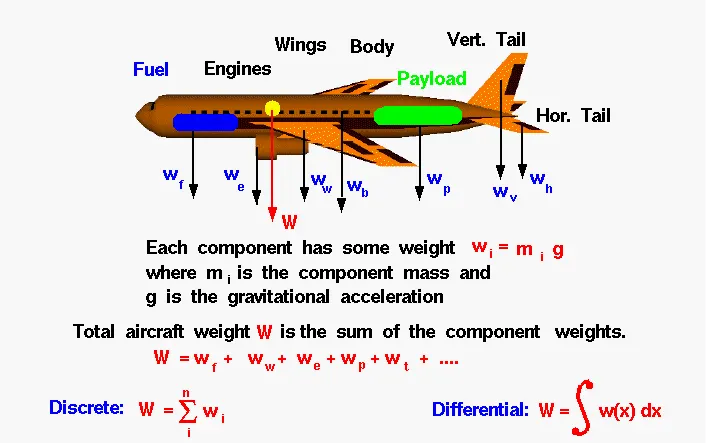
Different types of Aircraft Weight:
- Manufactured Empty Weight: This is the Weight of the aircraft excluding fuel, passanger and baggage.
- Zero Fuel Weight: It include all the complete weight of plane including the unusedable fuel and excluding the usable fuel weight.
- Payload: It is the load carried by the plane for which it is paid off.
- Maximum take off wieght: It is the permisible weight of the plane at which smooth take off can be done.
- Maximum Ramp wieght: It is the maximum weight used for towing aircraft to the ground.
Below table shows some model of aircraft and there Maximum gross take off weight.
| Aircraft | Empty Weight | Max Fuel Weight | Max Cargo Weight | Max Gross Takeoff Weight |
|---|---|---|---|---|
| Antanov AN-225 | 628,000 lbs 285,000 kg |
661,400 lbs 300,000 kg |
417,000 lbs 190,000 kg |
1,411,000 lbs 640,000 kg |
| Airbus A380-800 | 611,000 lbs 277,000 kg |
560,000 lbs 254,000 kg |
185,000 lbs 84,000 kg |
1,268,000 lbs 575,000 kg |
| Boeing 747-800 | 485,300 lbs 220,100 kg |
427,400 lbs 194,000 kg |
295,000 lbs 134,000 kg |
987,000 lbs 447,700 kg |
| Airbus A340-500 | 370,000 lbs 168,000 kg |
386,300 lbs 175,000 kg |
119,000 lbs 54,000 kg |
820,000 lbs 372,000 kg |
| Boeing 777-300ER | 370,000 lbs 168,000 kg | 320,800 lbs 145,500 kg | 148,000 lbs 67,100 kg |
776,000 lbs 352,000 kg |
| Boeing 787-10 | 299,000 lbs 135,500 kg | 223,500 lbs 101,500 kg |
126,300 lbs 57,300 kg | 560,000 lbs 254,000 kg |
| Boeing 737-900 | 98,500 lbs 44,700 kg |
53,100 lbs 24,000 kg |
44,600 lbs 20,200 kg |
187,000 lbs 85,000 kg |
| Airbus A320-100 | 93,900 lbs 42,600 kg |
48,700 lbs 22,100 kg |
44,000 lbs 20,000 kg |
150,000 lbs 68,000 kg |
| Embraer 190 | 63,500 lbs 28,800 kg |
28,600 lbs 13,000 kg |
28,800 lbs 13,100 kg |
106,000 lbs 48,000 kg |
| Gulfstream G650 | 54,000 lbs 24,500 kg | 48,200 lbs 21,900 kg | 6,500 lbs 3,000 kg |
100,000 lbs 45,200 kg |
| Bombardier CRJ900 | 48,160 lbs 21,850 kg | 19,600 lbs 8,900 kg | 6,075 lbs 2,760 kg | 80,500 lbs 36,500 kg |
| Bombardier Q400 | 39,300 lbs 17,800 kg |
11,700 lbs 5,300 kg |
18,700 lbs 8,500 kg |
62,000 lbs 28,000 kg |
| Learjet 75 | 13,900 lbs 6,300 kg | 6,060 lbs 2,750 kg |
2,900 lbs 1,300 kg |
21,500 lbs 9,700 kg |
| Cessna Citation CJ4 | 10,300 lbs 4,700 kg | 5,800 lbs 2,650 kg |
2,200 lbs 1,000 kg | 17,200 lbs 7,800 kg |
| Beechcraft King Air B100 | 7,100 lbs 3,200 kg | 3,200 lbs 1,450 kg |
4,150 lbs 1,900 kg |
12,000 lbs 5,400 kg |
| Diamond DA50 RG | 3,200 lbs 1,450 kg |
340 lbs 155 lbs |
1,250 lbs 560 kg |
4,400 lbs 2,000 kg |
| Beechcraft Bonanza G36 | 2,500 lbs 1,150 kg | 450 lbs 200 kg |
850 lbs 385 kg |
3,660 lbs 1,660 kg |
| Cessna 206H | 2,200 lbs 990 kg |
520 lbs 235 kg |
1,150 lbs 520 kg |
3,600 lbs 1,630 kg |
| Sirrus SR22 | 2,250 lbs 1,000 kg | 485 lbs 220 kg |
950 lbs 430 kg |
3,600 lbs 1,630 kg |
| Cessna 172R | 1,700 lbs 770 kg |
380 lbs 170 kg |
560 lbs 255 kg |
2,425 lbs 1,100 kg |
Aim: Is there any difference between ground speed and air speed?
Theory: Ground speed is the airplane’s speed relative to the surface of the Earth, airspeed – at least true airspeed – is its speed relative to the air it is flying in.
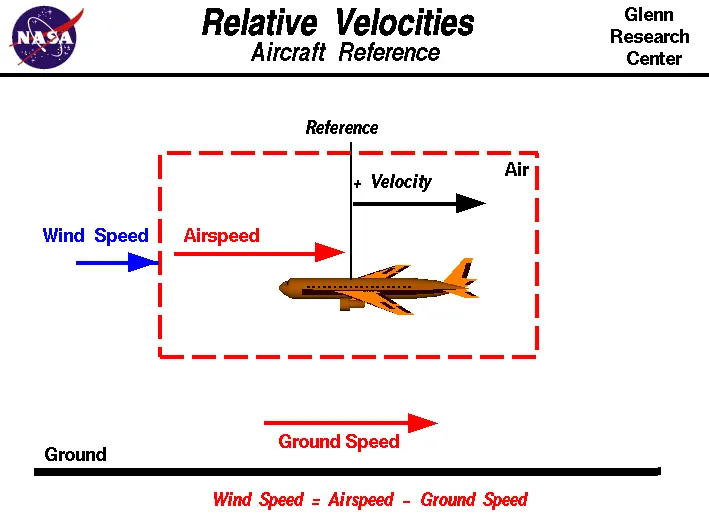
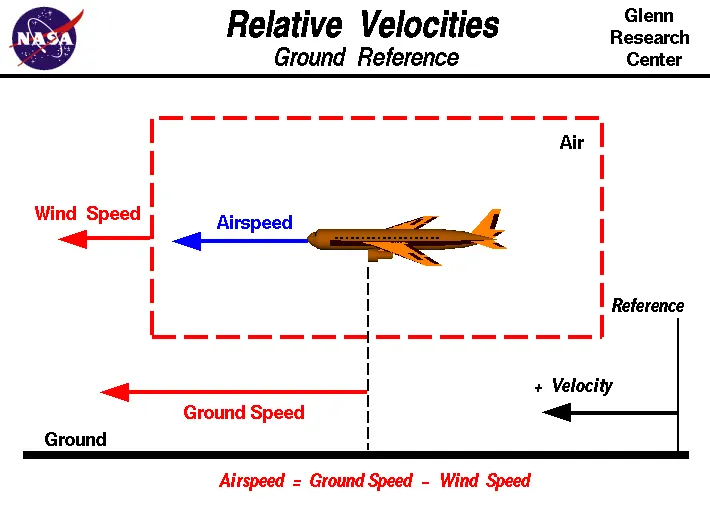
As mentioned above, true airspeed is simply the speed at which an aircraft is moving relative to the air it is flying in. As such, it’s also the speed at which the air is flowing around the aircraft’s wings.
Ground speed, on the other hand, is the aircraft’s speed relative to the ground. One thing that should be noted here is that it’s its horizontal rather than vertical speed – an aircraft climbing completely vertically would have a ground speed of zero.
In other words, while airspeed is what determines whether there is enough airflow around an aircraft to make it fly, ground speed is what determines how fast an aircraft will get to its destination.
Aim: Why is it not recommended to use aircraft engine power to move it on the ground at Airport?
Theory: Towing means coupling two or more object together so that it can be pulled by a specific source. This source can be anything that is able to pull such as Vehicle, animal, human etc.
Many of the aircraft are capable to move in reverse direction using backward thrust but the resulting jet produce might cause damage to terminal building or equipment. Engine close to ground may also blow sand and debris forward and then suck them into the engine, causing damage to engine. A push back is the preffered mode to move aircraft in reverse direction.
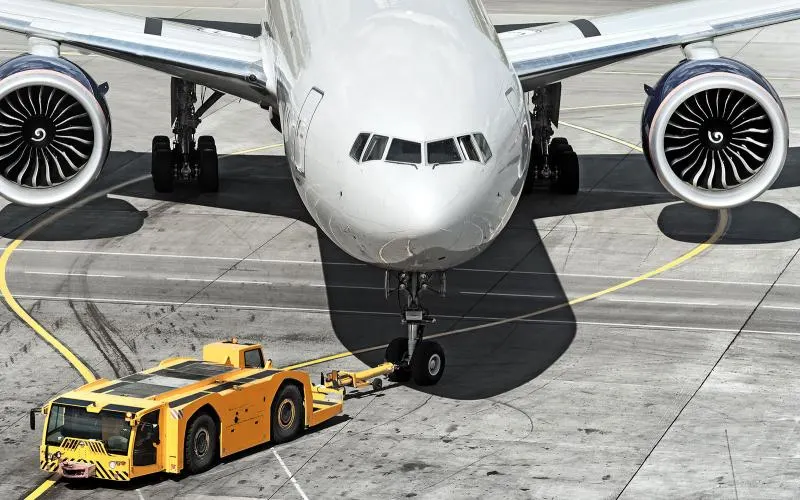
Below are some points given why backward thrust is not used to move aircraft in reverse direction.
- The jet blast from the engine can damage terminal building and nearby equipment
- It can throw away people standing nearby.
- Engine can bolw sand and debris.
- It is easy for the truck driver to correctlly park the aircraft instead of pilot with a small glass.
- The truck driver knows the airport better than the pilot.
- It will save fuel consumption.
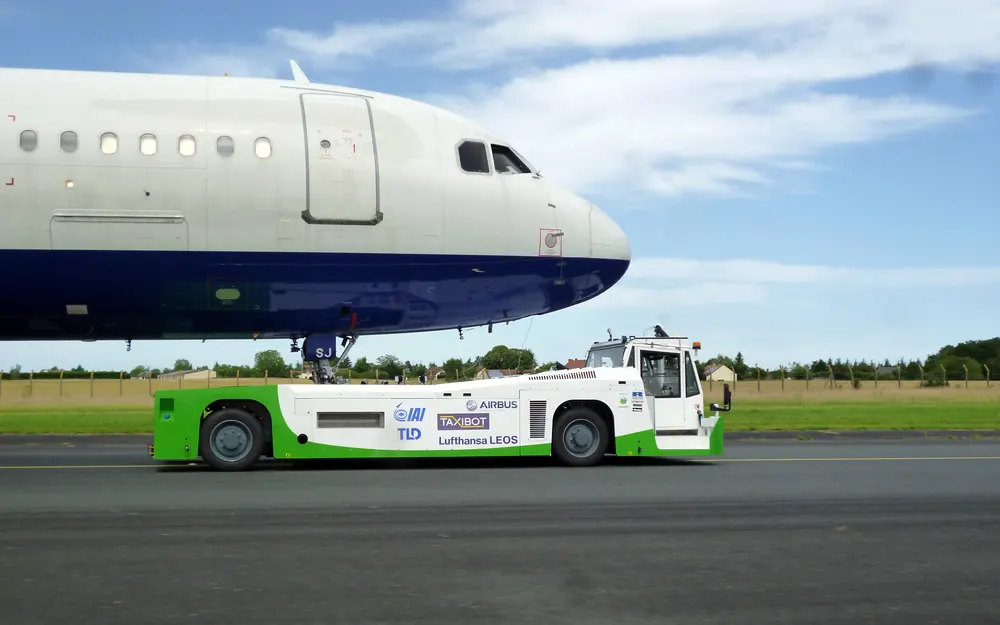
Aim: How an aircraft is pushed to runway when its ready to take off?
Theory: Taxiing is the movement of aircraft in the ground under its own power, in contrast to towing or push back where the aircraft is moved by a tug.
The power for taxing comes from engine itself. If the aircraft is propellor type then propellor provide thrust and aircraft is taken to the runway. If the aircraft is jet engine type then the exhaust air that comes out from engine creates forward motion of aircraft which is then taken to the runway.
Aircraft has nose wheel steering which is controlled from cockpit called as tiller. The tiller allow the nose wheel to turn extreme angle that makes sharp turn possible. It also reduces the fuel comsumption as we do not require much engine power during taxiing. if rudder were used, the power has to be increased to make sufficient air flow over the rudder surface to make it efficient.
Once in take off roll and the pilot gains sufficient speed i.e enough air flow over the rudder pilot uses rudder to keep the aircraft at center line of the runway.
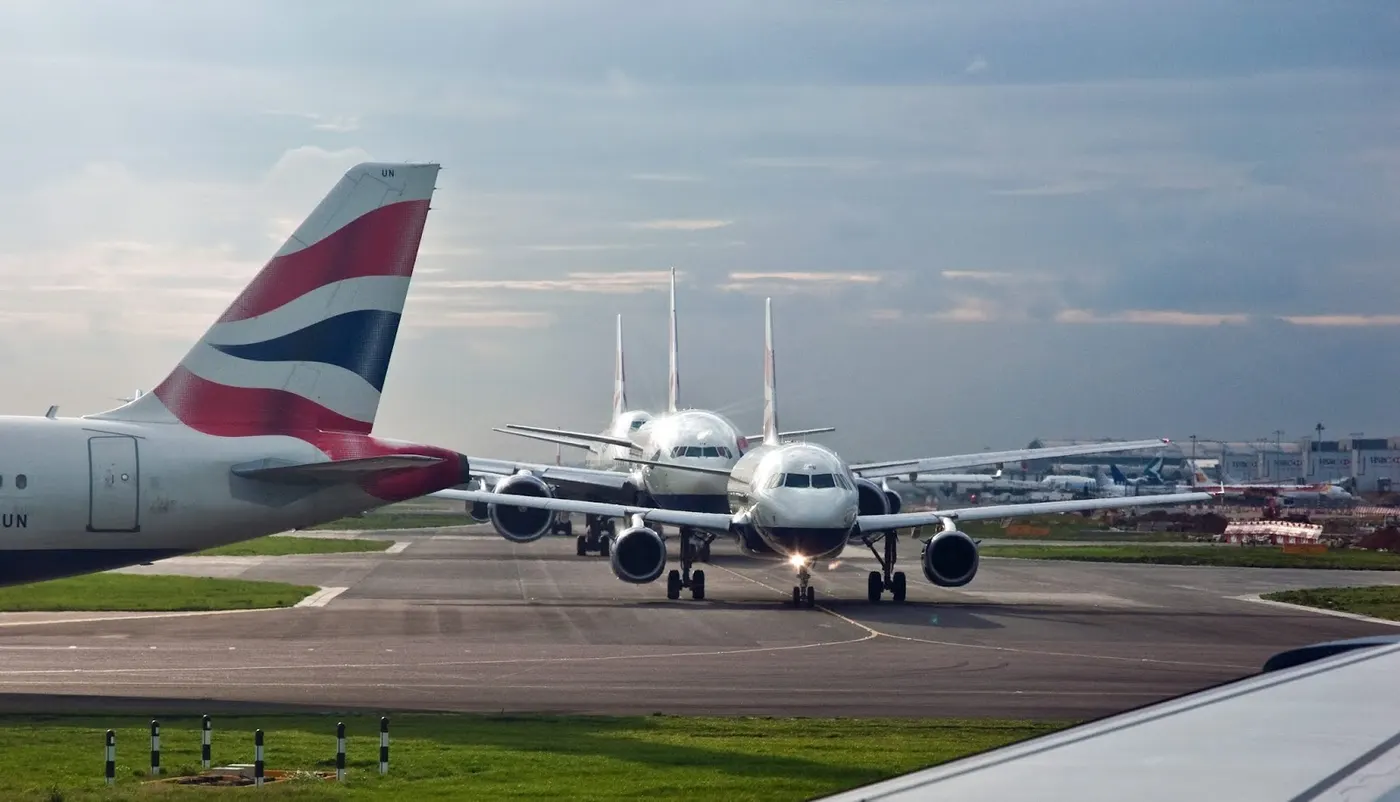
This is the way how planes taxi the towardthe runway and form a que for a proper and safe take off.
Aim: Learn about take off power, tyre design, rolling resistance, tyre pressure, brake forces when landing.
Take Off: Takeoff is the phase of flight in which an aircraft goes through a transition from moving along the ground to flying in the air, usually starting on a runway. For balloons, helicopter and some specialized fixed-wing aircraft, no runway is needed.
For lighter aircraft full engine power is given to accelerate the aircraft in a very short length of runway. where as for cargo aircraft full engine power is not given beacuse it may cause high load to engine and may result in engine damage or high maintanence of the engine so that overall costing can be reduced.
The forces involved during takeoff are as follows:
T = thrust force pushes the aircraft in forward direction.
D = drag force resisting the aircraft.
F = rolling resistance force when wheel comes in contact with ground during landing and takeoff.
During take off the inbalance force will cause acceleration to the aircraft and the equation is given as:
`(dv)/(dt)=T-D-F/m`
The Process of takeoff will be vehicle is brought to a safe take off speed using engine thrust and the winds are controlled to give the sufficient lift force which will lift the aircraft in air and no contact with the ground.
Here safe speed is defined as Vr which acts as a critical factor for determining take off performance. For safety reason Vr is determined as 1.1*Vstall.
Vstall: This is the lowest speed that the aircraft can be flown before the air flow starts to seperatefrom the wings as the angle of attack become to great. The formula of Vstall is given below:
Where,
W is the weight of aircraft.
p is the density.
S is the wind area.
Cl is the maximum lift coefficient.
Tyre design:
An aircraft tyres are design to withstand extream heavy loads by absorbing shocks during landing and takeoff andthere by produces cushioning effect.
The number off tyre required depend on the total weight of the aircraft. The moto is all the load should be equally shared between the tyres and load on each tyre should not go above the maximum permisible load on the tyre.
Aircraft tyre are designed to facillate stability in high crosswind condition, to chanalise the water away for preventing skidding and help to give a good braking effect.
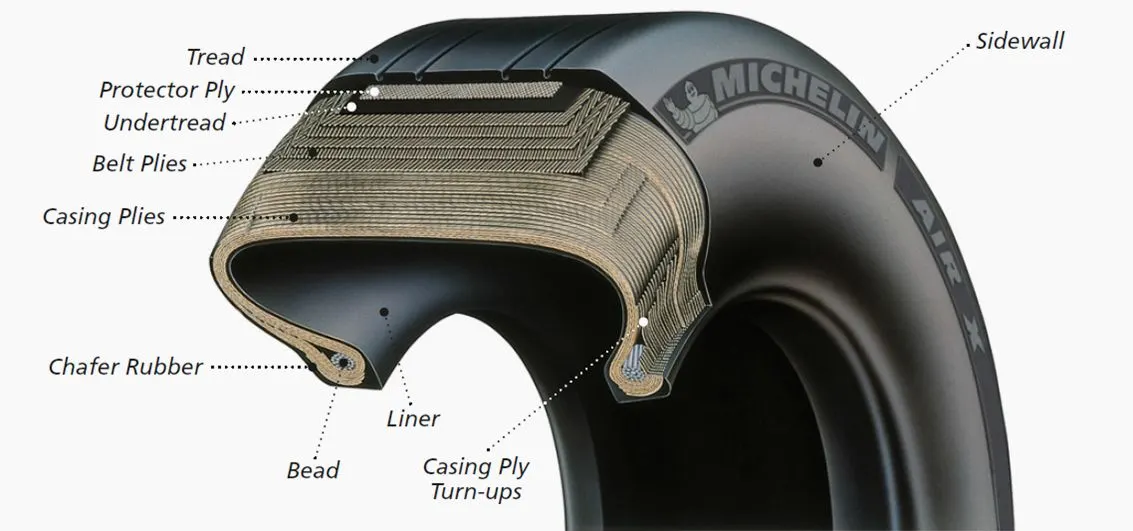
Aircraft tyres are usually inflated by nitrogen gas in order to reduce expansion and contraction from extreme change in pressure and temperature. This type inert gas will eliminate the possibility of tyre explosion.
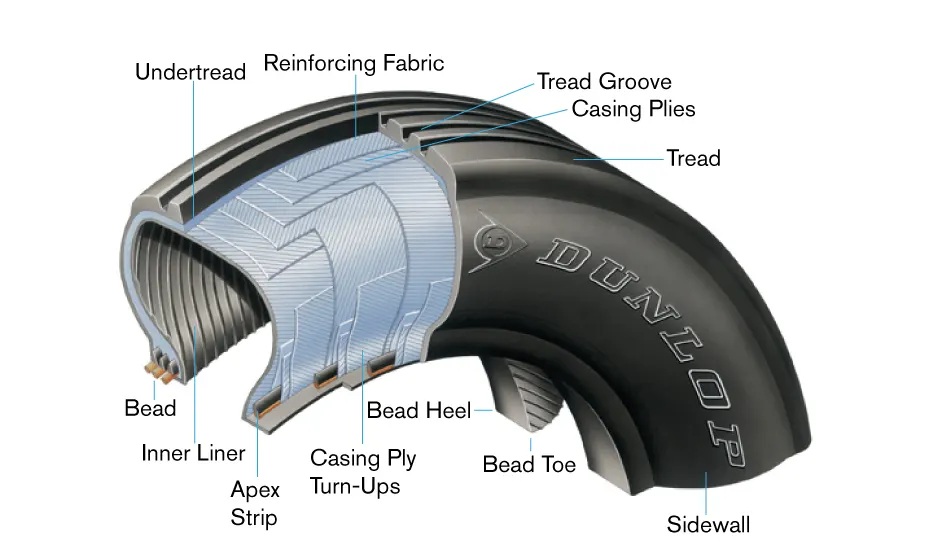
Rolling Resistance: Rolling resistance or rolling drag is the force resisting the motion when the body rolls on surface and it is mainly caused by non elasticity that is not all energy needed for deformation of wheel is recovered when the pressure is removed.
The rolling resistance equation cand be given by:
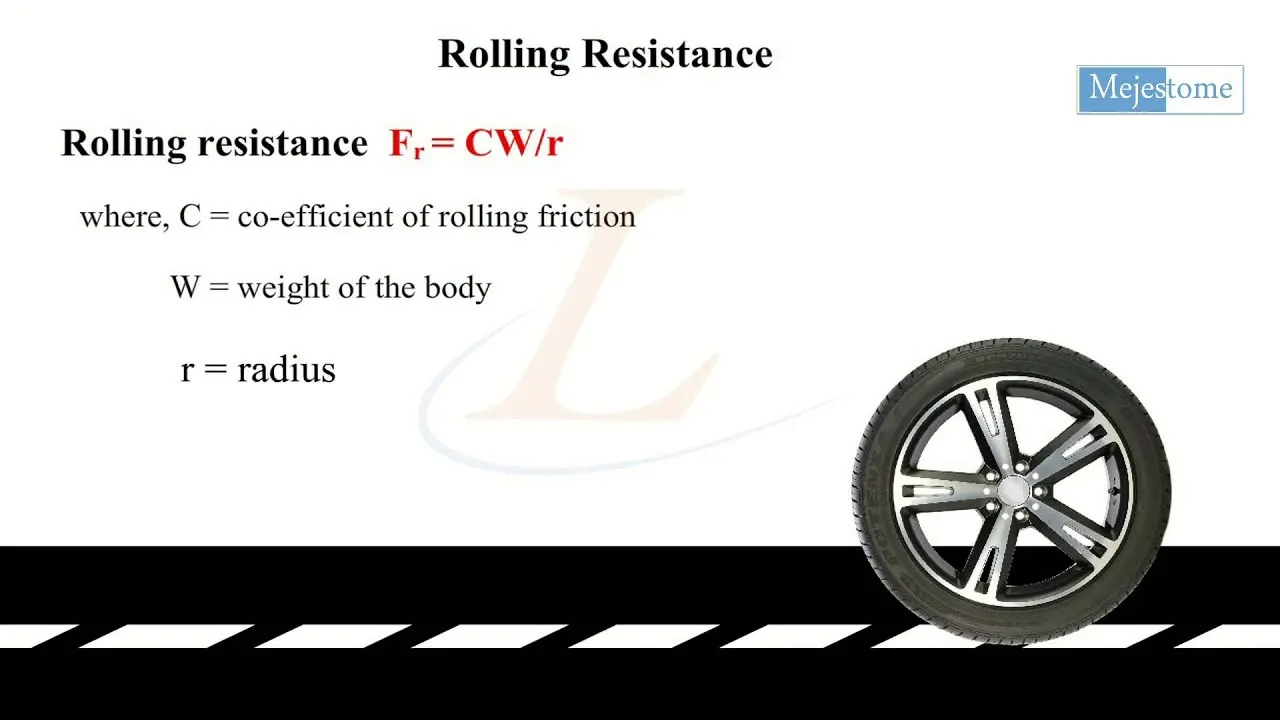
Actually for aircraft the co-efficient of rolling resistance is low as 0.06 some more example of different vehicle is shown below:
Tyre Pressure: An aircraft tyres are design to withstand extream heavy loads by absorbing shocks during landing and takeoff andthere by produces cushioning effect and the complete load to be distributed equally in all tyres.
As per reasearch it is found that aircraft tyres can take a maximum pressure of 800 psi. As in our vehicle we have a device to check the tyre pressure in the same way the aircraft tyre pressure is also monitered carefully using a sensor which is installed in the tyres. The diagram of this sensor is shown below:
If due to excess of pressure or any other reason if this tyre gets damaged or busted is can cause a huge accident.
Braking Force: Aircraft disc brake in the landing gear, used to brake the wheels while touching the ground. These brakes are operated hydraulically or pneumatically. In most modern aircraft they are activated by the top section of the rudder pedals ("toe brakes").
Thrust reversal that allow thrust from the engines to be used to slow the aircraft.
Air brakes, dedicated flight control surface that work by increasing drag.
Braking is an challenging job for most of the pilots especially in rainy and cross wind envirnoment.
To stop the aircraft the whole kinetic energy has to be absorbed i.e
Braking force = `1/2*m*V^2`
where,
m is mass of aircraft.
V is velocity of aircraft.
Landing speed for a typical comercial flight ranges from 150 to 165 MPH and for passenger flight the value is in the range of 166 to 172 MPH.
Aim:
A. With necessary assumptions, calculate the force and power required to push / pull an aircraft by a towing vehicle.
B. Develop the model for the calculated force and power using Simulink.
Solution:
Assumption:
Mass of aircraft (M1) = 183500 Kg
Mass of thug (M2) = 30000 Kg
Coeficient of rolling resistance of aircraft (Cr1) = 0.005
Coeficient of rolling resistance of thug (Cr2) = 0.002
Drag coefficient of aircraft (Cd1) = 0.12
Drag coefficient of thug (Cd2) = 0.6
Frontal area of aircraft (A1) = 320
Frontal area of thug (A2) = 42
Towing speed (V) = 3
Air density (d) = 1.25
Acceleration Due to gravity (g) = 9.81
Calculation:
Rolling Resistance of aircraft (Fr1) = (Cr1)*(M1)*g
=0.005*183500*9.81
Fr1 =9000 N
Rolling Resistance of thug (Fr2) = (Cr2)*(M2)*g
=0.002*30000*9.81
Fr2 =588.6 N
Drag force of Aircraft (Fd1) = `1/2*rho*A1*V^2*Cd1`
= 0.5*1.25*320*(3)^2*0.12
Fd1 = 216 N
Drag force of thug (Fd2) = `1/2*rho*A2*V^2*Cd2`
= 0.5*1.25*42*(3)^2*0.6
Fd2 = 141.75 N
From the above calculation it is clear that the force which contribute more is the rolling resistance force and hence while designing towing vehicle rolling force should be considered.
Total Force (F) = Fr1+Fr2+Fd1+Fd2
=9000+588.6+216+141.75
F = 9946.35 N
Power required for towing = Total force * velocity
= 9946.35 * 3
= 29.839 KW
Simulink Model: This is a model used to calculate the the towing force and the power required for given data of an aircraft.
In the model Four Subsystem are made where first one gives rolling resistance force of aircraft. second one gives rolling resistance of thug. Third one gives air drag resisting force of aircraft and the last subsystem gives drag resisting force of thug. Then all this forces are added together to get total towing force required.
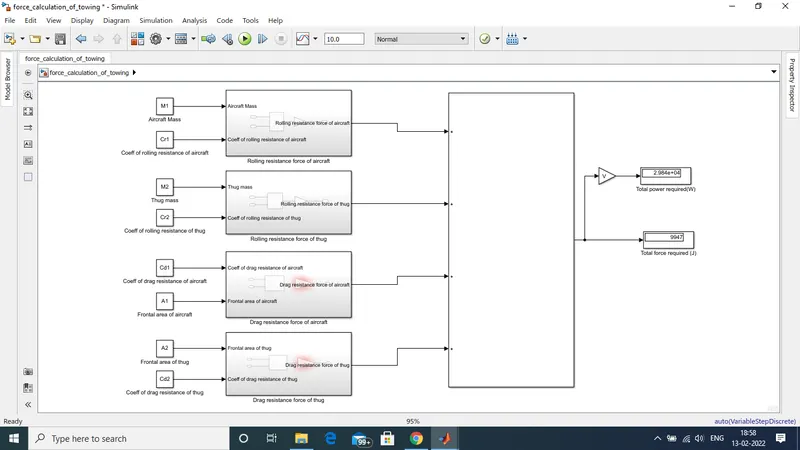
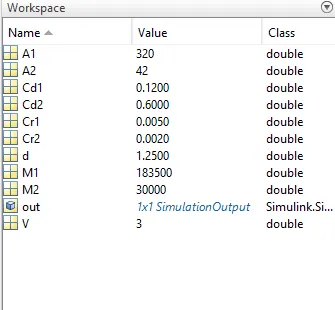
All the values of variable used in the above model are loaded in the workspace.
Aim:
A. Design an electric powertrain with type of motor, it’s power rating, and energy requirement to fulfill aircraft towing application in Simulink. Estimate the duty cycle range to control the aircraft speed from zero to highest. Make all required assumptions. Prepare a table of assumed parameters. Draw a block diagram of powertrain. (Hint :DC7 Block)
B. Also, Design the parameters in excel sheet.
Solution:
From the above calculation we came to know that the total power required to push or pull the aircraft is about 9.94 KN and the power requirement is 29.84 KW.
Now we need to find motor torque , rated power of motor and duty cycle of the motor.
The tyre radius of the aircraft is assumed as 26 inches i.e 660.4 mm.
Torque required at wheels = Force at wheels * tyre radius
= 9.94 * 0.6604
= 6.5643 KN-m
Assume,
Gear ratio to be 8 and transmission efficiency is 82 %.
Motor Torque at 100% efficient = (Wheel Torque) / (Gear ratio * efficiency of transmission)
= 6.5643 / (8 * 0.82)
=1 KN-m
If motor has a 90% efficiency then the motor torque is given by:
Motor Torque when motor efficiency is considered = 1/0.9
= 1.1111 KN-m
Power required by motor = caluclated power / (transmission efficiency * motor efficiency)
= 29.84 / ( 0.82* 0.9)
= 40.4336 KW
Assume the time duration of 10 minutes.
Total energy consumed = power required by motor * time
= 40.4336 * (10/60)
= 6.7389 KWh
For this power rating of the motor we have selected a battery which has a power output of 60 KW.
Now we can calculate the duty cycle which is given by output power to the input power.
d=(output power) / (input power)
= 40.4336 / 60
=0.67389
Hence the duty cycle to achieve zero and full speed ranges from 0 to 67.38 percent.
I have created a powertrain block for an pure electric vehicle which is shown below. Powertrain means the process how the battery power is converted into wheels rotation.
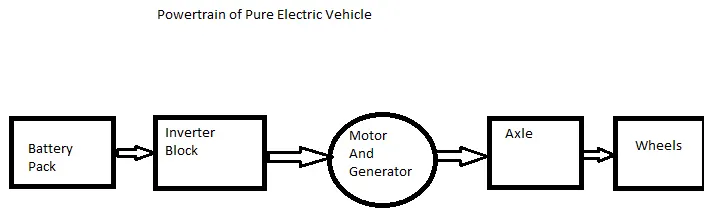
All the assumed values are listed in a excel sheet and is shown below:
| Parameter | Values | Units |
| Mass of aircraft | 183500 | Kg |
| Mass of thug | 30000 | Kg |
| Coefficient of rolling resistance of aircraft | 0.005 | No units |
| Coefficient of rolling resistance of thug | 0.002 | No units |
| Drag coefficient of aircraft | 0.12 | No units |
| Drag coefficient of thug | 0.6 | No units |
| Frontal aera of aircraft | 320 | m^2 |
| Frontal area of thug | 42 | m^2 |
| Towing Velocity | 3 | m/s |
| Air density | 1.25 | Kg/m^3 |
| Gravitational Acceleration | 9.81 | m/s^2 |
| Time of towing | 10 | min |
| Tyre radius | 26 | inches |
| Overall gear Ratio | 8 | No units |
| Motor efficiency | 90 | |
| Transmission efficiency | 82 |