Project-1: Powertrain for aircraft in runways
Ans.1)
The aircraft gross weight (also known as the all up weight and abbreviated AUW) is the total aircraft weight at any moment during the flight or ground operation.
An aircraft's gross weight will decrease during a flight due to fuel and oil consumption. An aircraft's gross weight may also vary during a flight due to payload dropping or in-flight refuelling.
At the moment of releasing its brakes, the gross weight of an aircraft is equal to its takeoff weight. During flight, an aircraft's gross weight is referred to as the en-route weight or in-flight weight.
Total weight of various types of aircrafts:-
|
Aircraft |
Empty Weight |
Max Fuel Weight |
Max Cargo Weight |
Max Gross Takeoff Weight |
|
628,000 lbs |
661,400 lbs |
417,000 lbs |
1,411,000 lbs |
|
|
611,000 lbs |
560,000 lbs |
185,000 lbs |
1,268,000 lbs |
|
|
485,300 lbs |
427,400 lbs |
295,000 lbs |
987,000 lbs |
|
|
370,000 lbs |
386,300 lbs |
119,000 lbs |
820,000 lbs |
|
|
370,000 lbs 168,000 kg |
320,800 lbs 145,500 kg |
148,000 lbs |
776,000 lbs |
|
|
299,000 lbs 135,500 kg |
223,500 lbs |
126,300 lbs 57,300 kg |
560,000 lbs |
|
|
98,500 lbs |
53,100 lbs |
44,600 lbs |
187,000 lbs |
|
|
93,900 lbs |
48,700 lbs |
44,000 lbs |
150,000 lbs |
|
|
63,500 lbs |
28,600 lbs |
28,800 lbs |
106,000 lbs |
|
|
54,000 lbs 24,500 kg |
48,200 lbs 21,900 kg |
6,500 lbs |
100,000 lbs |
|
|
48,160 lbs 21,850 kg |
19,600 lbs 8,900 kg |
6,075 lbs 2,760 kg |
80,500 lbs |
|
|
39,300 lbs |
11,700 lbs |
18,700 lbs |
62,000 lbs |
|
|
13,900 lbs 6,300 kg |
6,060 lbs |
2,900 lbs |
21,500 lbs |
|
|
10,300 lbs 4,700 kg |
5,800 lbs |
2,200 lbs 1,000 kg |
17,200 lbs |
|
|
7,100 lbs 3,200 kg |
3,200 lbs |
4,150 lbs |
12,000 lbs |
|
|
3,200 lbs |
340 lbs |
1,250 lbs |
4,400 lbs |
|
|
2,500 lbs 1,150 kg |
450 lbs |
850 lbs |
3,660 lbs |
|
|
2,200 lbs |
520 lbs |
1,150 lbs |
3,600 lbs |
|
|
2,250 lbs 1,000 kg |
485 lbs |
950 lbs |
3,600 lbs |
|
|
1,700 lbs |
380 lbs |
560 lbs |
2,425 lbs |
Aircraft Empty Weight (AEW):-
This is sometimes referred to as OEW – Operating Empty Weight and it is the weight of the aircraft with all its equipment on board but no fuel, no passengers or no cargo.
Think of this like the aircraft has just come out of the factory and is sitting waiting to be fueled up for delivery to the customer.
Aircraft Maximum Gross Takeoff Weight (MGTW):-
This is the maximum permissible weight the aircraft can weigh as it lifts off the ground at takeoff. This includes the aircraft’s empty weight, the fuel, the crew, the passengers, and all the cargo.
This weight limit is set by the manufacturer and is gospel. Many aircraft accidents have been caused by an aircraft being overweight and the pilot/s have not had enough power or maneuverability to prevent the accident.
Aircraft Useful Load:-
This is the weight that a pilot can place in the aircraft. Take the MGTW figure and subtract the AEW and this is the total useful load that can be placed into the aircraft. This is the fuel, crew, passengers, and cargo. The bigger the load, the more useful the aircraft can be to its customers.
Ans.2)
The different between airspeed and ground speed is fairly simple. Ground speed is simply the sum of airspeed and wind speed. On the other hand, if the wind is blowing against the direction the aircraft is traveling in, the aircraft experiences headwind, and its ground speed is lower than its airspeed.
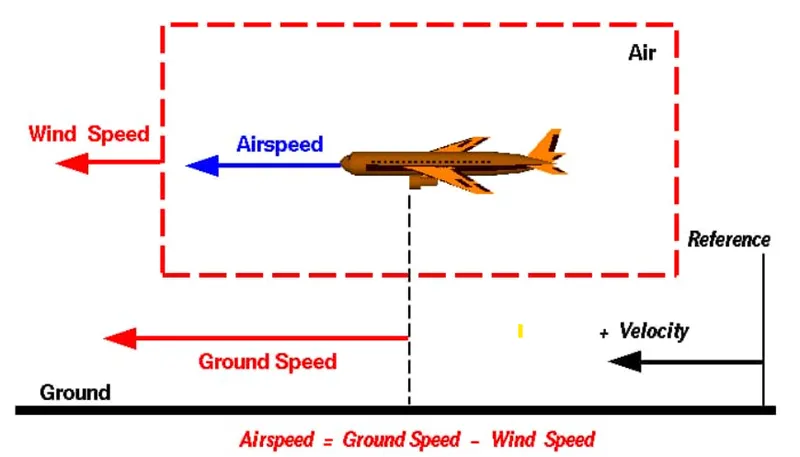
Ground Speed:-
For a reference point picked on the ground, the aircraft moves relative to the reference point at the ground speed. Ground speed is also a vector quantity so a comparison of the ground speed to the wind speed must be done according to rules for vector comparisons.
Airspeed:-
The important quantity in the generation of lift is the relative velocity between the object and the air, which is called the airspeed. Airspeed cannot be directly measured from a ground position, but must be computed from the ground speed and the wind speed. Airspeed is the vector difference between the ground speed and the wind speed.
Airspeed = Ground Speed - Wind Speed
On a perfectly still day, the airspeed is equal to the ground speed. But if the wind is blowing in the same direction that the aircraft is moving, the airspeed will be less than the ground speed.
Wind Speed:-
For a reference point picked on the ground, the air moves relative to the reference point at the wind speed. Notice that the wind speed is a vector quantity and has both a magnitude and a direction. Direction is important. A 20 mph wind from the west is different from a 30 mph wind from the east. The wind has components in all three primary directions (north-south, east-west, and up-down). In this figure, we are considering only velocities along the aircraft's flight path. A positive velocity is defined to be in the direction of the aircraft's motion. We are neglecting cross winds, which occur perpendicular to the flight path but parallel to the ground, and updrafts and downdrafts, which occur perpendicular to the ground.
For example taking wind speed as 30 km/hr and runway is east-west runway the wind blowing towards west and the flight runs at 70 km/hr the wind speed acting in the west and the flight takes off east then the
Airspeed=Groundspeed (70)- Wind Speed(-30) -100 km/hr
If the planes runs towards west along the wind
blowing direction then
the Airspeed-Groundspeed (70) - Wind Speed (30)=40km/hr
Hence there is a difference between ground speed and air speed.
Ans.3)
Aircraft move using their own engine power all the time on the airport apron and taxiways under their own power to go towards runways and after landing taxi to their assigned gate. The only time they use external assistance is to pushback from the gate. Large turbofan aircraft need help to reverse via a pushback tractor. The engines are turned on after the pushback is complete and the aircraft can move forward under its own power. To be accurate, some aircraft can reverse using a variable pitch prop or thrust reversing on turbofans but generally reversing is done via pushback tractors. Blasting jet reversers blows debris In the crowded gate area creating foreign object damage hazard for adjacent aircraft, gate equipment, or terminal waiting area glass windows.
The disadvantages of using aircraft engine power to move it on the ground at Airport is given below,
- Fuel consumption.
- Wear and tear on the engine.
- Unnecessary jet blast and noise
Ans.4)
pushback truck reverses the aircraft into taxiing position, pushing it with a towbar attached to the nose-wheel strut. Or, in the most modern versions, by actually lifting the wheel. The aircraft taxis to the runway to depart at the agreed time.
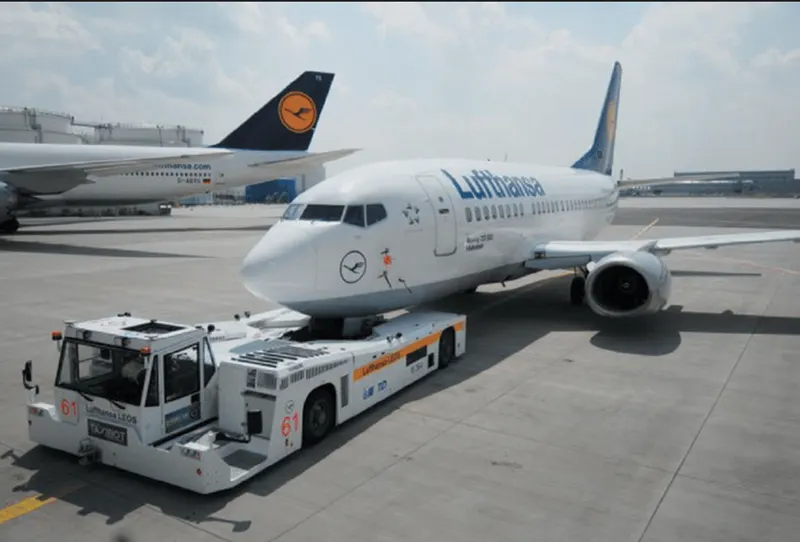
Taxiing:-
Taxiing is the movement of an aircraft on the ground, under its own power, in contrast to towing or push-back where the aircraft is moved by a tug. The aircraft usually moves on wheels, but the term also includes aircraft with skis or floats. An airplane uses taxiways to taxi from one place on an airport to another, for example, when moving from a hangar to the runway.
Towing:-
Movement of large aircraft about the airport, flight line, and hangar is usually accomplished by towing with a tow tractor. In the case of small aircraft, some moving is accomplished by hand pushing on the correct areas of the aircraft. Aircraft may also be taxied about the flight line but usually only by certain qualified personnel.
Towing aircraft can be a hazardous operation, causing damage to the aircraft and injury to personnel, if done recklessly or carelessly. This article outline the general procedure for towing aircraft. However, specific instructions for each model of aircraft are detailed in the manufacturer's maintenance instructions and are to be followed in all instances
Ans.5)
Takeoff Power:-
Takeoff is the phase of flight in which an aerospace vehicle leaves the ground and becomes airborne.
For aircraft that take off horizontally, this usually involves starting with a transition from moving along the ground on a runway. For balloons. helicopters, and some specialized fixed-wing aircraft (VTOL aircraft such as the Harrier), no. runway is needed. Takeoff is the opposite of landing
Take off performance can be predicted using a simple measure of the acceleration of the aircraft along the runway based on force equilibrium.
The forces involved will be,
T = Thrust of propulsion system pushing aircraft along runway.
D = Aerodynamic Drag of vehicle resisting the aircraft motion.
F = Rolling resistance friction due to the contact of wheels or skids on the ground.
During take-off run the imbalance in these forces will produce an acceleration along the runway.
dv/dt =T - D - F / m
where dv/dt is the acceleration along the runway and m is the mass of the vehicle.
The procedure for take-off will be that the vehicle will accelerate until it reaches a safe initial flying speed. The pilot can then rotate the vehicle to an attitude to produce climb lift and it will ascend from the ground. The determination of this safe flying speed or rotation speed. Vg, is a critical factor in determining take-off performance.
Tyre Design:-
Tyres are one of the most important components of aircraft. They help to absorb the shock of landing and provide cushioning. It also provides the necessary traction for braking and stopping of an aircraft.
An aircraft tyre is designed to withstand extremely heavy loads while landing, take off, taxing, and parking. The number of wheels required for aircraft increases with the weight of the aircraft, as the weight of the aeroplane needs to be distributed more evenly.
An aircraft tyre is constructed for the purpose it serves.
- They support the weight of an aircraft while it is on the ground.
- It also provides the necessary traction for braking and stopping of an aeroplane.
- Tyre also helps to absorb the shock of landing and provide cushioning the roughness of takeoff, roll-out, and taxi operations.
Unlike an automobile or truck tyre, it does not have to carry a load for a long period of continuous operation. However, an aircraft tyre absorbs the high impact loads of landing, and also it’s operating at high speeds for a short time when required.
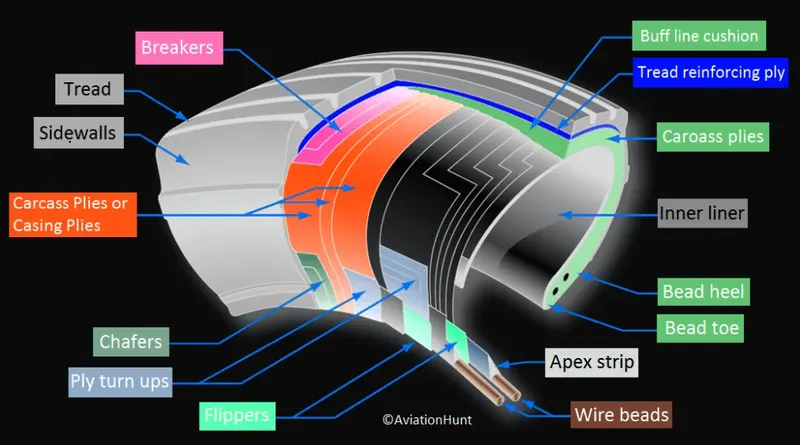
Skid Depth:- Skid depth is the distance between the tread surface and the deepest groove as measured in the mould.
Aircraft tyres must have an approved speed and load rating and have sufficient clearance when retracted through landing gear to allow for tyre growth. Tyre growth is the increase in the size of the tyre due to centrifugal forces at high speed.
Rolling Resistance:-
Rolling resistance is the force resisting the motion when a body (such as ball, tyre or wheel) rolls on a surface. Rolling resistance can be seen in the aircraft when the aircraft takes-off from the runway & while landing at the runway with the help of their wheels.
Rolling resistance can be expressed as
Frr = μrr.m.g
Where
Frr is the Rolli resistance(N)
μrr is coefficient of rolling resistance.
m is mass (kg)
g is acceleration due to gravity = 9.81m/s^2
Tyre Pressure:-
Aircraft tyres operate at such high extremes of pressure, load, and speed, their care and service is critically important. The most important action an operator can take to prevent tyre-related events is to maintain proper tire inflation pressure. Failure to keep aircraft tires properly inflated can lead to very serious consequences. One relatively easy way to help avoid those consequences is to check tire pressures regularly and service them as necessary. Following these three actions is a good way to make sure you get the most value out of your tires and contribute to the safe operation of your aircraft.
Aircraft tires are usually inflated with nitrogen to minimize expansion and contraction from extreme changes in ambient temperature and pressure experienced during flight. Dry nitrogen expands at the same rate as other dry atmospheric gases (normal air is about 80% nitrogen), but common compressed air sources may contain moisture, which increases the expansion rate with temperature.
Also, the use of an inert gas for tire inflation eliminates the possibility of tire explosion.
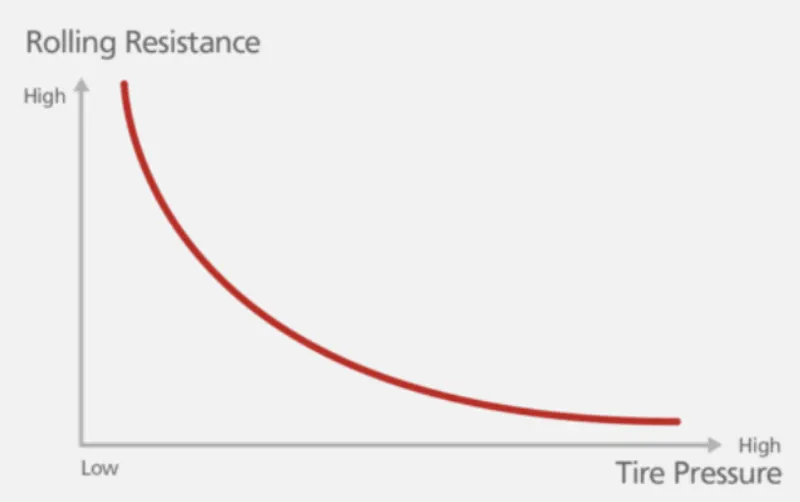
Relation to Rolling Resistance and Tire Pressure:-
Rolling resistance and Tyre pressure are inversly proportional.
Brake force when landing:-
The most common type of brake used on aircraft is the disc brake. Disc brakes function by exploiting friction between rotating and stationary discs inside the brake.
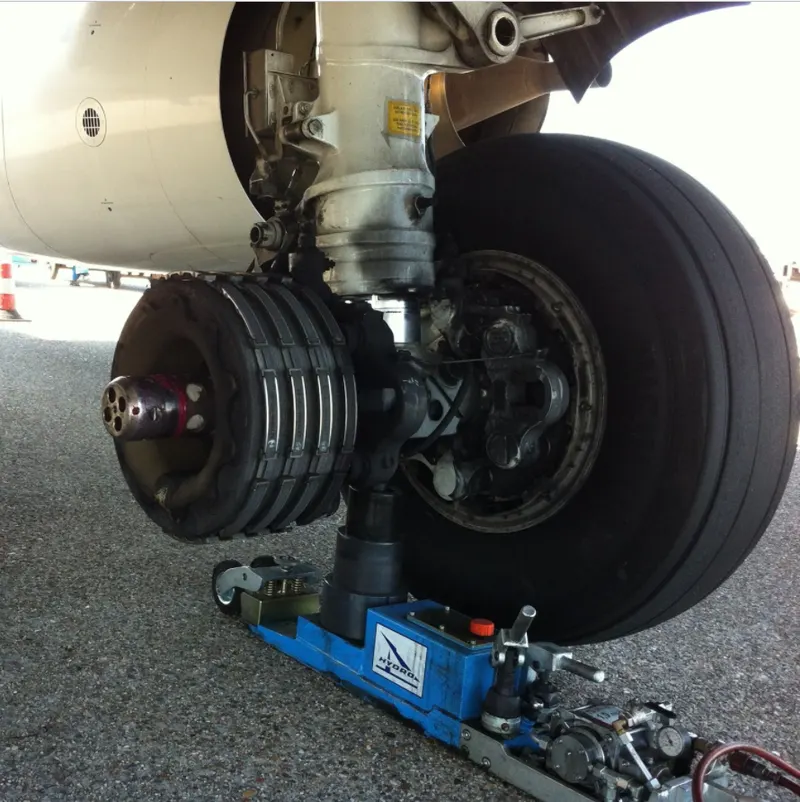
Aircraft disc brake:- This brakes are used when landing gear is applied and that provied brakes in wheel of aircraft. Normally, this system is operated by either hydraullic or pneumatic.
Thrust reversal:- In this method the reverse thrust is provided by propulsion system in opposite direction of motion of aircraft while its landing. so then aircraft starts to decelerate. This is also called as thrust reversal.
Spoilers:- spoilers are the plates which is hinged with the top portion of wings of aircraft. So when aircraft landed in ground these plates are opened and this will provide drag force against the direction of motion of aircraft. So it will result in deceleration.
Ans.6A)
Here hill climbing force is not considered becasue it is not travelling in slope and gradiant value is 0.
Rolling Resistance force
Frr =μrr mg
Air Drag force
Fad= (1/2)*(p*A*Cd*V^2)
Total tractive force
Fte = Frr + Fad
Total tractive power
Pte = Fte * V
m = total mass of vehicle
μrr = coefficient of rolling resistance
A = Frontal area of vehicle
Cd = Drag coefficient
p = air density
V = velocity of vehicle
The mass of the Aircraft or payload is 640000kg
Lets us consider the towing car mass is 50000kg
So,
total mass = 640000 + 50000
= 690000kg
coefficient of rolling reistance = 0.013
drag coefficent of towing vehicle = 0.5
drag coefficient of aircraft = 0.045
width = 6.4
height = 18.1
frontal area = 115.84
Velocity = 2.78(m/s)
Rolling Resistance force
Frr =μrr mg
Frr = 0.013*690000*9.81
Frr = 87995.7N
Air Drag force
Fad= (1/2)*(p*A*Cd*V^2)
Fad = (1/2)*(1.25*115.84*(0.5+0.045)*(2.78)^2)
Fad = 304.95 N
Total tractive force
Fte = Frr + Fad
= 87995.7 + 304.95
= 88300.65 N
Total tractive power
Pte = Fte * V
= 88300.65 * 2.78
= 245475.81 W
Total tractive power (Pte) = 245.47 Kw
(B) Develop the model for the calculated force and power using Simulink.
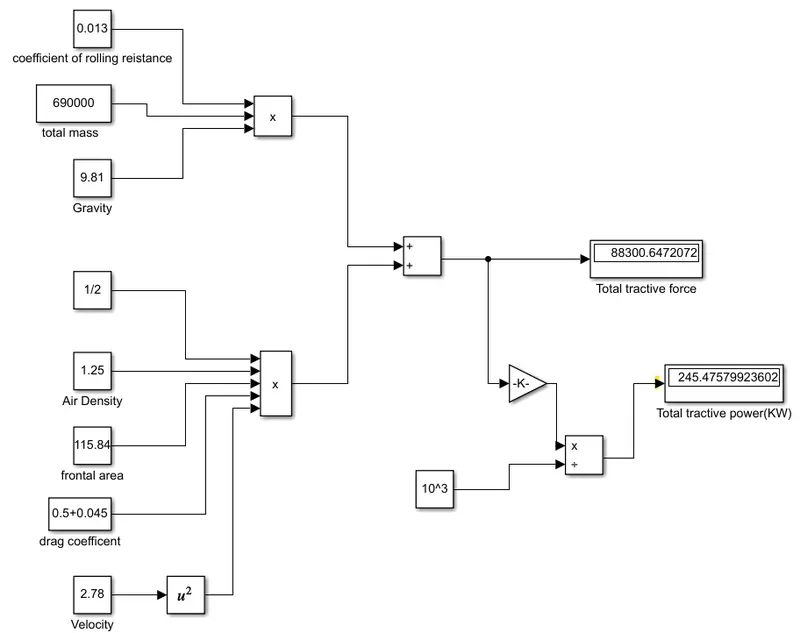
Ans.7 A)
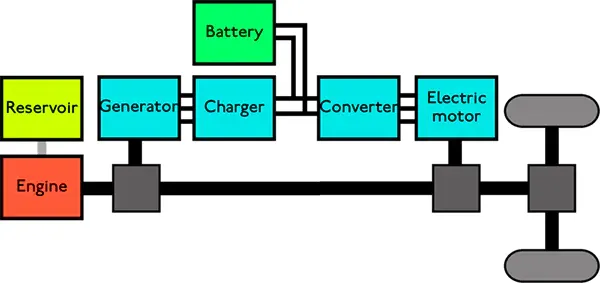
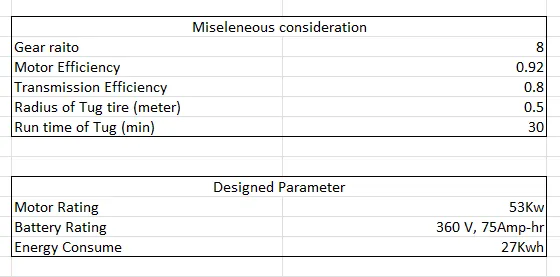
Total energy consumed by the tug in 20 min(+ extra 10 min considering free time run of tug) is
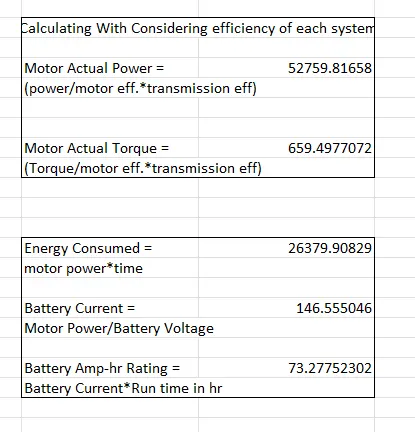
Energy consumed = Power of motor * 30/60
= (52.750*1000)*0.5
= 26375wh
= 27Kwh
Now for battery sizing, we choose a battery whose output voltage is around 360v
So, Battery current = Motor power/Voltage = 52750/360 = 146.52 =~ 150 amp approx.
for battery rating = Battery current * run time of tug = 150 * (30/60) = 75 amp-hr
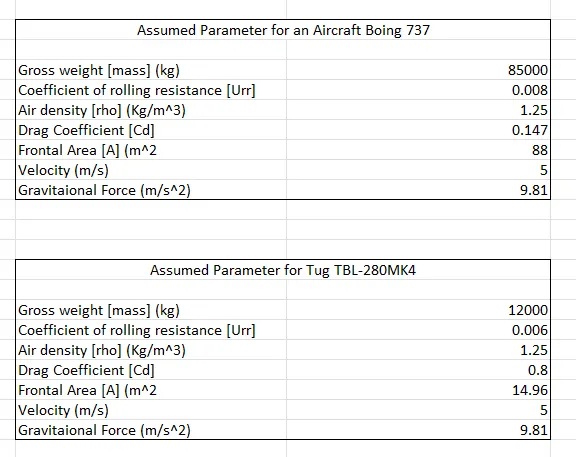
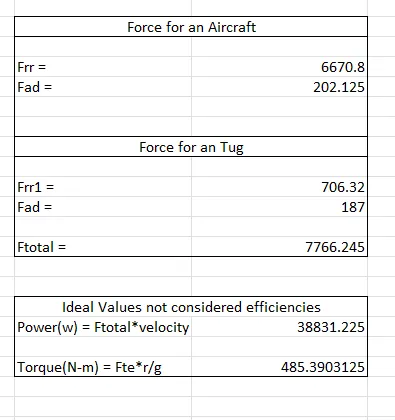
From the above calculation, we can see a 75 Amp-hr battery is required to fulfill our requirements which are providing 650 N-m of instantaneous torque with a motor rating of 53kw and a run time of 30min with a velocity of 5 m/sec.
B. Also, Design the parameters in excel sheet:-
https://1drv.ms/x/s!AgID4ew-wDzNgT-nbHKQCHV-YZyr?e=YxlNej