Project-1: Powertrain for aircraft in runways
AIM: Powertrain for aircraft in runways
Part A:
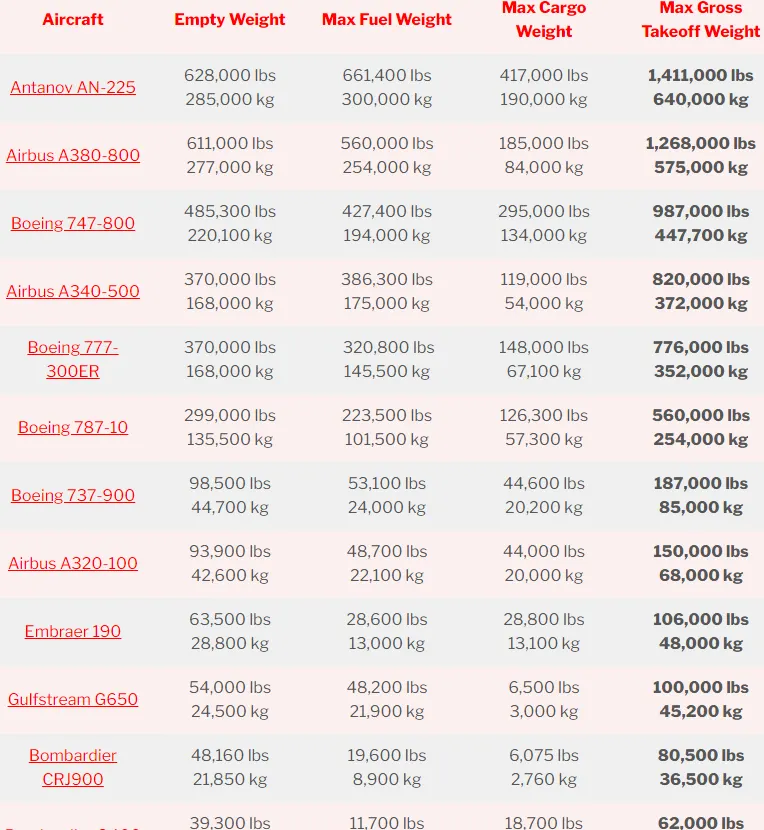
1. Search and list out the total weight of various types of aircrafts.
2. Is there any difference between ground speed and air speed?
3. Why is it not recommended to use aircraft engine power to move it on the ground at Airport?
4. How an aircraft is pushed to runway when its ready to take off?
5. Learn about take off power, tyre design, rolling resistance, tyre pressure, brake forces when landing.
Part B:
6. A. With necessary assumptions, calculate the force and power required to push / pull an aircraft by a towing vehicle.
B. Develop the model for the calculated force and power using Simulink.
7. A. Design an electric powertrain with type of motor, it’s power rating, and energy requirement to fulfill aircraft towing application in Simulink. Estimate the duty cycle range to control the aircraft speed from zero to highest. Make all required assumptions. Prepare a table of assumed parameters. Draw a block diagram of powertrain.
(Hint :DC7 Block)
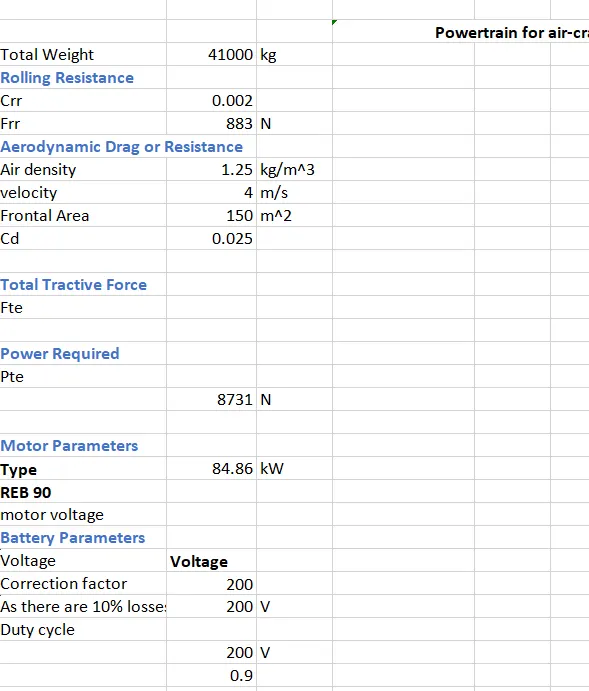
B. Also, Design the parameters in excel sheet.
POWERTRAIN OF AIRCRAFT:
1. Search and list out the total weight of various types of aircraft?
There are several different weights of the aircraft mentioned (e.g. maximum take-off weight, maximum landing weight, operating empty weight).
Manufacturer's empty weight (MEW)
Also called Manufacturer's Weight Empty (MWE) or Licensed Empty Weight
It is the weight of the aircraft "as-built" and includes the weight of the structure, power plant, furnishings, installations, systems, and other equipment that are considered an integral part of an aircraft.
This excludes any baggage, passengers, or usable fuel2.
Zero-fuel weight (ZFW)
This is the total weight of the airplane and all its contents (including unusable fuel), but excluding the total weight of the usable fuel on board.
As a flight progresses and fuel is consumed, the total weight of the airplane reduces, but the ZFW remains constant.
Maximum zero fuel weight (MZFW) is the maximum weight allowed before usable fuel and other specified usable agents (engine injection fluid, and other consumable propulsion agents) are loaded.
Operating empty weight (OEW) (Roughly equivalent to basic empty weight on light aircraft)
It is the basic weight of an aircraft including the crew, all fluids necessary for operation such as engine oil, engine coolant, water, unusable fuel and all operator items and equipment required for flight but excluding usable fuel and the payload.
It is the carrying capacity of an aircraft. It includes cargo, people, extra fuel. In the case of a commercial airliner, it may refer only to revenue-generating cargo or paying passengers.
Maximum takeoff weight (MTOW)
This is the maximum weight at which the pilot of the aircraft is allowed to attempt to take off3.
Regulated takeoff weight (RTOW)
Depending on different factors (e.g. flap setting, altitude, air temperature, length of runway), RTOW or maximum permissible takeoff weight varies for each takeoff. It can never be higher than MTOW.
Maximum landing weight (MLW)
This maximum weight at which an aircraft is permitted to land3.
The following image depicts takeoff weight components.
Maximum ramp weight (MRW)
also called maximum taxi weight (MTW)
It is the maximum weight authorized for maneuvering (taxiing or towing) an aircraft on the ground.
It is the total aircraft weight at any moment during the flight or ground operation. This decreases during the flight due to fuel and oil consumption.
The Boeing 737 can weigh from 132,000lbs/60,000kg to 187,000lbs/85,000kg at takeoff depending on the model, compared to a small Cessna 172 weighing around 2,400lb/1,11kg. An aircraft’s empty weight, fuel, passengers & cargo must not weigh more than the aircraft’s Maximum Gross Takeoff Weight.
The weight of the aircraft is needed to be calculated by the pilot for every flight to ensure the aircraft remains within weight limitations set by the manufacturer. These limitations are to ensure the aircraft is able to perform and recover from all flight maneuvers and withstand structural loading.
Typical Airplane Weights
Scenario #1: All Fuel & No Cargo or Passengers
This would be on a flight when I have finished a job and I am returning back to the hanger after dropping off the passengers and their cargo:
- Aircraft Empty Weight: 3000 lbs
- Pilot Weight: 185 lbs
- Aircraft Full Fuel Weight: 1000 lbs
- Total Aircraft Weight = 4,185 lbs (776 lbs under MGTW)
Scenario #2: Full Passengers & 200 lbs of Cargo
This would be on a flight when I am starting a job in the morning and I am departing from the hanger with a work crew and their tools:
- Aircraft Empty Weight: 3000 lbs
- Pilot Weight: 185 lbs
- Passengers Weight: 950 lbs
- Cargo Weight: 200 lbs
- Aircraft Full Fuel Weight: 1000 lbs
- Total Aircraft Weight = 5,335 lbs (374 lbs OVER MGTW)
In this scenario I would need to offload weight. The 3 variables are:-
- Passengers
- Cargo
- Fuel
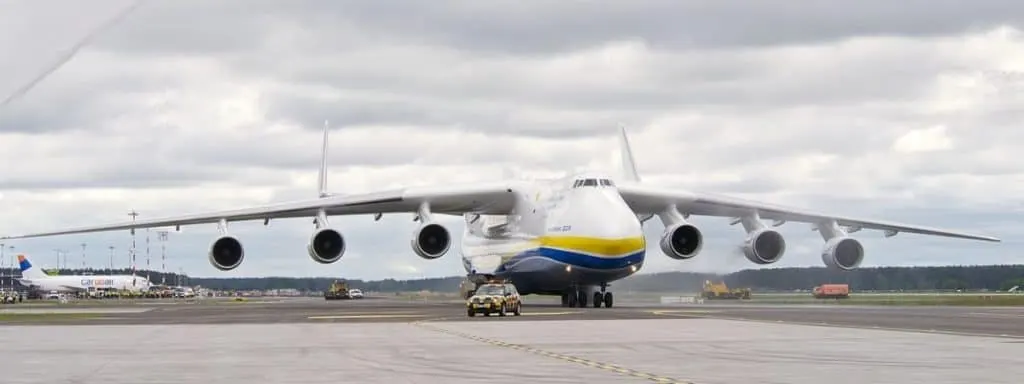
2. Is there any difference between ground speed and airspeed?
GROUND SPEED:
- Ground speed is how fast an airplane is traveling, relative to a fixed point on the ground. Think of it this way: Ground speed is how fast an airplane's shadow would move across the land. If there's a strong wind pushing an aircraft, that's reflected in the ground speed.
AIRSPEED:
- Airspeed, in contrast, is how fast an airplane is really flying strictly under its own power, which is calculated by subtracting the wind speed from the ground speed.
- Airspeed doesn't just affect airplanes. It also affects our vehicles on the ground. As this study published in 2013 in the International Journal of Energy and Environmental Engineering describes, a car's airspeed on the highway is what really determines its fuel efficiency, rather than ground speed or the speedometer reading.
>NOTE:
- On a perfectly still day, the airspeed is equal to the ground speed. But if the wind is blowing in the same direction that the aircraft is moving, the airspeed will be less than the ground speed.

We are assuming passenger commuter aircraft and large airliners. Aircraft move using their own engine power all the time on the airport apron and taxiways under their own power to go towards runways and after landing taxi to their assigned gate.
The only time they use external assistance is to pushback from the gate. Large turbofan aircraft need help to reverse via a pushback tractor. The engines are turned on after the pushback is complete and the aircraft can move forward under It’s own power.
Although many aircrafts are capable of moving in backward using reverse thrust, as result the jet blast or prop wash might cause damage to the terminal building or equipment. Engine close to ground may also blow sand and debris forward and then suck them into the engine, causing damage to the engine.
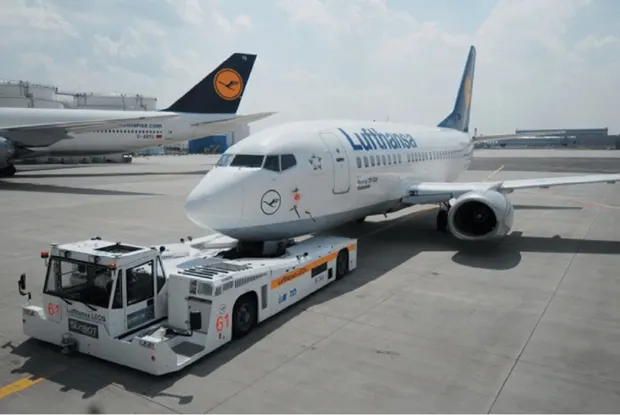
4. How an aircraft is pushed to runway when its ready to take off?
Large jetliner passenger aircraft are pushed away from the passenger loading gate by a tug. This is a machine with wheels, some form of power such as an internal combustion engine, or a battery. When the large aircraft is being pushed backwards, there is someone on each wing tip. They are looking out to make sure nothing will touch the aircraft. The whole idea is to avoid expensive crunching noises.
I hold mechanic certificate, trust me, when you hear a crunching sound and a modern airliner is involved, it will be expensive beyond your wildest imagination.
An airliner might be pushed backwards off the ramp, and onto a taxi way. Then the engines can start, the aircraft can proceed forward under its own power. A twin engine jet might not start the second engine until it is close to takeoff runway, clearance is certain.
A piston engine can run at idle power using only a small percentage of the fuel consumption used at operating power level. Turbine engines such as modern airliner turbo fan engine burn a lot of fuel once they are started. So, there is a lot of incentive to not run them until it is time to fly.
How to get off the gate? Three thugs, a tug, and a tow bar! No disrespect to ramp guys, they have a hard job, low pay, they are in the weather and the noise.
Airplanes have engines, and they can use them to move forward along the ground. So they push themselves to the runway.
It is true that most of the time, a small vehicle is needed to push the larger commercial airplanes backwards away from the terminal building, because even if a plane can reverse it’s thrust, it’s not always safe to hit the buildings with that reverse thrust. So the little trucks push the bigger planes back away from the buildings, but after that, the planes can apply a small amount of engine power to roll forward just as all airplanes can.
Aircraft push themselves to the runway.
5. Learn about take off power, tyre design, rolling resistance, tyre pressure, brake forces when landing.
TAKE OFF OF AIRCARFT:
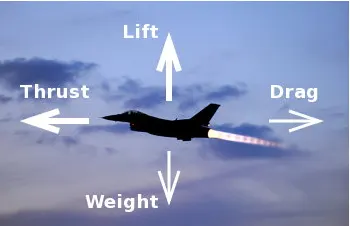
The pilot flying (PF) squeezes the thrust levers slightly forwards, advancing the engines to around 20% of their maximum power. Another pause as we hear the engines spool up. All three pilots scan the engine instruments for any anomalies. Satisfied, the PF uses their index finger to press the Take Off/Go Around (TOGA) button.
With a whir of an electric motor, the auto throttle advances the thrust levers forward and sets the takeoff power. With a reassuring whine, the two massive engines under the wings are woken from their slumber. Forcing 65,000 pounds of thrust out of the back of each engine, the 787 Dreamliner starts to pick up speed
As the aircraft reaches its critical speed, the PF pulls gently back on the control column. The tail of the aircraft sinks down, raising the nose into the air. For a moment, the aircraft seems to crouch, nose pointed up, poised, ready to launch skywards. Then, in a magical moment, the wings bite the air rushing over them and the aircraft eases into the night sky.
This is the wonder of flight.

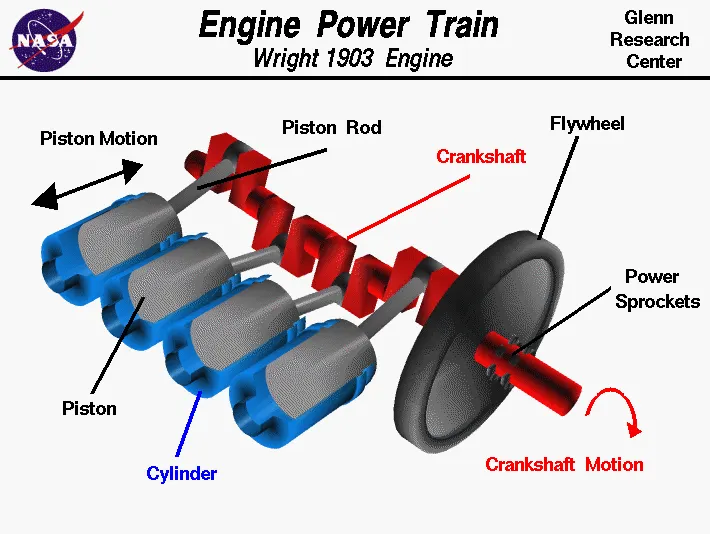
TAKE OFF POWER :
TYRE DESIGN :
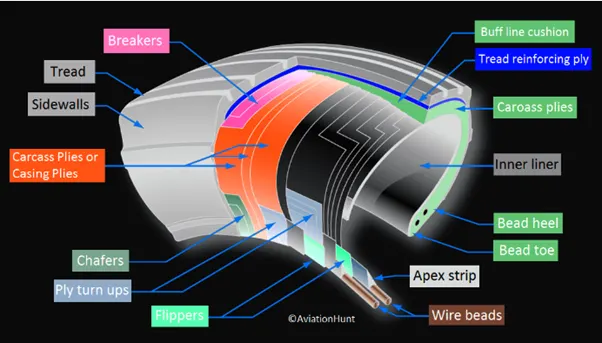
- The aircraft tyre is usually specially designed as the tyre has to withstant more load and also higher speed at the same time. The number of tyres required for any aircraft increases with aircraft's weight, as the weight of the aircraft needs to be distributed more evenly.
- Aircraft's tread pattern are designed to facilate stability in high crosswind conditions, to channel water away to de prevent hydroplanning and for braking effect. Some of the tyre design is given below.
BIAS PLY TYRE :
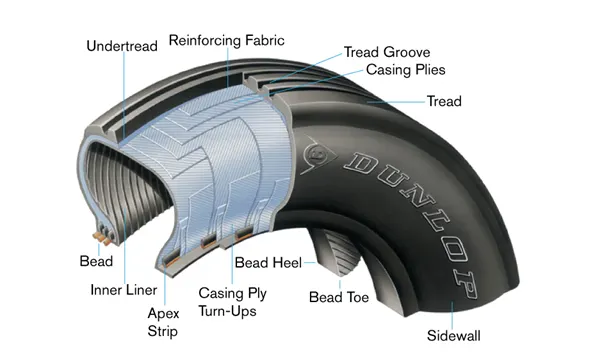
- The bias ply tyre consists of casing plies running diagonally at approximate right angles to one another. The number of plies and angles at which they are laid dictate strength and load capacity.
- High performance bias aircraft tyres feature inter-tread reinforcing fabric (ITF). This provides additional high speed stability, reduces tread distortion under load, protects the casing plies from damage and can act as wear indicators on retreadable tyres.
RADIAL TYRE :
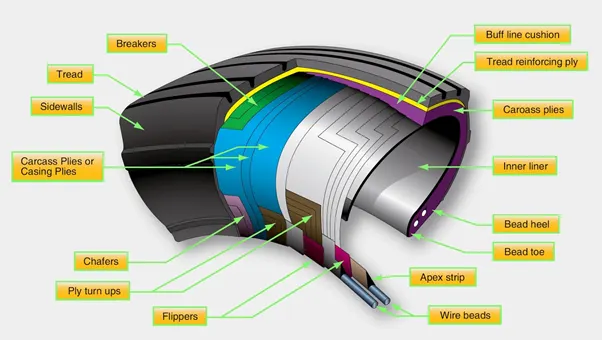
- Radial tired are the most modern design of aircraft tyres. It is a design that is similar to that of car tyres. Typically the radial tyre offers more landings per tread and lighter weight than a bias tyre, though sometimes at the expense of retread lives.
- Radial aircraft tyres differ to bias aircraft tyres in that the plies all run radially from bead to bead at approximately 90 degree to the center line of the tyre. Angled belt plies are laid between the tread and top casing ply, resulting in a flatter tread and adding strength to the tyre.
ROLLING RESISTANCE :
- The rolling resistance force is mainly experienced by the tyre when the vehicle moves over any surface. The rolling resistance force is given by the expression.
Frr = urr * (m.g)
where,
(m.g) = weight in newton.
(urr) = coefficient of rolling resistance.
- The coefficient of rolling resistance (urr) depends on many factors like the, tyre pressure, tyre temperature, material of the tyre, thread pattern of the tyre and also the road roughness and liquids on the road. These factors determine the rolling resistance force.
TYRE PRESSURE :
- The pressure generally is very high in an aircraft tire to reduce the rolling resistance and to withstand the weight. Usually it will be around 200 to 300psi of pressure and they change based on the type of the aircraft.
- Tests of airliner aircraft tyres have shown that they are able to sustain pressures of maximum 800 psi. Aircraft tyres are usually inflated with nitrogen to minimise expansion and contraction from extreme changes in ambient temperature and pressure experienced during flight.
BRAKE FORCE WHILE LANDING :
The brake force while landing is done by three different process they are.
- Aircraft disc brakes - Aircraft has disc rotors in the landing gear used to brake the wheels while touching the ground. These brakes are operated hydraulically or pneumatically.
- Thrust reversers - It allows thrust from the engines to be used to slow the aircraft. This is also very effective in bringing down the speed of the aircraft. by using a negative angle plane, we are turning the wind that is coming into the propeller to flow in the opposite direction.
- Air brake - It is dedicated flight control surface that work by increasing the drag force, air brakes are designed to increase drag while making little change to lift resulting in a higher stall speed. These are some of the tyres of braking methods used to bring down the aircrafts speed while landing the flight.
6) A. With necessary assumptions, calculate the force and power required to push / pull an aircraft by a towing vehicle.
Here the pushback trucks experience two kinds of forces acting on them when they try to push/pull the aircraft.
- Rolling resistance.
- Aerodynamic drag force.
Rolling resistance force
- The formula used for the rolling resistance is Frr = u*m*g
where,
U = coefficient of rolling resistance,
m = mass,
g = acceleration due to gravity.
- The rolling resistance force acts on both the pushback truck and the aircraft. So considering the aircraft,
u = 0.02, m = 40,000kg
Frr (aircraft) = 0.02*40000*9.81 = 7848 N
considering pushback
u = 0.09, m = 1000kg
Frr (pushback truck) = 0.09*1000*9.81 = 883 N
- The total resistance will be the sum of the aircraft and pushback truck rolling resistance = 7848 + 883 = 8731 N
Aerodynamic force
- The aerodynamic force to move an airplane on a absolute flat runway with no wind at constant low speed is usually very negligible. Fd = 1/2.p.A.Cd.v^2
where,
p = ai density kg/m^3,
A = front area in m^2,
Cd = drag coefficient
V = velocity is m/s.
- Since the aerodynamic force is very negligible the net force acting on the pushback truck during the push/pull of an aircraft
Fnet = Frr (pushback truck) + Frr(aircraft)
= 8731 N
The power required is
P = F * V
P = 8731 * 9.72
P = 84.86 KW.
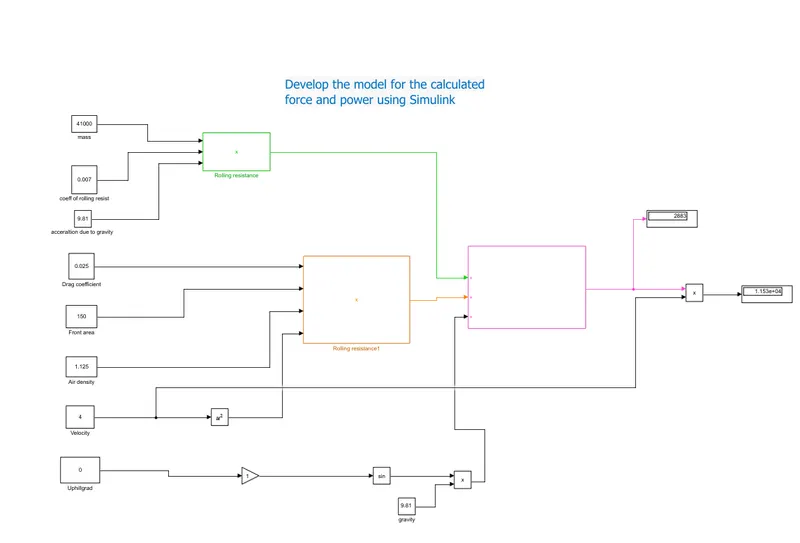
B. Develop the model for the calculated force and power using Simulink.
>SIMULINK MODEL
>sum block is used fromtotal resistive force
>Product block is used from to calculated the resistive force
>Constant block are used for the parameters of mass,rolling resistance,drag coefficient ,air density and velocity
>Dispaly is from show of output result
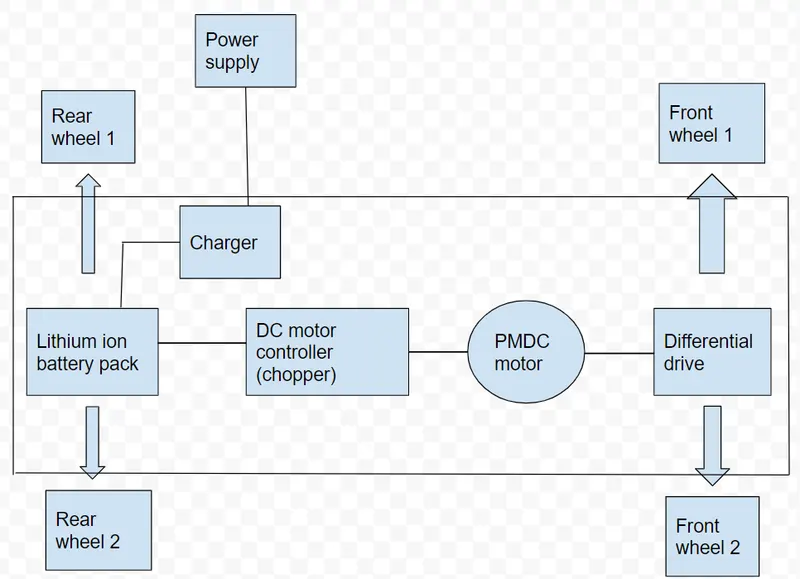
7. A. Design an electric powertrain with type of motor, it’s power rating, and energy requirement to fulfill aircraft towing application in Simulink. Estimate the duty cycle range to control the aircraft speed from zero to highest. Make all required assumptions. Prepare a table of assumed parameters. Draw a block diagram of powertrain.
(Hint :DC7 Block)
B. Also, Design the parameters in excel sheet.
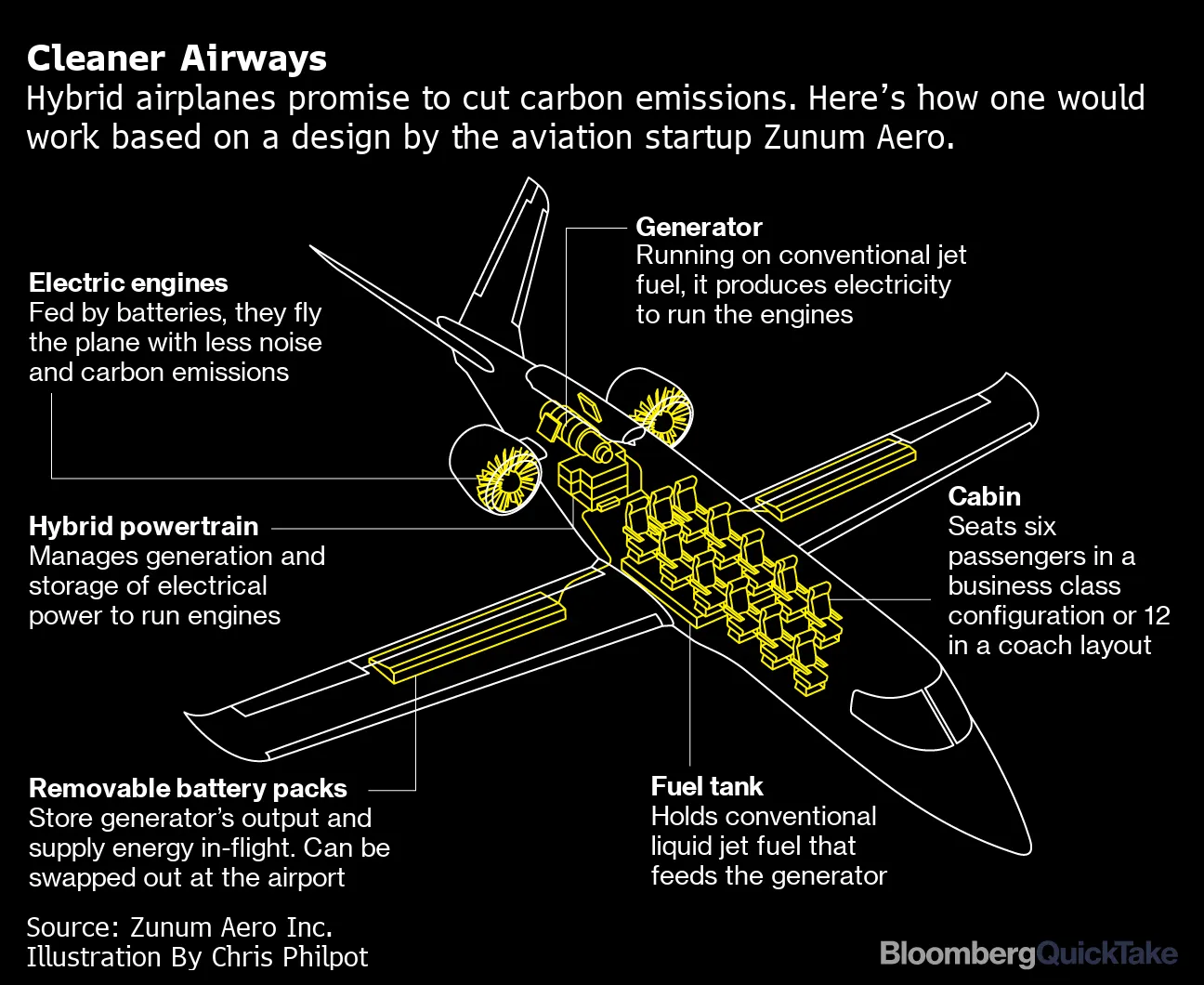
- The aircrafts use electric drives for ground operations (Taxxing and push back), in order to save the jet fuel consumptions.
- The type of motor to be used for aircraft towing applications. There are two types of alternatives. One is PMDC (Permanent magnet DC motor) and the BLDC (Brushless DC motor). We can select PMDC motor because it is widely used in electric vehicles.
- To calculate the power rating of the DC motor chosed. The power required for towing an aircraft is about 84.86KW. This will be our motor rating.
- To calculate the energy required for towing.
Energy for towing = (power required for towing) * (time required for towing)
Let the time be 15 mins for towing = 900 seconds.
It should be calculated in KW-h
E = 84.86*(900/1200) = 63.645 Kw-h.
This is the energy required for towing.
- Now to calculate the duty cycle for the towing operation. we can use a standard lithium ion battery pack for this operation. Assuming the input voltage needed to be 200V and the current required to be 400A.
Power input = V*I = 200*400 = 80000W = 80KW
- We have calculated the power output to be 63.645 Kw-h
- Duty cycle = power output/power input = 63.645/80 = 0.7955.
- Duty cycle for this towing operation is 79%
Paramters that have been assumed in this calculation :
Aircraft weight = 41000Kgs.
Rolling resistance (runway) = 0.02
Rolling resistance (Push back) = 0.10
Pushback vehicle weight = 2000kgs
Pushback velocity = 5.55m/s
Towing operation time = 15mins
Battery voltage = 200V
Current required = 400A
The aerodynamic drag is not considered because it is negligible in the ground.
B. Also, Design the parameters in excel sheet.