Project-1: Powertrain for aircraft in runways
Aim : Solve the Following questions of the Project 1 Powertrain for aircrafts:
Part A:
- Search and list out the total weight of various types of aircrafts.
- Is there any difference between ground speed and air speed?
- Why is it not recommended to use aircraft engine power to move it on the ground at Airport?
- How is an aircraft pushed to runway when its ready to take off?
- Learn about take-off power, Tyre design, rolling resistance, Tyre pressure, brake forces when landing.
Part B:
6.
- With necessary assumptions, calculate the force and power required to push / pull an aircraft by a towing vehicle.
- Develop the model for the calculated force and power using Simulink.
7.
- Design an electric powertrain with type of motor, its power rating, and energy requirement to fulfil aircraft towing application in Simulink. Estimate the duty cycle range to control the aircraft speed from zero to highest. Make all required assumptions. Prepare a table of assumed parameters. Draw a block diagram of powertrain. (Hint :DC7 Block)
- Also, Design the parameters in excel sheet.
Solutions for Part A:
Solution 1.
We need to find and list out the total weight of various types of aircrafts.
An Aircraft’s Weight is typically its structural weight as per its manufactured details, Although the weights in the aircraft are increased by the Structural modifications.
The gross weight limits are established during an aircrafts design and certification period and the its certification and the manufacturing documents. . The manufacturer provides the aircraft operator with the empty weight of the aircraft and the location of its empty weight centre of gravity (EWCG) at the time the certified aircraft leaves the factory
There are many factors that lead to efficient and safe operation of aircraft. Among these vital factors are proper weights and balance control.
Also there are many factors :
- Maximum Design Taxi Weight (MDTW OR MTW)
The maximum design taxi weight or maximum design ramp weight (MDRW) is the maximum certificated design weight for aircraft ground manoeuvres as limited by aircraft strength and airworthiness requirements.
The difference between the maximum taxi/ramp weight and the maximum take-off weight (maximum taxi fuel allowance) depends on the size of the aircraft, the number of engines, APU operation, and engines/APU fuel consumption, and is typically assumed for 10 to 15 minutes allowance of taxi and run-up operations.
- Maximum Design Take-off Weight (MDTOW OR MTOW)
The maximum design take-off weight is the maximum certificated design weight for take-off run as limited by aircraft strength and airworthiness requirements.
- Maximum Design Landing Weight (MDLW OR MLW)
The Maximum design landing weight is the maximum certificated design weight for landing limited by aircraft strength and airworthiness requirements. It generally depends on the landing gear strength, or the landing impact loads on certain parts of the wing structure.
MDLW < MDTOW < MDTW
- Maximum Design Zero-Fuel Weight (MDZFW)
The maximum design zero-fuel weight is the maximum certificated design weight of the aircraft less all usable fuel and other specified usable agents as limited by aircraft strength and airworthiness requirements.
It is the maximum weight permitted before usable fuel and other specified usable fluids are loaded in specified sections of the airplane.
The weight difference between the MDTOW and the MDZFW may be utilized only for the addition of fuel.
Maximum payload = MDZFW – OEW
- Minimum Flight Weight (MFW)
Minimum certificated weight for flight as limited by aircraft strength and airworthiness requirements.
Effects of weight:
- Some of the problems caused by overloading an aircraft are:
- The aircraft will need a higher take-off speed, which results in a longer take-off run.
- Both the rate and angle of climb will be reduced.
- The service ceiling will be lowered.
- The cruising speed will be reduced.
- The cruising range will be shortened.
- Maneuverability will be decreased.
- A longer landing roll will be required because the landing speed will be higher.
- Excessive loads will be imposed on the structure, especially the landing gear.
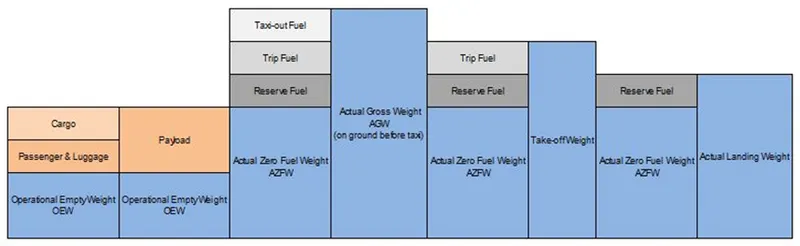
AIRCRAFT GROSS WEIGHT
The aircraft gross weight is the total aircraft weight at any moment during the flight or ground operation.
The aircraft gross weight decreases during flight due to fuel and oil consumption. The aircraft gross weight may also vary during flight due to payload dropping or in-flight refuelling.
Manufacturer’s Empty Weight (MEW)
Let’s start with the aircraft itself. An aircraft “as is” includes:
- Airframe structure with all moving mechanical parts (fuselage, wings, flaps, gear, rudder, nacelle …)
- Power generation system (APU, main engines, power plant…)
- Systems (electrical, hydraulics, pneumatic, fuel flow system, instrument, navigation, air conditioning, anti-ice, fixed furnishing)
- Fixed equipment and services considered an integral part of the aircraft
- Fixed ballast
- Closed system fluids
- Unused fuel only for small aircraft
- All these items above form the Manufacturer’s Empty Weight (MEW).
- This weight does not include:
- Fuel
- Oil, potable water
- Payload (Cargo, passenger, luggage)
- Removable equipment
- Customer specific installations or operator items
Operational Empty Weight (OEW)
The MEW and the operator’s items are summed up to the Operational Empty Weight (OEW). The OEW is usually fixed for a specific aircraft and only gets changed during maintenance or operational changes.
OEW is the empty weight that is used in the flight simulator or the usual planning software.

Also operator’s items are:
The necessary fluids for aircraft operation (engine oil and coolant, water, unusable fuel)
- the water for galleys and lavatories
- aircraft documentation
- passenger seats (and the life vests)
- galley structure
- catering emergency equipment
- aircraft crew and their luggage.
- standard items necessary for full operation
Actual Zero Fuel Weight (AZFW)
If we add the payload to the empty plane weight, we get the Actual Zero Fuel Weight (AZFW).
 The payload includes:
- the passenger’s weight (the standard weights used defined by ICAO respectively)
- the passenger’s luggage’s weight
- the cargo weights

The assumed weights vary around some kg / lbs. depending on the number of seats available on the aircraft.
- a male passenger (incl. cabin luggage) weighs around 82kg (181 lbs.)
- a female passenger around 67kg (148 lbs.)
- a child around 50kg (110lbs.)
- an infant 16kg (35 lbs.).
These are statistical values but otherwise one would need to weigh every single passenger during check in to get his exact weight. Additional payload consists of baggage and cargo (such as mail or goods).
Actual Gross Weight (AGW)
|
type |
1 Litre |
1 U.S. Gallon |
1 Imp. Gallon |
|
Aviation Gas |
1.58 lb. |
6.0 lb. |
7.20 lb. |
|
JP-4 |
1.76 lb. |
6.6 lb. |
8.01 lb. |
|
Kerosene |
1.85 lb. |
7.0 lb. |
8.39 lb. |
|
Oil |
1.95 lb. |
7.5 lb. |
8.5 lb. |
In addition to the actual zero fuel weight, we add the fuel required for the flight and we get the Actual Gross Weight (AGW).
At that time, you should have calculated your total fuel for this flight.
The actual gross weight is the weight of aircraft ready for departure at the gate before push-back and start-up.
Note: 1kg = 2.20462262185 lb(s)
The total fuel shall include:
- Taxi-out fuel (at departure airfield)
- Trip fuel
- Holding
- Re-routing expectation
- regulation needs depending on your route arrival airfield
- fuel to join alternate airfield
- taxi-in fuel at destination,
- final reserve
Take-Off Weight
Fuel burn during taxi operation to the departure runway reduces the gross weight. At the holding point, we have the Actual Take-off Weight (ATOW) which is used for take-off performance calculation.
The gross weight varies during flight. Fuel and oil consumption reduces the gross weight. Additionally, it may vary during flight due to inflight refuelling or payload dropping.

Maximum Design Take-off Weight (MDTOW)
The maximum take-off weight (also known as the maximum brake-release weight) is the maximum weight authorized at brake release for take-off, or at the start of the take-off roll.
The maximum take-off weight is always less than the maximum taxi/ramp weight to allow for fuel burned during taxi by the engines and the APU.
In operation, the maximum weight for take-off may be limited to values less than the maximum take-off weight due to aircraft performance, environmental conditions, airfield characteristics (take-off field length, altitude), maximum tire speed and brake
At this weight, the subsequent addition of fuel will not result in the aircraft design strength being exceeded. The weight difference between the MTOW and the MZFW may be utilized only for the addition of fuel.
LANDING WEIGHT
With the calculation of fuel consumption during flight, we can calculate the Estimated Landing Weight (ELW) which is used for landing performance calculation at the destination.
Approaching your destination, you use your current gross weight to determine the final approach speed. The gross weight now is the Actual Landing Weight (ALW).
Of course, before landing, you never land without any fuel in reserve. The regulation is strict about fuel calculation for commercial air transportation including reserve fuel. Except in specific situations like re-routing, multiple holding, landing at alternate or technical problems, at landing, the aircraft shall still have the expected reserve fuel if there was no extra consumption.

- GRAPHICAL SUMMARY OF OPERATIONAL WEIGHT
|
Type |
MTOW [kg] |
MLW [tonnes] |
TOR [m] |
LR [m] |
ICAO category |
FAA category |
|
Antonov An-225 |
640,000 |
591.7 |
3500 |
Heavy |
Super |
|
|
Scaled Composites Model 351 Stratolaunch |
589,670 |
3660 |
Heavy |
Super |
||
|
Airbus A380-800 |
575,000 |
394 |
3100 |
1930 |
Super |
Super |
|
Boeing 747-8F |
447,700 |
346.091 |
3100 |
1800 |
Heavy |
Heavy |
|
Boeing 747-8 |
443,613 |
306.175 |
3100 |
Heavy |
Heavy |
|
|
Boeing 747-400ER |
412,770 |
295.742 |
3090 |
Heavy |
Heavy |
|
|
Antonov An-124-100M |
405,060 |
330 |
2520 |
900 |
Heavy |
Heavy |
|
Boeing 747-400 |
396,900 |
295.742 |
3018 |
2179 |
Heavy |
Heavy |
|
Lockheed C-5 Galaxy |
381,000 |
288.417 |
2530 |
1494 |
Heavy |
Heavy |
|
Boeing 747-200 |
377,840 |
285.700 |
3338 |
2109 |
Heavy |
Heavy |
|
Boeing 747-300 |
377,840 |
260.320 |
3222 |
1905 |
Heavy |
Heavy |
|
Airbus A340-500 |
371,950 |
240 |
3050 |
2010 |
Heavy |
Heavy |
|
Airbus A340-600 |
367,400 |
256 |
3100 |
2100 |
Heavy |
Heavy |
|
Boeing 777F |
347,800 |
260.816 |
2830 |
Heavy |
Heavy |
|
|
Airbus A330-900 |
352,000 |
251.5 |
3100 |
Heavy |
Heavy |
|
|
Boeing 777-300ER |
351,800 |
251.29 |
3100 |
Heavy |
Heavy |
|
|
Boeing 777-200LR |
347,450 |
223.168 |
3000 |
Heavy |
Heavy |
|
|
Boeing 747-100 |
340,200 |
265.300 |
Heavy |
Heavy |
||
|
Airbus A350-1000 |
308,000 |
233.5 |
Heavy |
Heavy |
||
|
Boeing 777-300 |
299,370 |
237.683 |
3380 |
Heavy |
Heavy |
|
|
Boeing 777-200ER |
297,550 |
213.00 |
3380 |
1550 |
Heavy |
Heavy |
|
Airbus A340-300 |
276,700 |
190 |
3000 |
1926 |
Heavy |
Heavy |
|
McDonnell Douglas MD-11 |
273,300 |
185 |
2990 |
1890 |
Heavy |
Heavy |
|
Airbus A350-900 |
270,000 |
175 |
2670 |
1860 |
Heavy |
Heavy |
|
Ilyushin Il-96M |
270,000 |
195.04 |
3115 |
2118 |
Heavy |
Heavy |
|
McDonnell Douglas DC-10 |
256,280 |
183 |
2990 |
1890 |
Heavy |
Heavy |
|
Boeing 787-9 |
254,000 |
192.777 |
2900 |
Heavy |
Heavy |
|
|
Boeing 787-10 |
254,000 |
201.849 |
Heavy |
Heavy |
||
|
Airbus A340-200 |
253,500 |
181 |
2990 |
Heavy |
Heavy |
|
|
Ilyushin IL-96-300 |
250,000 |
175 |
2600 |
1980 |
Heavy |
Heavy |
|
Airbus A330-300 |
242,000 |
185 |
2500 |
1750 |
Heavy |
Heavy |
|
Airbus A330-200 |
242,000 |
180 |
2220 |
1750 |
Heavy |
Heavy |
|
Lockheed L-1011-500 |
231,300 |
166.92 |
2636 |
Heavy |
Heavy |
|
|
Boeing 787-8 |
228,000 |
172.365 |
3300 |
1695 |
Heavy |
Heavy |
|
Lockheed L-1011-200 |
211,400 |
Heavy |
Heavy |
|||
|
Ilyushin IL-86 |
208,000 |
175 |
Heavy |
Heavy |
||
|
Boeing 767-400ER |
204,000 |
158.758 |
3414 |
Heavy |
Heavy |
|
|
Airbus A300-600R |
192,000 |
140 |
2385 |
1555 |
Heavy |
Heavy |
|
Boeing 767-300ER |
187,000 |
136.08 |
2713 |
1676 |
Heavy |
Heavy |
|
Concorde |
185,000 |
111.1 |
3440 |
2220 |
Heavy |
Heavy |
|
Airbus A300-600 |
163,000 |
138 |
2324 |
1536 |
Heavy |
Heavy |
|
Boeing 767-300 |
159,000 |
136.078 |
2713 |
1676 |
Heavy |
Heavy |
|
Airbus A310-300 |
157,000 |
124 |
2290 |
1490 |
Heavy |
Heavy |
|
Vickers VC10 |
152,000 |
151.9 |
Heavy |
Heavy |
||
|
Boeing 707-320B |
151,000 |
97.5 |
Heavy |
Heavy |
||
|
Boeing 707-320C |
151,000 |
112.1 |
Heavy |
Heavy |
||
|
Douglas DC-8-61 |
147,000 |
Heavy |
Heavy |
|||
|
Airbus A310-200 |
142,000 |
123 |
1860 |
1480 |
Heavy |
Heavy |
|
Airbus A400M |
141,000 |
122 |
980 |
770 |
Heavy |
Heavy |
|
Douglas DC-8-32 |
140,000 |
Heavy |
Heavy |
|||
|
Douglas DC-8-51 |
125,000 |
Medium |
Large |
|||
|
Boeing 757-300 |
124,000 |
101.6 |
2550 |
1750 |
Medium |
Large |
|
Boeing 707-120B |
117,000 |
86.3 |
Medium |
Large |
||
|
Boeing 757-200 |
116,000 |
89.9 |
2347 |
1555 |
Medium |
Large |
|
Boeing 720B |
106,000 |
79.5 |
Medium |
Large |
||
|
Boeing 720 |
104,000 |
79.5 |
Medium |
Large |
||
|
Tupolev Tu-154M |
104,000 |
80 |
Medium |
Large |
||
|
Tupolev Tu-204SM |
104,000 |
87.5 |
2250 |
Medium |
Large |
|
|
Convair 880 |
87,500 |
Medium |
Large |
|||
|
Boeing 737-900 |
85,000 |
66.36 |
2500 |
1704 |
Medium |
Large |
|
Boeing 737-900ER |
85,000 |
71.35 |
2804 |
1829 |
Medium |
Large |
|
Boeing 727-200 Advanced |
84,000 |
70.1 |
Medium |
Large |
||
|
Airbus A321-100 |
83,000 |
77.8 |
2200 |
1540 |
Medium |
Large |
|
Boeing 737-800 |
79,000 |
65.32 |
2308 |
1634 |
Medium |
Large |
|
Boeing 727-200 |
78,000 |
68.1 |
Medium |
Large |
||
|
McDonnell-Douglas MD-83 |
73,000 |
63.28 |
Medium |
Large |
||
|
Boeing 727-100 |
72,500 |
62.4 |
Medium |
Large |
||
|
Boeing 727-100C[17] |
72,500 |
62.4 |
Medium |
Large |
||
|
McDonnell-Douglas MD-90-30 |
71,000 |
64.41 |
2165 |
1520 |
Medium |
Large |
|
de Havilland Comet 4 |
70,700 |
Medium |
Large |
|||
|
Boeing 737-700 |
70,000 |
58.06 |
1921 |
1415 |
Medium |
Large |
|
Airbus A320-100 |
68,000 |
66 |
1955 |
1490 |
Medium |
Large |
|
Boeing 737-400 |
68,000 |
54.9 |
2540 |
1540 |
Medium |
Large |
|
de Havilland Comet 3 |
68,000 |
Medium |
Large |
|||
|
Boeing 377 |
67,000 |
Medium |
Large |
|||
|
Boeing 737-600 |
66,000 |
54.66 |
1796 |
1340 |
Medium |
Large |
|
Airbus A220-300 |
65,000 |
57.61 |
1890 |
1494 |
Medium |
Large |
|
Hawker Siddeley Trident 2E |
65,000 |
Medium |
Large |
|||
|
Airbus A319 |
64,000 |
62.5 |
1850 |
1470 |
Medium |
Large |
|
Boeing 737-300 |
63,000 |
51.7 |
1939 |
1396 |
Medium |
Large |
|
Boeing 737-500 |
60,000 |
49.9 |
1832 |
1360 |
Medium |
Large |
|
Airbus A220-100 |
59,000 |
50.80 |
1463 |
1356 |
Medium |
Large |
|
Airbus A318 |
59,000 |
57.5 |
1375 |
1340 |
Medium |
Large |
|
Boeing 717-200HGW |
55,000 |
47.174 |
1950 |
Medium |
Large |
|
|
Douglas DC-7 |
55,000 |
Medium |
Large |
|||
|
de Havilland Comet 2 |
54,000 |
Medium |
Large |
|||
|
Boeing 717-200BGW |
50,000 |
46.265 |
1950 |
Medium |
Large |
|
|
de Havilland Comet 1 |
50,000 |
Medium |
Large |
|||
|
Douglas DC-6A |
48,600 |
Medium |
Large |
|||
|
Douglas DC-6B |
48,500 |
Medium |
Large |
|||
|
Embraer 190 |
48,000 |
43 |
2056 |
1323 |
Medium |
Large |
|
Caravelle III |
46,000 |
Medium |
Large |
|||
|
Fokker 100 |
46,000 |
39.95 |
1621 |
1350 |
Medium |
Large |
|
Douglas DC-6 |
44,000 |
Medium |
Large |
|||
|
Avro RJ-85 |
42,000 |
36.74 |
Medium |
Large |
||
|
Handley Page Hermes |
39,000 |
Medium |
Large |
|||
|
Embraer 175 |
37,500 |
32.8 |
2244 |
1304 |
Medium |
Large |
|
Bombardier CRJ900 |
36,500 |
33.345 |
1778 |
1596 |
Medium |
Large |
|
Embraer 170 |
36,000 |
32.8 |
1644 |
1274 |
Medium |
Large |
|
Bombardier CRJ700 |
33,000 |
30.39 |
1564 |
1478 |
Medium |
Large |
|
Douglas DC-4 |
33,000 |
Medium |
Large |
|||
|
Vickers Viscount 800 |
30,400 |
Medium |
Large |
|||
|
Bombardier Q400 |
28,000 |
28.01 |
1219 |
1295 |
Medium |
Large |
|
Bombardier CRJ200 |
23,000 |
21.319 |
1918 |
1479 |
Medium |
Large |
|
ATR 72-600 |
22,800 |
22.35 |
1333 |
914 |
Medium |
Large |
|
Saab 2000 |
22,800 |
21.5 |
1300 |
Medium |
Large |
|
|
Embraer ERJ 145 |
22,000 |
19.3 |
2270 |
1380 |
Medium |
Large |
|
ATR 42-500 |
18,600 |
18.3 |
1165 |
1126 |
Medium |
Small |
|
Saab 340 |
13,150 |
12.930 |
1300 |
1030 |
Medium |
Small |
|
Embraer 120 Brasilia |
11,500 |
11.25 |
1560 |
1380 |
Medium |
Small |
|
BAe Jetstream 41 |
10,890 |
10.570 |
1493 |
826 |
Medium |
Small |
|
Learjet 75 |
9,752 |
8.709 |
1353 |
811 |
Medium |
Small |
|
Pilatus PC-24 |
8,300 |
7.665 |
893 |
724 |
Medium |
Small |
|
Embraer Phenom 300 |
8,150 |
7.65 |
956 |
677 |
Medium |
Small |
|
Beechcraft 1900D |
7,765 |
7.605 |
1036 |
853 |
Medium |
Small |
|
Cessna Citation CJ4 |
7,761 |
7.103 |
1039 |
896 |
Medium |
Small |
|
de Havilland Hercules |
7,000 |
Medium |
Small |
|||
|
Embraer Phenom 100 |
4,800 |
4.43 |
975 |
741 |
Light |
Small |
Solution 2:
Is there any difference between ground speed and air speed?
- Ground Speed
The speed of the aircraft on ground as the aircraft moves relative to the reference point at the ground speed. Ground speed is also a vector quantity so a comparison of the ground speed to the wind speed must be done according to rules for vector comparisons.
- Air Speed
The speed in the air can be discussed as ,The important quantity in the generation of lift is the relative velocity between the object and the air, which is called the airspeed. Airspeed cannot be directly measured from a ground position but must be computed from the ground speed and the wind speed. Airspeed is the vector difference between the ground speed and the wind speed.
Airspeed = Ground Speed - Wind Speed
On a perfectly still day, the airspeed is equal to the ground speed. But if the wind is blowing in the same direction that the aircraft is moving, the airspeed will be less than the ground speed.
- Wind Speed
The air moves relative to the reference point at the wind speed. Notice that the wind speed is a vector quantity and has both a magnitude and a direction. Direction is important. A x-mph wind from the west is different from a x-mph wind from the east. The wind has components in all three primary directions (north-south, east-west, and up-down). In this figure, we are considering only velocities along the aircraft's flight path. A positive velocity is defined to be in the direction of the aircraft's motion. We are neglecting cross winds, which occur perpendicular to the flight path but parallel to the ground, and updrafts and downdrafts, which occur perpendicular to the ground.
- Relative Velocity
A kite usually has no ground speed because a kite is held on the end of a string. But the kite still has an airspeed that is equal to the wind speed. You can fly a kite only with the wind at your back. In the wind tunnel, the ground speed is zero because the model is fixed to the walls of the tunnel. The airspeed is then the negative of the wind speed that is generated in the tunnel. Whether the object moves through the air, or the air moves over the object, the forces are the same.
The importance of the relative velocity explains why airplanes take off and land on different runways on different days. Airplanes always try to take off and land into the wind. This requires a lower ground speed to become airborne, which means the plane can take off or land in the shortest distance travelled along the ground. Since runways have a fixed length, you want to get airborne as fast as possible on take-off and stopped as soon as possible on landing. In the old days, a large "windsock" was hung near the runway for pilots to see which way the wind was blowing to adjust their take-off and landing directions. Now mechanical or electronic devices provide the information that is radioed to the cockpit. The relationship between airspeed, wind speed, and ground speed explains why wind tunnel testing is possible and how kites fly.
Solution 3. Why is it not recommended to use aircraft engine power to move it on the ground at Airport?
The condition why it is not recommended to use aircraft engine power to move it on the ground at Airport because of following reasons,
Commercial airplanes are equipped with engines rated from 18,000 to nearly 100,000 lb of thrust. Such thrust levels provide for safe take-off, flight, and landing over a wide range of temperatures, altitudes, gross weights, and payload conditions. However, the exhaust wake from these engines can pose hazards in commercial airport environments. Operators and airport authorities must carefully consider these hazards and the resulting potential for injury to people and damage to or caused by baggage carts, service vehicles, airport infrastructure, and other airplanes.
When modern jet engines are operated at rated thrust levels, the exhaust wake can exceed 375 mi/h (325 kn or 603 km/h) immediately aft(tail/back) of the engine exhaust nozzle. This exhaust flow field extends aft in a rapidly expanding cone, with portions of the flow field contacting and extending aft along the pavement surface. Exhaust velocity components are attenuated with increasing distance from the engine exhaust nozzle. However, an airflow of 300 mi/h (260 km or 483 km/h) can still be present at the empennage (tail portion), and significant people and equipment hazards will persist hundreds of feet beyond this area. At full power, the exhaust wake speed can typically be 150 mi/h (130 km or 240 km/h) at 200 ft (61 m) beyond the airplane and 50 to 100 mi/h (43 to 88 km or 80 to 161 km/h) well beyond this point. At these velocities, minimal damage to stationary building structures would be anticipated, but more damage to unanchored mobile homes and utility structures would be expected and when winds greater than 155 mi/h (135 km or 249 km/h). Residential and industrial structures would experience roof failure, with lower strength structures experiencing complete collapse. Mobile homes, utility buildings, and utilities would be extensively damaged or destroyed, as would trees, shrubs, and landscaping hence aircraft engine power is not recommended at airport.
As per all the conditions predicts to avoid all such extreme cautions it is not recommended to use aircraft engine power to move it on the ground at the airport.
Solution 4. How is an aircraft pushed to runway when its ready to take off?
- Push-Back:
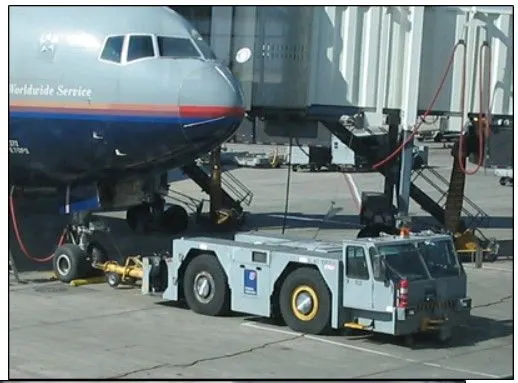
In aviation, pushback is an airport procedure during which an aircraft is pushed backwards away from its parking position, usually at an airport gate by external power. Pushbacks are carried out by special, low-profile vehicles called pushback tractors or tugs.
Although many aircraft can move themselves backwards on the ground using reverse thrust (a procedure referred to as a power back), the resulting jet blast or prop wash would cause increased noise, damage to the terminal building or equipment, and hurt airport staff due to high-speed debris. This debris would also be sucked into the engine, as it is in normal use, and cause excessive wear - a major cause of wear on aircraft engines is during ground use. A pushback is therefore the preferred method when ground-handling aircraft. - Moving the light weight Aircrafts:
Although the planes are small and weights less very small planes can be moved by Man Power alone , Hence the pulling or pushing process is handelled by landing gear or wing struts as they are strong enough to drag the airplane .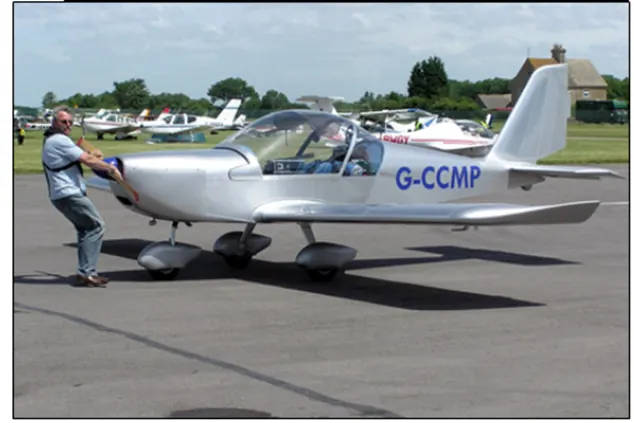
- Tractors And Towbars : Large and very large aircrafts requires a tractor or tug for the pushing and pulling. Pushback Tractors use a low profile design to fit under the aircraft nose , for sufficient traction the tractor are heavy and strong for example typical tractor for a heavy large weighted tractors weighs approx. 54 tonnes which has a drawbar pull of 334 KN.
Steps:
- Pushbacks at busy aerodromeasure usually subject to ground control clearance to facilitate ground movement on taxiways.
- Once clearance is obtained, the pilot will communicate with the tractor driver (or a ground handler walking alongside the aircraft in some cases) to start the pushback.
- To communicate, a headset may be connected near the nose gear.
- Since the pilots cannot see what is behind the aircraft, steering is done by the pushback tractor driver and not by the pilots.
- Depending on the aircraft type and airline procedure, a bypass pinmay be temporarily installed into the nose gear to disconnect it from the aircraft's normal steering mechanism.
- Once the pushback is completed, the towbar is disconnected, and any bypass pin removed.
- The ground handler will show the bypass pin to the pilots to make it clear that it has been removed.
- The pushback is then complete, and the aircraft can taxi forward under its own power.
Solution 5.
Learn about take-off power, tyre design, rolling resistance, tyre pressure, brake forces when landing.
Take-Off Power:
The amount of power that an engine is allowed to produce for a limited period for take-off is Take-Off Power.
- The use of takeoff power is usually limited to 5 min for reciprocating engines and up to 2½ min for gas turbine
- This may not always be the case because, with respect to reciprocating engines, it is the brake horsepower developed under standard sea-level conditions and under the maximum conditions of the crankshaft rotational speed and the engine manifold pressure approved for the normal take-off.
- It is limited in continuous use to the period shown in the approved engine
- With respect to gas turbine engines, it is the thrust developed under static conditions at a specified altitude and atmospheric conditions of the rotor shaft rotational speed and gas temperature approved for the normal take-off.
- It is limited in continuous use to the period shown in the approved engine
- Tyre Design:
An aircraft Tyre is designed to withstand extremely heavy loads while landing, take off, taxing, and parking. The number of wheels required for aircraft increases with the weight of the aircraft, as the weight of the aeroplane needs to be distributed more evenly.
Design and Construction of Aircraft Tyre Carcass plies are used to form the tire. They are sometimes called casing plies. An aircraft tyre is constructed for the purpose it serves.
- They support the weight of an aircraft while it is on the ground.
- It also provides the necessary traction for braking and stopping of an aeroplane.
- Tyre also helps to absorb the shock of landing and provide cushioning the roughness of take-off, roll-out, and taxi operations.
Unlike an automobile or truck tyre, it does not have to carry a load for a long period of continuous operation. However, an aircraft tyre absorbs the high impact loads of landing, and, it’s operating at high speeds for a short time when required.
- Rolling Resistance:
When taking off from a runway covered with slush, standing water or snow, the required take-off ground-run distance will be longer than on a dry runway. This is the result of the fact that slush, standing water and snow on the runway will generate a rolling resistance that increases the total resistance on the aircraft during the ground-run.
Fr= mrr*W
- Tyre Pressure:
The typical airliner tire can handle a 38-ton load. It can meet the ground 500 times before needing a re-tread, a refresh it can take on seven times in its life.
- A Boeing 777 uses 14 tires, Airbus' A380 carries 22, and the enormous Antonov An-225 demands 32.
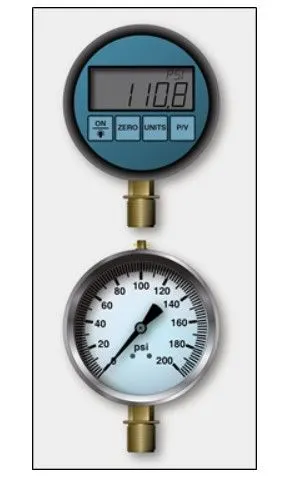
- The key to their remarkable durability is maximizing the air pressure.
- The high-flying rubber is typically inflated to 200 psi, roughly six times what you put in an automobile tire, and the tires on an F-16 fighter are pumped to 320 psi.
- It's the pressurized air that is helping the tires to be strong.
The tires themselves aren't terribly large--- a Boeing 737 have a tyre size of rubber 27 inches in diameter, 7.75 inches wide, and wrapped around a 15-inch wheel (27x7.75 R15). - They're typically made of nylon, and more recently a variety known as aramid.
- Each layer of the casing contributes to its load bearing and air pressure resisting capabilities.
- Of course, tires can fail, especially when under-inflated or overloaded. Treads can come off and casings can blow out.
- Brake Forces when Landing:
Airplanes rely on a braking system to safely land on runways. At cruising altitude, most commercial airplanes fly at a speed of roughly 500 to 600 mph. When landing, however, they must reduce their speed. A typical 747, for instance, has a landing speed of about 160 to 170 mph. And upon touching the runway, airplanes must quickly brake until they come to a complete stop. This is achieved by;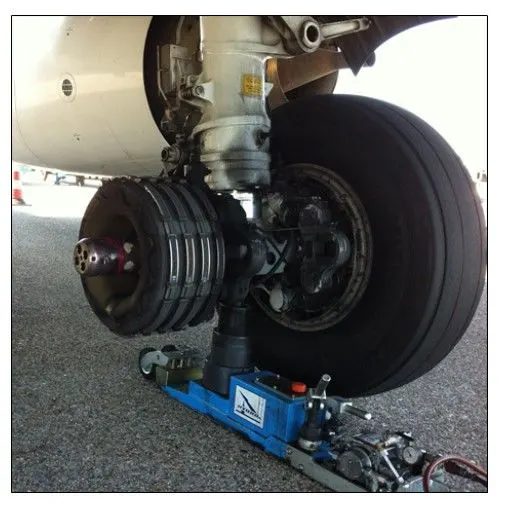
- Wing Spoilers:
Many airplanes use wing spoilers to assist with braking when landing. Not to be confused with ailerons, spoilers are extendable flaps on the ends of an airplane’s wings.- Pilots can raise the spoilers to decelerate the airplane as it approaches the runway.
- While on the runway, pilots will typically leave the wing spoilers raised.
- Raised wing spoilers create drag, which essentially slows down the airplane so that it’s able to brake more quickly.
- Disc Brakes:
In addition to wing spoilers, airplanes use disc brakes. Airplane disc brakes are like the braking system in automobiles. They consist of a pair of callipers that, when engaged, squeeze pads against the rotors of an airplane’s landing gear.- Disc brakes are designed to always remain static. In other words, they don’t rotate with the wheels of an airplane’s landing gear.
- As the wheels turn, the disc brakes will remain static and stationary.
- They are a vital component of an airplane’s braking system because they are designed to apply pressure to the airplane’s wheels.
- Disc brakes will squeeze the wheels, thereby slowing down the speed at which they spin.
- In turn, this reduces the speed of the airplane so that it can come to a complete stop on the runway.
- Reverse Thrust:
Many jet airplanes use reverse thrust to assist with braking during landings. Reverse thrust is a feature in jet engine airplanes that, as the name suggests, involves the reversal of the engines’ thrust. When flying, the thrust is projected out the rear of an airplane’s engines.- When landing, however, pilots may use the reverse thrust feature.
- Reverse thrust changes the direction of the engines’ thrust.
- Rather than projecting out the rear, the thrust will be projected out the front.
- This reversal of thrust provides deceleration that allows airplanes to slow down more quickly when landing.
Part B
Solution 6:
- With necessary assumptions, calculate the force and power required to push / pull an aircraft by a towing vehicle.
- Develop the model for the calculated force and power using Simulink.
To calculate the force and power required to push / pull an aircraft by a towing vehicle, let’s assume the following parameters.
Here we consider the Aircraft to be towed as Airbus A320-100 with MTOW = 68,000 Kg and Towing Vehicle with GVM = 5,000 Kg. Also, for this calculation, we neglect the effect of hill climbing since the plane is flat moving at a velocity of 15 Kmph. Thus, we will have to calculate the total Force from Rolling Resistance and Aerodynamic Force.
Assume,
For, Airbus A320-100,
GVM = 68,000 Kg
μrr = 0.008
Height = 11m
Width = 10 m (without wings)
Frontal Area = 110 m2
Cd = 0.032
For, Towing Vehicle,
GVM = 5,000 Kg
μrr = 0.01
Height = 5 m
Width = 10 m (without wings)
Frontal Area = 50 m2
Cd = 0.025
|
To calculate force & power required to push / pull an aircraft by a towing vehicle. |
||||
|
PARAMETER |
Aircraft |
Tow Vehicle |
||
|
Rolling Resistance Calculation |
68000 |
5000 |
||
|
Coefficient of Rolling Resistance |
0.008 |
0.01 |
||
|
Total Mass (Kg) |
68000 |
5000 |
||
|
Rolling Resistance Force (N) |
5336.64 |
490.5 |
||
|
Total Rolling Resistance Force (N) = Aircraft's Rolling Resistance Force + Tow vehicle's Rolling Resistance Force |
5827.14 |
|||
|
Air Drag Calculation |
|
|||
|
Air Density (Kg/m3) |
1.25 |
1.25 |
||
|
Width (m) |
11 |
5 |
||
|
Height (m) |
10 |
8 |
||
|
Drag Coefficient |
0.03 |
0.03 |
||
|
Speed (Kmph) |
15 |
15 |
||
|
Frontal Area (m2) |
110 |
40 |
||
|
Speed in m/s |
4.17 |
4.17 |
||
|
Air Drag Force (N) |
38.19 |
10.85 |
||
|
Total Air Drag Force (N) = Aircraft's Air Drag Force + Tow vehicle's Air Drag Force Force |
49.05 |
|||
|
Tractive Force exerted (N) = Air Drag Force + Rolling Resistance Force |
5374.83 |
501.35 |
||
|
Total Tractive Force exerted on Tow vehicle (N) = Total Air Drag Force + Total Rolling Resistance Force |
5876.19 |
|||
|
Total Power at given speed (kW) |
22.4 |
2.09 |
||
|
Total Power required for Push/Pull at given speed (kW) |
24.48 |
|||
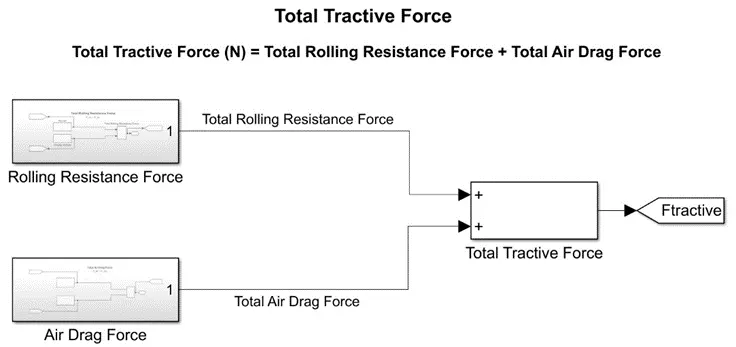
Q B. Simulink model :
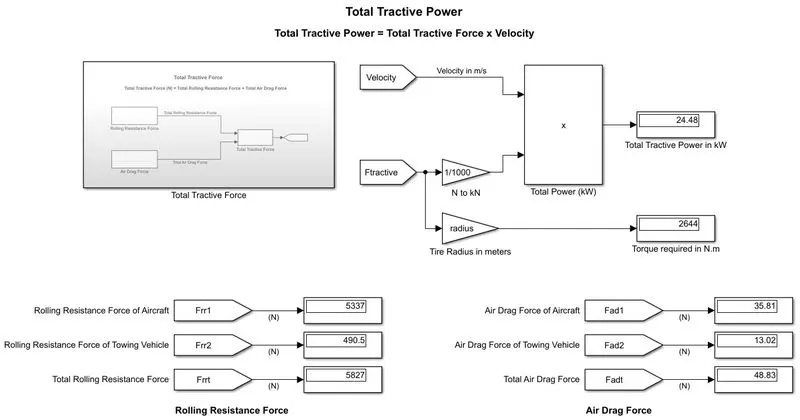
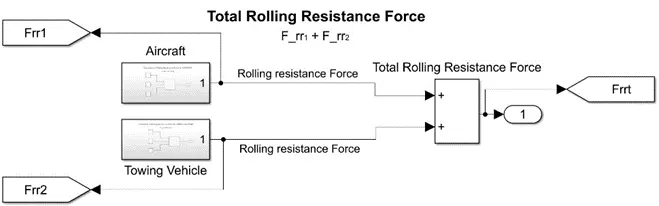
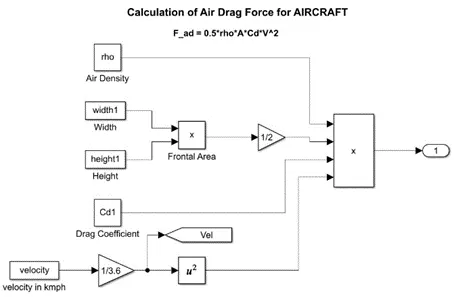
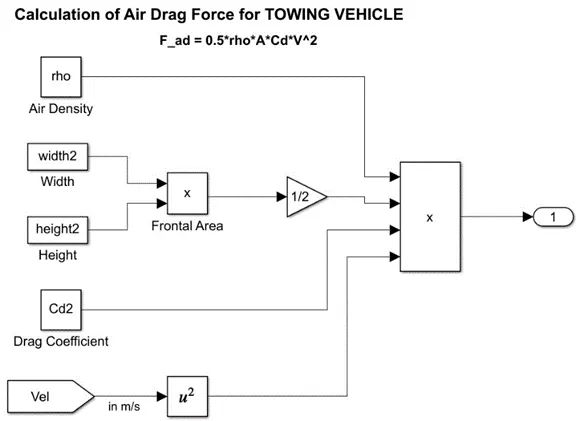
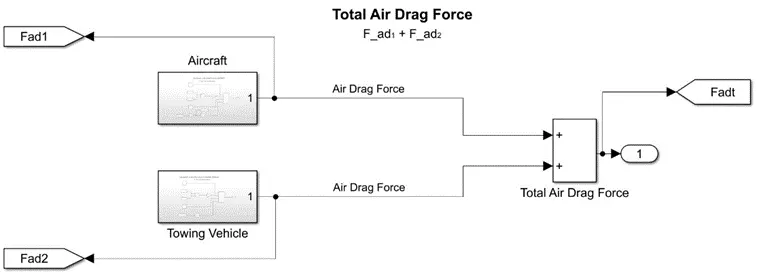
Above Simulink Model consists Subsystems used:
Subsystem 1 - Rolling Resistance Force for Aircraft
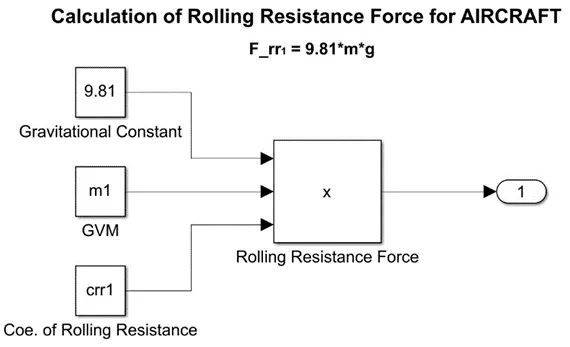
Subsystem 2 - Rolling Resistance Force for Towing Vehicle
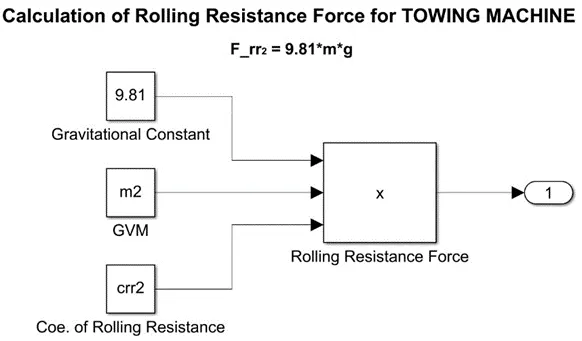
Subsystem 3 - Total Rolling Resistance Force
Subsystem 4 – Air Drag Force for Aircraft
Subsystem 5 – Air Drag Force for Towing Vehicle
Subsystem 6 – Total Air Drag Force
Subsystem 7 – Total Tractive Force
Solution 7:
- Design an electric powertrain with type of motor, its power rating, and energy requirement to fulfil aircraft towing application in Simulink. Estimate the duty cycle range to control the aircraft speed from zero to highest. Make all required assumptions. Prepare a table of assumed parameters. Draw a block diagram of powertrain. (Hint :DC7 Block)
Also, Design the parameters in excel sheet.
Since, we are continuing with the previous questions, lets consider the same parameters.
We calculated the required Force and Power as,
Force = 5876.2 N
Power = 24.48 kW
radius = 0.45 m
Considering motor efficiency as 95%, lets calculate the required output Power
Output Power of Motor = Calculated Power / efficiency
= 24.48/0.95
= 25.76 kW
For Required Torque calculation, consider a gear ratio of 0.5 and transmission efficiency to be 90%
Output Torque = (Traction Force * Radius of tire) / (Gear Ratio * efficiency)
= ( 5876.2 * 0.45 ) / ( 10 * 0.9 )
= 2644.29 / 9
= 293.81 Nm
Thus, Speed produced by motor, ω = Power/ Torque
= 25.76 kW / 293.81 Nm
= 87.67 rad/sec or 837 rpm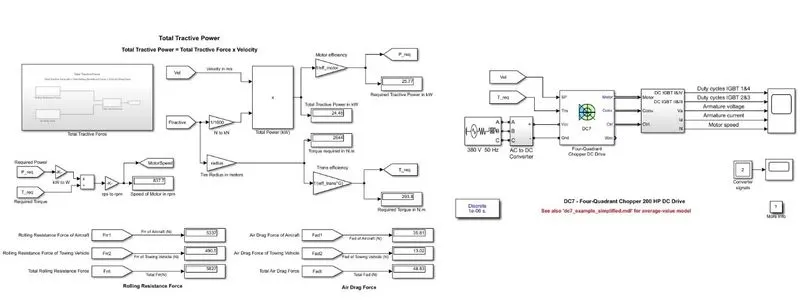
Here, we require a motor of minimum specification as,
Motor Power = 26kW or 35 hp
Motor Torque = 294 Nm
Motor Speed = 840 rpm
Thus, we can use a 3- phase Induction motor matching the above specifications as,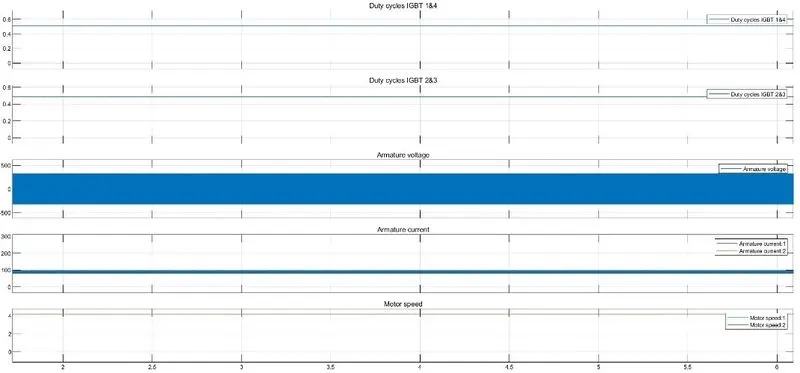
- Prepared Excel Sheet for calculations:
|
To calculate force & power required to push / pull an aircraft by a towing vehicle. |
||||
|
PARAMETER |
Aircraft |
Tow Vehicle |
||
|
Rolling Resistance Calculation |
68000 |
5000 |
||
|
Coefficient of Rolling Resistance |
0.008 |
0.01 |
||
|
Total Mass (Kg) |
68000 |
5000 |
||
|
Rolling Resistance Force (N) |
5336.64 |
490.5 |
||
|
Total Rolling Resistance Force (N) = Aircraft's Rolling Resistance Force + Tow vehicle's Rolling Resistance Force |
5827.14 |
|||
|
Air Drag Calculation |
|
|||
|
Air Density (Kg/m3) |
1.25 |
1.25 |
||
|
Width (m) |
11 |
5 |
||
|
Height (m) |
10 |
8 |
||
|
Drag Coefficient |
0.03 |
0.03 |
||
|
Speed (Kmph) |
15 |
15 |
||
|
Frontal Area (m2) |
110 |
40 |
||
|
Speed in m/s |
4.17 |
4.17 |
||
|
Air Drag Force (N) |
38.19 |
10.85 |
||
|
Total Air Drag Force (N) = Aircraft's Air Drag Force + Tow vehicle's Air Drag Force |
49.05 |
|||
|
Tractive Force exerted (N) = Air Drag Force + Rolling Resistance Force |
5374.83 |
501.35 |
||
|
Total Tractive Force exerted on Tow vehicle (N) = Total Air Drag Force + Total Rolling Resistance Force |
5876.19 |
|||
|
Total Power at given speed (kW) |
22.4 |
2.09 |
||
|
Total Power required for Push/Pull at given speed (kW) |
24.48 |
|||
|
radius of Tire (m) |
- |
0.45 |
||
|
Efficiency of Motor |
0.95 |
|||
|
Gear Ratio |
10 |
|||
|
Efficiency of Transmission |
0.9 |
|||
|
Required Output Power of Motor (kW) |
25.77 |
|||
|
Required Torque of Motor (N. m) |
293.81 |
|||
- Conclusions:
We have solved the Questions in two parts A And B
For Part A:
- In Question 1, We have listed total weight of various types of aircrafts.
- In Question 2, We have differentiated between the ground speed and air speed of the aircrafts.
- In Question 3, We have Concluded that why is it not recommended to use aircraft engine power to move it on the ground at Airport with the following reasons listed in the Answer.
- In Question 4, we have demonstrated How is an aircraft pushed to runway when its ready to take off.
- In Question 5, we have described take-off power, tyre design, rolling resistance, tyre pressure, brake forces when landing.
For Part B:
- In Question 6, We have calculated the force and power required to push / pull an aircraft by a towing vehicle. And also Develop the model for the calculated force and power using Simulink.
- In Question 7, electric powertrain with type of motor, its power rating, and energy requirement to fulfil aircraft towing application in Simulink. Estimate the duty cycle range to control the aircraft speed from zero to highest. Make all required assumptions. Prepare a table of assumed parameters. Draw a block diagram of powertrain