Project-1: Powertrain for aircraft in runways
Part A:
1. Search and list out the total weight of various types of aircrafts.
| Aircraft | Empty Weight | Max Fuel Weight | Max Cargo Weight | Max Gross Takeoff Weight |
| Antanov AN-225 | 628,000 lbs | 661,400 lbs | 417,000 lbs | 1,411,000 lbs |
| 285,000 kg | 300,000 kg | 190,000 kg | 640,000 kg | |
| Airbus A380-800 | 611,000 lbs | 560,000 lbs | 185,000 lbs | 1,268,000 lbs |
| 277,000 kg | 254,000 kg | 84,000 kg | 575,000 kg | |
| Boeing 747-800 | 485,300 lbs | 427,400 lbs | 295,000 lbs | 987,000 lbs |
| 220,100 kg | 194,000 kg | 134,000 kg | 447,700 kg | |
| Airbus A340-500 | 370,000 lbs | 386,300 lbs | 119,000 lbs | 820,000 lbs |
| 168,000 kg | 175,000 kg | 54,000 kg | 372,000 kg | |
| Boeing 777-300ER | 370,000 lbs 168,000 kg |
320,800 lbs 145,500 kg |
148,000 lbs | 776,000 lbs |
| 67,100 kg | 352,000 kg | |||
| Boeing 787-10 | 299,000 lbs 135,500 kg | 223,500 lbs | 126,300 lbs 57,300 kg | 560,000 lbs |
| 101,500 kg | 254,000 kg | |||
| Boeing 737-900 | 98,500 lbs | 53,100 lbs | 44,600 lbs | 187,000 lbs |
| 44,700 kg | 24,000 kg | 20,200 kg | 85,000 kg | |
| Airbus A320-100 | 93,900 lbs | 48,700 lbs | 44,000 lbs | 150,000 lbs |
| 42,600 kg | 22,100 kg | 20,000 kg | 68,000 kg | |
| Embraer 190 | 63,500 lbs | 28,600 lbs | 28,800 lbs | 106,000 lbs |
| 28,800 kg | 13,000 kg | 13,100 kg | 48,000 kg | |
| Gulfstream G650 | 54,000 lbs 24,500 kg | 48,200 lbs 21,900 kg | 6,500 lbs | 100,000 lbs |
| 3,000 kg | 45,200 kg | |||
| Bombardier CRJ900 | 48,160 lbs 21,850 kg | 19,600 lbs 8,900 kg | 6,075 lbs 2,760 kg | 80,500 lbs |
| 36,500 kg | ||||
| Bombardier Q400 | 39,300 lbs | 11,700 lbs | 18,700 lbs | 62,000 lbs |
| 17,800 kg | 5,300 kg | 8,500 kg | 28,000 kg | |
| Learjet 75 | 13,900 lbs 6,300 kg | 6,060 lbs | 2,900 lbs | 21,500 lbs |
| 2,750 kg | 1,300 kg | 9,700 kg | ||
| Cessna Citation CJ4 | 10,300 lbs 4,700 kg | 5,800 lbs | 2,200 lbs 1,000 kg | 17,200 lbs |
| 2,650 kg | 7,800 kg | |||
| Beechcraft King Air B100 | 7,100 lbs 3,200 kg | 3,200 lbs | 4,150 lbs | 12,000 lbs |
| 1,450 kg | 1,900 kg | 5,400 kg | ||
| Diamond DA50 RG | 3,200 lbs | 340 lbs | 1,250 lbs | 4,400 lbs |
| 1,450 kg | 155 lbs | 560 kg | 2,000 kg | |
| Beechcraft Bonanza G36 | 2,500 lbs 1,150 kg | 450 lbs | 850 lbs | 3,660 lbs |
| 200 kg | 385 kg | 1,660 kg | ||
| Cessna 206H | 2,200 lbs | 520 lbs | 1,150 lbs | 3,600 lbs |
| 990 kg | 235 kg | 520 kg | 1,630 kg | |
| Sirrus SR22 | 2,250 lbs 1,000 kg | 485 lbs | 950 lbs | 3,600 lbs |
| 220 kg | 430 kg | 1,630 kg | ||
| Cessna 172R | 1,700 lbs | 380 lbs | 560 lbs | 2,425 lbs |
| 770 kg | 170 kg | 255 kg | 1,100 kg |
Above table showa the various types of aircraft and their Empty Weight, Max Fuel Weight, Max Cargo Weight ,Max Gross Takeoff Weight
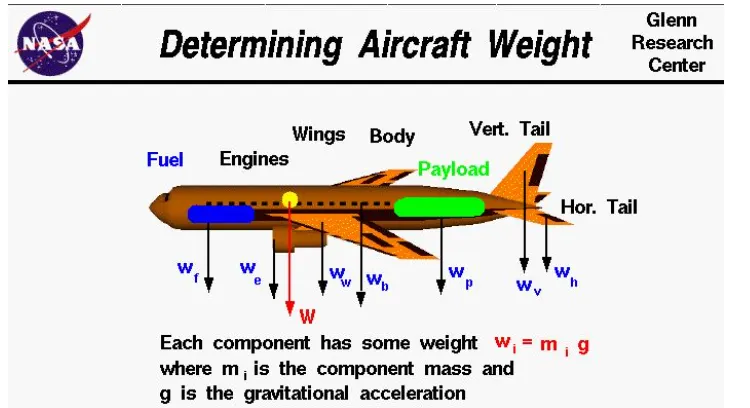
Each component of the aircraft hasa some weight.
Empty weight:
The empty weight of the aircraft is defined as the weight of aircraft ithout any eight on it such as payload or without even fuel.
Consider the aircraft being ready from the manufacturing and ready to fuel it up and deliver to customer.
Maximum fuel weight:
Maximum fuel weight is the weight of the fuel allowed in the aircraft to the limit.
Maximum cargo weight:
Maximum cargo weight is the permisiible weight on the aircraft.
This weight exclude the Empty weight, fuel weight of the air craft.
Aircraft Maximum Gross Takeoff Weight(MGTW)
This is the maximum permissible weight the aircraft can weigh as it lifts off the ground at takeoff. This includes the aircraft’s empty weight, the fuel, the crew, the passengers, and all the cargo.
2. Is there any difference between ground speed and air speed?
There is three types of speeds for studying the aircraft speed.
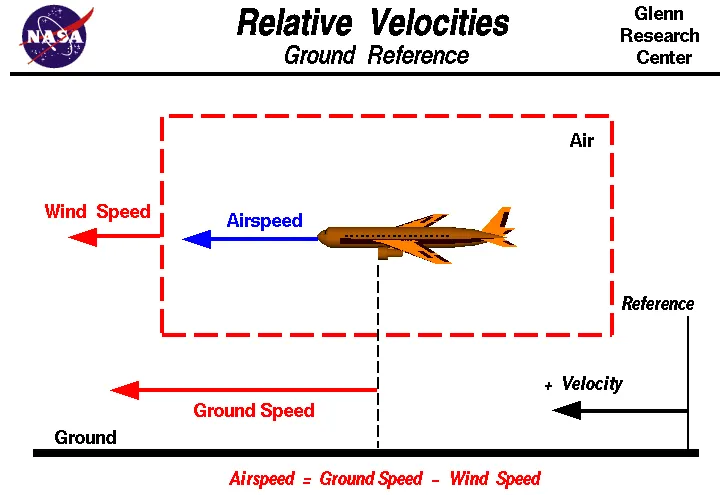
Ground Speed:
It is the horizontal speed of anaircraft with respect to earth surface.
if the Wind speed is in favour with Air speed, the ground speed increases.
Ground speed is also a vector quantity so a comparison of the ground speed to the wind speed must be done according to rules for vector comparisons.
Air Speed:
Air speed is the relative speed between object and the air. Air speed is depends upon the ground speed and wind speed.
The air speed can not measure from the ground.
Airspeed = Ground Speed - Wind Speed
Wind Speed:
It is normally speed of the wind in the specific direction. It is vectorial quantity and has amplitude and direction.
It is the speed of the air with respect to the object on the ground.
Analogy for above speed:
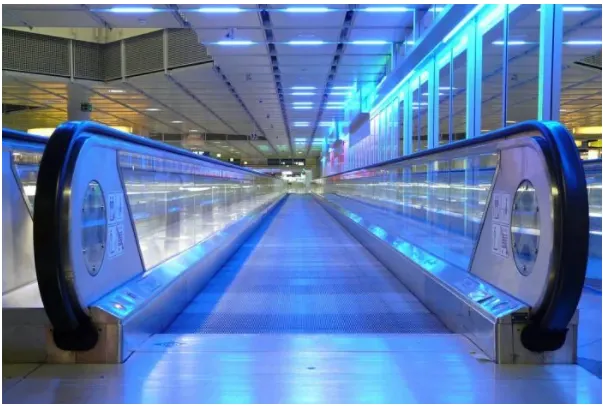
Imagine a walkway going from point A to Point B with 3 miles per hour speed.
And you are walking 3 miles per hour speed on the 3 miles per hour.
In other worlds you are walking from A to B with speed of 6 miles per hour.
If you are walking opposite to the walkay speed direction you will be stand still , because you are movinng exact same speed opposite to walk way speed.
Now here the speed of the walkway is Wind Speed.
The speed at which you are moving with respect to walkway is Air Speed.
And the speed at which you are moving from point A to Point B is ground speed.
Air speed + wind speed = Ground Speed
Hence, The Air speed = Ground Speed - Wind Speed
3. Why is it not recommended to use aircraft engine power to move it on the ground at Airport?
Basically, aircrafts are capable of reverse direction motion using it's reverse thrust.
Due to the use of airplane engine the fuel usage is huge and it is not economical to just move the airplane on the ground by using own engine.
Also it makes too much noise it is louder for nearby people.
due to the airplane is near to the ground it my be hazardous to near by objects and the people.
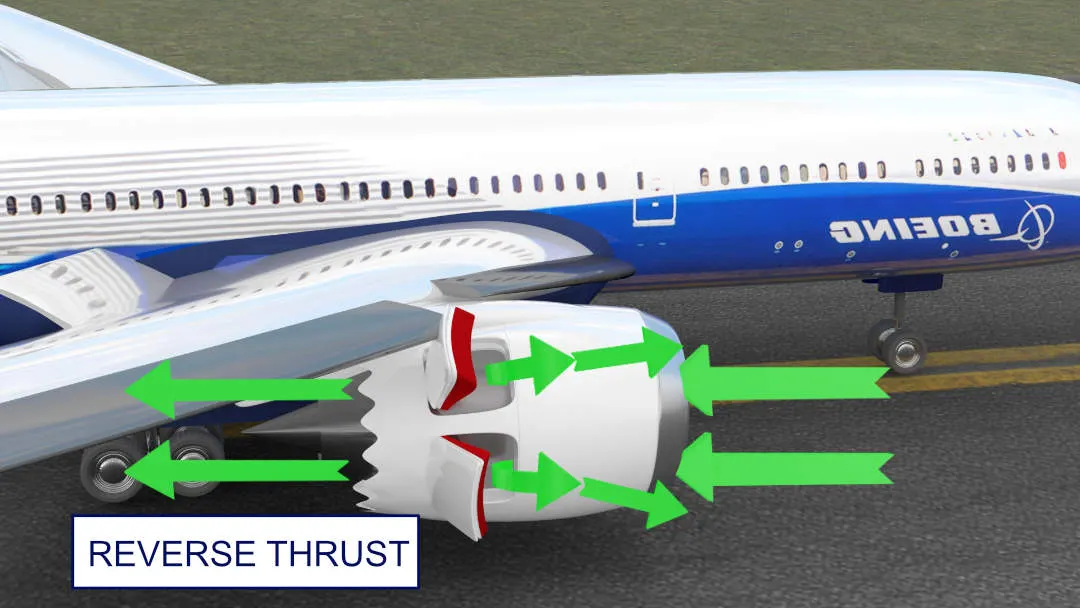
Additionally due to the thrust ,the debris present on the ground are hazardous to the air craft and it's vital parts.
The jet blast can cause damage to terminal buildings or its equipments.
Since the engine is also close to the ground it will blow off the sand and debreis forward and sucks it to the engine and causes damage to it.
4. How an aircraft is pushed to runway when its ready to take off?
Aircraft is pushed to runway when its ready by push backtruck by attaching tow bar to the nose wheel of the aircraft.
pushback truck reverses the aircraft into taxiing position, pushing it with a towbar attached to the nose-wheel strut.

As shown in above gif image file the pushback is used for reverse direction motion with the help of tow bar attached with the air craft.
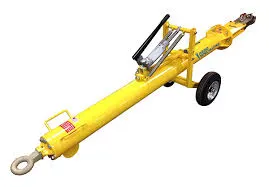
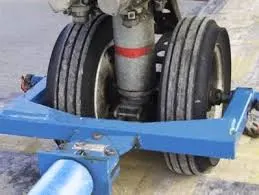
The above image represent to tow bar, it is used to attach aircrat and pushback truck.
5. Learn about take off power, tyre design, rolling resistance, tyre pressure, brake forces when landing.
Take off Power:
- Take off is the process when the aircraft leaves the ground and fly to the sky.
- The power produced by the aircfat for the limited duration of take off is called take off power.
-The use of takeoff power is usually limited to 5 min for reciprocating engines and up to 2½ min for gas turbine engines.
Tyre design:
-As seen in the above image there are many layers of tyre to provide the required strenghth, so that it can withstand the tremendous force during landing.
-Unlike the car and truck, aircraft tyre are not in continous service for loading. It has higher rotation for short duration.
- Aircraft tyer is specially design to ithstand the heavy load during the landing.
- An aircrat tyre is similar to the car tyre and not extreamly big in size, but they are way ore stronger than the car tyre.
-Also they have huge pressure handling capacity.
- Boeing 737 rides on 27x7.75 R15 rubber. In English, that means it is 27 inches in diameter, 7.75 inches wide, and wrapped around a 15-inch wheel.
- When aircraft touches the ground the tyre start skidding not rolling, till the rotation of tyre matches the velocity of aircraft.
Rolling Resistance:
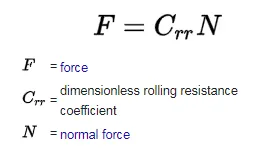
- Rolling ressistance is the force act on the tire during rolling. It can be also called as friction on the tire.
-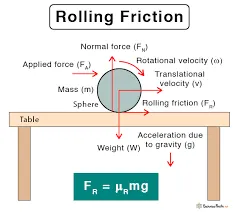
The rolling resistance formula is given as shown in above image.
- It can be also expressed as below image .
Tyre Pressure:
According to: www.wired.com
The high-flying rubber is typically inflated to 200 psi, roughly six times what you put in an automobile tire, and the tires on an F-16 fighter are pumped to 320 psi. “It's really pressurized air that's so strong,”
Aircraft tires generally operate at high pressures, up to 200 psi (14 bar; 1,400 kPa) for airliners, and even higher for business jets
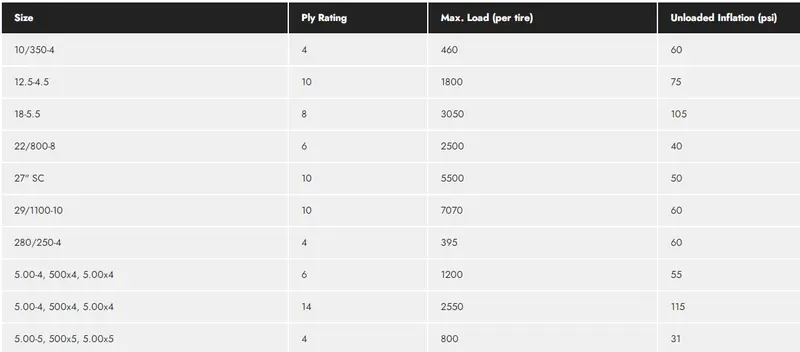
Here below is the inflation chart according to size of the tire, it the data for car and truck. We can compare the aircraft pressure with it.
Brake force when landing:
- The brake forcce is nothing but the amount of the applied force on the tire of the aircraft during the landing and braking.
- Therae are various methods applied for the braking. The most common type of braking applied for the air craft is the Hydraulic brake.
-For the bracking, the electric signal is sent to the hydraulic actutor. Generally hydraulic actuator produces the pressure hydraulic fluid at 3,000 pound per square inch is used to force the brake unit against the wheel, thus slowing it down.
PART-B
6.
A. With necessary assumptions, calculate the force and power required to push / pull an aircraft by a towing vehicle

Lets consider Antanov AN-255 aircraft for the calculation.
i) Rolling Resistance calculation (`F_(rr)`)
- Total weight `m_1`( Max gross takeoff Weight) = 640,000 kg
- Rolling Resistance coefficient for air craft (`\mu_(rr1)`) = 0.004
Total weight of the tow truck `m_2` = 50000 kg
-Rolling resistance coefficient of the tow truck (`\mu_(rr2)` = 0.001
Then
Rolling resistance of the aircraft = `\mu_(rr1) (m_1*g)`
=0.004 *640,000*9.8 = 25088 N
Rolling resistance of the aircraft = `\mu_(rr2)*m_2*g`
= 0.001 *50000*9.8 = 490 N
Total Rolling resistance force is given by `F_(rr)` = 25578 N
ii) Air drag Force:
The air drag is give as below formula:
`F_(ad) = (1/2)*\rho*A*v^2*C_d`
That force is experience when the vehicle is in moving condition, it is due to the air resistance. It also depends upon the velocity and the frontal area of the vehicle.
Here
A = frontal area of the vehicle(aircraft) in `m^2` = 20 c`m^2`
v = velocity of the vehicle(aircraft) while towing in `m/s` = 10`m/s`
`C_d` = The air drag coefficient = 0.026
`\rho` = The air density `(kg)/m^3` =1.225 `(kg)/m^3`
Hence
`F_(ad) = (1/2)*\rho*A*v^2*C_d`
`= 0.5*1.225*20*(10)^2*0.026`
`=31.85`
Hence total force acting on the vehicle is = 25578 N+31.85 N = 25609.85 N
Hence the power required for the towing is P = F *v = 25609.85 * 10 = 256098.5 watt = 256.098 kw
B. Develop the model for the calculated force and power using Simulink.
All te equations are implemented inside the simulation model.
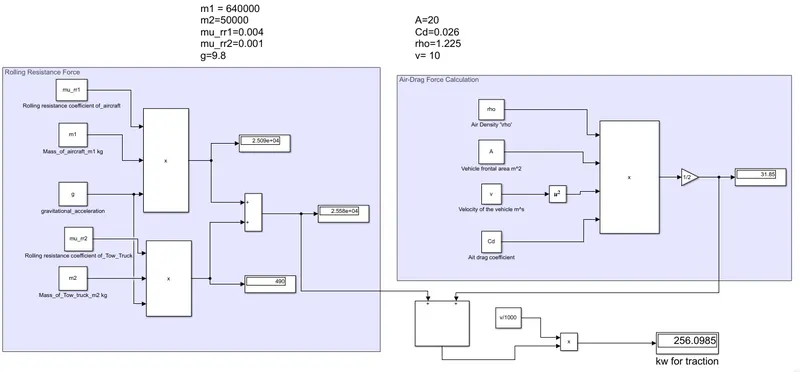
The power calculation is done in the simulation for rolling resistance and air drage force. Here the hill climb angle is considered as 0.
All the parameters are initialized into the model property as shown in the below screenshot.
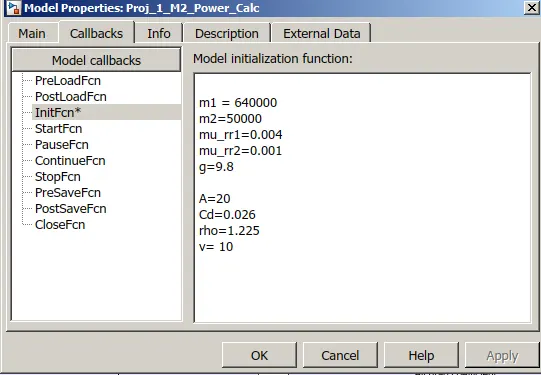
The result is matching with the calculations, which is 256098.5 watt for 10 m/s velocity.
7.
A.
From the above calcuation the power required for the traction is 256.0985 kw
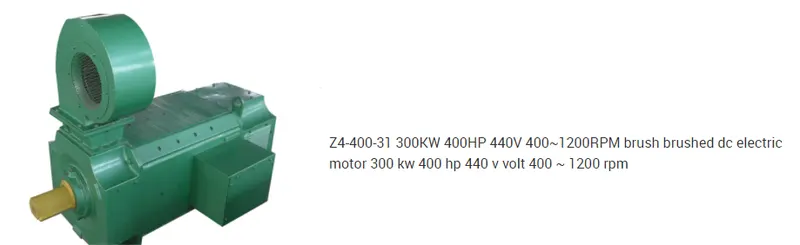
The below moter Z4-400-31 is chosen for that purpose.
The total traction weight is much more thats why the motor rating also huge.
300kw ,400HP 440V.
Block diagram:
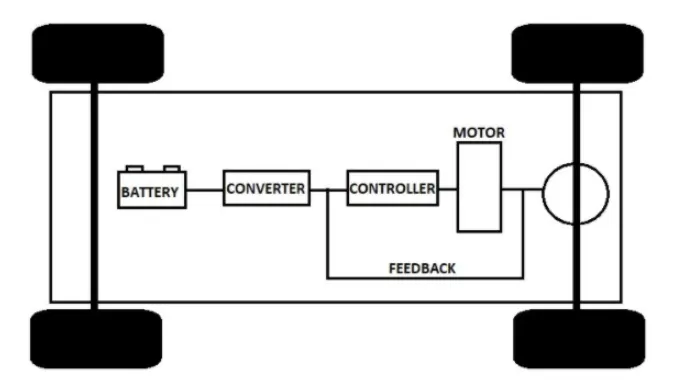
The power power flow takes place as shown in the above block diagram.
Simulation:
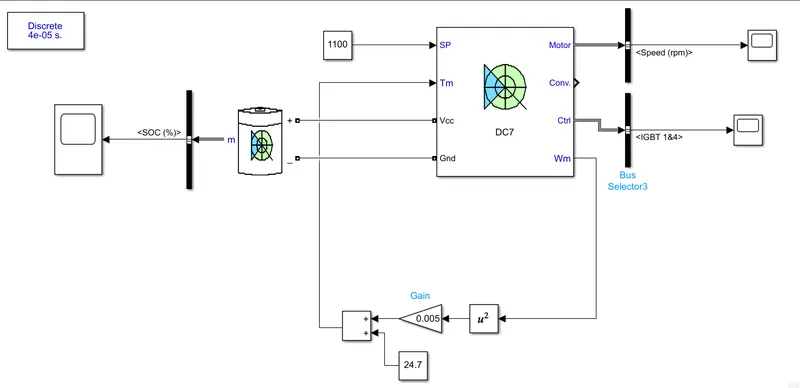
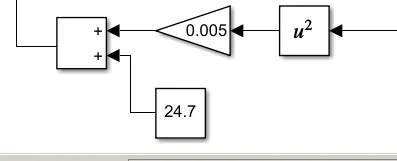
The simulation is prepared for the given data and the specifiactions discussed as above.
The load is chosen is linear load which is directly proportional to the speed. In other words the load chosen the fan load.
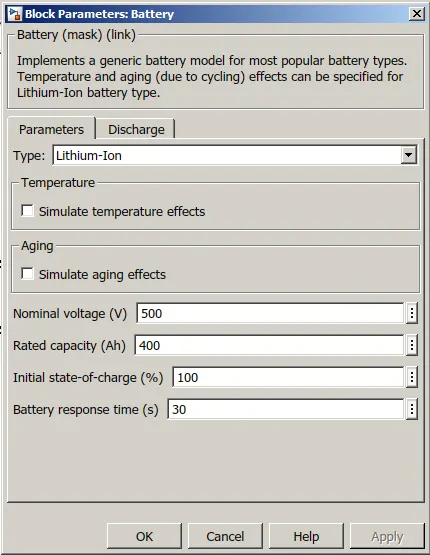
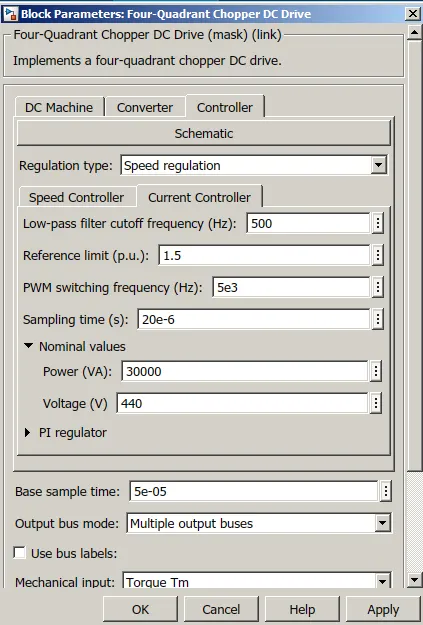
The specification of the battery and the dc motor is as given in the above screenhots.
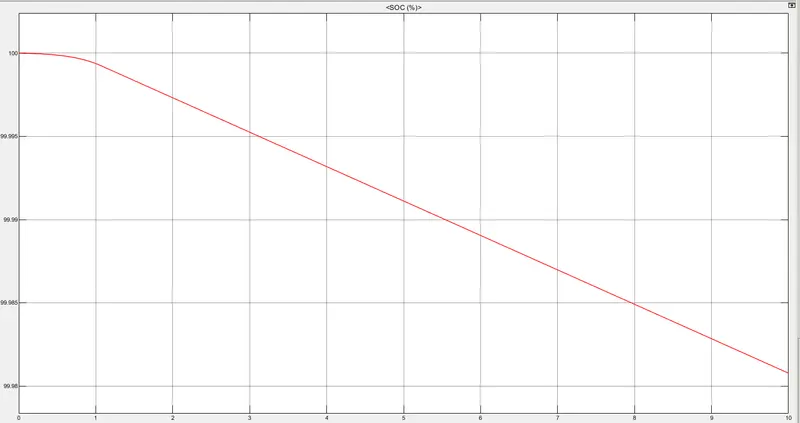
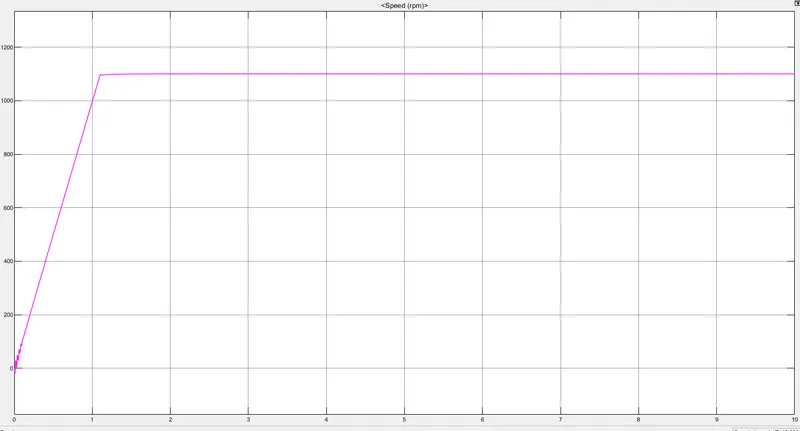
The speed is successfully rised from 0 to 1100 RPM.
The converter chosen for the application is DC-DC converter is buck converter.
For speed control from zero to hight is clculated as below:
the given motor is 440V and this is the vlotage at which the motor produce rated speed, which is 1200 RPM.
Suppose the battery voltage is 500 V.
hence duty cycle for highest speed: D = 440/500 = 0.88
Adding the 10% losses.
D = 0.88*1.1 = 0.968
B.
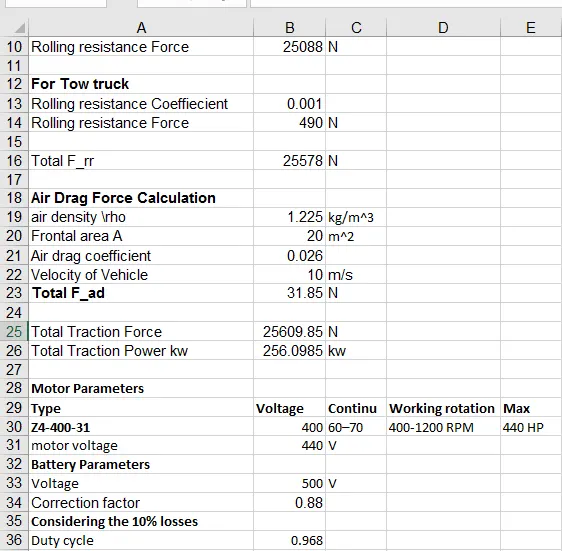
the excel sheet is prepared for the all the given data and calculated data.
The excel file is attached in the upload section.