Project-1: Powertrain for aircraft in runways
PART A :
1) List of various types of Aircraft and their total weight -
Aircraft gross weight is the total weight of the plane during flight or ground operation . The gross weight decreases due to fuel consumption or may vary according due to the payload in flight due to refueling .
There are eight various types of weights considered for the manufacture of aircraft are ,
- Standard Empty weight - The weight of an empty airplane including unusable fuel, full operating fluids (hydraulic fluids) and full engine oil.
- Basic Empty weight - Standard Empty Weight plus optional equipment. This is the starting point of weight and balance calculations.
- Useful Loads - Useful load is total usable fuel, cargo, passengers, and drainable fuel.
Equation: Maximum Ramp Weight - Basic Empty Weight = Useful Load.
- Payload - It is the weight how much a aircraft can carry . In other means it the weight of cargos and passengers.
- Maximum Ramp weight (Taxi weight) - This is the maximum allowable weight mass for ground operations. MRW assures acceptable ground maneuverability and includes fuel for taxi, run-up and start.
- Maximum takeoff weight - Maximum allowable mass for the initiation of a takeoff roll. Depending on how big an airplane is, we may have a variety of MTOWs limited by: structural limitations, runway distance, climb performance, or landing weight limits.
- Minimum Flight weight - Minimum certificated weight for flight as limited by aircraft strength and airworthiness requirements. This weight has a lot to do with the balance of weight considering fuel/payload distribution.
- Maximum landing weight - Maximum landing weight is usually a structural limit, but may include calculations based on missed approach climb performance.
The weights of various types of plane -
| Aircraft | Empty Weight | Max Fuel Weight | Max Cargo Weight | Max Gross Takeoff Weight |
|---|---|---|---|---|
| Antanov AN-225 | 628,000 lbs 285,000 kg |
661,400 lbs 300,000 kg |
417,000 lbs 190,000 kg |
1,411,000 lbs 640,000 kg |
| Airbus A380-800 | 611,000 lbs 277,000 kg |
560,000 lbs 254,000 kg |
185,000 lbs 84,000 kg |
1,268,000 lbs 575,000 kg |
| Boeing 747-800 | 485,300 lbs 220,100 kg |
427,400 lbs 194,000 kg |
295,000 lbs 134,000 kg |
987,000 lbs 447,700 kg |
| Airbus A340-500 | 370,000 lbs 168,000 kg |
386,300 lbs 175,000 kg |
119,000 lbs 54,000 kg |
820,000 lbs 372,000 kg |
| Boeing 777-300ER | 370,000 lbs 168,000 kg | 320,800 lbs 145,500 kg | 148,000 lbs 67,100 kg |
776,000 lbs 352,000 kg |
| Boeing 787-10 | 299,000 lbs 135,500 kg | 223,500 lbs 101,500 kg |
126,300 lbs 57,300 kg | 560,000 lbs 254,000 kg |
| Boeing 737-900 | 98,500 lbs 44,700 kg |
53,100 lbs 24,000 kg |
44,600 lbs 20,200 kg |
187,000 lbs 85,000 kg |
| Airbus A320-100 | 93,900 lbs 42,600 kg |
48,700 lbs 22,100 kg |
44,000 lbs 20,000 kg |
150,000 lbs 68,000 kg |
| Embraer 190 | 63,500 lbs 28,800 kg |
28,600 lbs 13,000 kg |
28,800 lbs 13,100 kg |
106,000 lbs 48,000 kg |
| Gulfstream G650 | 54,000 lbs 24,500 kg | 48,200 lbs 21,900 kg | 6,500 lbs 3,000 kg |
100,000 lbs 45,200 kg |
| Bombardier CRJ900 | 48,160 lbs 21,850 kg | 19,600 lbs 8,900 kg | 6,075 lbs 2,760 kg | 80,500 lbs 36,500 kg |
| Bombardier Q400 | 39,300 lbs 17,800 kg |
11,700 lbs 5,300 kg |
18,700 lbs 8,500 kg |
62,000 lbs 28,000 kg |
| Learjet 75 | 13,900 lbs 6,300 kg | 6,060 lbs 2,750 kg |
2,900 lbs 1,300 kg |
21,500 lbs 9,700 kg |
| Cessna Citation CJ4 | 10,300 lbs 4,700 kg | 5,800 lbs 2,650 kg |
2,200 lbs 1,000 kg | 17,200 lbs 7,800 kg |
| Beechcraft King Air B100 | 7,100 lbs 3,200 kg | 3,200 lbs 1,450 kg |
4,150 lbs 1,900 kg |
12,000 lbs 5,400 kg |
| Diamond DA50 RG | 3,200 lbs 1,450 kg |
340 lbs 155 lbs |
1,250 lbs 560 kg |
4,400 lbs 2,000 kg |
| Beechcraft Bonanza G36 | 2,500 lbs 1,150 kg | 450 lbs 200 kg |
850 lbs 385 kg |
3,660 lbs 1,660 kg |
| Cessna 206H | 2,200 lbs 990 kg |
520 lbs 235 kg |
1,150 lbs 520 kg |
3,600 lbs 1,630 kg |
| Sirrus SR22 | 2,250 lbs 1,000 kg | 485 lbs 220 kg |
950 lbs 430 kg |
3,600 lbs 1,630 kg |
| Cessna 172R | 1,700 lbs 770 kg |
380 lbs 170 kg |
560 lbs 255 kg |
2,425 lbs 1,100 kg |
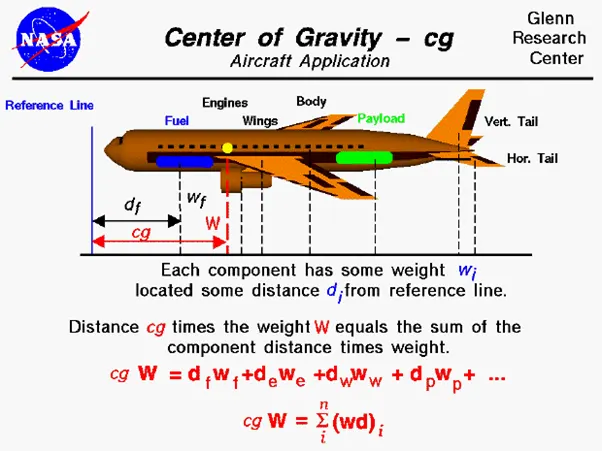
Now each component of aircraft has some their weights . The figure shown below shows the weight of the different components of plane ,
2) Difference between Ground Speed and Air Speed -
- True airspeed is simply the speed at which an aircraft is moving relative to the air it is flying in. As such, it’s also the speed at which the air is flowing around the aircraft’s wings .
- Ground speed, on the other hand, is the aircraft’s speed relative to the ground. One thing that should be noted here is that it’s its horizontal rather than vertical speed (an aircraft climbing completely vertically would have a ground speed of zero) .
- In other words, while airspeed is what determines whether there is enough airflow around an aircraft to make it fly, ground speed is what determines how fast an aircraft will get to its destination .
3) It is not recommended to use aircraft engine power to move it on the ground at Airport due to following reasons ,
- Because there are extreme cautios for everything around us .
- Applying thrust can create a blast behind each engine . People , equipment and anything else in the way can be injured or damaged from jet blast .
- Before applying power to engine the areas around the engine are like super critical factors which must be carefully negotiated .
- The area in front of the jet engine creates an area where equipment and people can be sucked into engine if anything is too close to the intake .
- To avoid any damages or accident it is not recommended to use engine power to move it on the ground at airport .
4) The process that an aircraft is pushed to runway when its ready to take off -
- Taxxing refers to the movement of the aircraft on ground under its own power . The aircraft moves on wheel . An airplane use taxiways to taxi from one place to another like moving from terminal to runway or from runway to terminal .
- When aircraft is ready with passengers and luggages the aviation is an airport procedure during which an aircraft pushed backward away from gate by external power .
- The taxxing has its some speed limits . On turn the pilot reduces the speed of aircarft to avoid any tire skids . The pilot follows the yellow line provided on the track to avoid any collision with surroundings .
- Once the pilot reaches the runway , the aircraft stands at starting of the runway for approx 2 mins so to check once whether the runway is clear or not and to check surroundings to be clear before taking takoff . The pilot starts the jet engine which makes the aircarft to run at high speed to takeoff .
5)
- Take Off Power :
The amount of power that an engine is allowed to produce for a limited period of time for takeoff. The use of takeoff power is usually limited to 5 min for reciprocating engines and up to 2½ min for gas turbine engines. This may not always be the case. Specifically, with respect to reciprocating engines, it is the brake horse- power developed under standard, sealevel conditions and under the maximum conditions of the crankshaft rotational speed and the engine manifold pressure approved for the normal takeoff. It is limited in continuoususe to the period of time shown in the approved engine specifications .
- Tyre design :
When it comes to safety , tyres are one of the most important components of aircraft. They help to absorb the shock of landing and provide cushioning. It also provides the necessary traction for braking and stopping of an aircraft . An aircraft tyre is designed to withstand extremely heavy loads while landing, take off, taxing, and parking. The number of wheels required for aircraft increases with the weight of the aircraft, as the weight of the aeroplane needs to be distributed more evenly .
Carcass plies are used to form the tire. They are sometimes called casing plies. An aircraft tyre is constructed for the purpose it serves.
- They support the weight of an aircraft while it is on the ground.
- It also provides the necessary traction for braking and stopping of an aeroplane.
- Tyre also helps to absorb the shock of landing and provide cushioning the roughness of takeoff, roll-out, and taxi operations.
Unlike an automobile or truck tyre, it does not have to carry a load for a long period of continuous operation . However, an aircraft tyre absorbs the high impact loads of landing, and also it’s operating at high speeds for a short time when required .
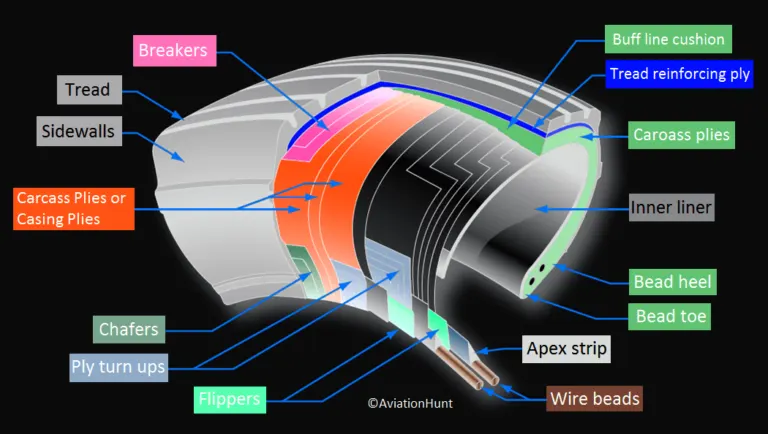
Retreading – Retreading is methods of restoring a worn tyre by renewing the tread area or by renewing the tread area plus one or both sidewalls. Repairs are included in the tyre retreading process .
Load Rating – Load rating is the maximum permissible load at a specified inflation pressure .
Ply Rating – Ply Rating is used to identify the maximum recommended load rating and inflation pressure for a specified tyre. It is an index of tyre strength.
Speed Rating – The speed rating is the maximum takeoff speed to which the tyre has been tested.
Skid Depth – Skid depth is the distance between the tread surface and the deepest groove as measured in the mould .
Aircraft tyres must have an approved speed and load rating and have sufficient clearance when retracted through landing gear to allow for tyre growth. Tyre growth is the increase in the size of the tyre due to centrifugal forces at high speed .
- Rolling Resistance :
The rolling resistance is mainly experienced by tyre when the vehicle moves over the surface . The rolling resistance force is given by ,
Frr = Urr *(m*g)
where Urr is the coefficient of Rolling resistance .
The coefficient of rolling resistance depends upon factors like tyre pressure , tyre temperature , material of tyre , thread pattern and also the roughness and liquid on road .
- Tyre pressure :
Aircraft tires generally operate at high pressures, up to 200 psi (14 bar; 1,400 kPa) for airliners, and even higher for business jets. The main landing gear on the Concorde was typically inflated to 232 psi (16.0 bar), whilst its tail bumper gear tires were as high as 294 psi (20.3 bar) .
- Brake forces when landing :
- Wing Spoiler -
Many airplanes use wing spoilers to assist with braking when landing. Not to be confused with ailerons, spoilers are extendable flaps on the ends of an airplane’s wings. Pilots can raise the spoilers to decelerate the airplane as it approaches the runway. And even while on the runway, pilots will typically leave the wing spoilers raised. Raised wing spoilers create drag, which essentially slows down the airplane so that it’s able to brake more quickly .
- Disc Brakes -
In addition to wing spoilers, airplanes use disc brakes. Airplane disc brakes are similar to the braking system in automobiles. They consist of a pair of calipers that, when engaged, squeeze pads against the rotors of an airplane’s landing gear .
Disc brakes are designed to remain static at all times. In other words, they don’t rotate with the wheels of an airplane’s landing gear. As the wheels turn, the disc brakes will remain static and stationary. They are a vital component of an airplane’s braking system because they are designed to apply pressure to the airplane’s wheels. Disc brakes will squeeze the wheels, thereby slowing down the speed at which they spin. In turn, this reduces the speed of the airplane so that it can come to a complete stop on the runway .
- Reverse Thrust -
Finally, many jet airplanes use reverse thrust to assist with braking during landings. Reverse thrust is a feature in jet engine airplanes that, as the name suggests, involves the reversal of the engines’ thrust. When flying, the thrust is projected out the rear of an airplane’s engines. When landing, however, pilots may use the reverse thrust feature. Reverse thrust changes the direction of the engines’ thrust. Rather than projecting out the rear, the thrust will be projected out the front. This reversal of thrust provides deceleration that allows airplanes to slow down more quickly when landing .
PART B :
6A) The forces acting on towing vehicle during pulling/pushing of an aircraft are ,
- Rolling Resistance force
- Aerodynamic Drag force
To calculate the force and power required to push / pull an aircraft by a towing vehicle , we have to calculate these two forces ,
Rolling Resistance force is given as ,
Frr = Urr *(m*g)
Rolling Resistance force must be acting on both aircraft and towing vehicle ,
Rolling Resistance force for aircraft is ,
Frr = 0.02 * 40000 * 9.81 = 7848 N
Rolling Resistance force for towing vehicle ,
Frr = 0.09 * 1000 * 9.81 = 882.9 N
Total Rolling Resistance force = 7848 N + 882.9 N = 8730.9 N .
Aerodynamic Drag force on flat runway with constant low speed and without wind is considered neglegible .
So aerodynamic drag force on both aircraft and towing vehicle is considered neglegibe .
So power is given as ,
Power = Traction Force * Velocity
Power = 8730.9 * 9.7
Power = 84689.73 J or 84.68 kJ .
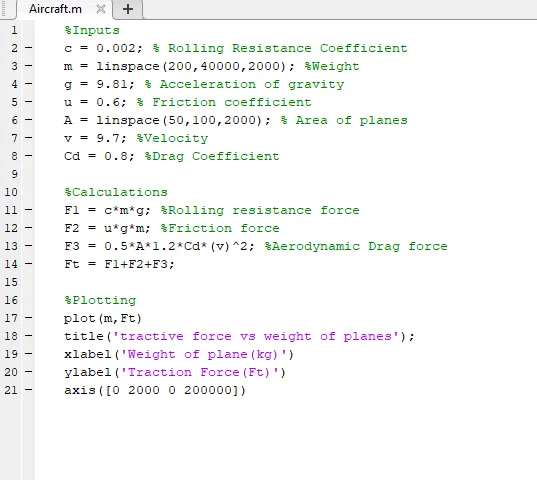
6B) Model for the calculated force and power -
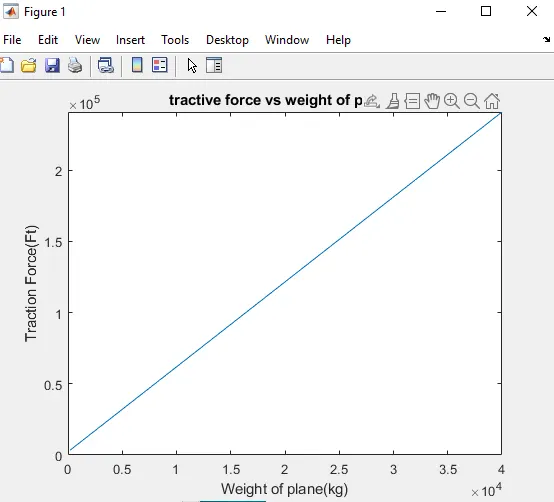
Result -
7a) Parameters to be assumed for calculating the energy required for towing and Duty Cycle ,
Aircraft weight = 40000 kg
Rolling Resistance coefficient (aircraft) = 0.02
Rolling Resistance coefficient (towing vehicle) = 0.09
Towing vehicle weight = 1000 kg
Towing velocity = 9.7 m/s
Towing operation time = 15 mins
Input Battery voltage = 200V
Current required = 400A
Aerodynamic Force on flat runway is considered neglegible
As we have calculated the power required for towing an aircraft is 84.68 kW .
To calculate the energy required for towing ,
Energy for towing = (Power required for towing)*(time taken for towing)
We have assumed that time taken for towing is 15 mins .
Energy is calculated in kw-h ,
Energy = (84.68)*(900/1200) = 63.51 kJ-h .
Now to calculate the duty cycle for towing operation , we can use s standard lithium ion battery pack for this operation .
Assume the battery input required is 200V and current required to be 400A .
Input Power = 200 * 400 = 80000 W = 80 kW .
Duty Cycle = Output Power / Input Power .
= 84.68 / 80
= 1.058 or 105.8% .
7b) Excel Sheet of Parameters :
| Powertrain for air-craft | ||
| Total Weight | 40000 | kg |
| Rolling Resistance | ||
| Crr (aircraft) | 0.02 | |
| Crr (Towing Vehicle) | 0.09 | |
| Frr (aircraft) | 7848 | N |
| Frr(Towing vehicle) | 882.9 | N |
| Total Frr | 8730.9 | N |
| Total Tractive Force | ||
| Fte (=Frr) | 8730.9 | N |
| Power Required | ||
| Pte | 84.68 | kJ |
| Motor Parameters | ||
| Type | ||
| REB 90 | 84.86 | kW |
| motor voltage | 350 | V |
| Battery Parameters | ||
| Voltage | 200 | V |
| Correction factor | 200 | |
| As there are 10% losses, the demanded voltage to be 10% high | 220 | V |
| Duty cycle | 105.8 | % |