Project-1: Powertrain for aircraft in runways
1. Question(1) :-
Search and list out the total weight of various types of aircrafts.
In general the gross weight of an aircraft is the sum of various terms related to weight and that are :-
- Aircraft empty weight (AEW) :-
It is the weight of the aircraft with all its equipment on board but no fuel, no passengers or no cargo.
- Aircraft maximum gross takeoff weight(AMGTW):-
This is the maximum weight the aircraft can weigh as it lift off the ground.This includes the aircraft’s empty weight, the fuel, the crew, the passengers, and all the cargo.
- Aircraft useful load:-
It is the weight that remain when the aircraft empty weight is substracted from AMGTW and this weight include the weifgt of fuel,passenger and cargo.
Following is the list of 10 different types of aircraft whose maximum weight distribution are given :-
| Aircraft | Empty weight | Max Fuel Weight | Max Cargo Weight | Max Gross Takeoff Weight |
| Antanov AN-225 | 285,000 kg | 300,000 kg | 190,000 kg | 640,000 kg |
| Airbus A380-800 | 277000kg | 254000kg | 84000kg | 575000kg |
| Boeing 747-800 | 220100kg | 194000kg | 134000kg | 447700kg |
| Airbus A340-500 | 168000kg | 175000kg | 54000kg | 372000kg |
| Boeing 777-300ER | 168000kg | 145500kg | 67100kg | 352000kg |
| Boeing 787-10 | 135500kg | 101500kg | 57300kg | 254000kg |
| Boeing 737-900 | 44700kg | 24000kg | 20200kg | 85000kg |
| Airbus A320-100 | 42600kg | 22100kg | 20000kg | 68000kg |
| Embraer 190 | 28800kg | 13000kg | 13100kg | 48000kg |
| Gulfstream G650 | 24500kg | 21900kg | 3000kg | 45200kg |
- In this list empty weight , max fuel weight ,maximum cargo weight and max gross takeoff weight are given for different aircraft like antanov,airbus,boeing,embraer and gulfstream with different model.
- This weight limits are given by manufacturer of aircraft ,and it has to be followed strictly otherwise if not followed it leds to an accident for overloading.
2. Question(2):-
Is there any difference between ground speed and air speed?
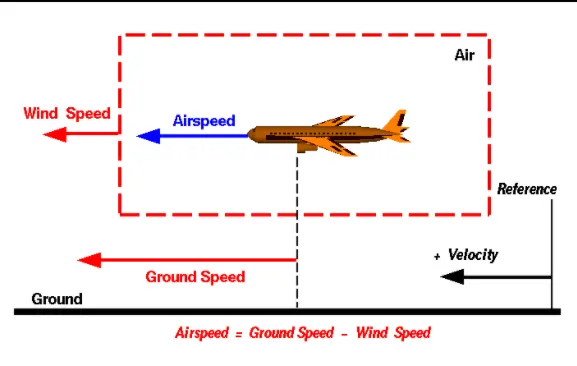
Air speed and ground speed are the two most important factors in an aircraft.
Air speed :-
The actual speed at which an aircraft is moving relative to the air it is traveling in.
It’s also the speed at which the air is flowing around the aircraft’s wings.
Airspeed is what determines whether there is enough airflow around an aircraft to make it fly
It’s calibrated airspeed adjusted for the the exact conditions (altitude, air temperature, etc.) that the aircraft is flying in.
Ground speed :-
Ground speed, is the speed of an aircraft’s relative to the ground.
It should be noted here is that it’s its horizontal rather than vertical speed if an aircraft climbing completely vertically would have a ground speed of zero.
Ground speed is the sum of air speed and wind speed.
Yes, there is the difference between air speed and ground speed , this can be seen by an example:-
Suppose an aircraft is in crusise mode with 200kmph speed and has to cover a ground distance of 4000km.
If the wind speed is 0 then air speed and ground speed is same and aircraft reaches its destination at 20 hrs.
But if there is a wind speed of 60kmph that is in opposite direction of an air speed then the ground speed is 200kmph air speed-60kmph wind speed .
So,ground speed we get is 140kmph so air craft reach at its destination in28.57hrs.
So wind speed plays a very important roles and it create a difference between ground speed and air speed.
There are two terms :-
Headwind:- Wind is blowing against the direction of aircraft is moving.
Tailwind :- Wind is blowing in same direction as aircraft is moving.
3. Question(3):-
Why is it not recommended to use aircraft engine power to move it on the ground at Airport?
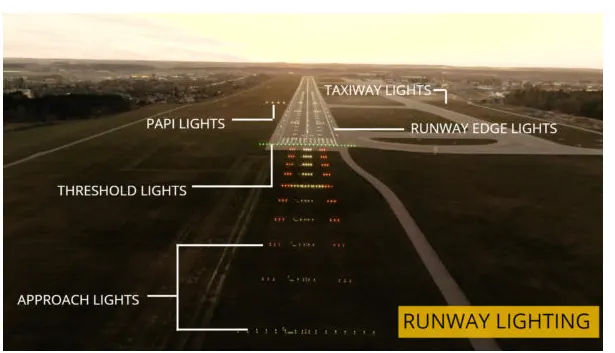
The area on which aircraft move on the airfield can broadly be separated into three separate categories and that are :-
Ramp or apron is where the stands are located for aircraft to park.
Runways are what the aircraft use to takeoff and land.
Taxiways are the route ,which they use to get between the two.
Taxiing is the movement of an aircraft on airport under its own power. An aircraft uses taxi ways to travel from one location to other.
During takeoff the acceleration happens and decceleration while landing is not come under taxiing.
Once the aircraft is landed now its time to park the aircraft at parking stand and this is done by towing action.
Towing is coupling two or more objects together so that they may be pulled by a designated power source or sources and once the aircraft is parked then during unloading and loading between flights.
They have to provide electrical power for the aircraft whilst the engines are shut down and also enough area around the aircraft to give the multitude of servicing vehicles space to access the aircraft.
Now, during takeoff aircraft has to pushed back itself from parking stand and again this is done by pushback tugs a small vehicle .
For smaller aircraft, the pushback tug doesn’t require a massive amount of power.
They utilize the weight of the tug, sometimes up to 60 tons, to ensure that the wheels don’t just spin on the tarmac.It takes skill to push an aircraft back using some types of tug.
Now during both operation such as during towing the aircraft to parking stand and free the aircraft from parking stand in boyh cases we don't use engine power and this process is done by towing vehicle.
It is not recommended to use engine power during such operation because of the jet blast.
Jet blast is the phenomenon of rapid air movement produced by the jet engine of aircraft, particularly on or before takeoff.
A large jet-engined aircraft can produce winds of up to 190kmph.
Jet blast can be a hazard to people or other unsecured objects behind the aircraft, and is capable of flattening buildings and destroying vehicles in that surrounding.
4. Question(4):-
How an aircraft is pushed to runway when its ready to take off?
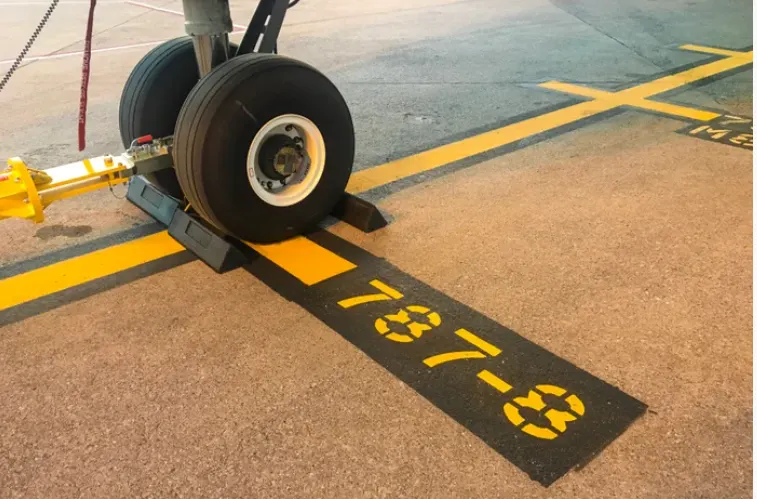
When the aircraft is landed it needs to park at parking stand and it is done with the help of towing vehicle.
Once it is parked ,now to make the aircraft ready to takeoff so prepation are to be made for this process to free the aircraft from the parking stand.
As aircraft does not have reverse gear to reverse the aircraft from its position so we have to take help of pushback tug.
For smaller aircraft it is easy for, the pushback tug as it doesn’t require a massive amount of power.
They utilize the weight of the tug, sometimes up to 60 tons, to ensure that the wheels don’t just spin on the tarmac.
But for large aircraft tow-barless tugs clamp around the nose wheel of the aircraft and lift it up.
Thus utilizing the weight of the aircraft to provide the traction for its wheels.
It need approximately between 40 and 90 seconds to connect the tug with the aircraft and lift it up.
Once the tug has disconnected and the engines are running, the pilots call ATC for their clearance to taxi to the departure runway.
They will then be issued with a series of taxiways, which will eventually take them to the departure point.
However, aircraft wheels aren’t connected to the engines in any way. When the pilots squeeze the thrust levers forwards, the thrust generated from the engines pushes the aircraft forwards. The wheels merely turn under this forward power allowing the aircraft to move.
Now the aircraft is pushed to runway to take off but before takeoff the pilots need to be able to steer the aircraft around corners.
5. Question(5):-
Learn about take off power, tyre design, rolling resistance, tyre pressure, brake forces when landing.
a. Take off power :-
It is the amount of power that an engine is allowed to produce for a limited period of time for takeoff.
The use of takeoff power is usually limited to 5 min for reciprocating engines and up to 2½ min for gas turbine engines.
In reciprocating engines, it is the brake horsepower developed under standard, sealevel conditions and under the maximum conditions of thr crankshaft rotational speed and the engine manifold pressure for the normal take off.
With respect to gas turbine engines, it is the thrust developed under static conditions at a specified altitude and atmospheric conditions of the rotor shaft rotational speed and gas temperature approved for the normal takeoff.
b. Tyre design:-
Tyre is one of important component of an aircraft .
It does not have to carry a load for a long period of continuous operation like an vehicle tyre on roads. However, an aircraft tyre absorbs the high impact loads of landing, and also it’s operating at high speeds for a short time when required that is during takeoff and taxiing.
Aircraft tyres may be tube type or tubeless. Tube tyre was an old version of tyre but now a tubeless tyre are used.
Further tyre's are classified as radial and baised tyres.
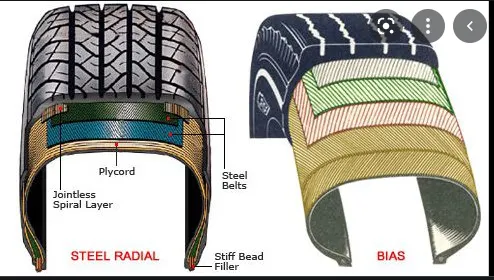
Radial tyre :-
A radial tyre has the fibre strands of the ply fabric oriented with and at 90° to the direction of rotation and the tyre sidewall.
Bais tyre :-
A bias-ply tyre has the fabric bias oriented with and across the direction of rotation and the sidewall.
Different manufacturer make tyre with there own design with different thread pattern ,wear pattern and limits.But all tyres must fulfill standard requirement given by an organisation.
Some of the technical aspects of the tyre are :-
Load Rating – Load rating is the maximum permissible load at a specified inflation pressure.
Ply Rating – Ply Rating is used to identify the maximum recommended load rating and inflation pressure for a specified tyre. It is an index of tyre strength.
Speed Rating – The speed rating is the maximum takeoff speed to which the tyre has been tested.
Skid Depth – Skid depth is the distance between the tread surface and the deepest groove as measured in the mould.
c. Rolling resistance :-
The friction between aircraft and runway will be proportional to the normal force exerted by the aircraft on the runway.
F=u*(W-L)
The normal force will be the difference between Weight of aircraft and Lift, the friction coefficient will be typically of a magnitude of 0.02 for a standard tarmac runway.
d. Tyre pressure:-
While discussing about the tyre pressure the inflation pressure in tyre is an important factor to know.
In an aircraft tyre pressure plays an important role and it has to be maintained with an acceptable range. There are maintenance of tyre in which inflation pressure has to be checked to see whether an aircraft with tire pressures within an acceptable operating range and to see the actual loss of inflation gas from each tire .
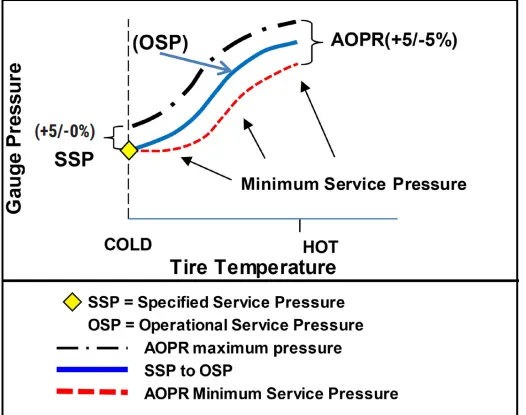
In the above graph some terms are used whose meaning are explained below:-
SSP (Specified Service Pressure) – The tire inflation pressure target defined by the airframe manufacturer, specific to an aircraft model and gross weight, as read on a pressure gauge in an ambient temperature. This is always a “cold” pressure value.
Minimum Service Pressure – The minimum gauge pressure reading for the dispatch of a tire.
OSP (Operational Service Pressure) – The expected tire inflation pressure, as read on a pressure gauge influenced by thermal conditions (ambient or rolling effects) when referenced from the SSP.
Hot Tire – A tire for which the temperature of the contained gas has risen 25 degrees F or more above the ambient.
Cold Tire – A tire for which the temperature of the contained gas has been conditioned to the local ambient.
AOPR (Acceptable Operating Pressure Range) – The range of pressure readings relative to the SSP or its associated OSP which are acceptable for aircraft dispatch.
e. Brake forces when landing :-
Brake forces are applied on an aircraft to reduce the speed of an aircraft .
While aircraft is landing some braking forces are applied on the aircraft and taht brakes are mechanical brake,aerodynamic brake that depends on aerodynamic structure and electrical brake.
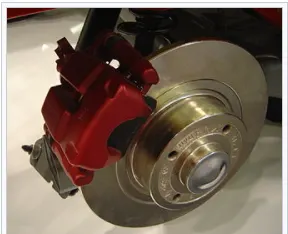
Aircraft disc brake is the mechanical brake used to brake the wheels while touching the ground. These brakes are operated hydraulically or pneumatically.For such type of braking more fuels is required and emission also increases so electrical braking are used and it is faster and easy to monitor.
Thrust reversers that allow thrust from the engines to be used to slow the aircraft.
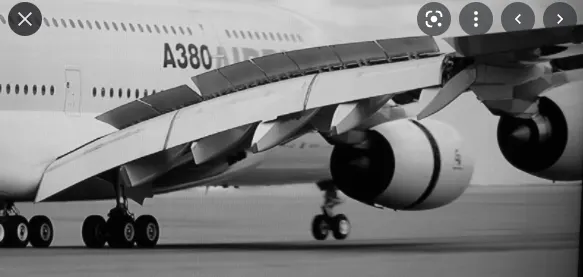
Airbrake are dedicated to flight control that work by increasing drag.It include's:-
Spoiler :-
In aircraft a spoiler (sometimes called a lift spoiler or lift dumper) is a device which intentionally reduces the lift component of an airfoil in a controlled way.
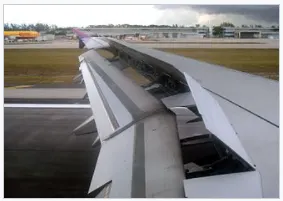
Flap:-
. Flaps are usually mounted on the wing trailing edges of a fixed aircraft. Flaps are used to reduce the take-off distance and the landing distance. Flaps also cause an increase in drag so they are retracted when not needed.
Large drouge parachutes, used by several former and current military and civilian aircraft to reduce the speed when landing.
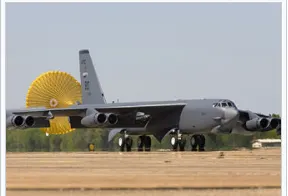
So there are the braking forces used in an aircrft to reduce the speed during landing.
6. Question(6):-
a With necessary assumptions, calculate the force and power required to push / pull an aircraft by a towing vehicle.
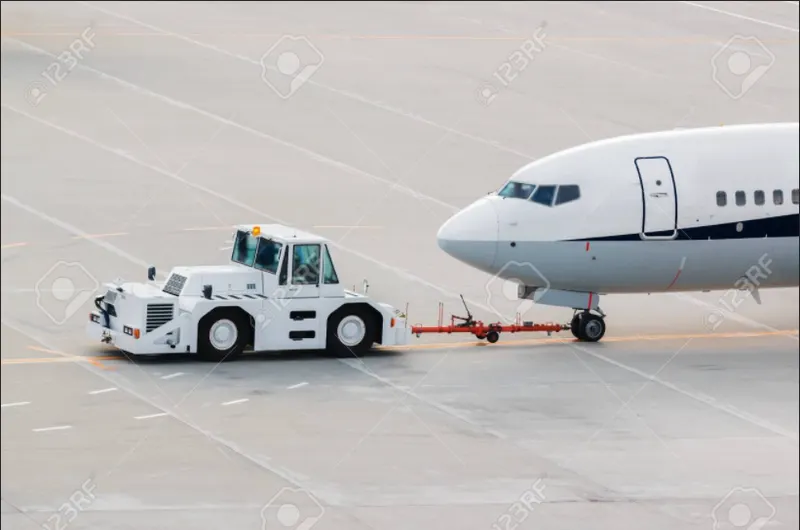
The mass of an aircraft is to massive nearly from thousand kg to approximately 3 lakhs kg.But we can push/pull with help of towing vehicle.
Forces that acting while towing with vehicle is a frictional force by assumming 0 wind speed and aircraft is towed with constant speed.
Most frictional forces are parallel to the ground and acting in the opposite direction as the motion of the object.But there are really two types of friction that come into play when pulling a plane that is one frictional force between wheel and the axle as they rub together and then there is rolling friction between tyre and tarmac.
When the aircraft is move on tarmac road then force due to rolling resistance is exerted and it is given by :-
Fr = c*ma*g
c=cofficient of rolling resistance
ma=mass of an aircraft
g= acceleration due to gravity
Let, assume
Mass of aircraft to be ma =30000kg
Coefficient of rolling resistance c=0.02
and g=9.8 m/sec^2
So,the force to move an airplane on an absolute flat runway with at constant speed is equal is the force due to rolling resistance:-
Fr= c*ma*g
=0.02*30000*9.8
Fr =5880 N
Now this much amount of force required to pull an aircraft by a towing vehicle . But the selection of the vehicle also plays an important factor.
The friction force for the puller can be calculated as :-
Ff = μ*mv*g
μ friction coefficient betrween tyres of towing vehicle and tarmac =0.9
mv is the mass of towing vehicle.
Enough weight for the towing vehicle are required to create friction forces against the tarmac that equals the plane rolling resistance.
Fr=Ff
c*ma*g = μ*mv*g
5880 = 0.9*mv*9.8
mv = 5880/(0.9*9.8)
mv = 666.67kg aprox 667 kg... towing vehicle is required.
The force required to pull the aircraft is 5880 N . Now the power required to pull the aircraft by towing vehicle is calculated as :-
Power (W)=Force (N)*velocity(m/sec)
Assume the aircraft is moving with constant speed of 32kmph=8.89m/sec
Power = 5880 * 8.89
Power = 52273.2 watts = 52.27 kw
b. Develop the model for the calculated force and power using Simulink.
The simulink model for force and power calculation are as follows:-
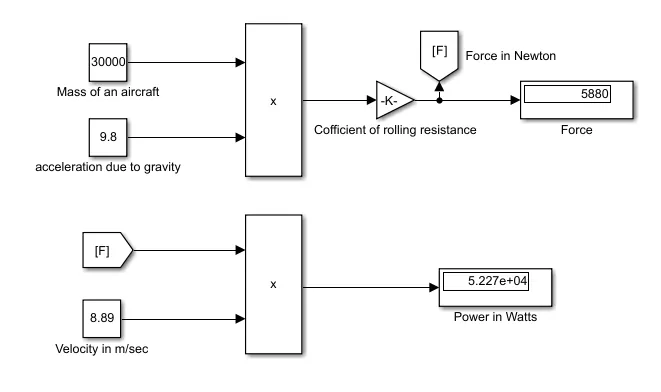
This model includes some basic blocks and they are:-
- Constant
- Product
- Goto and from
- Gain
- scope
To make model of the Ff = μ*mv*g expression we require product block ,gain block ,constant and scope.
As the input port are restricted to two only therefore we require gain block.
Mass of an aircraft to be 30000 Kg and it is given with help of constant block.
Cofficient of rolling resistance is given as 0.02 with help of constant block.
This two input are given to product block and output of product block multiplied by gain block gives a force in newton that is 5880 N,which is displayed with help of display.
Now for power calculation the expression for power is Power=Force*velocity.
The two input force (taken with help of goto and from block) and velocity of 8.89m/sec are given to product block and the output is the power in watts 52.27 kw is shown with help of display.
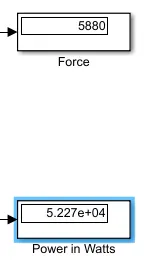
So here the simulink model are simulated and result are calculated.
7. Question(7):-
a. Design an electric powertrain with type of motor, it’s power rating, and energy requirement to fulfill aircraft towing application in Simulink. Estimate the duty cycle range to control the aircraft speed from zero to highest. Make all required assumptions. Prepare a table of assumed parameters. Draw a block diagram of powertrain. (Hint :DC7 Block)
Some assumed parameter for an aircraft :-
| Mass of an empty aircraft "ma" | 30000kg |
| Coefficient of rolling resistance "C" | 0.02 |
| Coefficient of air drag "Cd" | 0.0265 |
| Acceleration due to gravity "g" | 9.8 m/sec^2 |
| Air density "ρ" | 1.225 kg/m^3 |
| Frontal area "A" | 102 sq.m |
| Acceleration from o to 8.89 m/sec in 8 seconds | 8.89/8 = 1.11 m/sec^2 |
| Velocity of an aircraft "V" | 8.89 m/sec |
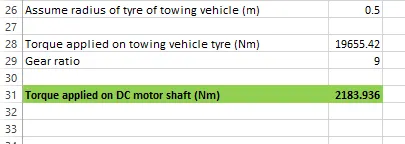
| Radius of towing vehicle"r" | 0.5m |
| Towing time (minutes) | 8 |
| Gear ratio | 9 |
Force due to rolling resistance "Frr" = C*ma*g = 0.02*30000*9.8 = 5880 N
Force due to aerodynamic drag "Fad" = 0.5*ρ*Cd*A*V^2
= 0.5*1.225*0.0265*102*8.89*8.89
Force due to aerodynamic drag "Fad" =130.84 N
Force due to acceleration "Fa" = ma*a =30000*1.11 =33300N
Total tractive force "Ft" = Frr+Fad+Fa = 5800+130.84+33300
Total tractive force "Ft" = 39310.84 N
Torque applied on wheel of towing vehicle = Ft * r = 39310.84*0.5=19655.42 Nm
Torque applied on DC motor shaft = 19655.42/gear ratio = 19655.42/9 = 2183.93 approx. to 2184 Nm
Power required to pull aircraft (Kw) = Ft * v = 39310.84*8.89 = 349473.36=349.47 approx to 350 Kw
Energy utilize for towing application = Power *Time =349.47*(8/60) = 49.596 approx to 50 Kwhr
Duty cycle calculation :-
Based on above value of power and torque we get a DC motor is selected for towing application whose specification as follows :-
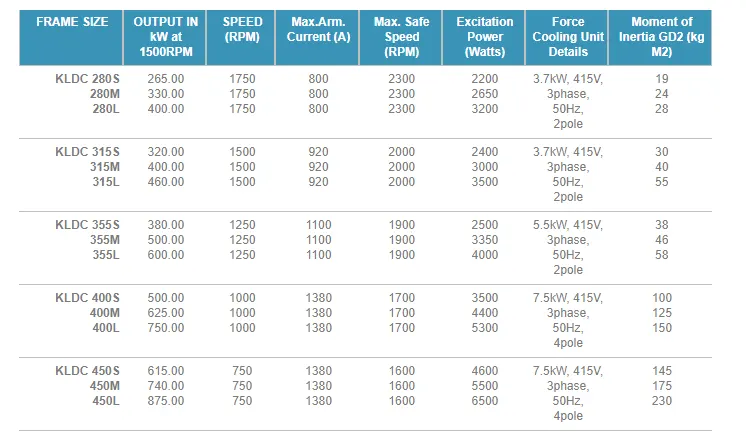
- There are different model of DC motor manufactured by Kirloskar company.
- Depending upon the frame size , max speed ,max current there are different models of DC motor.
- As per our requirement we want at output 350Kw with torque of 2200 Nm.
- Accordingly we select 400 kw KLDC 315M motor seen in second row .
- As torque =power / speed (rad/sec)
- For power 350Kw and speed 1500 rpm which is 2*3.1415*1750/60=157.07rad/sec equivalent.
- Torque = 350000/157.07 = 2228.23 appro to 2229 Nm.
- We want 2184 Nm and we get 2229 at 1500 RPM so this motor is suited for towing application.
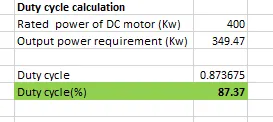
To calculate duty cycle :-
Rated power of selected DC motor = 400 Kw.
Output power required for towing application = 350 Kw
Therefore duty cycle = 350/400=0.8737
Percentage duty cycle = 87.37 %
Block diagram of power train :-
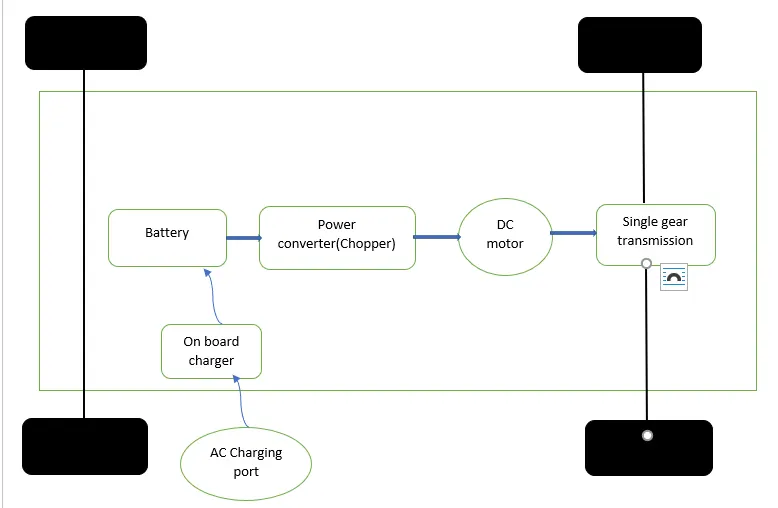
- This is the block diagram of power train of towing vehicle we used.
- We used DC motor with appropiate rating as discuss above .
- Battery give supply to power chopper in our case it is chopper and output of chopper is given to dc motor .
- As the supply voltage changes wiyh help of chopper we can control its speed.
- Then single transmission gear are used that is gear ratio is 9.
- There is on board charger(Which convert AC to DC ) is available we can charge with help of AC supply.
b Also, Design the parameters in excel sheet.
The parameter assumed in part (a ) are same taken in excel sheet :-
Calculation of total tractive force ,power and energy are shown as follows :-
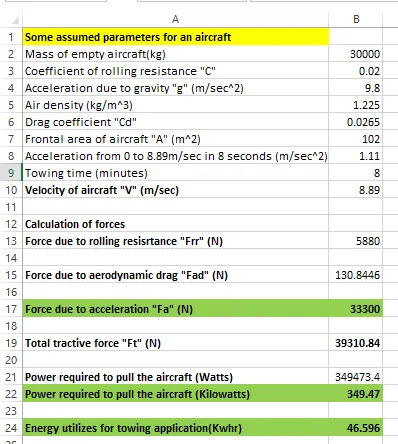
Calculation of torque :-
Calculation of duty cycle :-