Project-1: Powertrain for aircraft in runways
1.Weight of various aircraft:
The weight of the aircraft is generally is calculated under two category,
1.Maximum take off weight
2.Maximum landing weight
Maximum take off weight(MTOW):
The maximum takeoff weight (also known as the maximum brake-release weight) is the maximum weight authorised at brake release for takeoff, or at the start of the takeoff roll. The maximum takeoff weight is always less than the maximum taxi/ramp weight to allow for fuel burned during taxi by the engines and the APU.
Maximum landing weight(MLW):
The maximum weight authorised for normal landing of an aircraft. The MLW must not exceed the MTOW. The operation landing weight may be limited to a weight lower than the Maximum Landing Weight.
2.Ground speed-Air speed:
Yes,there is differance between the ground speed and the air speed.To know the differance we need to take wind speed into the account.
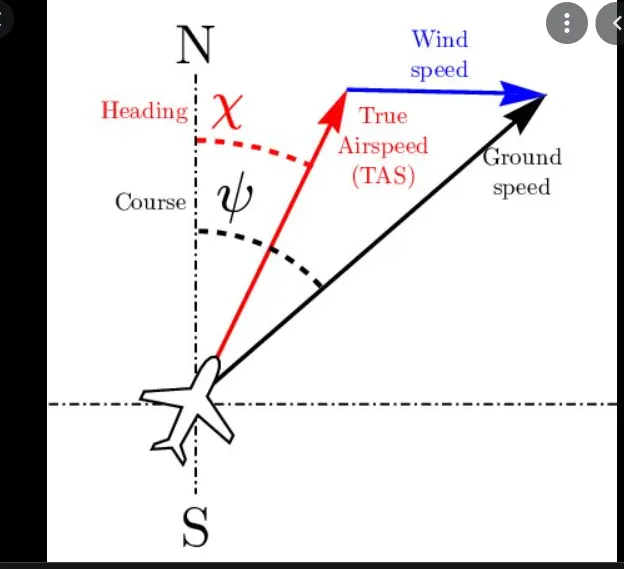
Ground speed is the airplane’s speed relative to the surface of the Earth, airspeed – at least true airspeed – is its speed relative to the air it is flying in.Ground speed, on the other hand, is the aircraft’s speed relative to the ground. One thing that should be noted here is that it’s its horizontal rather than vertical speed – an aircraft climbing completely vertically would have a ground speed of zero.
The relationship between airspeed and ground speed is fairly simple. Ground speed is simply the sum of airspeed and wind speed.
Ground speed =air speed+wind speed
For pilots, both airspeed and ground speed are very important. While the first of those helps them make sure they are flying fast enough to take off, not to stall, and so on, the second one helps them figure out how long it will take them to get from one place to another.
3.Aircraft engine not recommended to move in ground:
For movement in the ground the aircraft uses its own engine power which is known as taxing.Generally it is not preferred as the engine propeller may drag in some of the sand particules in the ground which may cause serious problems in the engine.
In aiport there are the pushback vechicle available which will move the aircraft in the ground.Its main purpose is to move the front wheel from the parking spot to the taxiways,it is known as towing.
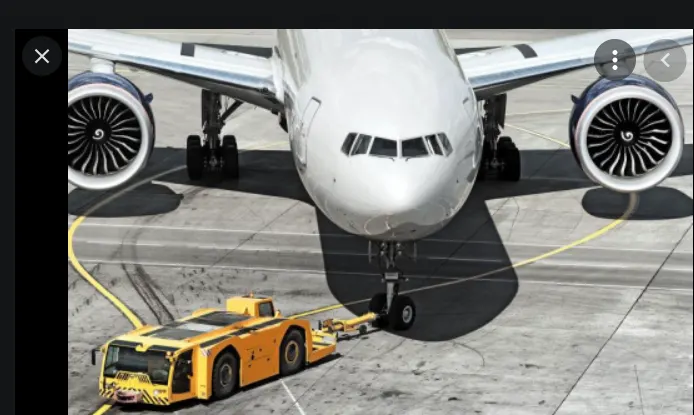
During the towing process unintended movement of the flight may cause serious damages.Unwanted consequences from static running are mainly related to those arising from,
1.The unintended movement of the aircraft during engine running
2.Effectively a loss of control
3.Especially during high power engine running
4.Aircraft is pushed to runway:
The aircraft is pushed to takeoff usually by two main process known as towing and taxing.
Towing:
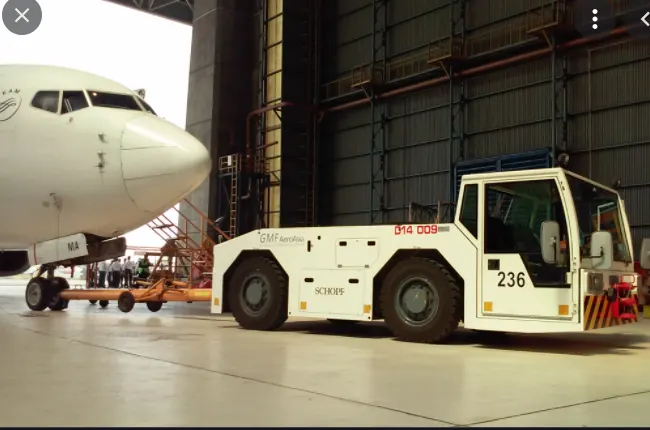
Movement of large aircraft about the airport, flight line, and hangar is usually accomplished by towing with a tow tractor.Before the aircraft to be towed is moved, a qualified person must be in the flight deck to operate the brakes in case the tow bar fails or becomes unhooked. The aircraft can then be stopped, preventing possible damage.
Some types of tow bars available for general use can be used for many types of towing operations.These bars are designed with sufficient tensile strength to pull most aircraft, but are not intended to be subjected to torsional or twisting loads. Many have small wheels that permit them to be drawn behind the towing vehicle going to or from an aircraft. When the bar is attached to the aircraft, inspect all the engaging devices for damage or malfunction before moving the aircraft.
Aircraft equipped with tail wheels are generally towed forward by attaching the tow bar to the main landing gear. In most cases, it is permissible to tow the aircraft in reverse by attaching the tow bar to the tail wheel axle. Any time an aircraft equipped with a tail wheel is towed, the tail wheel must be unlocked or the tail wheel locking mechanism may damage or break.
Taxing:
Taxiing (rarely spelled taxying) is the movement of an aircraft on the ground, under its own power, in contrast to towing or pushback where the aircraft is moved by a tug.The thrust to propel the aircraft forward comes from its propellers or jet engines. Reverse thrust for backing up can be generated by thrust reversers.
Steering is achieved by turning a nose wheel or tail wheel/rudder; the pilot controls the direction travelled with their feet. Larger jet aircraft have a tiller wheel on the left side of the cockpit that acts as a steering wheel allowing the nosewheel to be turned hydraulically. Braking is controlled by differential toe or heel brakes. Not all aircraft have steerable wheels, and in some cases steering is solely by means of differential braking (all Van's aircraft for instance) or solely by means of the rudder (including all floatplanes).
5.Takeoff power:
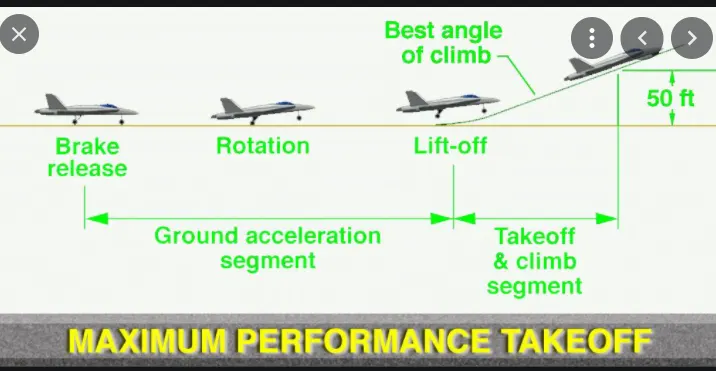
For light aircraft, usually full power is used during takeoff. Large transport category (airliner) aircraft may use a reduced power for takeoff, where less than full power is applied in order to prolong engine life, reduce maintenance costs and reduce noise emissions. In some emergency cases, the power used can then be increased to increase the aircraft's performance.The nose is raised to a nominal 5°–15° nose up pitch attitude to increase lift from the wings and effect liftoff. For most aircraft, attempting a takeoff without a pitch-up would require cruise speeds while still on the runway.
The takeoff speed required varies with aircraft weight and aircraft configuration (flap or slat position, as applicable), and is provided to the flight crew as indicated airspeed.
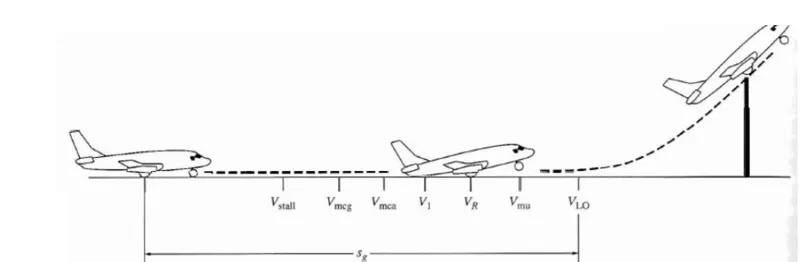
The airplane continues to accelerate until the takeoff rotational speed, VR is achieved. At this velocity, the pilot initiates by elevator deflection a rotation of the airplane in order to increase the angle of
attack and to overcome the weight. Attention should be paid not to stall.
The angle of attack necessary to overcome the weight may not be achievable because the tail may drag the ground. If the rotation of the airplane is limited by ground clearance for the tail, the airplane
must continue to accelerate while rolling along the ground after rotation is achieved. This speed is called the minimum unstick speed, denoted by Vus.
Tyre design:
An aircraft tyre is designed to withstand extremely heavy loads while landing, take off, taxing, and parking. The number of wheels required for aircraft increases with the weight of the aircraft, as the weight of the aeroplane needs to be distributed more evenly.
A Boeing 737NG & 737MAX uses 6 wheels, Boeing 787 uses 10 wheels, Boeing 777 uses 14 wheels and Airbus A380 uses 22 wheels. Aircraft tyres work under extreme conditions, carrying up to 340 tons and accelerating at over 250 km/hour at takeoff, in addition to enduring varied environmental stress when in flight and taxiing.
Carcass plies are used to form the tire. They are sometimes called casing plies. An aircraft tyre is constructed for the purpose it serves.
- They support the weight of an aircraft while it is on the ground.
- It also provides the necessary traction for braking and stopping of an aeroplane.
- Tyre also helps to absorb the shock of landing and provide cushioning the roughness of takeoff, roll-out, and taxi operations.
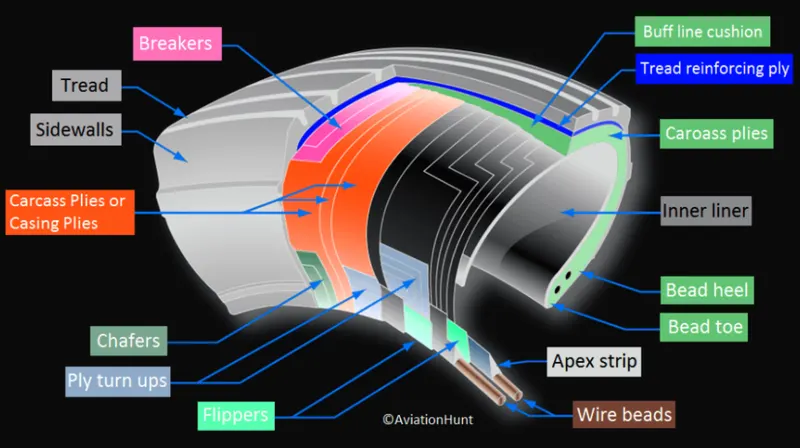
Retreading – Retreading is methods of restoring a worn tyre by renewing the tread area or by renewing the tread area plus one or both sidewalls. Repairs are included in the tyre retreading process.
Ply Rating – Ply Rating is used to identify the maximum recommended load rating and inflation pressure for a specified tyre. It is an index of tyre strength.
Speed Rating – The speed rating is the maximum takeoff speed to which the tyre has been tested.
Skid Depth – Skid depth is the distance between the tread surface and the deepest groove as measured in the mould.
Rolling resistance:
In addition to the familiar forces of thrust, weight, lift, and drag, there is a rolling resistance R, caused by friction between the tires and the ground.
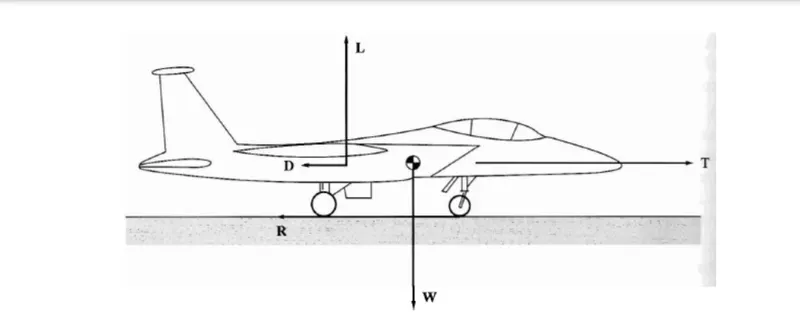
The design parameters that have an important effect on takeoff ground roll are wing loading, thrust-to-weight ratio and maximum lift coefficient.
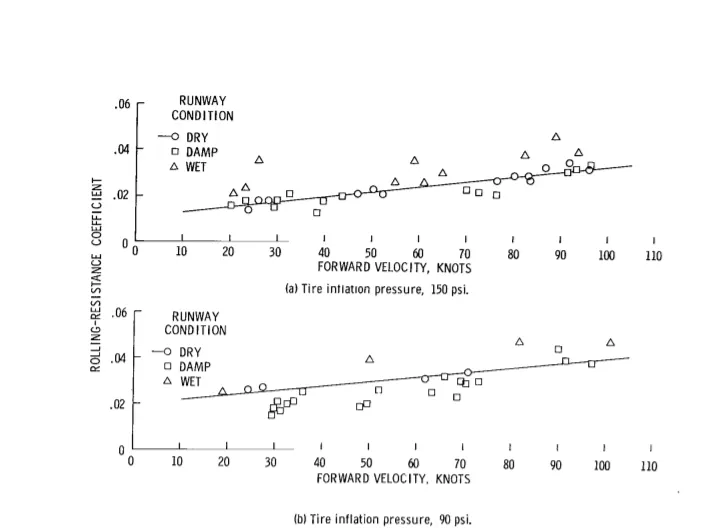
Free-rolling resistance force was measured for tire I11 on dry, damp, and wet concrete surfaces and the results are presented in figure . A straight line is faired through the dry-runway values for the two tire pressures investigated (90 and l5O psi) and, as might be expected, a somewhat higher rolling resistance is obtained for the lower tire pressure. It is of interest to note the effect of runway-surface condition on rolling resistance. Somewhat lower rolling resistance is obtained on the damp runway surface than on the dry surface, undoubtedly because of lubrication by the water
film; however, higher rolling resistance is obtained on the wet surface (water depth 0.1 to 0.3 inch) and must be due to fluid drag on the tire.
Tyre pressure:
Aircraft tires generally operate at high pressures, up to 200 psi (14 bar; 1,400 kPa) for airliners, and even higher for business jets. The main landing gear on the Concorde was typically inflated to 232 psi (16.0 bar), whilst its tail bumper gear tires were as high as 294 psi (20.3 bar). The high pressure and weight load on the Concorde tyres were a significant factor in the loss of Air France Flight 4590.
Tests of airliner aircraft tires have shown that they are able to sustain pressures of maximum 800 psi (55 bar; 5,500 kPa) before bursting.During the tests the tires have to be filled with water, to prevent the test room being blown apart by the energy that would be released by a gas when the tire bursts.
Aircraft tires are usually inflated with nitrogen to minimize expansion and contraction from extreme changes in ambient temperature and pressure experienced during flight.Dry nitrogen expands at the same rate as other dry atmospheric gases (normal air is about 80% nitrogen), but common compressed air sources may contain moisture, which increases the expansion rate with temperature.
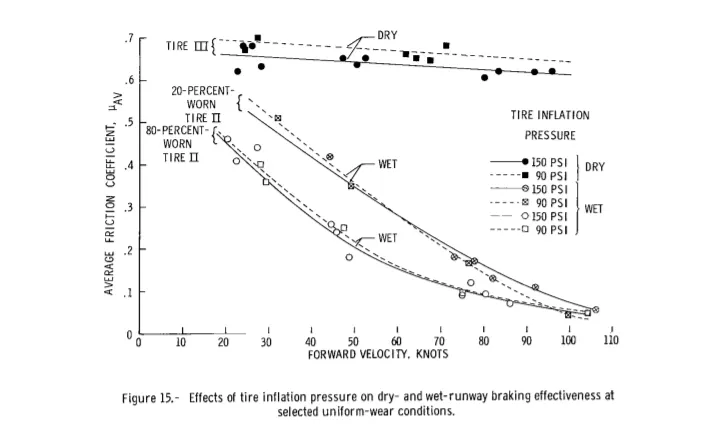
The figure shows the effects of tire-inflation pressure on braking effectiveness on dry and wet runways. The lower tire pressure (90 psi) resulted in somewhat higher friction coefficients on dry-runway braking, an effect previously noted in reference 1. On wet-runway braking, however, only slight differences were observed between the two tire pressures.
Brake force:
Aircraft brakes stop a moving aircraft by converting its kinetic energy to heat energy by means of friction between rotating and stationary discs located in brake assemblies in the wheels.
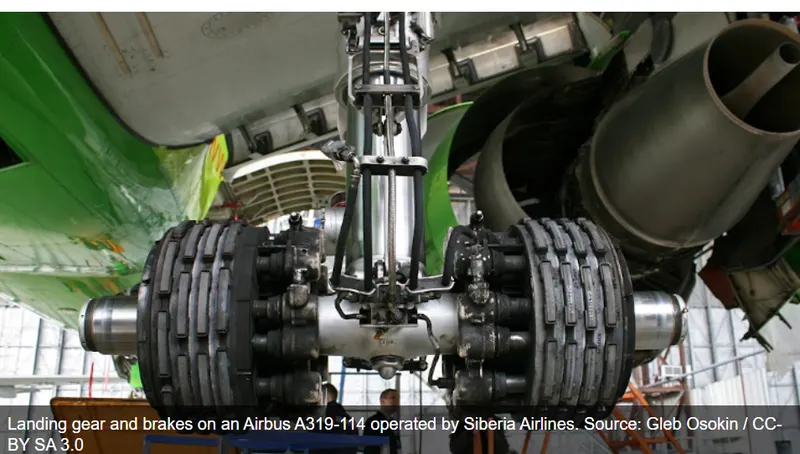
Brakes provide this critical stopping function during landings to enable airplanes to stop within the length of the runway. They also stop aircraft during rejected takeoff events, in which an attempted takeoff is canceled as the airplane is rolling down the runway before it lifts off from the ground due to engine failure, tire blowout, other system failure or direction from air traffic control.
Disc brakes:
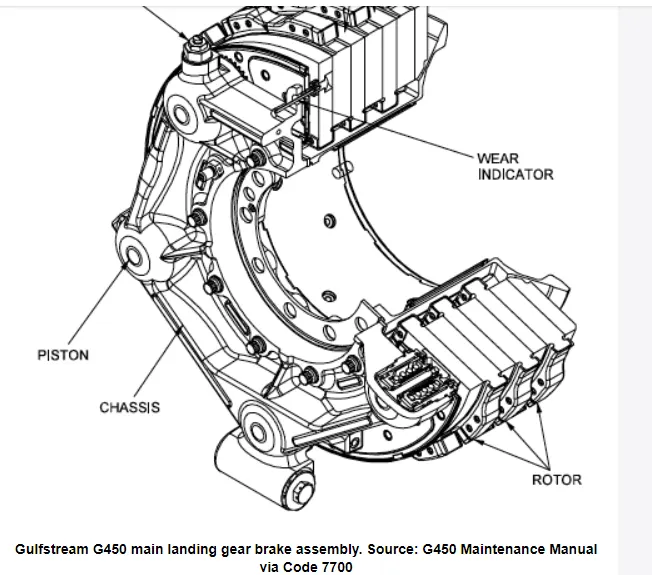
The most common type of brake used on aircraft is the disc brake. Disc brakes function by exploiting friction between rotating and stationary discs inside the brake.
Upon receiving a command signal to brake — from the pilot depressing a foot pedal or from the autobrake system — actuators in the brake move a piston to squeeze the discs together, generating a frictional force that slows the rotation of the wheel. The friction between the discs generates heat as the aircraft’s kinetic energy is converted to heat energy. In this function, the brakes act as a heat sink, absorbing tremendous amounts of heat as the aircraft sheds kinetic energy. During RTO stops, the temperature of carbon disc brakes can exceed 1,800° C.
Autobrakes and skid control
Modern commercial aircraft are equipped with an autobrake system that controls the deceleration of the aircraft by automatically optimizing the application of brake force independent of pilot operation of the brake pedals to minimize stopping distance, reduce pilot workload and smooth braking action.
The maximum take-off weight of an A380 is 575,000 kg (1,267,658 lb) and its maximum V1 is around 170 knots (about 195 mph or 87 m/s). A rough estimate for the maximum energy that the A380’s 16 brakes need to dissipate during RTO can be obtained by calculating the kinetic energy of the aircraft (neglecting the effects of thrust reversers, air brakes, tailwinds, headwinds and runway slope).
Since kinetic energy (KE) is a function of mass (m) and velocity (v) according to the equation:
KE = ½mv2
The kinetic energy of the A380 during RTO is calculated as follows:
KE = 0.5 * 575,000 kg * (87.4556 m/s)2 = 2.2 x 10⁹ J = 2.2 GJ
6.Force and power to push/pull aircraft:
Let us take the assumption as,
Mass of aircraft(m1) =450000Kg
Roling resistance coefficient of aircraft (`mu1`) =0.004
Mass of towing vechicle(m2) = 50000Kg
Roling resistance coefficient of towing vechicle(`mu2`)=0.0035
Velocity of aircraft while towing (v) =25Km/h=6.944m/s
Density of air medium(`rho`)=1.25Kg/m^3
Area of aircraft(A1) =20m^2
Area of towing vechicle(A2) =1.8m^2
Drag coefficient of aircraft(d1) =0.025
Drag coefficient of towing vechicle(d2) =1.8
The total force on the vechicle to pull aircraft=Rolling force of aircraft+Rolling force of Towing vechicle+Airdrag force of aircraft+Air drag force of towing vechicle
Rolling force=`mu`mg
Air drag force=0.5*`rho`*A*v^2*d
1.For Aircraft,
Rolling force=0.004*450000*9.8
=17640 N
Air drag force=0.5*1.25*20*(6.944)^2*0.025
=15.07 N
2.For Towing vechicle,
Rolling force=0.0035*50000*9.8
=1715
Air drag force =0.5*1.25*1.8*(6.944)^2*1.8
=97.65 N
The total force to push/pull the aircraft=17640+15.07+1715+97.65
=19467.63 N
Power calculation:
Power required to push/pull the aircraft=Force*velocity of the aircraft
=19467.63*6.994
=135.192Kw
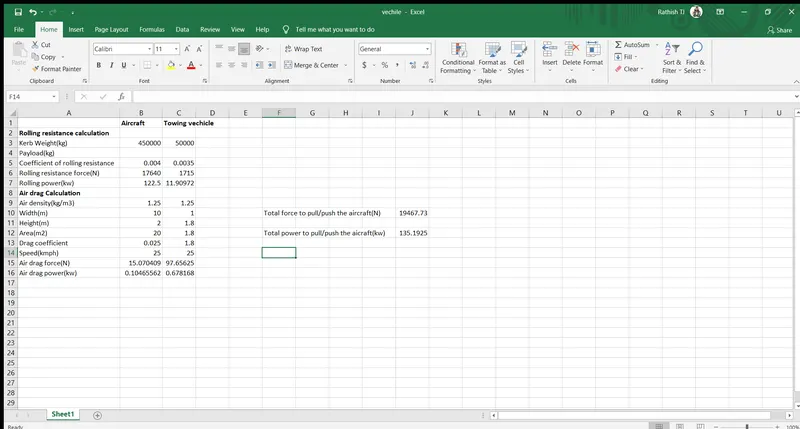
The above calculation can also be done using the mathlab model.
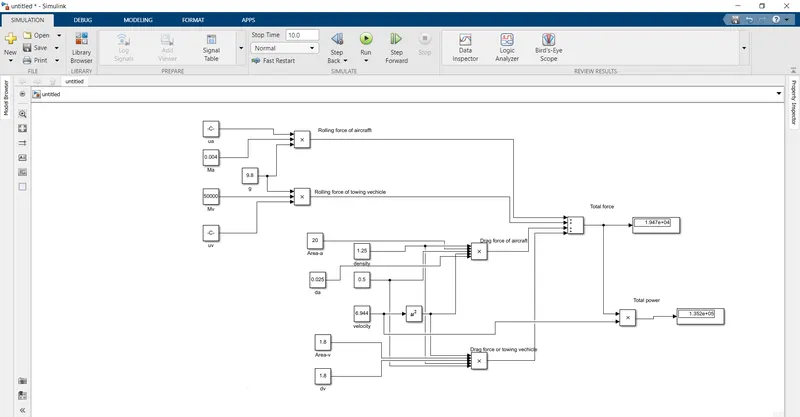
The above mathlab model also depicts the same value as calculated by the excel calculator.
7.Electric powertrain for towing application:
The assumptions made are,
Mass of aircraft(m1) =450000Kg
Roling resistance coefficient of aircraft (`mu1`) =0.004
Mass of towing vechicle(m2) = 50000Kg
Roling resistance coefficient of towing vechicle(`mu2`)=0.0035
Velocity of aircraft while towing (v) =25Km/h=6.944m/s
Density of air medium(`rho`)=1.25Kg/m^3
Area of aircraft(A1) =20m^2
Area of towing vechicle(A2) =1.8m^2
Drag coefficient of aircraft(d1) =0.025
Drag coefficient of towing vechicle(d2) =1.8
Tyre radius of towing vechicle(r) =0.5m
Gear ratio(G) =11
Time of towing operation(t) =0.25hour
In the above section we have calculated the force and power value for the above parameters,
Force=19467.63N
Power=135.19kw
From this values we can calculate the Torque of motor and the energy of the battery.
We know, F=T(G/r)
T=F(r/G)
=19467.63*(0.5/11)
=884.89Nm
Required energy,E=P*t
=135.19(kw)*0.25(hour)
=33.79kwh
So the battery should able to store the energy of 33.79kwh and need to supply it through out the time of towing to the motor to develope a torque of 884.89Nm
Motor selection:
The motor has to be selected in order that it should deliver 135kw of power and to develope a torque of 884Nm.We can select a Permanent magnet Dc motor for this operation.
Motor parameters,
|
Series Number |
APEV80-12(16) |
|
Pole |
12 |
|
Direct Current Voltage (VDC) |
540 |
|
Rated current (A) |
255 |
|
Peak Current (A) |
650 |
|
Rated Power (kW) |
150 |
|
Peak Power (kW) |
220 |
|
Rated Speed (RPM) |
1,650 |
|
Peak Speed (RPM) |
3,300 |
|
Rated Torque (N.m) |
868 |
|
Peak Torque (N.m) |
3,000 |
|
BEMF (VAC)/rpm rms |
660/ 2401 |
|
Efficiency |
90% |
Duty cycle calulation:
The power converter used is DC-DC boost converter.The duty cycle can calculated from,
Vo=Vi/(1-D)
V0=output voltage
Vi=input voltage
D=duty cycle
Let us assume the input battery voltage to be 48V.The maximum output voltage of the motor can be calculated from the standard parameter.
rated power=Rated current*maximum voltage
Vo=Rated power/Rated current
=150000/255
=588.76V
Duty cycle,D=1-(Vi/Vo)
=1-(48/588.76)
=0.92
The duty cycle of the dc-dc boost converter is operated at a range of(0-0.9) to achieve the zero speed to maximum speed of the aircraft.
Block diagram of powertrain:
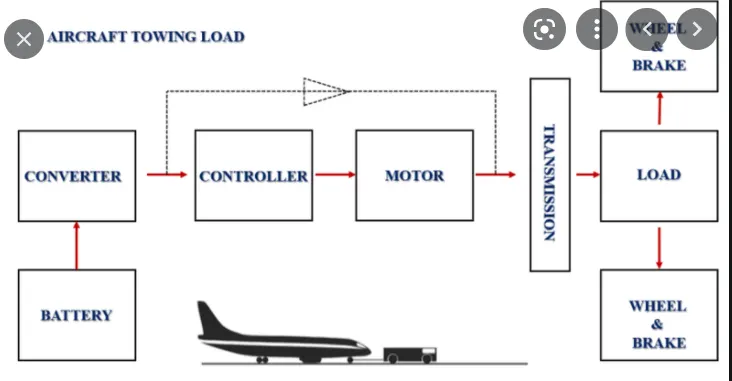
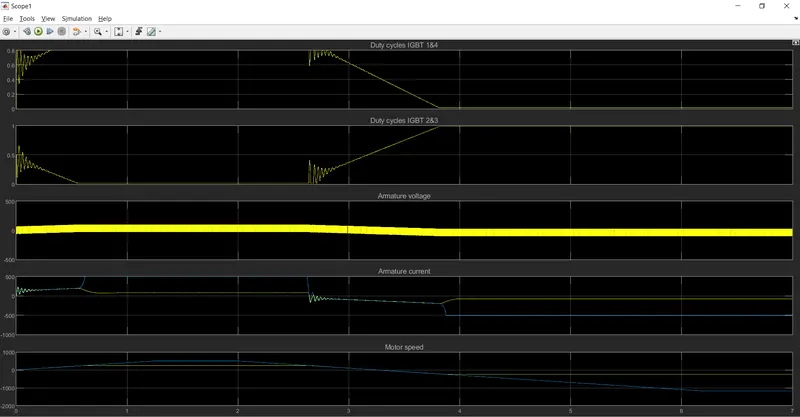
The motor parameters and working can be stimulated using a mathlab model.
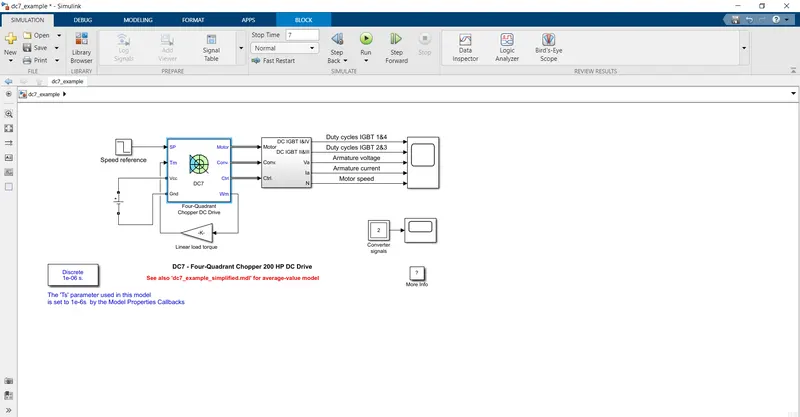
The model contains the Dc7 chopper controller for the dc motor and the stimulation is done and thenplots are plotted.