Project-1: Powertrain for aircraft in runways
1.
MTOW = Maximum take-off weight, MLW = Maximum landing weight, TOR = Take-off run (SL, ISA+15°, MTOW), LR = Landing run (SL, ISA+15°, MLW)
| Type | MTOW [kg] | MLW [tonnes] | TOR [m] | LR [m] | ICAO category | FAA category |
|---|---|---|---|---|---|---|
| Antonov An-225 | 640,000 | 591.7 | 3500 | Heavy | Super | |
| Scaled Composites Model 351 Stratolaunch | 589,670 | 3660 | Heavy | Super | ||
| Airbus A380-800[1][2][3] | 575,000 | 394 | 3100 | 1930 | Super | Super |
| Boeing 747-8F | 447,700 | 346.091 | 3100 | 1800 | Heavy | Heavy |
| Boeing 747-8 | 443,613 | 306.175 | 3100 | Heavy | Heavy | |
| Boeing 747-400ER | 412,770 | 295.742 | 3090 | Heavy | Heavy | |
| Antonov An-124-100M | 405,060 | 330 | 2520 | 900 | Heavy | Heavy |
| Boeing 747-400 | 396,900 | 295.742 | 3018 | 2179 | Heavy | Heavy |
| Lockheed C-5 Galaxy | 381,000 | 288.417 | 2530 | 1494 | Heavy | Heavy |
| Boeing 747-200 | 377,840 | 285.700 | 3338 | 2109 | Heavy | Heavy |
| Boeing 747-300 | 377,840 | 260.320 | 3222 | 1905 | Heavy | Heavy |
| Airbus A340-500 | 371,950 | 240 | 3050 | 2010 | Heavy | Heavy |
| Airbus A340-600 | 367,400 | 256 | 3100 | 2100 | Heavy | Heavy |
| Boeing 777F | 347,800 | 260.816 | 2830 | Heavy | Heavy | |
| Airbus A330-900 | 352,000 | 251.5 | 3100 | Heavy | Heavy | |
| Boeing 777-300ER | 351,800 | 251.29 | 3100 | Heavy | Heavy | |
| Boeing 777-200LR | 347,450 | 223.168 | 3000 | Heavy | Heavy | |
| Boeing 747-100[7] | 340,200 | 265.300 | Heavy | Heavy | ||
| Airbus A350-1000 | 308,000 | 233.5 | Heavy | Heavy | ||
| Boeing 777-300 | 299,370 | 237.683 | 3380 | Heavy | Heavy | |
| Boeing 777-200ER | 297,550 | 213.00 | 3380 | 1550 | Heavy | Heavy |
| Airbus A340-300 | 276,700 | 190 | 3000 | 1926 | Heavy | Heavy |
| McDonnell Douglas MD-11 | 273,300 | 185 | 2990 | 1890 | Heavy | Heavy |
| Airbus A350-900 | 270,000 | 175 | 2670 | 1860 | Heavy | Heavy |
| Ilyushin Il-96M | 270,000 | 195.04 | 3115 | 2118 | Heavy | Heavy |
| McDonnell Douglas DC-10 | 256,280 | 183 | 2990 | 1890 | Heavy | Heavy |
| Boeing 787-9 | 254,000 | 192.777 | 2900 | Heavy | Heavy | |
| Boeing 787-10 | 254,000 | 201.849 | Heavy | Heavy | ||
| Airbus A340-200 | 253,500 | 181 | 2990 | Heavy | Heavy | |
| Ilyushin IL-96-300 | 250,000 | 175 | 2600 | 1980 | Heavy | Heavy |
| Airbus A330-300 | 242,000 | 185 | 2500 | 1750 | Heavy | Heavy |
| Airbus A330-200 | 242,000 | 180 | 2220 | 1750 | Heavy | Heavy |
| Lockheed L-1011-500 | 231,300 | 166.92 | 2636 | Heavy | Heavy | |
| Boeing 787-8 | 228,000 | 172.365 | 3300 | 1695 | Heavy | Heavy |
| Lockheed L-1011-200 | 211,400 | Heavy | Heavy | |||
| Ilyushin IL-86 | 208,000 | 175 | Heavy | Heavy | ||
| Boeing 767-400ER | 204,000 | 158.758 | 3414 | Heavy | Heavy | |
| Airbus A300-600R | 192,000 | 140 | 2385 | 1555 | Heavy | Heavy |
| Boeing 767-300ER | 187,000 | 136.08 | 2713 | 1676 | Heavy | Heavy |
| Concorde | 185,000 | 111.1 | 3440 | 2220 | Heavy | Heavy |
| Airbus A300-600 | 163,000 | 138 | 2324 | 1536 | Heavy | Heavy |
| Boeing 767-300 | 159,000 | 136.078 | 2713 | 1676 | Heavy | Heavy |
| Airbus A310-300 | 157,000 | 124 | 2290 | 1490 | Heavy | Heavy |
| Vickers VC10 | 152,000 | 151.9 | Heavy | Heavy | ||
| Boeing 707-320B | 151,000 | 97.5 | Heavy | Heavy | ||
| Boeing 707-320C | 151,000 | 112.1 | Heavy | Heavy | ||
| Douglas DC-8-61 | 147,000 | Heavy | Heavy | |||
| Airbus A310-200 | 142,000 | 123 | 1860 | 1480 | Heavy | Heavy |
| Airbus A400M | 141,000 | 122 | 980 | 770 | Heavy | Heavy |
| Douglas DC-8-32 | 140,000 | Heavy | Heavy | |||
| Douglas DC-8-51 | 125,000 | Medium | Large | |||
| Boeing 757-300 | 124,000 | 101.6 | 2550 | 1750 | Medium | Large |
| Boeing 707-120B | 117,000 | 86.3 | Medium | Large | ||
| Boeing 757-200 | 116,000 | 89.9 | 2347 | 1555 | Medium | Large |
| Boeing 720B | 106,000 | 79.5 | Medium | Large | ||
| Boeing 720 | 104,000 | 79.5 | Medium | Large | ||
| Tupolev Tu-154M | 104,000 | 80 | Medium | Large | ||
| Tupolev Tu-204SM | 104,000 | 87.5 | 2250 | Medium | Large | |
| Convair 880 | 87,500 | Medium | Large | |||
| Boeing 737-900 | 85,000 | 66.36 | 2500 | 1704 | Medium | Large |
| Boeing 737-900ER | 85,000 | 71.35 | 2804 | 1829 | Medium | Large |
| Boeing 727-200 Advanced | 84,000 | 70.1 | Medium | Large | ||
| Airbus A321-100 | 83,000 | 77.8 | 2200 | 1540 | Medium | Large |
| Boeing 737-800 | 79,000 | 65.32 | 2308 | 1634 | Medium | Large |
| Boeing 727-200 | 78,000 | 68.1 | Medium | Large | ||
| McDonnell-Douglas MD-83 | 73,000 | 63.28 | Medium | Large | ||
| Boeing 727-100[17] | 72,500 | 62.4 | Medium | Large | ||
| Boeing 727-100C[17] | 72,500 | 62.4 | Medium | Large | ||
| McDonnell-Douglas MD-90-30 | 71,000 | 64.41 | 2165 | 1520 | Medium | Large |
| de Havilland Comet 4 | 70,700 | Medium | Large | |||
| Boeing 737-700 | 70,000 | 58.06 | 1921 | 1415 | Medium | Large |
| Airbus A320-100 | 68,000 | 66 | 1955 | 1490 | Medium | Large |
| Boeing 737-400 | 68,000 | 54.9 | 2540 | 1540 | Medium | Large |
| de Havilland Comet 3 | 68,000 | Medium | Large | |||
| Boeing 377 | 67,000 | Medium | Large | |||
| Boeing 737-600 | 66,000 | 54.66 | 1796 | 1340 | Medium | Large |
| Airbus A220-300 | 65,000 | 57.61 | 1890 | 1494 | Medium | Large |
| Hawker Siddeley Trident 2E | 65,000 | Medium | Large | |||
| Airbus A319 | 64,000 | 62.5 | 1850 | 1470 | Medium | Large |
| Boeing 737-300 | 63,000 | 51.7 | 1939 | 1396 | Medium | Large |
| Boeing 737-500 | 60,000 | 49.9 | 1832 | 1360 | Medium | Large |
| Airbus A220-100 | 59,000 | 50.80 | 1463 | 1356 | Medium | Large |
| Airbus A318[18] | 59,000 | 57.5 | 1375 | 1340 | Medium | Large |
| Boeing 717-200HGW | 55,000 | 47.174 | 1950 | Medium | Large | |
| Douglas DC-7 | 55,000 | Medium | Large | |||
| de Havilland Comet 2 | 54,000 | Medium | Large | |||
| Boeing 717-200BGW | 50,000 | 46.265 | 1950 | Medium | Large | |
| de Havilland Comet 1 | 50,000 | Medium | Large | |||
| Douglas DC-6A | 48,600 | Medium | Large | |||
| Douglas DC-6B | 48,500 | Medium | Large | |||
| Embraer 190 | 48,000 | 43 | 2056 | 1323 | Medium | Large |
| Caravelle III | 46,000 | Medium | Large | |||
| Fokker 100 | 46,000 | 39.95 | 1621 | 1350 | Medium | Large |
| Douglas DC-6 | 44,000 | Medium | Large | |||
| Avro RJ-85 | 42,000 | 36.74 | Medium | Large | ||
| Handley Page Hermes | 39,000 | Medium | Large | |||
| Embraer 175 | 37,500 | 32.8 | 2244 | 1304 | Medium | Large |
| Bombardier CRJ900 | 36,500 | 33.345 | 1778 | 1596 | Medium | Large |
| Embraer 170 | 36,000 | 32.8 | 1644 | 1274 | Medium | Large |
| Bombardier CRJ700 | 33,000 | 30.39 | 1564 | 1478 | Medium | Large |
| Douglas DC-4 | 33,000 | Medium | Large | |||
| Vickers Viscount 800 | 30,400 | Medium | Large | |||
| Bombardier Q400 | 28,000 | 28.01 | 1219 | 1295 | Medium | Large |
| Bombardier CRJ200 | 23,000 | 21.319 | 1918 | 1479 | Medium | Large |
| ATR 72-600 | 22,800 | 22.35 | 1333 | 914 | Medium | Large |
| Saab 2000 | 22,800 | 21.5 | 1300 | Medium | Large | |
| Embraer ERJ 145 | 22,000 | 19.3 | 2270 | 1380 | Medium | Large |
| ATR 42-500 | 18,600 | 18.3 | 1165 | 1126 | Medium | Small |
| Saab 340 | 13,150 | 12.930 | 1300 | 1030 | Medium | Small |
| Embraer 120 Brasilia | 11,500 | 11.25 | 1560 | 1380 | Medium | Small |
| BAe Jetstream 41 | 10,890 | 10.570 | 1493 | 826 | Medium | Small |
| Learjet 75 | 9,752 | 8.709 | 1353 | 811 | Medium | Small |
| Pilatus PC-24 | 8,300 | 7.665 | 893 | 724 | Medium | Small |
| Embraer Phenom 300 | 8,150 | 7.65 | 956 | 677 | Medium | Small |
| Beechcraft 1900D | 7,765 | 7.605 | 1036 | 853 | Medium | Small |
| Cessna Citation CJ4 | 7,761 | 7.103 | 1039 | 896 | Medium | Small |
| de Havilland Hercules | 7,000 | Medium | Small | |||
| Embraer Phenom 100 | 4,800 | 4.43 | 975 | 741 | Light | Small |
Reference: https://en.wikipedia.org/wiki/List_of_airliners_by_maximum_takeoff_weight
2. Difference between air speed and ground speed
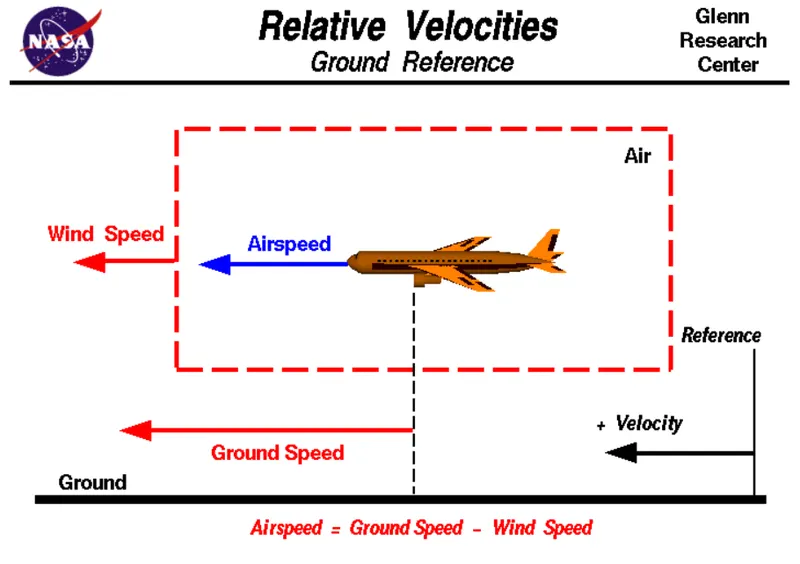
Ground Speed
For a reference point picked on the ground, the aircraft moves relative to the reference point at the ground speed. Ground speed is also a vector quantity so a comparison of the ground speed to the wind speed must be done according to rules for vector comparison.
Airspeed
The important quantity in the generation of lift is the relative velocity between the object and the air, which is called the airspeed. Airspeed cannot be directly measured from a ground position, but must be computed from the ground speed and the wind speed. Airspeed is the vector difference between the ground speed and the wind speed.
Airspeed = Ground Speed - Wind Speed
On a perfectly still day, the airspeed is equal to the ground speed. But if the wind is blowing in the same direction that the aircraft is moving, the airspeed will be less than the ground speed.
Reference: https://www.grc.nasa.gov/www/k-12/airplane/move.html
3.
Let us assume passenger commuter aircraft and large airliners. Aircraft move using their own engine power all the time on the airport apron and taxiways under their own power to go towards runways and after landing taxi to their assigned gate.
The only time they use external assistance is to pushback from the gate. Large turbofan aircraft need help to reverse via a pushback tractor. The engines are turned on after the pushback is complete and the aircraft can move forward under It’s own power.
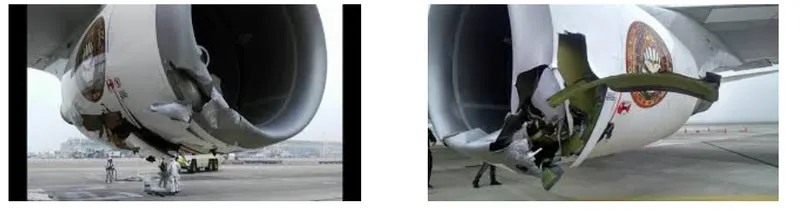
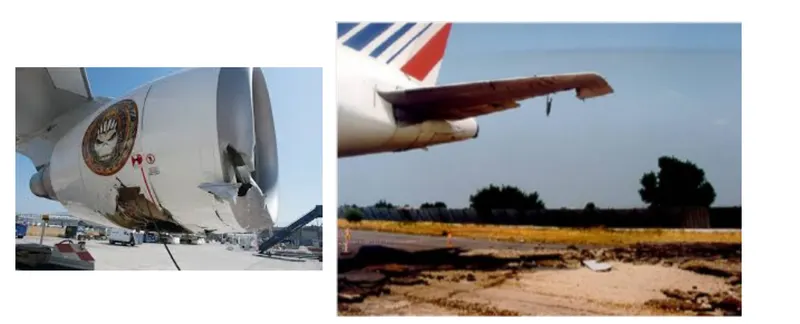
To be accurate, some aircraft can reverse using a variable pitch prop or thrust reversing on turbofans but generally reversing is done via pushback tractors. Blasting jet reversers blows debris In the crowded gate area creating foreign object damage hazard for adjacent aircraft, gate equipment or terminal waiting area glass windows and also foreign particle entering the engine may leed to damage the engine so it is not recommended to use aircraft engine power to move it on the ground at Airport.
4.
- The pilot parks the aircraft in exactly the right place. Usually with the help of an automatic system, but occasionally guided by a marshaller waving two paddles or wands. Dozens of handling personnel are already standing by to perform a whole range of tasks simultaneously.
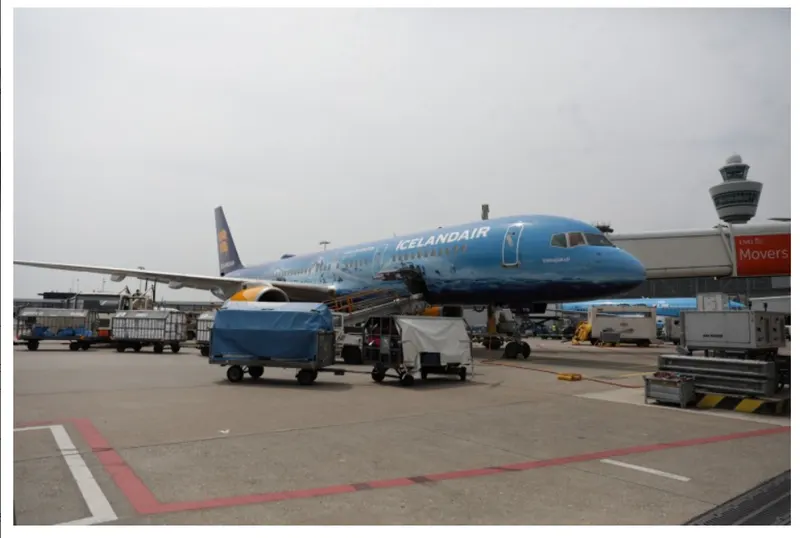
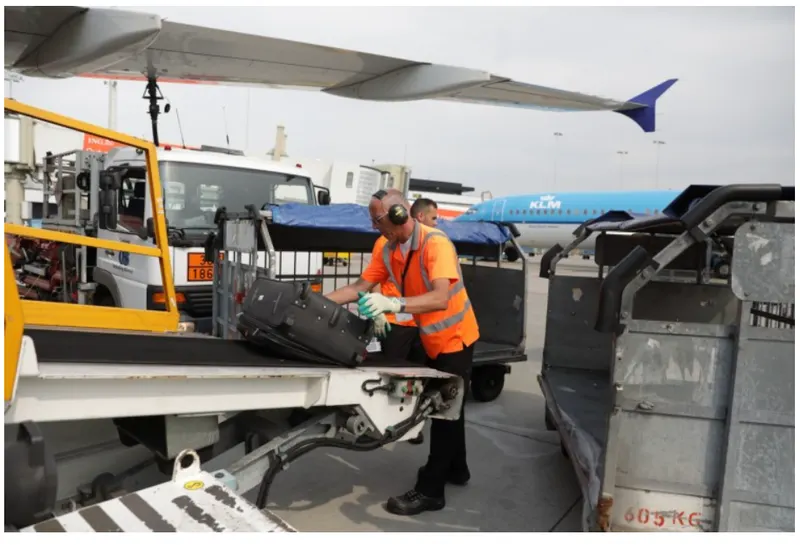
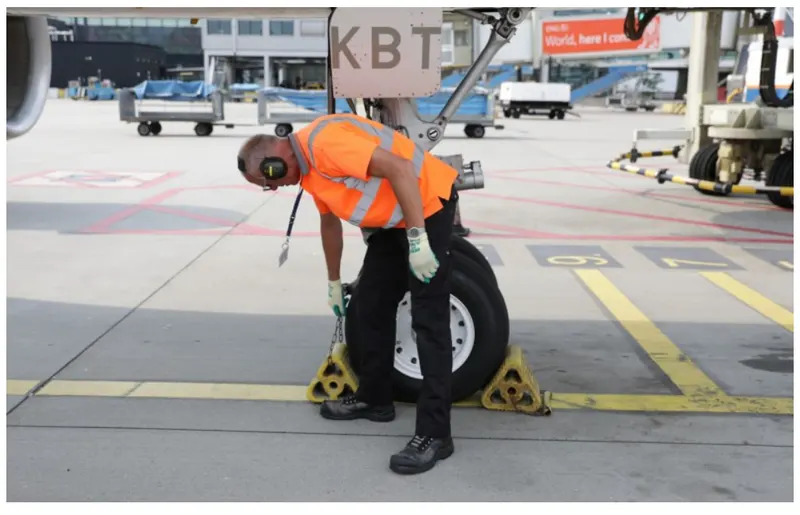
- As soon as the aircraft is stationary and the engines are switched off, the first priority is to disembark the passengers as quickly as possible. The apron handler places chocks in front of the wheels and connects the ground power. Meanwhile, the passenger bridge manoeuvres up to the door and a belt loader rolls up to the cargo hold. Luggage is unloaded and transferred to the terminal on baggage carts.
- Refuelling begins, usually from a hydrant at the stand. A hose is attached to this from a special vehicle called a dispenser, with the other side connected to the fuel tank in the wing.
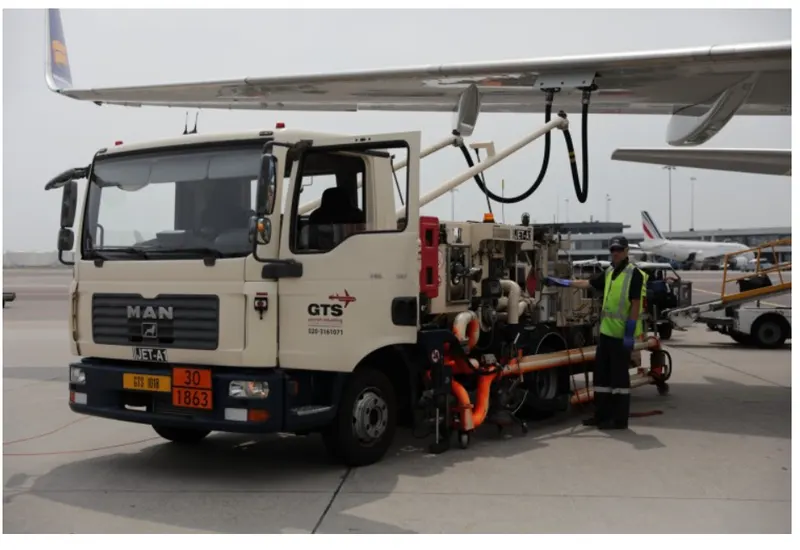
- Now it is time to service the aircraft. The caterer loads new meals and takes away the food waste and used cutlery and crockery. Other activities include draining the lavatories, replacing the headrest covers, removing rubbish and distributing fresh blankets and in-flight magazine.
- A specialist team – or sometimes the crew themselves – cleans the cabin so that the new passengers board a pristine aircraft.
- Meanwhile, specialists from the airline conduct a technical check to make sure that the engines, wings, control surfaces, landing gear, instruments, doors and other equipment are in full working order.
- The aircraft is now ready for baggage to be loaded for the next flight. This is a quick process, on average taking only 10-15 minutes. A little later the passengers start boarding. As soon as they are all in their seats, the door is closed and the pilot informs air-traffic control that the flight is ready for departure.
- The apron handler removes the chocks. A so-called pushback truck reverses the aircraft into taxiing position, pushing it with a towbar attached to the nose-wheel strut. Or, in the most modern versions, by actually lifting the wheel. That speeds up coupling and decoupling.
- The aircraft taxis to the runway to depart at the agreed time.
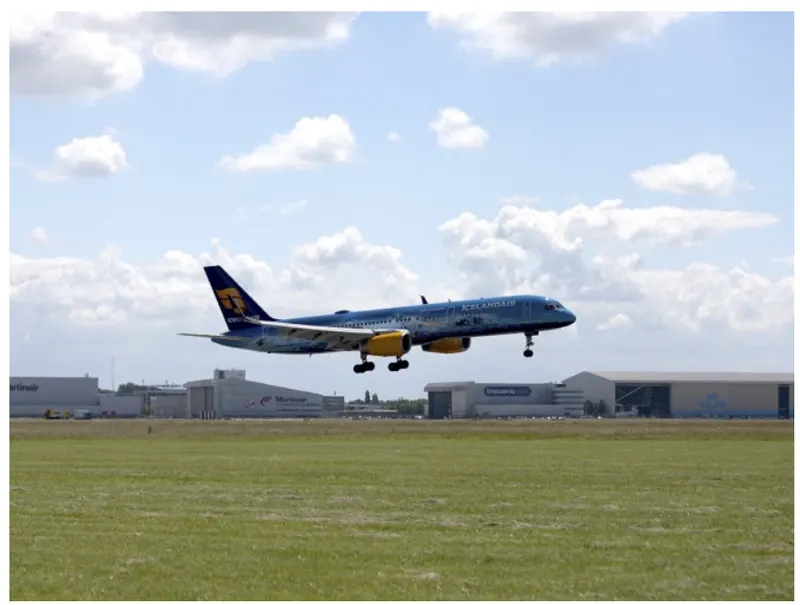
- The pilot waits for permission to take off from air-traffic control. This is possible once the departure route is clear. As soon as the go-ahead is received, the plane takes to the air at full power.
5.
Take off power:
Power Requirement to Keep a Jet Aircraft in the Air.
The total energy of an aircraft flying in the atmosphere can be calculated using equation
E = 1/2mv^2+mgh
However, the engines mounted onto the wings of the plane are required to provide additional energy per time, power, in order to keep the aircraft flying at a constant altitude and speed. This extra power needed to overcome the drag acting on the airplane and is calculated using
P = (dh/dt)mg
where (dh/dt) is the decent speed required to keep the plane's speed constant if the engines fail.
Takeoff and Climb:
- When ready for takeoff, and cleared by Air Trafic Control to proceed, the pilot or first officer of an aircraft releases the brakes and advances the throttle to increase engine power to accelerate down the runway.Once aligned on the runway, steering the aircraft is normally accomplished by using foot pedals that manipulate the nose wheel until the speed is sufficient enough that wind rushing by the rudder on the aircraft tail makes nose wheel steering unnecessary.
- As the aircraft gains speed, air passes faster and faster over its wings and lift is created. Instruments onboard the aircraft display this airspeed, which equals not only the speed of the plane relative to the ground, but also the speed of any wind that may be blowing toward the aircraft (aircraft normally take off headed into the wind).
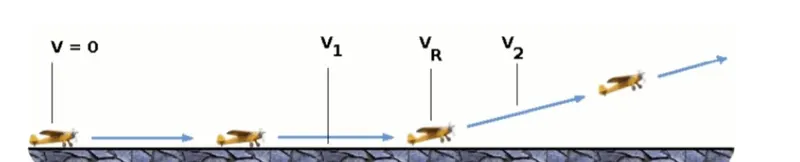
- When the airspeed reaches a certain predetermined point known as rotation speed, the pilot manipulates panels on the tail of the aircraft to rotate the nose of the plane upward. This creates even stronger lift and the plane leaves the ground.
- Rotation speed, abbreviated VR, is one of three important airspeed settings calculated before every flight .The others are V1 - the speed beyond which a safe stop on a runway is no longer possible; and V2 - the minimum speed needed to keep a plane flying should an engine fail after the aircraft surpasses V1. Some of the factors affecting VR and V2 are the weight of the aircraft, the air temperature and the altitude of the airport.
- The heavier the aircraft, the more lift, and thus speed is needed to get it off the ground. Aircraft also need to go faster to y on a hot day than on a cool day. Hot air is less dense than cool air and less density produces less lift for the same speed.
- Similarly, the higher the altitude, the less dense the air. Aircraft need more speed to leave the ground at a place like Denver than at a place like New York, with all other factors such as weight being equal. Some of these factors also are important in calculating V1, although the key factor is the length of the runway that is being used.
- Most large jets leave the ground at about 160 miles per hour and initially climb at an angle in excess of 15 degrees. The angle of a plane's wings to the air owing around them is extremely important to maintaining lift. If the so-called angle of attack is too severe, the ow of air around the wings becomes disrupted and the plane loses lift. To make an aircraft more aerodynamically effcient, the wheels on which an aircraft rolls when it is on the ground are retracted into a cavity in the belly of the plane after it is airborne. There is less drag (wind resistance), and an aircraft can fly faster when its landing gear is retracted.
Tyre design:
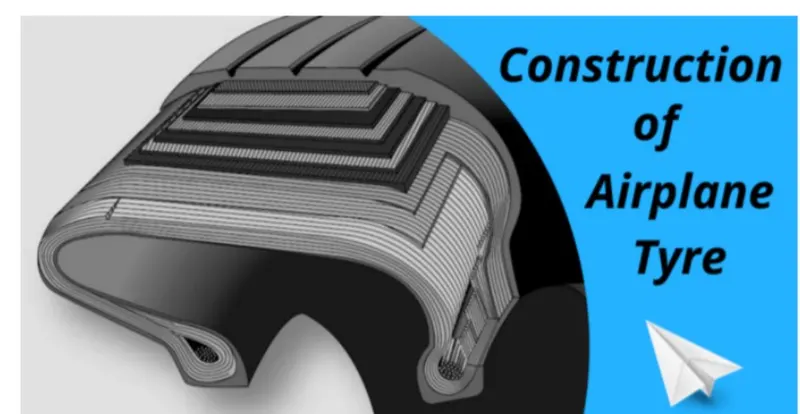
- When it comes to safety tyres are one of the most important components of aircraft. They help to absorb the shock of landing and provide cushioning. It also provides the necessary traction for braking and stopping of an aircraft.
- An aircraft tyre is designed to withstand extremely heavy loads while landing, take off, taxing and parking. The number of wheels required for aircraft increases with the weight of the aircraft, as the weight of the aeroplane needs to be distributed more evenly.
- A Boeing 737NG 737MAX uses 6 wheels, Boeing 787 uses 10 wheels, Boeing 777 uses 14 wheels and Airbus A380 uses 22 wheels. Aircraft tyres work under extreme conditions, carrying up to 340 tons and accelerating at over 250 km/hour at takeoff, in addition to enduring varied environmental stress when in flight and taxiing.
Design and Construction of Aircraft tyre:
Carcass plies are used to form the tire. They are sometimes called casing plies. An aircraft tyre is constructed for the purpose it serves.
1. They support the weight of an aircraft while it is on the ground.
2. It also provides the necessary traction for braking and stopping of an aeroplane.
3. Tyre also helps to absorb the shock of landing and provide cushioning the roughness of takeoff, roll-out, and taxi operations.
Unlike an automobile or truck tyre, it does not have to carry a load for a long period of continuous operation. However, an aircraft tyre absorbs the high impact loads of landing and also it is operating at high speeds for a short time when required.
Some technical aspects of the tyre :
- Retreading is methods of restoring a worn tyre by renewing the tread area or by renewing the tread area plus one or both sidewalls. Repairs are included in the tyre retreading process.
- Load rating is the maximum permissible load at a specified inflation pressure.
- Ply Rating is used to identify the maximum recommended load rating and inflation pressure for a specified tyre. It is an index of tyre strength.
- The speed rating is the maximum takeoff speed to which the tyre has been tested.
- Skid depth is the distance between the tread surface and the deepest groove as measured in the mould.
- Aircraft tyres must have an approved speed and load rating and have sufficient clearance when retracted through landing gear to allow for tyre growth. Tyre growth is the increase in the size of the tyre due to centrifugal forces at high speed.
- Aircraft tyres may be Tube-type or Tubeless. Tubeless tyres are more advantageous over tube-type. There is no longer the use of tube-type tyre in recent aviation. Nowadays all airliners are using tubeless tyres. Tubeless that are meant to be used without a tube has the word TUBELESS on the sidewall of the tyre.
- Aircraft tyres may be Radial or Bias. Almost all airliners are using Radial tyre. Bias is an older design, and its mainly used for road vehicles. Radial tyres have the word RADIAL on the sidewall. Radial tires are more expensive than bias-ply tyres. Radial tires are in demand because of their lower life cycle cost and long term value.
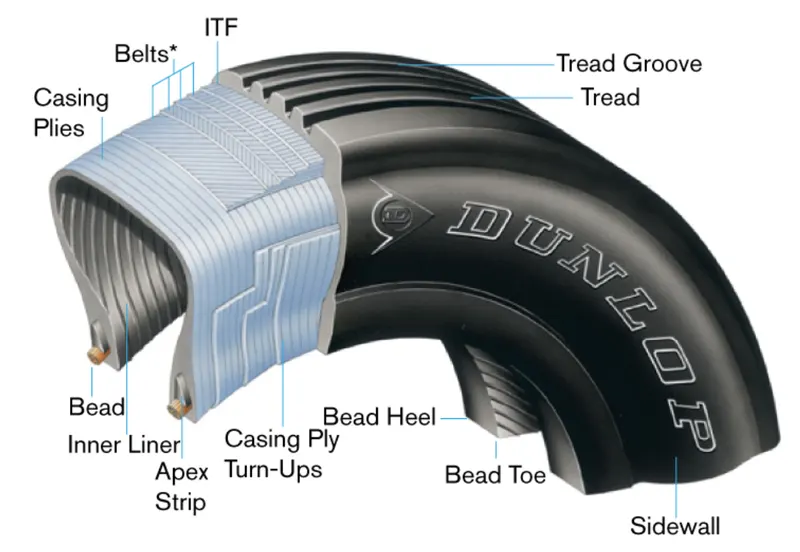
This is the Construction of Radial tyre.
Rolling resistance :
Rolling resistance is one of the forces that act to oppose the motion of a cyclist. It is caused mainly because of deformation of the tyre and can be understood by thinking about
- energy losses due to heat (hysteresis)
- the forces pushing on the tyre.
Energy is lost as heat As the tyre comes into contact with the road, it changes shape as it is compressed (pushed in a bit). This compression causes parts of the rubber tube and the casing of the tyre to heat up. It also causes the tread on the outside of the tyre to heat up as it comes into contact with the road. A tyre with knobbly tread will have a lot more rolling resistance than a smooth tyre because there will be more rubber being compressed and so there will be more heat.
The tyre is a bit like a spring or a rubber band. Some of the energy is stored as the tyre becomes compressed (squeezed in). As the tyre comes back off the road, there is not as much of this stored energy returned because some of it has gone towards making the tyre heat up. This loss of available energy due to heating is called hysteresis. This means there will be less energy available to make the bike go faster.
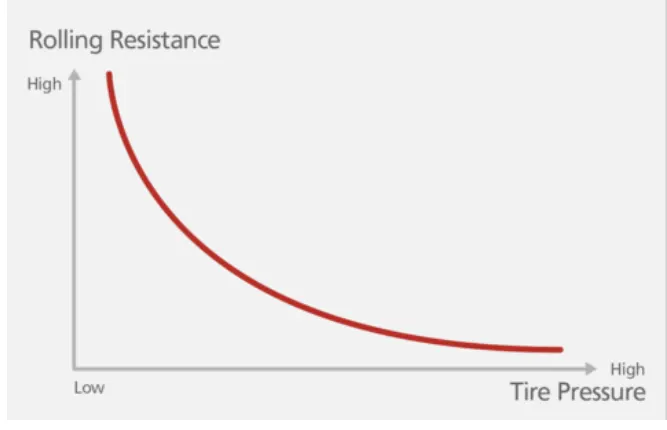
If you feel the temperature of your tyres when you have been biking fast, you will notice this heat. If your tyres are not pumped up hard, there will be even more heat created.The force of rolling resistance does not change at higher speeds. However, because there is a lot more heat being produced at higher speeds, the cyclist uses more power (energy per second) to work against rolling resistance.
Tyre pressure:
An aircraft tire or tyre is designed to withstand extremely heavy loads for short durations.The number of tires required for aircraft increases with the weight of the aircraft, as the weight of the airplane needs to be distributed more evenly. Aircraft tire tread patterns are designed to facilitate stability in high crosswind conditions, to channel water away to prevent hydroplaning, and for braking effect.
Aircraft tires also include fusible plugs (which are assembled on the inside of the wheels), designed to melt at a certain temperature. Tires often overheat if maximum braking is applied during an aborted takeoff or an emergency landing. The fuses provide a safer failure mode that prevents tire explosions by deflating in a controlled manner, thus minimizing damage to aircraft and objects in the surrounding environment.
Inflation : Each of the twelve Boeing 777-300ER main tires is inflated to 220 psi (15 bar; 1,500 kPa), weighs 120 kg (260 lb), has a diameter of 134 cm (53 in) and is changed every 300 cycles while the brakes are changed every 2000 cycles.Aircraft tires generally operate at high pressures, Inflation up to 200 psi (14 bar; 1,400 kPa) for airliners, and even higher for business jets.Tests of airliner aircraft tires have shown that they are able to sustain pressures of maximum 800 psi (55 bar; 5,500 kPa) before bursting.Aircraft tires are usually inflated with nitrogen to minimize expansion and contraction from extreme changes in ambient temperature and pressure experienced during flight.
Brake forces and landing:
Bringing at aircraft down to the runway from 37,000 feet is only part of the challenge. Its not over until the aircraft is safely parked at its gate. In order to do this, pilots have a number of systems available to slow the aircraft down, even in a blizzard on a snowcovered runway.
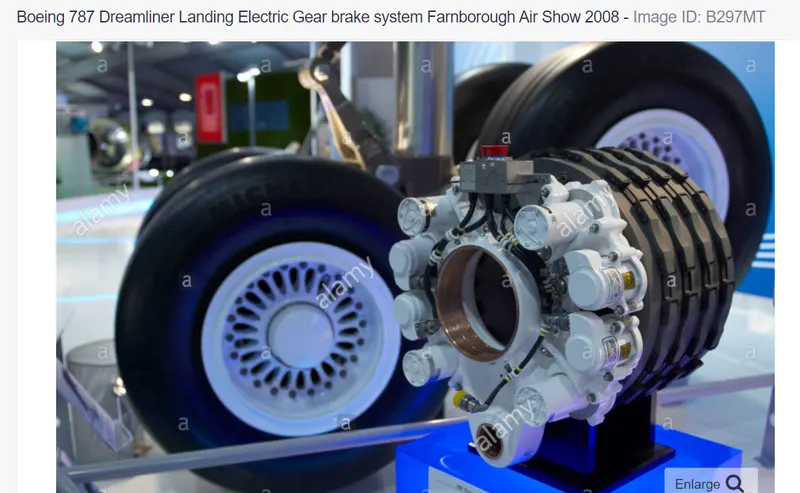
The 787 braking system: Stopping a 200-tonne aircraft landing at 180 mph requires a lot of braking force. To do this, the 787 has one brake unit on each of the eight wheels on the main gear assembly.On other aircraft types, the brake units are powered by the hydraulics system. An electrical signal is sent from the flight deck to hydraulic actuators near the main landing gear. Here, hydraulic fluid at 3,000 pound per square inch is used to force the brake unit against the wheel, thus slowing it down.Thats the case on the 787 Dreamliner. Designers did away with the use of the hydraulic system and all its associated architecture and instead used electricity to power the brakes. When the pilots press on the brake pedals, an electrical signal is sent to the brake unit on the wheel. Here, electrically powered actuators are used to press the carbon brake disc against the wheel, slowing it down.
Electric brakes The brake system on the 787 Dreamliner is controlled by the pilots pressing the tops of the rudder pedals under their feet, demanding the rate of braking which they require. This sends an electronic signal to the Left and Right Brake System Control Units.These then send signals to the four Electronic Brake Actuator Controllers (EBAC) which control the rate of braking on the wheels. Each wheel has four Electric Brake Actuators (EBA), a kind of piston which presses against the carbon brake discs.
The brake disks themselves are made up of two parts. Firstly, there are the rotors. These are connected to the wheel by drive tabs (in the video below they are the black rectangles on the rotor disks). As these drive tabs are in contact with the inside of the wheel, they spin at the same speed. Depending on the brake manufacturer, there are either four or five of these rotors on each brake assembly.The second part of the disks are the stators. These sit around each rotor and are fixed in place and thus dont move. As the wheel turns, the rotors spin round inside the stators.
When the brakes are applied, the four EBAs apply pressure to the first stator. This in turn squeezes the stationary stators up against the spinning rotors and its this friction which slows the wheel down.
Anti-skid protection When landing on slippery runways, theres a chance that the wheels may start to skid as the brakes are applied. To stop this from happening and to maintain maximum effective braking, each wheel has anti-skid protection.Using a variety of sources to determine the aircraft speed, the brake units know how fast the wheels should be spinning. If that speed drops significantly, its because the current brake pressure on that wheel is too great and the wheel is just skidding over the surface.
In this situation, the anti-skid system automatically reduces the braking on that wheel to a point where the skid stops before reapplying the pressure. All this is done in a fraction of a second.
Bottom line Bringing an aircraft to a safe stop is the most important part of a flight. In order to do this, pilots have a number of facilities available to them.The brakes bear the brunt of the hard work with the spoilers and reverse thrust lending a helping hand to ensure maximum efficiency. The autobrake system helps keep the deceleration nice and smooth whilst the anti-skid system reduces the distances needed to stop by modulating the brakes on individual wheels and stopping them from skidding.
Aircraft can also depart with part of the braking system not working. By carrying out a performance calculation before every takeoff and landing, we ensure that the aircraft will stop safely in the given conditions, even at maximum takeoff weight.
6.
A. Power required to pull/push ariplane with towing vehicle
Assuming the average parameter of an airplane
Total mass of airplane(including payload) = 575,000kg
mass of push back = 1000kg
Rolling resistence(Frr)
coefficient of rolling resistence =Crr = 0.002
Rolling resistence force = Frr = Crr*m*g
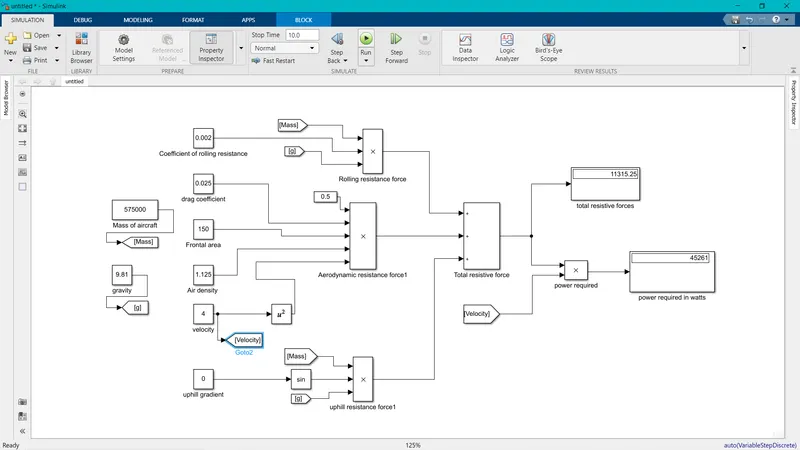
For air craft Frr = 0.002*575000*9.81 = 11281.5 N
For towing vehicle Frrt = 0.002*1000*9.81 = 19.62N
Aerodynamic drag force
Drag coefficient Cd = 0.025
air density (ρ)= 1.125kg/m^3
frontal area (A) = 150`m^2`
velocity (V) = 14.5kmph
Far = 1/2Cd * ρ*A*V^2
= 1/2 *0.025*1.125*150*(4)^2 = 33.75N
Hill climb force
Fh = mgsinθ
Runways are constructed flat so the hill climg force can be neglected
Total resistence
Ft = 11.2815KN
Power required
P = Ft*v
= 11.2815*4 = 45.26KW
The minimum power required by the towing vehicle is 45.26KW to pull/push the Airplane at 4m/s
B. The simulink model to calculate the above conditions
7.
A. Parameter assumed for designing the electric power train block of motor
| Sl no. | Assumed parameter | Assumed values |
| 1 | Mass of aircraft | 575000kg |
| 2 | Mass of towing vehicle | 1000kg |
| 3 | Rolling resistence coefficient of aircraft | 0.002 |
| 4 | Rolling resistence coefficient of towing vehicle | 0.002 |
| 5 | Velocity of aircraft while towing | 4m/s |
| 6 | Density of air (ρ) | 1.125kg/m^3 |
| 7 | Frontal area of aircraft | 150m^2 |
| 8 | Time for towing | 15mins |
| 9 | Tyre radius | 25 inch |
| 10 | Overall gear ratio | 8 |
| 11 | Transmission efficiency | 85% |
| 12 | Motor efficiency | 95% |
Based on the calculation done above
force required = 11.2815KN
Required power = 45.26KW
assuming the tyre radius as 25 inch = 0.635m
Torque required at wheel = (Total force)*Radius = 7.16KNm
Motor torque = Wheel torque/(Gear ratio * Efficiency) ..........Assuming gear ratio as 8 and transmition efficiency as 85%
7.16/8*0.85 = 1.052KNm
If the motor is considered to be 95% efficient then Motor torque = 1.052/0.95 = 1.107KNm
Similarly power required by motor considering all efficiency = 45.26/0.85*0.95 = 56.04Kw
Let us assume the towing activity takes for 15mins = 0.25Hr
total energy consumed = 56.04*0.25 = 14.01Kwh
A battery of higher capacity than this has to be selected.
If the battery of 150Kw power rating is selected the duty cycle range to control the speed from 0 to max (here 4m/s) is
d = Required power/Rated power = 56.04/150 = 0.3736
This means the controller should provide the duty cycle ranging from 0 to 37.36% in order to control the towing speed.
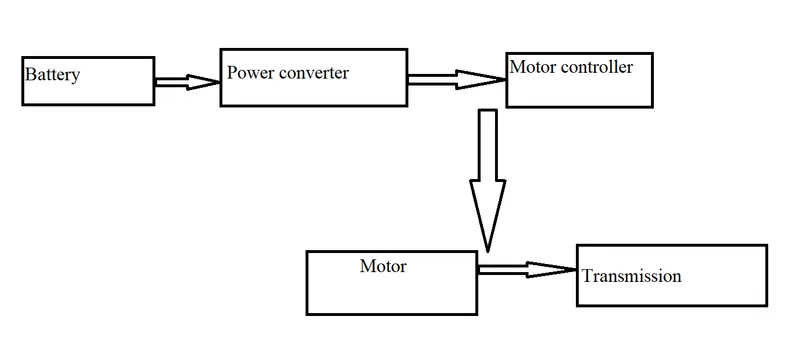
Block diagram of Power train of Towing machine
B.