Week-6 Challenge: EV Drivetrain
1. Types of power converter circuits employed in EV and HEV are
AC to DC converter:
This type of power converter takes an AC power supply and converts it to a DC. Basically the AC source is 230v at a frequency of 50hz which is availabel at home but the Battery in EV/Hev works on DC. Hence we need a AC to DC converter. The AC to DC converter consists of a step down transformer to reduce the voltage level to required voltage, a bridge rectifier circuit to convert a AC to DC and a voltage regulator to supply constant dc voltage .Normally the voltage is operated at 110/120volts for charging the battery it is alsocalled as level 1 charger there are level 2&3 which are high voltage reating charger.
DC to AC converter:
This type of converter takes a DC supply and converts it to an AC supply. Power which is supplied from a battery or capacitor can have its form changed to the AC type for use in homes or systems which use AC load. This type of converter is referred to as an inverter and is widely used in homes an in EV/HEVs.In the case fo EV/HEV the battery pack will supply its power to the inverter. The inverter contains a transformer which consists of a primary and secondary winding .The current from the battery is first supplied to the primary winding where the electronic switches will repetedly reverse the direction of the current to creat an AC wave form. the example for this is an AC traction motor.
DC to DC converter:
This type of converter is similar to a transformer in that it can change the voltage from its current level to another level. It can take an input supply of voltage and increase it or do the exact opposite and decrease it similar to a step up or step down transformer. This type of converter is called chopper. In EV/HEVs and conventional vehicle this type of converter is usedfor variou purpose. Ex:- In the case of stepping down the voltage the car radio may require a stepped down voltage of 12v to operate and would not need a full voltage of a car battery.In the case of stepping up the voltage the motor of a car may require 500v to operate but the vehicle may need more voltage than the battery can provide.
2. Given
Armature voltage = 72v
Armature current = 400A
Ra=0.5ohm
Kϕ=0.7volt second
Chopper switching frequency = 400Hz
given the vehicle speed torq characteristics
Tv = 24.7+(0.0051)w^2
To find the steady state speed for duty cycle 70%
The torque equation is given by the formula
T = (v*K/R)-(K^2.w/R)
Now substituting the T value from the above vehicle speed torque characteristics
24.7+(0.0051)w^2 = (v*K/R)-(K^2.w/R)
24.7+(0.0051)w^2 = (72*0.7*0.7/0.5)-(0.7^2.w/0.5)
24.7+(0.0051)w^2 = 70.56 - 0.98w
45.86 - (0.0051)w^2 - 0.98w = 0
finding the roots
w = 38.9415rad/sec
3.
mathematical model of a DC Motor for the below equation using Simulink.
ω= V/Kϕ -Ra/Kϕ^2 .T
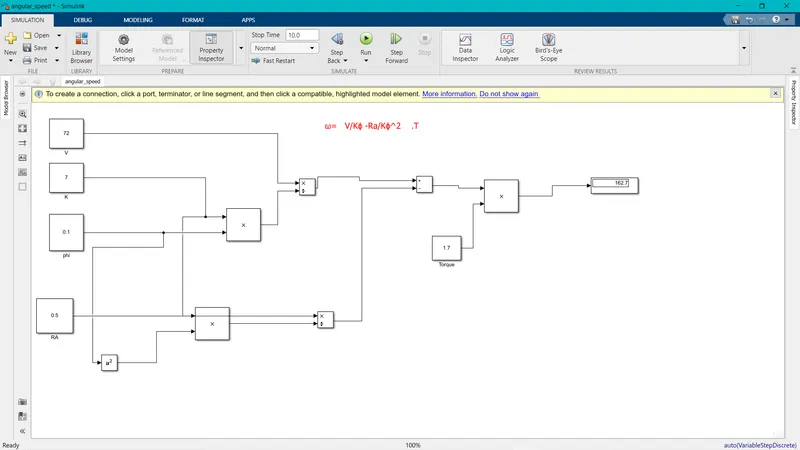
this is the mathematical model for the above equation.
4.
In the blog of induction and DC brushless motor, the author has mentioned about positivies and negatives side of both the induction and dc motor.
- In case of DC brushless motor permanent magnets are used which produces a rotating magnetic field this magnetic field will induce a current in the conductor.This current results in generation of force which results in rotation of rotor.
- In case of induction motor the current is supplied to the stator which results in the generation of emf when thi emf comes in contact with the rotar which is generally a squirrel cage type.Results in current induced in the rotor this also consists of bars around them in which current get induced and the rotor starts rotating.
- In DC brushless drive less rotor heat is generated and rotor cooling is easier and peak point efficiency is generally higher for this drive.
- In induction drive the best power factor is about 85%.
- As machine size increases magnetic losses also increases proportionally and part load efficiency drops.In case of induction motor as machine size grows there is no necessary growth of loss.
- The construction of DCbrushless motor is costly compared with an induction motor due to use of permanent magnets.
- Speed variation of induction motor depends upon the frequency input it is difficult to control.
- In DC brushless motor the strength of the magnetic field is adjustable and easy to control.