Project-1: Powertrain for aircraft in runways
Part A:
1. Search and list out the total weight of various types of aircrafts.
The aircraft gross weight (also known as the all-up weight and abbreviated AUW) is the total aircraft weight at any moment during the flight or ground operation.
An aircraft's gross weight will decrease during a flight due to fuel and oil consumption. An aircraft's gross weight may also vary during a flight due to payload dropping or in-flight refueling.
At the moment of releasing its brakes, the gross weight of an aircraft is equal to its takeoff weight. During the flight, an aircraft's gross weight is referred to as the en-route weight or in-flight weight.
An aircraft's gross weight is limited by several weight restrictions in order to avoid overloading its structure or to avoid unacceptable performance or handling qualities while in operation.
Aircraft gross weight limits are established during an aircraft's design and certification period and are laid down in the aircraft's type certificate and manufacturer specification documents.
The absolute maximum weight capabilities of a given aircraft are referred to as the structural weight limits.
An aircraft's structural weight capability is typically a function of when the aircraft was manufactured, and in some cases, old aircraft can have their structural weight capability increased by structural modifications.
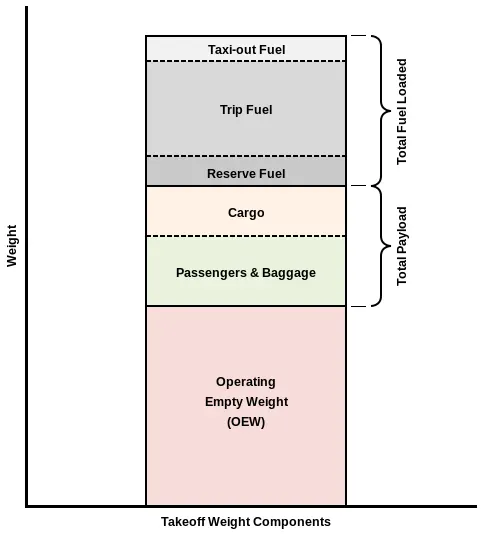
Maximum design taxi weight (MDTW) or Maximum design ramp weight (MDRW)
the maximum weight certificated for aircraft maneuvering (taxiing or towing) on the ground as limited by aircraft strength and airworthiness requirements.
Maximum design takeoff weight (MDTOW)
Is the maximum certificated design weight when the brakes are released for takeoff and is the greatest weight for which compliance with the relevant structural and engineering requirements has been demonstrated by the manufacturer.
Maximum design landing weight (MDLW)
The maximum certificated design weight at which the aircraft meets the appropriate landing certification requirements. It generally depends on the landing gear strength or the landing impact loads on certain parts of the wing structure.
The MDLW must not exceed the MDTOW.
The maximum landing weight is typically designed for 10 feet per second (600 feet per minute) sink rate at touch down with no structural damage.
Maximum design zero-fuel weight (MDZFW)
The maximum certificated design weight of the aircraft less all usable fuel and other specified usable agents (engine injection fluid, and other consumable propulsion agents). It is the maximum weight permitted before usable fuel and other specified usable fluids are loaded in specified sections of the airplane. The MDZFW is limited by strength and airworthiness requirements. At this weight, the subsequent addition of fuel will not result in the aircraft design strength being exceeded. The weight difference between the MDTOW and the MDZFW may be utilized only for the addition of fuel.
Minimum flight weight (MFW)
Minimum certificated weight for flight as limited by aircraft strength and airworthiness requirements.
MTOW = Maximum take-off weight, MLW = Maximum landing weight
2. Is there any difference between ground speed and airspeed?
Ground speed is the horizontal speed of an aircraft relative to the Earth’s surface. It is vital for accurate navigation to the destination that the pilot has an estimate of the ground speed that will be achieved during a flight.
An aircraft diving vertically would have a ground speed of zero. The information displayed to passengers through the entertainment system of airline aircraft usually gives the aircraft ground speed rather than airspeed.
Ground speed can be determined by the vector sum of the aircraft's true airspeed and the current wind speed and direction; a headwind subtracts from the ground speed, while a tailwind adds to it. Winds at other angles to the heading will have components of either headwind or tailwind as well as a crosswind component.
An airspeed indicator indicates the aircraft's speed relative to the air mass. The air mass may be moving over the ground due to wind, and therefore some additional means to provide position over the ground is required. This might be through navigation using landmarks, radio-aided position location, inertial navigation system, or GPS. When more advanced technology is unavailable, an E6B flight computer may be used to calculate ground speed.
Ground speed is quite different from airspeed. When an aircraft is airborne the ground speed does not determine when the aircraft will stall, and it doesn't influence the aircraft's performance such as rate of climb.
Airspeed
The important quantity in the generation of lift is the relative velocity between the object and the air, which is called the airspeed. Airspeed cannot be directly measured from a ground position but must be computed from the ground speed and the wind speed. Airspeed is the vector difference between the ground speed and the wind speed.
Airspeed = Ground Speed - Wind Speed
On a perfectly still day, the airspeed is equal to the ground speed. But if the wind is blowing in the same direction that the aircraft is moving, the airspeed will be less than the ground speed.
Reference:https://science.howstuffworks.com/transport/flight/modern/airspeed-vs-groundspeed.htm
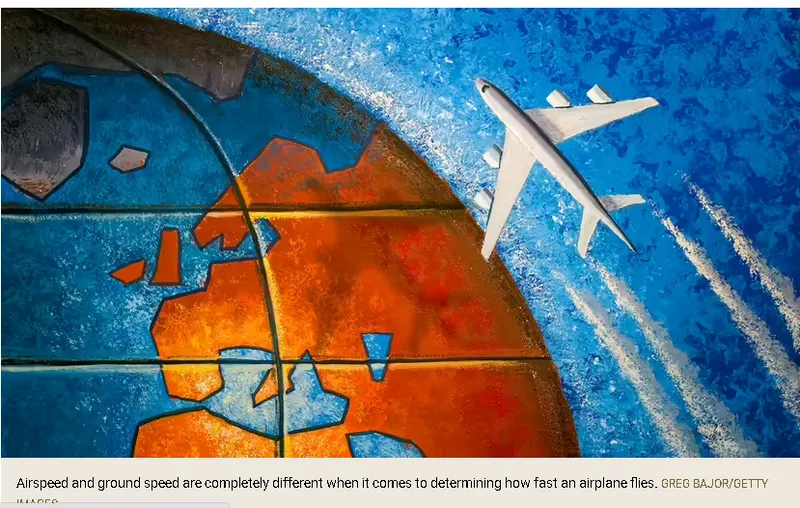
On a perfectly still day, the airspeed is equal to the ground speed. But if the wind is blowing in the same direction that the aircraft is moving, the airspeed will be less than the ground speed.
To prove the above statement, a virgin Atlantic Boeing 787 jet reached London from Los Angeles with a speed of 801 mph(1289kmph) where the fastest cruising speed is only 561 mph (902.8Kmph). This happened due to the high-speed wind moving 231 mph(371.7kmph) which was the fastest jet stream in the same direction as the plane.
3. Why is it not recommended to use aircraft engine power to move it on the ground at Airport?
Taxiing is the movement of an aircraft on the ground, under its own power, in contrast to towing or pushback where the aircraft is moved by a tug. The aircraft usually moves on wheels, but the term also includes aircraft with skis or floats (for water-based travel).
An airplane uses taxiways to taxi from one place on an airport to another;
When taxiing, aircraft travel slowly. This ensures that they can be stopped quickly and do not risk wheel damage on larger aircraft if they accidentally turn off the paved surface. Taxi speeds are typically 30 to 35 km/h.
Engine close to the ground may blow sand and debris forward and suck them into the engine causing damage to the engine.
So there are pushback tracks in the airport. Push back truck lifts the front wheel of the aircraft, their role in most airports is to move the aircraft away from the parking spot on the taxiways, which is called towing.
The risks which may arise from engine ground running relate to the potential for loss of control of the aircraft by those persons occupying the pilot seats in the flight deck. In most cases, such persons will be maintenance personnel holding specific company-issued approval for the required tasks.
The damage may happen during the ground run
-> Loss of control during high power engine running.
-> Risk of injury to the ground support personnel
-> As the visibility to the ground is less, the pilot view is limited.
-> Plane engines make a loud noise. when more than one plane adds up, it will not be pleasant for passengers and others near the airport.
4. How an aircraft is pushed to runway when its ready to take off?
In aviation, pushback is an airport procedure during which an aircraft is pushed backward away from its parking position, usually at an airport gate by an external power. Pushbacks are carried out by special, low-profile vehicles called pushback tractors or tugs.
Although many aircraft are capable of moving themselves backward on the ground using reverse thrust (a procedure referred to as a power back), the resulting jet blast or prop wash might cause damage to the terminal building or equipment.
Engines close to the ground may also blow sand and debris forward and then suck them into the engine, causing damage to the engine. A pushback is therefore the preferred method to move the aircraft away from the gate.
Pushbacks at busy aerodromes are usually subject to ground control clearance to facilitate ground movement on taxiways.
Once clearance is obtained,
->the pilot will communicate with the tractor driver (or a ground handler walking alongside the aircraft in some cases) to start the pushback.
->To communicate, a headset may be connected near the nose gear.
->Since the pilots cannot see what is behind the aircraft, steering is done by the pushback tractor driver and not by the pilots.
->Depending on the aircraft type and airline procedure, a bypass pin may be temporarily installed into the nose gear to disconnect it from the aircraft's normal steering mechanism.
->Once the pushback is completed, the towbar is disconnected, and any bypass pin removed.
->The ground handler will show the bypass pin to the pilots to make it clear that it has been removed.
-> The pushback is then complete, and the aircraft can taxi forward under its own power.
5. Learn about take-off power, tyre design, rolling resistance, tyre pressure, brake forces when landing.
Take-off power:
Takeoff is the phase of flight in which an aerospace vehicle leaves the ground and becomes airborne. For aircraft traveling vertically, this is known as liftoff.
For aircraft that take off horizontally, this usually involves starting with a transition from moving along the ground on a runaway.
Full power is used for takeoff for light aircraft.
Large transport category aircraft may use a reduced power for takeoff, where less than full power is applied in order to prolong engine life, reduced maintenance costs, and reduce noise emissions.
In some emergency cases, the power used can then be increased to increase the aircraft's performance.
Before takeoff, the engines, piston engines are routinely run up at high power to check for engine-related problems. The aircraft is permitted to accelerate to rotation speed (often referred to as Vr).
Tyre Design:
When it comes to safety, tires are one of the most important components of aircraft. They help to absorb the shock of landing and provide cushioning. It also provides the necessary traction for the braking and stopping of an aircraft.
An aircraft tire is designed to withstand extremely heavy loads while landing, take off, taxing, and parking. The number of wheels required for aircraft increases with the weight of the aircraft, as the weight of the airplane needs to be distributed more evenly.
example:A Boeing 737NG & 737MAX uses 6 wheels, Boeing 787 uses 10 wheels, Boeing 777 uses 14 wheels and Airbus A380 uses 22 wheels.
Carcass plies are used to form the tire. They are sometimes called casing plies. An aircraft tire is constructed for the purpose it serves.
- They support the weight of an aircraft while it is on the ground.
- It also provides the necessary traction for the braking and stopping of an airplane.
- Tyre also helps to absorb the shock of landing and provides cushioning for the roughness of takeoff, roll-out, and taxi operations.
Rolling Resistance:
The force that resists the motion of a body rolling on a surface is called the rolling resistance or the rolling friction.
The rolling and braking performance on the paved runway is well established inside the aeronautical industry
and published regulations and models are already available and constantly used during aircraft performance
certification.
Rolling resistance depends on
Tires diameter and width.
Tyres pressure.
Aircraft weight over tire axle.
Tyres loaded deflection.
tyre pressure:
Aircraft tires generally operate at high pressures, up to 200 psi (14 bar; 1,400 kPa) for airliners, and even higher for business jets. The main landing gear on the Concorde was typically inflated to 232 psi (16.0 bar), whilst its tail bumper gear tires were as high as 294 psi (20.3 bar).
The high pressure and weight load on the Concorde tires were a significant factor in the loss of Air France Flight 4590.
Aircraft tires are usually inflated with nitrogen to minimize expansion and contraction from extreme changes in ambient temperature and pressure experienced during flight. Dry nitrogen expands at the same rate as other dry atmospheric gases (normal air is about 80% nitrogen), but common compressed air sources may contain moisture, which increases the expansion rate with temperature.
In the first moments after a plane touches down, the tires are skidding, not rolling. The airplane essentially drags them down the runway until their rotational velocity matches the velocity of the plane. That's why they smoke upon landing, and why Michelin uses grooves instead of the block patterns seen on your car's rubber---blocks would simply break off. (Most tire wear comes from this moment of contact---where the rubber meets the runway.) The stoutest tires are rated for speeds of up to 288 mph.
brake forces
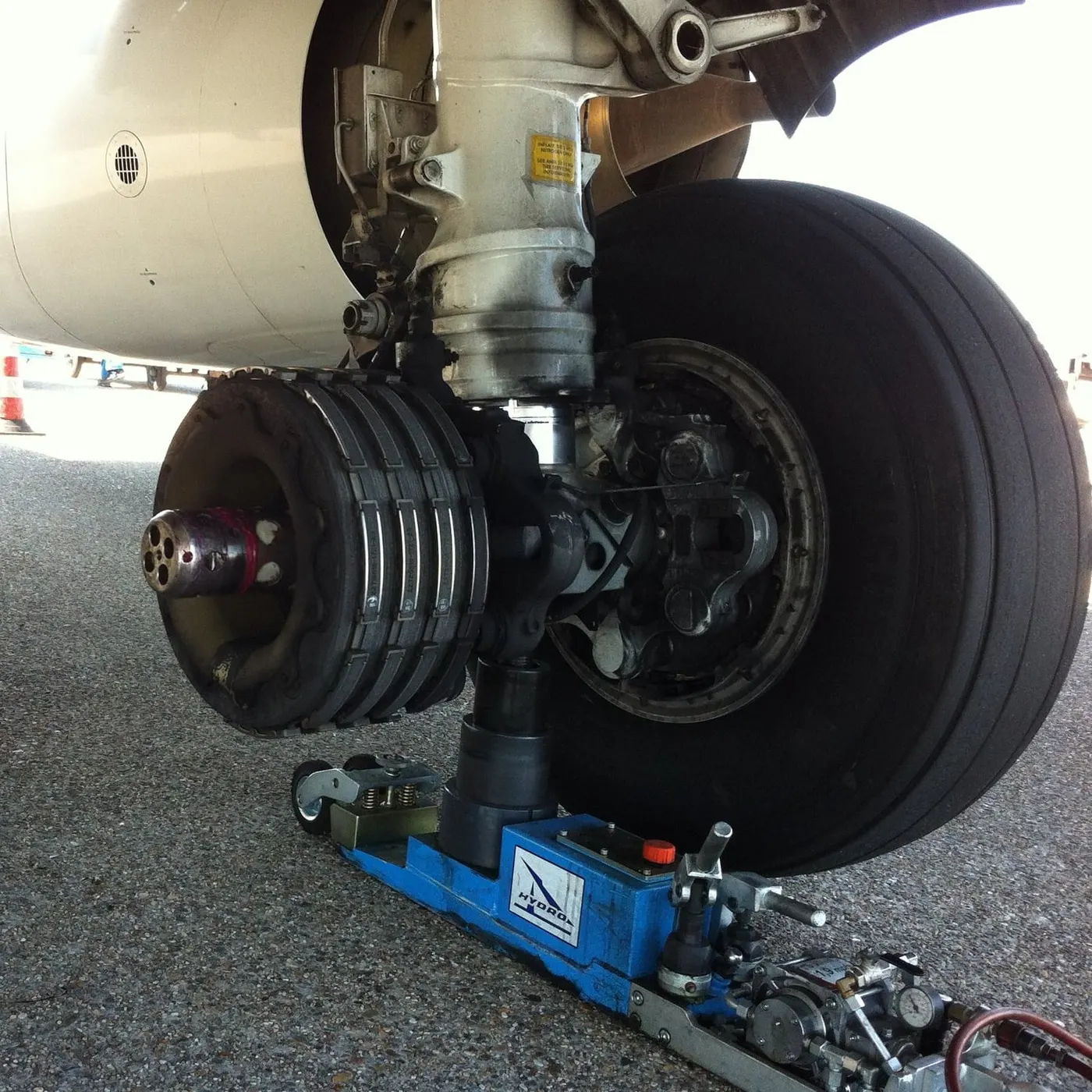
Aircraft brakes stop a moving aircraft by converting its kinetic energy to heat energy by means of friction between rotating and stationary discs located in brake assemblies in the wheels.
Brakes provide this critical stopping function during landings to enable airplanes to stop within the length of the runway.
They also stop aircraft during rejected takeoff events, in which an attempted takeoff is canceled as the airplane is rolling down the runway before it lifts off from the ground due to engine failure, tire blowout, another system failure, or direction from air traffic control.
Part B:
6. A. With necessary assumptions, calculate the force and power required to push/pull an aircraft by a towing vehicle.
To push/Pull an aircraft by a towing vehicle, forces acts are
- Rolling resistance force
- Aerodynamic force and
- Hill climbing force.
The force to move an airplane on an absolute flat runway with no wind at constant low speed is equal to the rolling resistance between the plane and the tarmac.
The rolling resistance for the airplane can be calculated as
Fr = c mr ag (1)
where
Fr = rolling resistance (N, lbf)
c = rolling resistance coefficient
mr = rolling mass (kg, lbm)
ag = acceleration of gravity (9.81 m/s2)
Let Towing vehicle mass = 50000kg
aircraft mass or payload on towing vehicle = 183700kg
Total mass of the vehicle = (50000+183700) = 233700kg
Towing vehicle frontal area = 20m^2
Speed of the vehicle v = 30 Km/hr = 8.333m/s
Rolling resistance force (Frr) = Urr * m*g
= 0.013 *(50000 + 183700) * 9.8 = 29,773.38N
Aerodynamic drag force (Fad) = `(1/2)*rho*V^2*A*(C_d_t + C_d_a)`
= (1/2) *1.225 *(2.778)^2*20*(0.5+0.045)
= 51.514N
Hill climbing force(Fhc) = m*g*sin`phi`
(233700 *9.81*0)=0
So total power required = 29773.38 + 51.514 + 0 = 29824894N
B. Develop the model for the calculated force and power using Simulink.
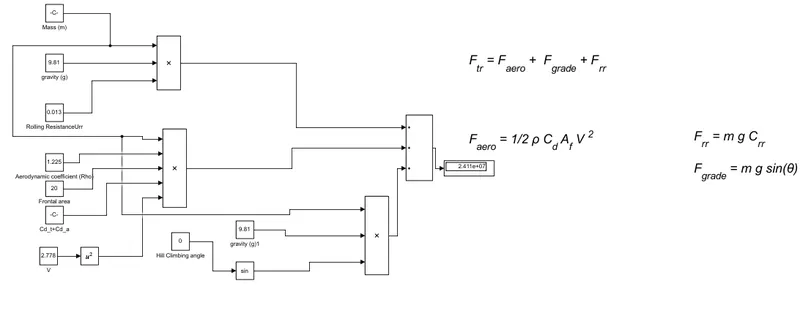
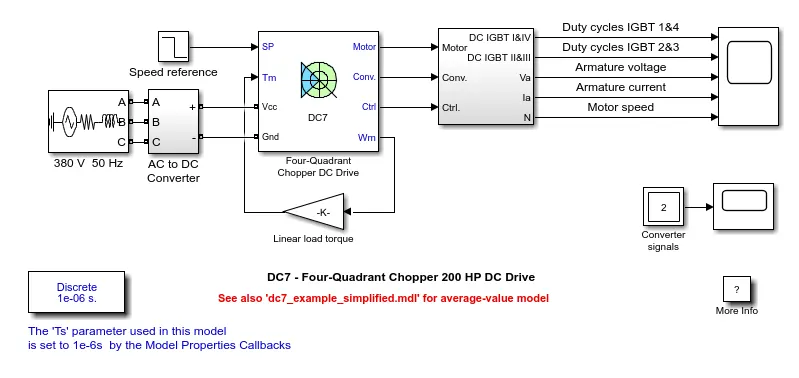
7. A. Design an electric powertrain with type of motor, it’s power rating, and energy requirement to fulfill aircraft towing application in Simulink. Estimate the duty cycle range to control the aircraft speed from zero to highest. Make all required assumptions. Prepare a table of assumed parameters. Draw a block diagram of powertrain.
(Hint :DC7 Block)
B. Also, Design the parameters in excel sheet.
Assumptions made for powertrain design are as follows:
Let Towing vehicle mass = 50000kg
aircraft mass or payload on towing vehicle = 183700kg
Total mass of the vehicle = (50000+183700) = 233700kg
Towing vehicle frontal area = 20m^2
Speed of the vehicle v = 30 Km/hr = 8.333m/s
Drag coefficient = 0.045
Frontal area = 20 m62
Inclination angle = 0 deg
Towing velocity V = 10Km/hr or 2.778m/s
Towing time = 2 min
Radius of towing vehicle wheel = 0.38 m
| Aircraft | |
| Rolling Resistance Calculation | |
| Vehicle Kerb Weight(Kg) | 183700.0000 |
| Pay load | 50000.0000 |
| Coefficient of Rolling Resistance | 0.0130 |
| Coefficient of Rolling Resistance | 0.0130 |
| Rolling Resistance Force Frr (N) | 29803.7610 |
| Aero Dynamic Drag Calculation | |
| Air Density(Kg/m3) | 1.2500 |
| Frontal Area (m2) | 20.0000 |
| Drag Coefficient | 0.0450 |
| Speed(Kmph) | 10.0000 |
| Air Drag Force(N) | 4.3403 |
| Force(N)=Air Drag Force + Rollong Force | 29808.1013 |
| Total Power at given speed(KW) = (F*V) KW | 82.8003 |
| Torque calculation | |
| Wheel radius | 0.3800 |
| Torque (N-m) = Force * wheel Radius | 11327.0785 |
| Energy required | |
| time (min) | 2.0000 |
| time in hours | 0.0333 |
| Energy in Kwh= power*time | 2.7600 |
As per the calculations made in excel sheet, motor power is more than 82 KW.
So motor requirement is 90 KW considering the 90% efficiency.
Induction motor chosen is 90Kw, 120Hp, 3 phase 415v Induction motor
Input power of induction motor is 95.64KW
efficiency = output power / Input power = 94.1%
vout *Iout = eff*Vin*Iin
Vout*216 = 0.94*415*216
vout = 390v
Vout = Vin/(1-D)
1-D = vin/vout = 0.94
d=0.06
D=0.06