Project-1: Powertrain for aircraft in runways
Question 1: Search and list out the total weight of various types of aircrafts?
Solution 1:
Basic Empty Weight (BEW) is the weight of the aircraft "as built" and includes the weight of the structure, power plant, furnishings, installations, systems and other equipment that are considered an integral part of an aircraft before additional operator items are added for operation.
Dry Operating Weight (DOW) =BEW + Weight of Crew (Pilot + Cabin including their bags) + Pantry
Operating Weight (OW) =DOW + Takeoff fuel (i.e. Ramp Fuel - Taxi fuel)
Maximum Zero Fuel Weight (MZFW) =DOW + Payload (anything put on the aircraft that generates revenue to the company, e.g. passenger, baggage, cargo, mail and fret)
Maximum Taxi Weight (MTW) =MZFW + Ramp fuel
Maximum Takeoff Weight (MTOW) =MZFW + Takeoff fuel, or MTW - Taxi fuel
Maximum Landing Weight (MLW) =MTOW - Trip Fuel
|
Type |
MTOW [kg] |
MLW [tonnes] |
TOR [m] |
LR [m] |
||
|
640,000 |
591.7 |
3500 |
Heavy |
Super |
||
|
589,670 |
3660 |
Heavy |
Super |
|||
|
575,000 |
394 |
3100 |
1930 |
Super |
Super |
|
|
447,700 |
346.091 |
3100 |
1800 |
Heavy |
Heavy |
|
|
443,613 |
306.175 |
3100 |
Heavy |
Heavy |
||
|
412,770 |
295.742 |
3090 |
Heavy |
Heavy |
||
|
Antonov An-124-100M |
405,060 |
330 |
2520 |
900 |
Heavy |
Heavy |
|
396,900 |
295.742 |
3018 |
2179 |
Heavy |
Heavy |
|
|
381,000 |
288.417 |
2530 |
1494 |
Heavy |
Heavy |
|
|
377,840 |
285.700 |
3338 |
2109 |
Heavy |
Heavy |
|
|
377,840 |
260.320 |
3222 |
1905 |
Heavy |
Heavy |
|
|
371,950 |
240 |
3050 |
2010 |
Heavy |
Heavy |
|
|
367,400 |
256 |
3100 |
2100 |
Heavy |
Heavy |
|
|
347,800 |
260.816 |
2830 |
Heavy |
Heavy |
||
|
352,000 |
251.5 |
3100 |
Heavy |
Heavy |
||
|
351,800 |
251.29 |
3100 |
Heavy |
Heavy |
||
|
347,450 |
223.168 |
3000 |
Heavy |
Heavy |
||
|
340,200 |
265.300 |
Heavy |
Heavy |
|||
|
308,000 |
233.5 |
Heavy |
Heavy |
|||
|
299,370 |
237.683 |
3380 |
Heavy |
Heavy |
||
|
297,550 |
213.00 |
3380 |
1550 |
Heavy |
Heavy |
|
|
276,700 |
190 |
3000 |
1926 |
Heavy |
Heavy |
|
|
273,300 |
185 |
2990 |
1890 |
Heavy |
Heavy |
|
|
270,000 |
175 |
2670 |
1860 |
Heavy |
Heavy |
|
|
270,000 |
195.04 |
3115 |
2118 |
Heavy |
Heavy |
|
|
256,280 |
183 |
2990 |
1890 |
Heavy |
Heavy |
|
|
254,000 |
192.777 |
2900 |
Heavy |
Heavy |
||
|
254,000 |
201.849 |
Heavy |
Heavy |
|||
|
253,500 |
181 |
2990 |
Heavy |
Heavy |
||
|
250,000 |
175 |
2600 |
1980 |
Heavy |
Heavy |
|
|
242,000 |
185 |
2500 |
1750 |
Heavy |
Heavy |
|
|
242,000 |
180 |
2220 |
1750 |
Heavy |
Heavy |
|
|
231,300 |
166.92 |
2636 |
Heavy |
Heavy |
||
|
228,000 |
172.365 |
3300 |
1695 |
Heavy |
Heavy |
|
|
211,400 |
Heavy |
Heavy |
||||
|
208,000 |
175 |
Heavy |
Heavy |
|||
|
204,000 |
158.758 |
3414 |
Heavy |
Heavy |
||
|
192,000 |
140 |
2385 |
1555 |
Heavy |
Heavy |
|
|
187,000 |
136.08 |
2713 |
1676 |
Heavy |
Heavy |
|
|
185,000 |
111.1 |
3440 |
2220 |
Heavy |
Heavy |
|
|
163,000 |
138 |
2324 |
1536 |
Heavy |
Heavy |
|
|
159,000 |
136.078 |
2713 |
1676 |
Heavy |
Heavy |
|
|
157,000 |
124 |
2290 |
1490 |
Heavy |
Heavy |
|
|
152,000 |
151.9 |
Heavy |
Heavy |
|||
|
151,000 |
97.5 |
Heavy |
Heavy |
|||
|
151,000 |
112.1 |
Heavy |
Heavy |
|||
|
147,000 |
Heavy |
Heavy |
||||
|
142,000 |
123 |
1860 |
1480 |
Heavy |
Heavy |
|
|
141,000 |
122 |
980 |
770 |
Heavy |
Heavy |
|
|
140,000 |
Heavy |
Heavy |
||||
|
125,000 |
Medium |
Large |
||||
|
124,000 |
101.6 |
2550 |
1750 |
Medium |
Large |
|
|
117,000 |
86.3 |
Medium |
Large |
|||
|
116,000 |
89.9 |
2347 |
1555 |
Medium |
Large |
|
|
106,000 |
79.5 |
Medium |
Large |
|||
|
104,000 |
79.5 |
Medium |
Large |
|||
|
104,000 |
80 |
Medium |
Large |
|||
|
104,000 |
87.5 |
2250 |
Medium |
Large |
||
|
87,500 |
Medium |
Large |
||||
|
85,000 |
66.36 |
2500 |
1704 |
Medium |
Large |
|
|
85,000 |
71.35 |
2804 |
1829 |
Medium |
Large |
|
|
84,000 |
70.1 |
Medium |
Large |
|||
|
Airbus A321-100[18] |
83,000 |
77.8 |
2200 |
1540 |
Medium |
Large |
|
79,000 |
65.32 |
2308 |
1634 |
Medium |
Large |
|
|
78,000 |
68.1 |
Medium |
Large |
|||
|
73,000 |
63.28 |
Medium |
Large |
|||
|
72,500 |
62.4 |
Medium |
Large |
|||
|
72,500 |
62.4 |
Medium |
Large |
|||
|
71,000 |
64.41 |
2165 |
1520 |
Medium |
Large |
|
|
70,700 |
Medium |
Large |
||||
|
70,000 |
58.06 |
1921 |
1415 |
Medium |
Large |
|
|
Airbus A320-100[18] |
68,000 |
66 |
1955 |
1490 |
Medium |
Large |
|
68,000 |
54.9 |
2540 |
1540 |
Medium |
Large |
|
|
68,000 |
Medium |
Large |
||||
|
67,000 |
Medium |
Large |
||||
|
66,000 |
54.66 |
1796 |
1340 |
Medium |
Large |
|
|
65,000 |
57.61 |
1890 |
1494 |
Medium |
Large |
|
|
65,000 |
Medium |
Large |
||||
|
64,000 |
62.5 |
1850 |
1470 |
Medium |
Large |
|
|
63,000 |
51.7 |
1939 |
1396 |
Medium |
Large |
|
|
60,000 |
49.9 |
1832 |
1360 |
Medium |
Large |
|
|
59,000 |
50.80 |
1463 |
1356 |
Medium |
Large |
|
|
59,000 |
57.5 |
1375 |
1340 |
Medium |
Large |
|
|
55,000 |
47.174 |
1950 |
Medium |
Large |
||
|
55,000 |
Medium |
Large |
||||
|
54,000 |
Medium |
Large |
||||
|
50,000 |
46.265 |
1950 |
Medium |
Large |
||
|
50,000 |
Medium |
Large |
||||
|
48,600 |
Medium |
Large |
||||
|
48,500 |
Medium |
Large |
||||
|
48,000 |
43 |
2056 |
1323 |
Medium |
Large |
|
|
46,000 |
Medium |
Large |
||||
|
46,000 |
39.95 |
1621 |
1350 |
Medium |
Large |
|
|
44,000 |
Medium |
Large |
||||
|
42,000 |
36.74 |
Medium |
Large |
|||
|
39,000 |
Medium |
Large |
||||
|
37,500 |
32.8 |
2244 |
1304 |
Medium |
Large |
|
|
36,500 |
33.345 |
1778 |
1596 |
Medium |
Large |
|
|
36,000 |
32.8 |
1644 |
1274 |
Medium |
Large |
|
|
33,000 |
30.39 |
1564 |
1478 |
Medium |
Large |
|
|
33,000 |
Medium |
Large |
||||
|
30,400 |
Medium |
Large |
||||
|
28,000 |
28.01 |
1219 |
1295 |
Medium |
Large |
|
|
23,000 |
21.319 |
1918 |
1479 |
Medium |
Large |
|
|
22,800 |
22.35 |
1333 |
914 |
Medium |
Large |
|
|
22,800 |
21.5 |
1300 |
Medium |
Large |
||
|
22,000 |
19.3 |
2270 |
1380 |
Medium |
Large |
|
|
18,600 |
18.3 |
1165 |
1126 |
Medium |
Small |
|
|
13,150 |
12.930 |
1300 |
1030 |
Medium |
Small |
|
|
11,500 |
11.25 |
1560 |
1380 |
Medium |
Small |
|
|
10,890 |
10.570 |
1493 |
826 |
Medium |
Small |
|
|
9,752 |
8.709 |
1353 |
811 |
Medium |
Small |
|
|
8,300 |
7.665 |
893 |
724 |
Medium |
Small |
|
|
8,150 |
7.65 |
956 |
677 |
Medium |
Small |
|
|
7,765 |
7.605 |
1036 |
853 |
Medium |
Small |
|
|
7,761 |
7.103 |
1039 |
896 |
Medium |
Small |
|
|
7,000 |
Medium |
Small |
||||
|
4,800 |
4.43 |
975 |
741 |
Light |
Small |
Question 2: Is there any difference between ground speed and air speed?
Solution 2: Ground speed is the horizontal speed of an aircraft relative to the Earth’s surface.It is vital for accurate navigation to the destination that the pilot has an estimate of the ground speed that will be achieved during a flight.
An aircraft diving vertically would have a ground speed of zero. Information displayed to passengers through the entertainment system of airline aircraft usually gives the aircraft ground speed rather than airspeed.
Ground speed can be determined by the vector sum of the aircraft's true airspeed and the current wind speed and direction; a headwind subtracts from the ground speed, while a tailwind adds to it. Winds at other angles to the heading will have components of either headwind or tailwind as well as a crosswind component.
An airspeed indicator indicates the aircraft's speed relative to the air mass. The air mass may be moving over the ground due to wind, and therefore some additional means to provide position over the ground is required. This might be through navigation using landmarks, radio aided position location, inertial navigation system, or GPS. When more advanced technology is unavailable, an E6B flight computer may be used to calculate ground speed. Ground speed radar can measure it directly.
Ground speed is quite different from airspeed. When an aircraft is airborne the ground speed does not determine when the aircraft will stall, and it doesn't influence the aircraft performance such as rate of climb.
Airspeed is the speed of an aircraft relative to the air. Among the common conventions for qualifying airspeed are indicated airspeed ("IAS"), calibrated airspeed ("CAS"), equivalent airspeed ("EAS"), and true airspeed ("TAS").
Indicated airspeed is simply what is read on an airspeed gauge connected to a pilot–static system; calibrated airspeed is indicated airspeed adjusted for pilot system position and installation error; and equivalent airspeed is calibrated airspeed adjusted for compressibility effects. True airspeed is equivalent airspeed adjusted for air density, and is also the speed of the aircraft through the air in which it is flying. Calibrated airspeed is typically within a few knots of indicated airspeed, while equivalent airspeed decreases slightly from CAS as aircraft altitude increases or at high speeds.
With EAS constant, true airspeed increases as aircraft altitude increases. This is because air density decreases with higher altitude.
The measurement and indication of airspeed is ordinarily accomplished on board an aircraft by an airspeed indicator ("ASI") connected to a pilot-static system. The pilot-static system comprises one or more pilots probes (or tubes) facing the on-coming air flow to measure pilot pressure (also called stagnation, total or ram pressure) and one or more static ports to measure the static pressure in the air flow. These two pressures are compared by the ASI to give an IAS reading.
Question 3: Why is it not recommended to use aircraft engine power to move it on the ground at Airport?
Solution 3: We are assuming passenger commuter aircraft and large airliners. Aircraft move using their own engine power all the time on the airport apron and taxiways under their own power to go towards runways and after landing taxi to their assigned gate.
The only time they use external assistance is to push back from the gate. Large turbofan aircraft need help to reverse via a pushback tractor. The engines are turned on after the pushback is complete and the aircraft can move forward under its own power.
To be accurate, some aircraft can reverse using a variable pitch prop or thrust reversing on turbofans but generally reversing is done via pushback tractors. Blasting jet reversers blows debris in the crowded gate area creating foreign object damage hazard for adjacent aircraft, gate equipment or terminal waiting area glass windows. Taxiing (rarely spelled taxying) is the movement of an aircraft on the ground, under its own power, in contrast to towing or pushback where the aircraft is moved by a tug. The aircraft usually moves on wheels, but the term also includes aircraft with skis or floats (for water-based travel).
An airplane uses taxiways to taxi from one place on an airport to another; for example, when moving from a hangar to the runway. The term "taxiing" is not used for the accelerating run along a runway prior to takeoff, or the decelerating run immediately after landing, which are called the takeoff roll and landing rollout, respectively.
Question 4: How an aircraft is pushed to runway when it’s ready to take off?
Solution 4: Airplanes fly when the movement of air across their wings creates an upward force on the wings (and thus the rest of the plane) that is greater than the force of gravity pulling the plane toward the earth. The physics behind this phenomenon was first described by Daniel Bernoulli, an 18th century Swiss mathematician and scientist who studied the movement of fluids. Bernoulli discovered that the pressure exerted by a moving fluid is inversely proportional to the speed of the fluid. In other words, fluid pressure decreases as fluid speed increases, and vice versa.
This first phase of flight, after all doors have been secured, involves the movement of the aircraft away from the terminal jet way and along taxiways to a runway. A motorized vehicle called a tug sometimes is used to push the aircraft back from its gate. At some airports, certain aircraft are permitted to power back. This means that following engine start at the gate, the thrust reversers are used to literally back the aircraft away from the gate. The aircraft then moves under its own power along the taxiways. Since aircraft are designed primarily for flight, and are not ground vehicles, they are taxied at very low speeds. Push-back occurs only when the pilot has clearance to do so from Air Traffic Control, which monitors all aircraft movements during taxi.
Takeoff and Climb
When ready for takeoff, and cleared by Air Traffic Control to proceed, the pilot or first officer of an aircraft releases the brakes and advances the throttle to increase engine power to accelerate down the runway. Once aligned on the runway, steering the aircraft is normally accomplished by using foot pedals that manipulate the nose wheel until the speed is sufficient enough that wind rushing by the rudder on the aircraft tail makes nose wheel steering unnecessary.
As the aircraft gains speed, air passes faster and faster over its wings and lift is created. Instruments onboard the aircraft display this airspeed, which equals not only the speed of the plane relative to the ground, but also the speed of any wind that may be blowing toward the aircraft (aircraft normally take off headed into the wind). When the airspeed reaches a certain predetermined point known as rotation speed, the pilot manipulates panels on the tail of the aircraft to rotate the nose of the plane upward. This creates even stronger lift and the plane leaves the ground.
Rotation speed, abbreviated VR, is one of three important airspeed settings calculated before every flight. The others are V1 - the speed beyond which a safe stop on a runway is no longer possible; and V2 - the minimum speed needed to keep a plane flying should an engine fail after the aircraft surpasses V1. Some of the factors affecting VR and V2 are the weight of the aircraft, the air temperature and the altitude of the airport. The heavier the aircraft, the more lift, and thus speed is needed to get it off the ground. Aircraft also need to go faster to fly on a hot day than on a cool day. Hot air is less dense than cool air and less density produces less lift for the same speed. Similarly the higher the altitude, the less dense the air. Aircraft need more speed to leave the ground at a place like Denver than at a place like New York, with all other factors such as weight being equal. Some of these factors also are important in calculating V1, although the key factor is the length of the runway that is being used.
Most large jets leave the ground at about 160 miles per hour and initially climb at an angle in excess of 15 degrees. The angle of a plane's wings to the air flowing around them is extremely important to maintaining lift. If the so-called angle of attack is too severe, the flow of air around the wings becomes disrupted and the plane loses lift.
To make an aircraft more aerodynamically efficient, the wheels on which an aircraft rolls when it is on the ground are retracted into a cavity in the belly of the plane after it is airborne. There is less drag (wind resistance), and an aircraft can fly faster when its landing gear is retracted.
Question 5: Learn about take off power, tyre design, rolling resistance, tyre pressure, brake forces when landing.
Solution 5:
Take off power: A power take-off or power takeoff (PTO) is any of several methods for taking power from a power source, such as a running engine, and transmitting it to an application such as an attached implement or separate machine.
Most commonly, it is a splined drive shaft installed on a tractor or truck allowing implements with mating fittings to be powered directly by the engine.
Semi-permanently mounted power take-offs can also be found on industrial and marine engines. These applications typically use a drive shaft and bolted joint to transmit power to a secondary implement or accessory. In the case of a marine application, such shafts may be used to power fire pumps.
Tyre design: Carcass plies are used to form the tire. They are sometimes called casing plies. An aircraft tyre is constructed for the purpose it serves.
- They support the weight of an aircraft while it is on the ground.
- It also provides the necessary traction for braking and stopping of an aeroplane.
- Tyre also helps to absorb the shock of landing and provide cushioning the roughness of takeoff, roll-out, and taxi operations.
Unlike an automobile or truck tyre, it does not have to carry a load for a long period of continuous operation. However, an aircraft tyre absorbs the high impact loads of landing, and also it’s operating at high speeds for a short time when required.
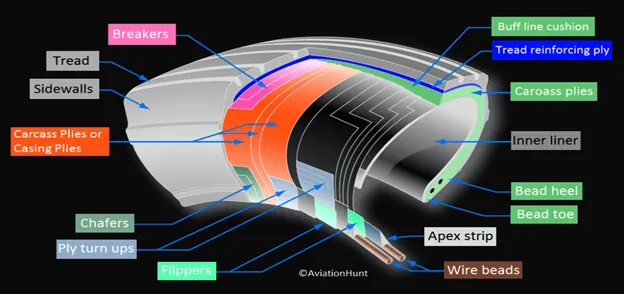
Aircraft tyres must have an approved speed and load rating and have sufficient clearance when retracted through landing gear to allow for tyre growth. Tyre growth is the increase in the size of the tyre due to centrifugal forces at high speed.
Aircraft tyres may be Tube-type or Tubeless
Tubeless tyres are more advantageous over tube-type. There is no longer the use of tube-type tyre in recent aviation. Nowadays all airliners are using tubeless tyres. Tubeless that are meant to be used without a tube has the word TUBELESS on the sidewall of the tyre.
Aircraft tyres may be Radial or Bias
Almost all airliners are using Radial tyre. Bias is an older design, and it’s mainly used for road vehicles. Radial tyres have the word RADIAL on the sidewall. Radial tires are more expensive than bias-ply tyres. Radial tires are in demand because of their lower life cycle cost and long term value.
Rolling resistance: It is sometimes called rolling friction or rolling drag, is the force resisting the motion when a body (such as a ball, tire, or wheel) rolls on a surface. ... Another cause of rolling resistance lies in the slippage between the wheel and the surface, which dissipates energy. The force that resists the motion of a body rolling on a surface is called the rolling resistance or the rolling friction. Rolling resistance of tires can be measured by the drum test, which, as the name suggests, is performed by holding the test tire up against a drum and applying a load to the tire.
Four common methods are used to measure rolling resistance;
•Force on tire axle
• Torque applied on drum shaft
• Motor power
• Coast down (down rolling)
The drum measurements are the most common and has to be adjusted to get similar values as a flatbed measurement.
F = f x W/R
F = the force required to overcome the rolling friction
f = the coefficient of rolling friction (units must match same units as R (radius))
W = Load on the wheel
R = Radius of the wheel
Tyre Pressure: A tire-pressure gauge, or tyre-pressure gauge, is a pressure gauge used to measure the pressure of tires on a vehicle.
Since tires are rated for specific loads at certain pressure, it is important to keep the pressure of the tire at the optimal amount. Tires are rated for their optimal pressure when cold, meaning before the tire has been driven on for the day and allowed to heat up, which ultimately changes the internal pressure of the tire due to the expansion of gases. The precision of a typical mechanical gauge as shown is ±3 psi (21 kPa). Higher precision gauges with ±1 psi (6.9 kPa) uncertainty can also be obtained. Aircraft tires generally operate at high pressures, up to 200 psi (14 bar; 1,400 kPa) for airliners, and even higher for business jets. The main landing gear on the Concorde was typically inflated to 232 psi (16.0 bar), whilst its tail bumper gear tires were as high as 294 psi (20.3 bar).
Break force: Brakes provide this critical stopping function during landings to enable airplanes to stop within the length of the runway. They also stop aircraft during rejected takeoff events, in which an attempted takeoff is canceled as the airplane is rolling down the runway before it lifts off from the ground due to engine failure, tire blowout, other system failure or direction from air traffic control.
Aircraft brakes also prevent motion of the aircraft when it is parked, limit its speed during taxiing and can even help steer the aircraft on the ground by applying different levels of braking force to the left- and right-side brakes.
Aircraft brakes work in conjunction with other brake mechanisms such as thrust reversers, air brakes and spoilers. Thrust reversers are surfaces that are deployed into the path of the jet blast from the engines to redirect propulsive thrust in a direction that opposes the motion of the aircraft. Air brakes and spoilers are flight control surfaces that create additional aerodynamic drag when deployed into the path of air flowing around the aircraft.
How aircraft breaks work
The most common type of brake used on aircraft is the disc brake. Disc brakes function by exploiting friction between rotating and stationary discs inside the brake.
Upon receiving a command signal to brake — from the pilot depressing a foot pedal or from the autobrake system — actuators in the brake move a piston to squeeze the discs together, generating a frictional force that slows the rotation of the wheel. The friction between the discs generates heat as the aircraft’s kinetic energy is converted to heat energy. In this function, the brakes act as a heat sink, absorbing tremendous amounts of heat as the aircraft sheds kinetic energy. During RTO stops, the temperature of carbon disc brakes can exceed 1,800° C.
Part B:
Question 6A. With necessary assumptions, calculate the force and power required to push / pull an aircraft by a towing vehicle.
Solution 6A.
|
Aircraft Parameters |
|
|
Rolling resistance calculation |
|
|
Kerb Weight (Kg) |
575000 |
|
Payload (Kg) |
394000 |
|
Coefficient of Rolling Resistance; cr |
0.02 |
|
Gravitational Force (m/s^2) ;g |
9.8 |
|
Towing Vehicle speed; Km/h |
25 |
|
Rolling resistance Force (N) ; Frr |
189924 |
`F_rr=m*g*c_r`
`F_rr=969000*9.8*0.02`
`F_rr=189924 N`
Power can be calculated using formula =
`v=25*5/18=6.9 m/s`
`P_rr= F_rr*v`
`P_rr= F_rr*v`
`P_rr= 189924*6.9`
`P_rr=`1310.48 kW
This force can be delivered by a pulling truck or - as occasionally seen - by a number of pulling people. Enough weight for the pullers is required to create friction forces against the tarmac that equals the plane rolling resistance.
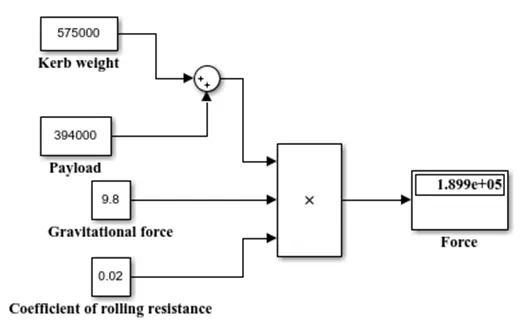
- B. Develop the model for the calculated force and power using Simulink.
Soln :
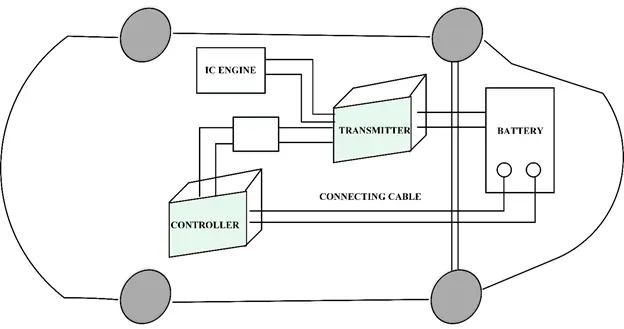
Question 7: A. Design an electric powertrain with type of motor, it’s power rating, and energy requirement to fulfill aircraft towing application in Simulink. Estimate the duty cycle range to control the aircraft speed from zero to highest. Make all required assumptions. Prepare a table of assumed parameters. Draw a block diagram of powertrain.
Solution 7.A
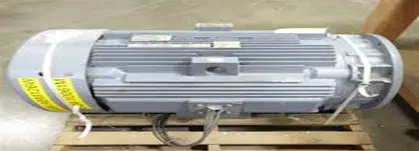
Assumption: Three phase 200hp motor
Frequency = 50Hz
Voltage = 440V
Current = 270A
Efficiency = 94.5%
Power kW = 150kW
Duty Cycle = Power output/ power input
= 141.7/150
= 94.5%
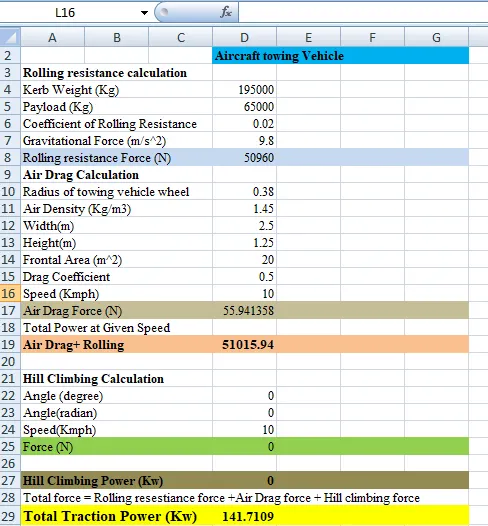
|
Kerb Weight (Kg) |
195000 |
|
Payload (Kg) |
65000 |
|
Coefficient of Rolling Resistance |
0.02 |
|
Gravitational Force (m/s^2) |
9.8 |
|
Rolling resistance Force (N) |
50960 |
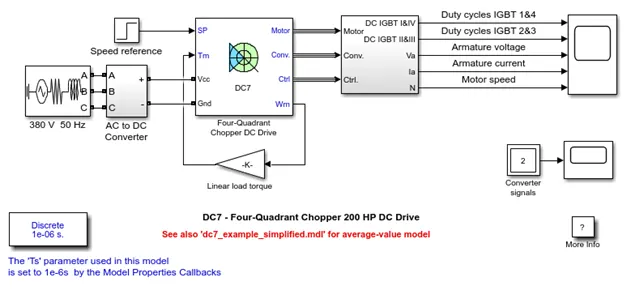
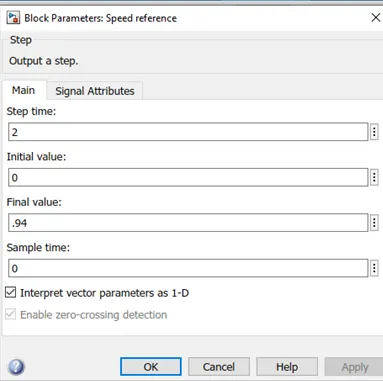
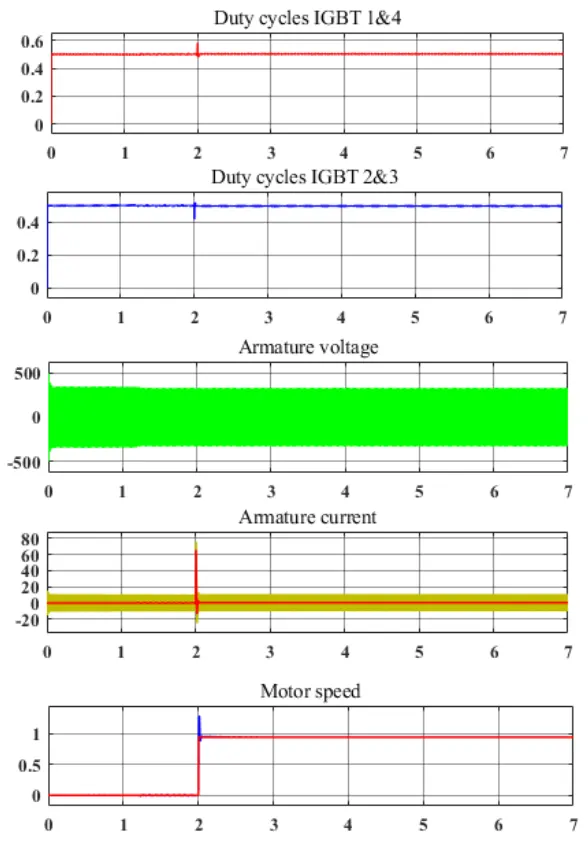
Duty cycle changed to lowest (0) to highest (0.94 or 94%)
Question 7.b Design the parameters in excel sheet.
Solution 7.b