Project-1: Powertrain for aircraft in runways
PROJECT: POWERTRAIN FOR AIRCRAFT IN RUNWAYS
We all have seen aircraft in runways but did you observe how an airplane moves from one place to another when its in ground. Powertrain or movement of aircrafts completely changes when its in ground. We will look into this area of aviation industry which involves movement of aircraft in ground. We will understand about this area from its weight to the powertrain design.
WEIGHT OF AIRCRAFT
Manufacturer's empty weight (MEW) [Also called Manufacturer's Weight Empty (MWE) or Licensed Empty Weight]
It is the weight of the aircraft "as built" and includes the weight of the structure, power plant, furnishings, installations, systems and other equipment that are considered an integral part of an aircraft. This excludes any baggage, passengers, or usable fuel2.
Zero-fuel weight (ZFW)
This is the total weight of the airplane and all its contents (including unusable fuel), but excluding the total weight of the usable fuel on board. As a flight progresses and fuel is consumed, the total weight of the airplane reduces, but the ZFW remains constant.
Maximum zero fuel weight (MZFW) is the maximum weight allowed before usable fuel and other specified usable agents (engine injection fluid, and other consumable propulsion agents) are loaded.
Operating empty weight (OEW) (Roughly equivalent to basic empty weight on light aircraft)
It is the basic weight of an aircraft including the crew, all fluids necessary for operation such as engine oil, engine coolant, water, unusable fuel and all operator items and equipment required for flight but excluding usable fuel and the payload.
Payload
It is the carrying capacity of an aircraft. It includes cargo, people, extra fuel. In the case of a commercial airliner, it may refer only to revenue-generating cargo or paying passengers.
Maximum take-off weight (MTOW)
This is the maximum weight at which the pilot of the aircraft is allowed to attempt to take off3.
Regulated take-off weight (RTOW)
Depending on different factors (e.g. flap setting, altitude, air temperature, length of runway), RTOW or maximum permissible take-off weight varies for each take-off. It can never be higher than MTOW. More information is on this answer.
Maximum landing weight (MLW)
This maximum weight at which an aircraft is permitted to land.
Maximum ramp weight (MRW) [also called maximum taxi weight (MTW)]
It is the maximum weight authorized for manoeuvring (taxiing or towing) an aircraft on the ground.
Aircraft gross weight
It is the total aircraft weight at any moment during the flight or ground operation. This decreases during flight due to fuel and oil consumption.
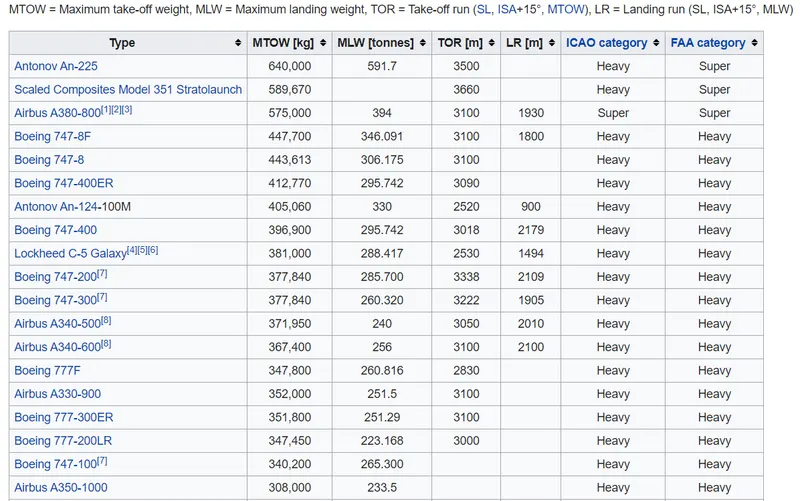
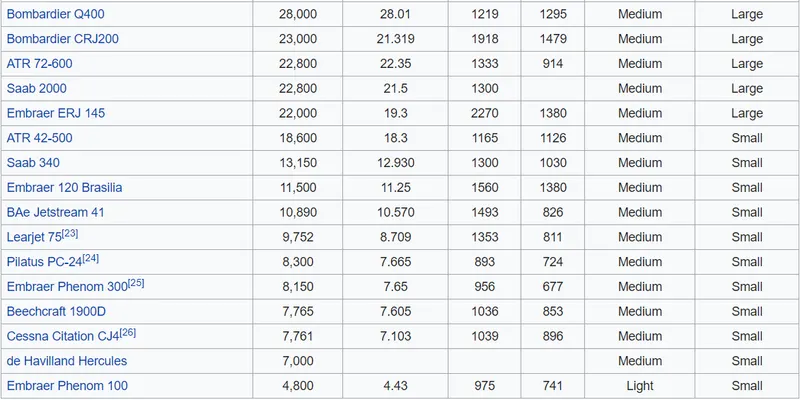
Some of the aircrafts name with there weight:
DIFFRENCE BETWEEN GROUND SPEED AND AIR SPEED OF AIRCRAFT
While ground speed is the airplane’s speed relative to the surface of the Earth, airspeed – at least true airspeed – is its speed relative to the air it is flying in. True airspeed is simply the speed at which an aircraft is moving relative to the air it is flying in. As such, it’s also the speed at which the air is flowing around the aircraft’s wings.
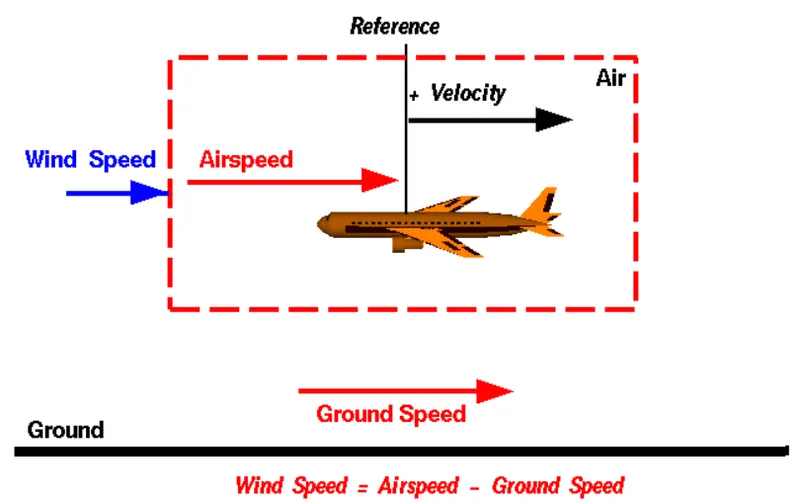
Ground speed, on the other hand, is the aircraft’s speed relative to the ground. One thing that should be noted here is that it’s its horizontal rather than vertical speed – an aircraft climbing completely vertically would have a ground speed of zero.
In other words, while airspeed is what determines whether there is enough airflow around an aircraft to make it fly, ground speed is what determines how fast an aircraft will get to its destination.
Wind effect on ground speed:
The relationship between airspeed and ground speed is fairly simple. Ground speed is simply the sum of airspeed and wind speed.
If the aircraft is flying in the same direction as the wind is blowing, the aircraft experiences tailwind, and its ground speed is higher than its airspeed. On the other hand, if the wind is blowing against the direction the aircraft is traveling in, the aircraft experiences headwind, and its ground speed is lower than its airspeed.
For pilots, both airspeed and ground speed are very important. While the first of those helps them make sure they are flying fast enough to take off, not to stall, and so on, the second one helps them figure out how long it will take them to get from one place to another.
On the other hand, if you are a passenger, you will only need to be concerned about the ground speed as that will tell you how fast are you flying from your origin to your destination – how fast you will be able to get to your meeting, meet your relatives, or do whatever else the reason for your travel might be.
WHY IS IT NOT RECOMMENDED TO USE AIRCRAFT ENGINE POWER TO MOVE IT ON THE GROUND AT AIRPORT?
The area on which aircraft move on the airfield can broadly be separated into three separate categories. The ramp, or apron, is where the stands are located for aircraft to park. The runways are what the aircraft use to take-off and land. And the taxiways, which they use to get between the two.
The thrust to propel the aircraft forward comes from its propellers or jet engines. Reverse thrust for backing up can be generated by thrust reversers, or reversible pitch propellers, a procedure known as power back. Most aircraft, however, are not designed to back up on their own and must be pushed back either by hand or by using an aircraft tug.
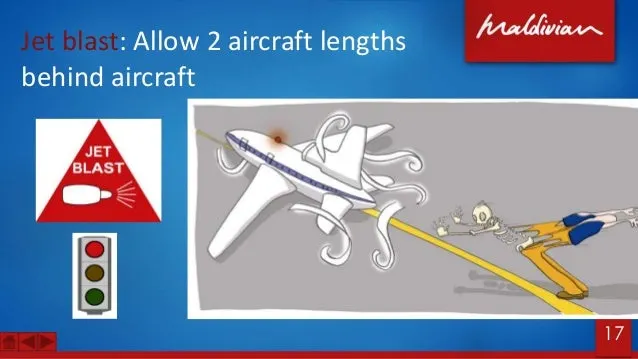

At low power settings, combustion aircraft engines operate at lower efficiency than at cruise power settings. Although now many aircraft are capable of moving themselves backwards on the ground using reverse thrust (a procedure referred to as a power back), the resulting jet blast or prop wash might cause damage to the terminal building or equipment. Engines close to the ground may also blow sand and debris forward and then suck them into the engine, causing damage to the engine. A pushback is therefore the preferred method to move the aircraft away from the gate.
Too Much Fuel is Wasted While Taxiing if done through engine power:
By using jet engines as an aircraft’s primary thrust for taxiing, airlines are expending huge amounts of jet fuel while still on the ground, which could be much better used for flying. With the Cost of Fuel being their single biggest expense, many airlines plan to adopt electric taxiing to save fuel and reduce environmental impacts.
HOW AN AIRCRAFT IS PUSHED TO RUNWAY WHEN ITS READY TO TAKE OFF?
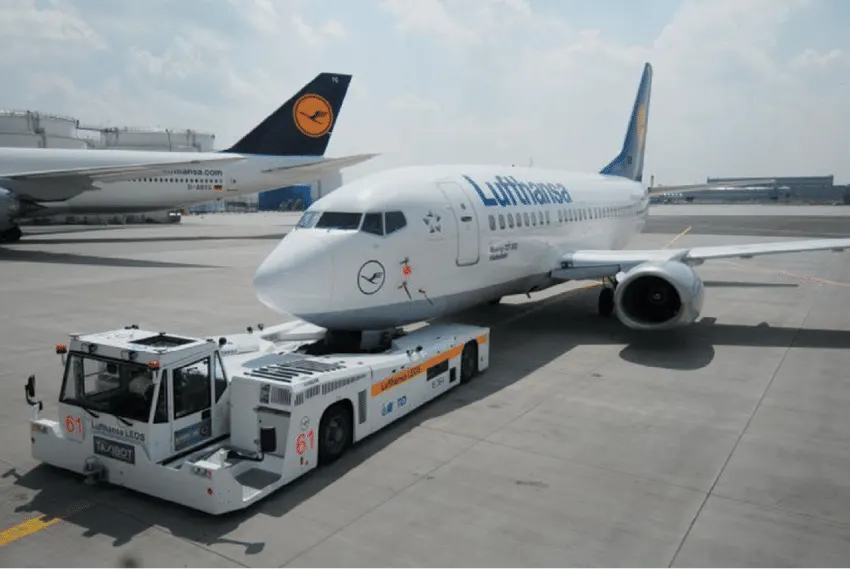
Movement of large aircraft about the airport, flight line, and hangar is usually accomplished by towing with a tow tractor (sometimes called a “tug”). In the case of small aircraft, some moving is accomplished by hand pushing on the correct areas of the aircraft. Aircraft may also be taxied about the flight line but usually only by certain qualified personnel.
In aviation, towing is an airport procedure during which an aircraft is pushed backwards away from an airport gate by external power. Pushbacks or towing are carried out by special, low-profile vehicles called pushback tractors or tugs.
Pushbacks or towing at busy aerodromes are usually subject to ground control clearance to facilitate ground movement on taxiways. Once clearance is obtained, the pilot will communicate with the tractor driver (or a ground handler walking alongside the aircraft in some cases) to start the pushback. To communicate, a headset may be connected near the nose gear.
Since the pilots cannot see what is behind the aircraft, steering is done by the pushback tractor driver and not by the pilots. Depending on the aircraft type and airline procedure, a bypass pin may be temporarily installed into the nose gear to disconnect it from the aircraft's normal steering mechanism.
Once the pushback is completed, the towbar is disconnected, and any bypass pin removed. The ground handler will show the bypass pin to the pilots to make it clear that it has been removed. The pushback is then complete, and the aircraft can taxi forward under its own power.
TAKE OFF POWER, TYRE DESIGN, ROLLING RESISTANCE, TYRE PRESSURE, BRAKE FORCES (WHEN LANDING) OF AIRCRAFT:
TAKE OFF POWER:
Takeoff is the phase of flight in which an aircraft goes through a transition from moving along the ground (taxiing) to flying in the air, usually starting on a runway. Usually the engines are run at full power during takeoff. Following the taxi motion, the aircraft stops at the starting line of the runway.
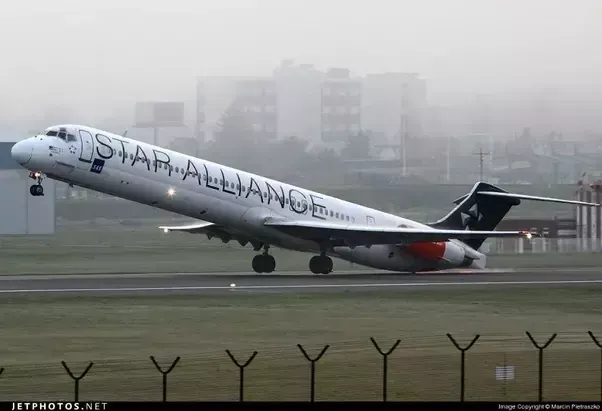
The takeoff speed required varies with air den-sity, aircraft weight, and aircraft configuration (flap and/or slat position, as applicable). Air density is affected by factors such as field elevation and air temperature.
For light aircraft, usually full power is used during takeoff. Large transport category (airliner) aircraft may use a reduced power for takeoff, where less than full power is applied in order to prolong engine life, reduce maintenance costs and reduce noise emissions. In some emergency cases, the power used can then be increased to increase the aircraft's performance.
Aircrafts don't always takeoff with 100% power to avoid wear and tear. They usually takeoff at about 90-98% power depending on the outside temperature. If the power is more it csn takeoff within a short distance and vice-verse.
Takeoff power is different on every takeoff because it depends on the environmental conditions I listed in the bullet points. Aside from that, a maximum thrust setting is computed by the engines but is on new types of no real concern to the pilots. Pilots can just go full forward with the throttles so that max takeoff/go around thrust gets set. It’s the engine’s computers (called FADECs on the Airbus) that calculate the exact N1 or EPR for that. Full thrust is however rarely needed on a takeoff. You’ll more likely encounter full thrust on a go around, where it’s sometimes cause for chaos if the level off altitude in the missed approach is low; too much thrust gives the pilots little time before they have to level off already then. Full thrust will almost certainly not be 100% N1 that day.
TYRE DESIGN:
Aircraft tyre design would be just as carefully considered as any other aspect of the vehicle. Grooves in tyres serve only one real purpose, channelling water away from the contact surface between the tyre and the ground. Contrary to popular belief they do not improve grip, in fact they reduce it.
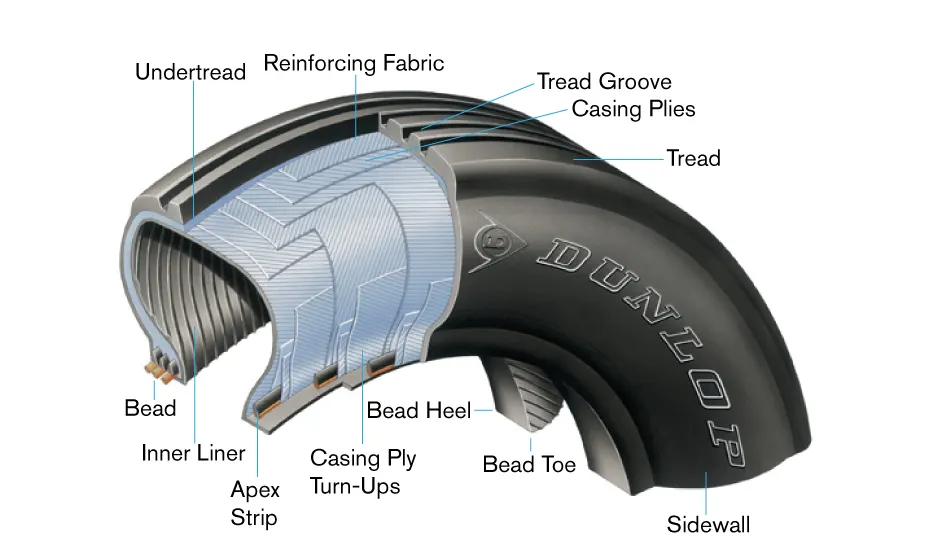
They differ from car tyres in several ways:
- They are generally bias ply, versus radials.
- The tread is usually lines parallel to the direction of travel only, versus the siping or tread blocks found on car tires.
- Airplane tires generally have a fair bit of vertical ‘give’ in them to help absorb the landing contact, which would make a car tire handle quite poorly.
- Tires designed for large aircraft sometimes have fused plugs, designed to burst when overheated. The deflated tire can help slow a plane during an aborted takeoff or emergency landing, for example.
- For their size and construction, airplane tires cost WAY more than car tires.
When you press down on the accelerator in your vehicle, you are essentially transferring energy—in the form of gas or electricity, depending on your automobile, through the engine and other systems in your vehicle. That results in your tires turning and enough momentum being built up to move your automobile. To accomplish this, though, your vehicle must overcome a lot of different factors that can make it resistant to forward movement. One of those factors is the tires’ rolling resistance.
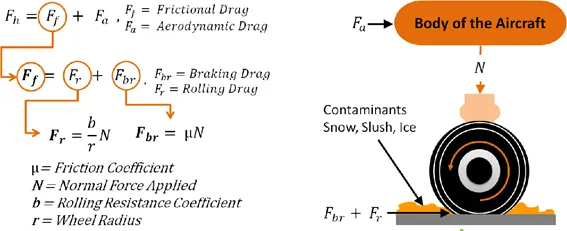
Tire rolling resistance is the energy that your vehicle needs to send to your tires to maintain movement at a consistent speed over a surface. In other words, it is the effort required to keep a tire rolling. The main contributor to rolling resistance is the process known as hysteresis. Hysteresis is essentially the energy loss that occurs as a tire rolls through its footprint. The energy loss must be overcome by the vehicle’s engine, which results in wasted fuel.
Rolling resistance is going to happen whenever a tire makes contact with a road surface. However, although it can’t be avoided, it can be minimized. Since tire rolling resistance is caused by hysteresis, tires can be engineered with specially formulated tread compounds that are more resistant to heat generation and constructed to minimize tire deflection for less energy loss. These are known as low rolling resistance tires.
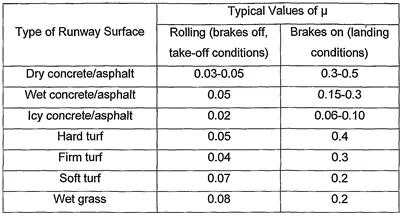
In calculation of rolling resistance force, the effect of of rolling resistance is accounted by the constant called rolling resistance coefficient. Above fig. respresents its value with respect to the runway surface.
TYRE PRESSURE:
An aircraft tire or tyre is designed to withstand extremely heavy loads for short durations. The number of tires required for aircraft increases with the weight of the aircraft, as the weight of the airplane needs to be distributed more evenly. Aircraft tire tread patterns are designed to facilitate stability in high crosswind conditions, to channel water away to prevent hydroplaning, and for braking effect.
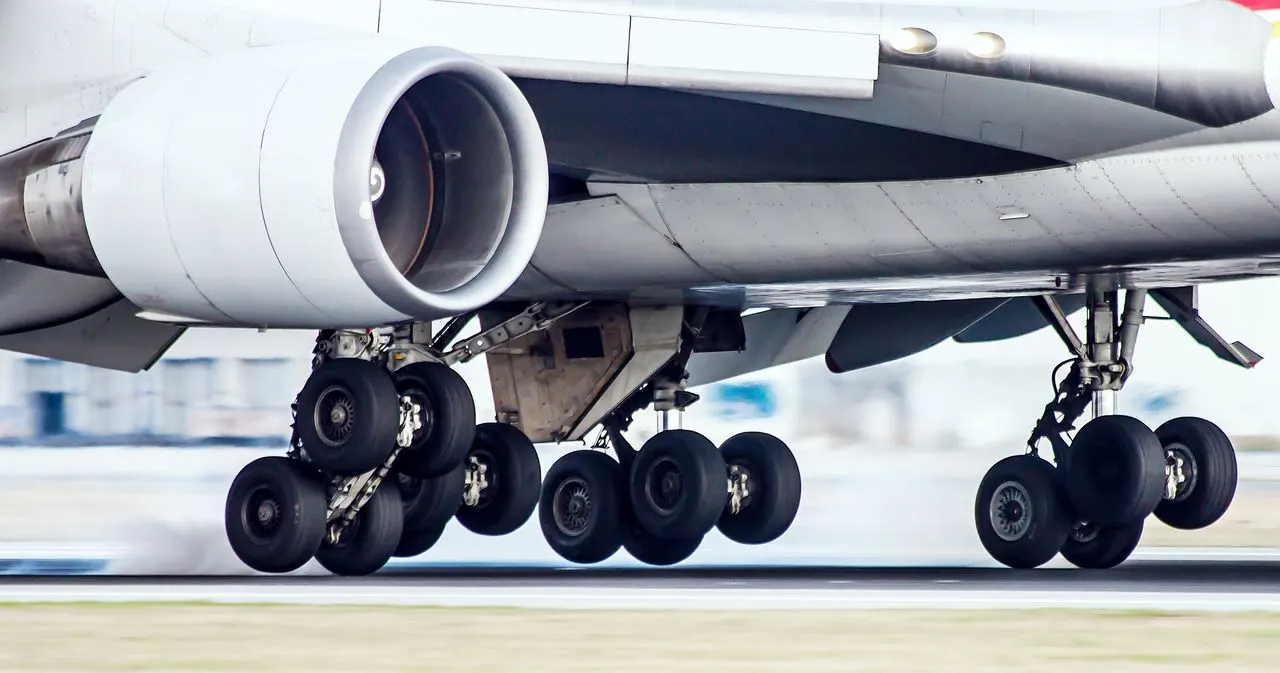
Aircraft tires generally operate at high pressures, up to 200 psi (14 bar; 1,400 kPa) for airliners, and even higher for business jets. For eg. the main landing gear on the Concorde was typically inflated to 232 psi (16.0 bar), whilst its tail bumper gear tires were as high as 294 psi (20.3 bar). The high pressure and weight load on the Concorde tyres were a significant factor in the loss of Air France Flight 4590.
Tests of airliner aircraft tires have shown that they are able to sustain pressures of maximum 800 psi (55 bar; 5,500 kPa) before bursting. During the tests the tires have to be filled with water, to prevent the test room being blown apart by the energy that would be released by a gas when the tire bursts.
Aircraft tires are usually inflated with nitrogen to minimize expansion and contraction from extreme changes in ambient temperature and pressure experienced during flight. Dry nitrogen expands at the same rate as other dry atmospheric gases (normal air is about 80% nitrogen), but common compressed air sources may contain moisture, which increases the expansion rate with temperature.
The requirement that an inert gas, such as nitrogen, be used instead of air for inflation of tires on certain transport category airplanes was prompted by at least three cases in which the oxygen in air-filled tires had combined with volatile gases given off by a severely overheated tire and exploded upon reaching autoignition temperature. The use of an inert gas for tire inflation eliminates the possibility of tire explosion.
BRAKE FORCES WHEN LANDING:
A short landing run requirement for an aircraft is important from economic, operational and strategic considerations. Too strong a braking produces skid, which is an undesirable condition, while weak breaking results in a long landing run. The shortest possible (optimal) landing run without any skidding requires a variable braking force to match the frictional force at all times.
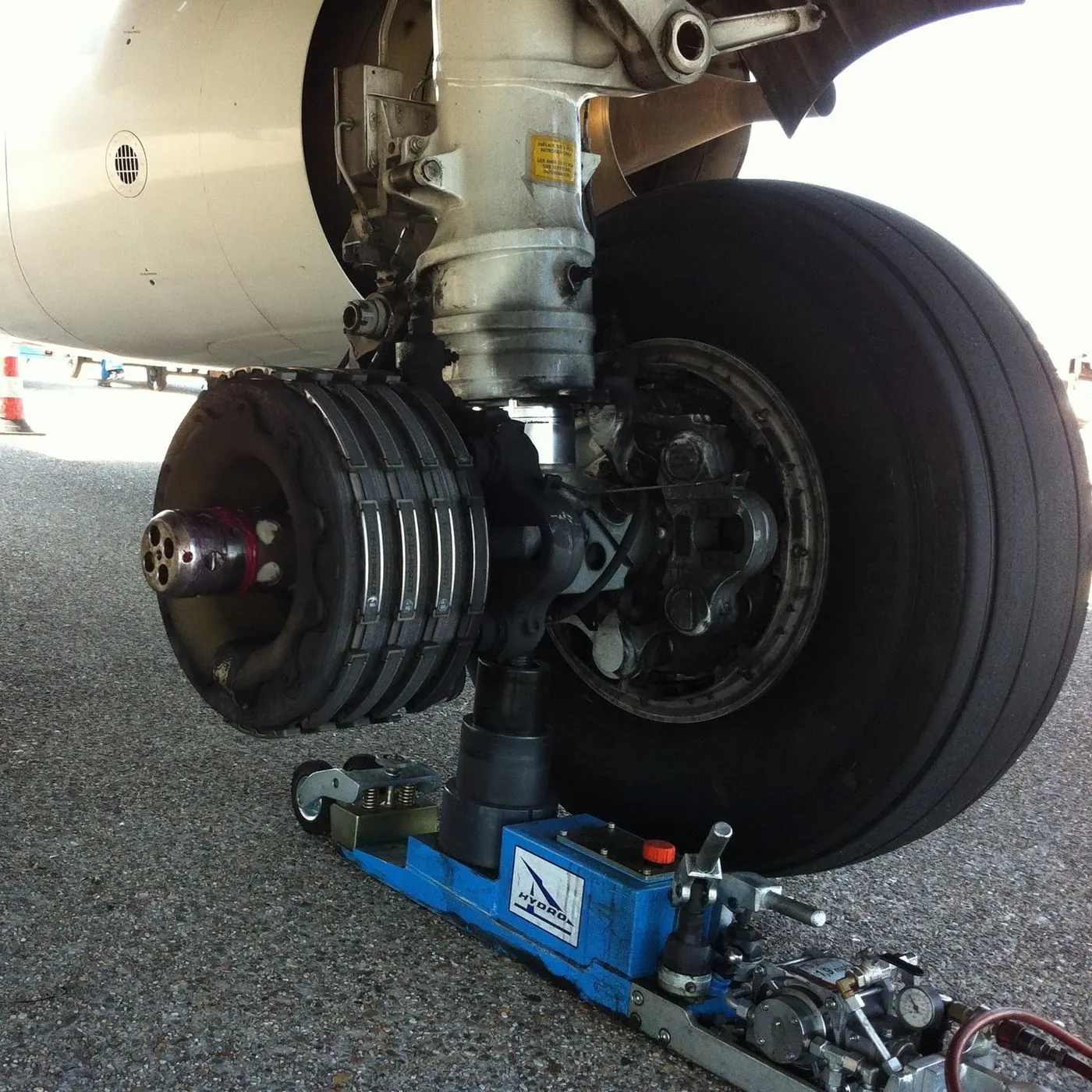
The maximum allowable braking force at any instant is a random variable as the ground-induced excitation and the frictional force between the wheel and the tyre are random in nature. In view of the time lag in the actuation of a servo system and its completion of the execution, a one-step prediction is employed to obtain the braking force required at a future instant.
Calculation of braking force (respective units can be converted as needed):
First, some requirement assumptions . . .
Landing weight = takeoff weight in case of aborted takeoff = 1500 lbf
Landing distance = 500 ft
Speed (assume aborted takeoff) = 60 kt (100 ft/sec)
We will use Newton’s second law to determine force due to deceleration:
Deceleration: from simple kinematics, acceleration = velocity^2 / distance
= (100 ft/s)^2 / 500 ft = 20 ft / s^2
Mass of aircraft = (weight) / g = 1500/32.2 = 46.58 lbf*s^2 / ft
Force = mass * acceleration (46.58 lbf*s^2/ft) * (20 ft / s^2) = 931.6 lbf
So in this example, the braking (deceleration) force is 931.6 lbf or 4.1439632 kN.
CALCULATING FORCE AND POWER REQUIRED TO PUSH/PULL AN AIRCRAFT BY A TOWING VEHICLE:
Airliners are often (almost always actually) pushed back by a tug or a tractor to leave the gate. The tug can also tow an aircraft that cannot taxi by itself. Tugs do not need that much horsepower, even the biggest tugs only have around 400bhp. What they do need is lots of torque for push/pull power, lots of weight to give it plenty of inertia, and big grippy tires to transfer the power to the surface.
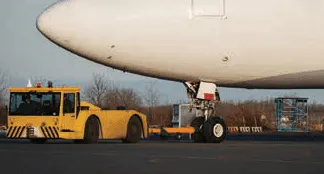
As we all know that runways are always flat and the taxing path for the airplanes is flat so the gradient force is eliminated. Aerodynamic drag is negligible here because towing of aircrafts is done at low speed. Hence the only dominant force would be rolling resistance force.
The force to move an airplane on an absolute flat runway with no wind at constant low speed is equal to the rolling resistance between the plane and the tarmac.
The rolling resistance for the air plane can be calculated as
Fr = c mr ag (1)
where
Fr = rolling resistance force (N, lbf)
c = rolling resistance coefficient
mr = rolling mass (kg, lbm)
ag = acceleration of gravity (9.81 m/s2)
If the mass of a plane is 40000 kg and the rolling coefficient between the aircraft wheel and the tarmac is 0.02 - the force required to overcome the rolling resistance can be calculated as-
Fr = 0.02 (40000 kg) (9.81 m/s2)
= 7848 N or 8 kN
This force can be delivered by a pulling truck or - as occasionally seen - by a number of pulling people. Enough weight for the pullers are required to create friction forces against the tarmac that equals the plane rolling resistance.
The friction force for the puller can be calculated to
Ff = μ W
= μ mf ag (2)
where
Ff = frictional force (N, lb)
μ = friction coefficient
W =weight (N, lbf)
mf = friction mass (kg)
Required Mass for Pulling Truck
The friction coefficient between a pulling truck rubber wheels and dry tarmac is 0.9. Since pulling trucks are connected to air crafts nose wheels close to tarmac we simplify the calculation of required truck mass to
mf = (7848 N) / (0.9 (9.81 m/s2))
= 889 kg
Average towing speed of aircraft in runway is roughly about 10 kmph or 2.78 m/s. Power is calculated as:
Power = Force*velocity
`P=Fastv`= `8000ast2.78`
= 22240 W or 22.3 kW
Hence the force and power required to push/pull an aircraft by a towing vehicle is 8 kN and 22.3 kW respectively.
ELECTRIC POWERTRAIN DESIGN WITH TYPE OF MOTOR, IT’S POWER RATING, AND ENERGY REQUIREMENT TO FULFIL AIRCRAFT TOWING APPLICATION
As we have calculated the power required to tow an aircraft to runway we will now design the motor.
From above calculation we have: Power=22.3 kW, Avg. speed=10 kmph or 2.78 m/s, Force=8 kN, Tow vehicle wheel radius=0.38 m.
Therefore torrque required by motor will be Torque =Force*wheel_radius = 3.04 kNm
Hence we need motor of power rating of 22.3 kW, Max speed of 15 kmph, and torque of 8.03 kNm. But such motors can be costly hence it is recommende use gear system to increase torque. Based on the motors available on market we have chose motor with following specs:
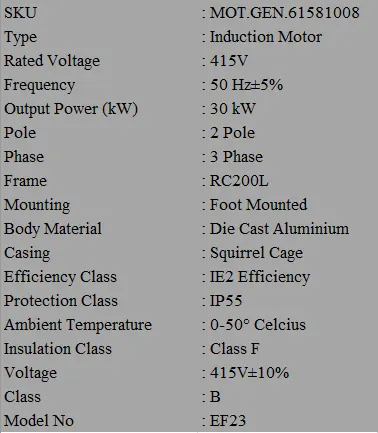
Energy required for towing: Powe*time = 22.3 kW*(20/60) = 7.4 kWh
Duty cycle range= 0.2% to 0.74% (duty cycle= Vin\vout)
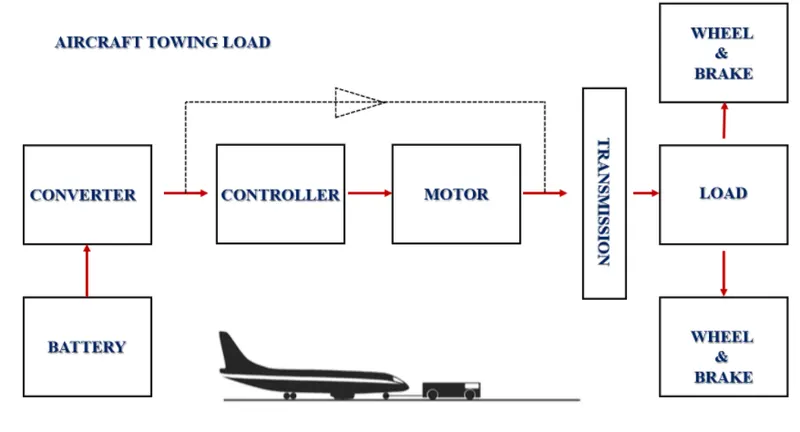
BLOCK DIAGRAM OF THE POWERTRAIN