Powertrain for aircraft in runways
Aim:
- Search and list out the total weight of various types of aircraft.
- Is there any difference between ground speed and airspeed?
- Why is it not recommended to use aircraft engine power to move it on the ground at the Airport?
- How an aircraft is pushed to the runway when it's ready to take off?
- Learn about take-off power, tyre design, rolling resistance, tyre pressure, brake forces when landing.
- With necessary assumptions, calculate the force and power required to push/pull an aircraft by a towing vehicle.
- Design an electric powertrain with the type of motor, it’s power rating, and energy required to fulfil aircraft towing application. Estimate the duty cycle range to control the aircraft speed from zero to highest. Make all required assumptions. Prepare a table of assumed parameters. Draw a block diagram of the powertrain.
Study 1: Listing out the various types of aircraft with their weights
The list of different aircraft with their weight is provided in the table below.
MTOW=Maximum Take-Off Weight, MLW=Maximum Landing Weight.
| Type | MTOW [kg] | MLW [tons] |
|---|---|---|
| Antonov An-225 | 640,000 | 591.7 |
| Airbus A380-800 | 575,000 | 394 |
| Boeing 747-8F | 447,700 | 346.091 |
| Boeing 747-8 | 443,613 | 306.175 |
| Boeing 747-400ER | 412,770 | 295.742 |
| Antonov An-124-100M | 405,060 | 330 |
| Boeing 747-400 | 396,900 | 295.742 |
| Lockheed C-5 Galaxy | 381,000 | 288.417 |
| Boeing 747-200 | 377,840 | 285.700 |
| Boeing 747-300 | 377,840 | 260.320 |
| Airbus A340-500 | 371,950 | 240 |
| Airbus A340-600 | 367,400 | 256 |
| Boeing 777F | 347,800 | 260.816 |
| Boeing 777-300ER | 351,800 | 251.29 |
| Boeing 777-200LR | 347,450 | 223.168 |
| Boeing 747-100 | 340,200 | 265.300 |
| Airbus A350-1000 | 308,000 | 233.5 |
| Boeing 777-300 | 299,370 | 237.683 |
| Boeing 777-200ER | 297,550 | 213.00 |
| Airbus A340-300 | 276,700 | 190 |
| McDonnell Douglas MD-11 | 273,300 | 185 |
| Airbus A350-900 | 270,000 | 175 |
| Ilyushin Il-96M | 270,000 | 195.04 |
| McDonnell Douglas DC-10 | 256,280 | 183 |
| Boeing 787-9 | 254,000 | 192.777 |
| Boeing 787-10 | 254,000 | 201.849 |
| Airbus A340-200 | 253,500 | 181 |
There are many aircrafts other than the above mentioned. Let's consider an Airbus A318 and design a powertrain for towing this aircraft of 59,000kg weight.
Study 2: Finding out whether ground speed and airspeed are different terminologies.
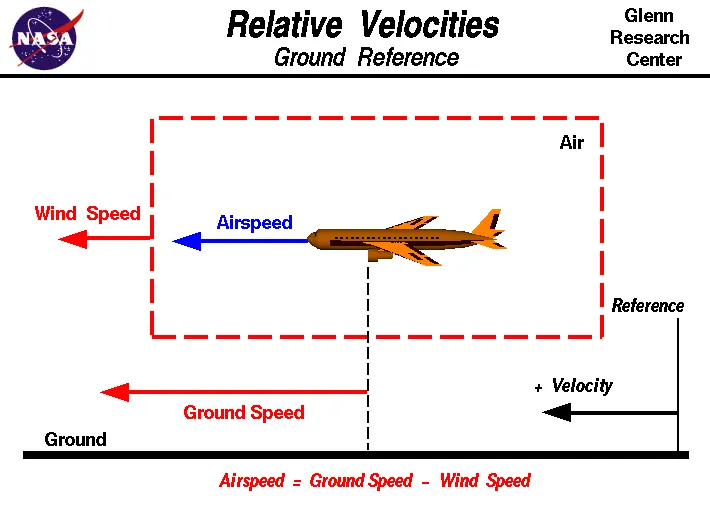
Ground Speed is the speed of a flying object when measured from a point on the ground.
Airspeed: It is the difference between ground speed and wind speed.
Airspeed = Ground speed - Wind speed
Wind speed is the speed of wind measured from a point on the ground.
Ground speed and Wind speed are both vector quantities. Their direction is of measure concern when solving.
Study 3: why it is not recommended to use aircraft engine power to move it on the ground at the Airport.
The use of an aircraft's engine is not very preferred to move it on the ground at the airport, because;
- Fuel consumption: A lot of fuel is used by the aircraft engine because it is used to generate high power for propulsion and if we use it for moving around the airport it will cause wastage of fuel.
- Wear and tear on the engine: When the engines are running on the ground, the downwards acting thrust blows the air from the ground in the air. This contains particles from the ground and air. There are quite high chances of the engine sucking these particles in and causing damage to its parts.
Study 4: How is an aircraft pushed to the runway when it's ready to take off?
"Taxiing" refers to the aircraft movement while on the ground under its own power. This term excludes the accelerating run before take-off and the decelerating run after landing.
So we know the repercussions that might occur when the engine is used on the runway. So Pushback seemed to be a widely popular option for rolling the aircraft on the runway.
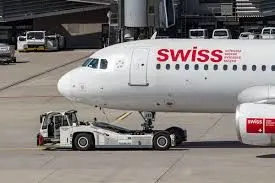
Pushback means the movement of an aircraft from nose-in parking stand using the power of a specialized ground vehicle attached to or supporting the nose landing gear. Conventionally a tow bar is a link used between the aircraft and Pushback tug.
Since the pilots have limited vision from the cockpit of what lies behind & side of the aircraft, most of the steering will be done by the driver in Pushback.
Study 5: To learn about takeoff power, tyre design, rolling resistance, tyre pressure, brake forces when landing.
Takeoff power:
Takeoff is the phase of flight in which an aerospace vehicle leaves the ground and becomes airborne. For aircraft that take off horizontally, this usually involves starting with a transition from moving along the ground on a runway.
When a plane is moving on the ground, the forces acting on it are gravity, thrust and drag. The lift is also acting, but as the plane is on the ground, the lift force is obviously less than gravity which is why it's on the ground. In order to take off, the amount of thrust with the required speed of the plane results in the generation of lift force. This thrust force and the speed gives the power product. It has to overcome gravity by generating lift and drag by generating thrust. This is how an aircraft take-off takes place.
Rolling Resistance:
Rolling resistance is the force resisting the motion when a body rolls on a surface. It is mainly caused by non-elastic effects; that is, not all the energy needed for deformation (or movement) of the wheel, roadbed, etc., is recovered when the pressure is removed.
The rolling resistance coefficient is defined by the following equation:
F=μ(W−L)
where
F =is the rolling resistance force
ur =is the rolling resistance coefficient
N =is the normal force, the force perpendicular to the surface on which the wheel is rolling.
Tire Pressure:
The pressure usually operates at higher pressure up to 200 psi for domestic and as well as international flights which are usually heavier.
Brake forces when landing:
There are three kinds of braking forces that can be employed in the aircraft to decelerate it on the runway.
1. Engine power: The most important action to achieve deceleration from a speed at which the engines are still producing forward motion is to select all thrust/power levers to the ground idle position promptly, and if available, continue the action through to the selection of reverse thrust or reverse propeller pitch. Thrust reversers and reverse propeller pitch are most effective at high speeds.
2. Wheel brakes: To be effective, braking action at any speed depends upon sufficient friction existing between the tires and the runway surface achieved through freely rotating wheels.
3. Mechanical spoilers:
The mechanical deflection of parts of the wing upper surfaces and tail cone assembly can assist deceleration in two ways:
- Directly, by increasing aerodynamic drag on the moving aircraft. This can be achieved by raising upper wing surface panels called ground spoilers or by the operation of a tail cone ‘clamshell’ type air brake.
- Indirectly by increasing the effective downward load on the landing gear and thereby increasing the efficiency of wheel braking.
Tyre Design:
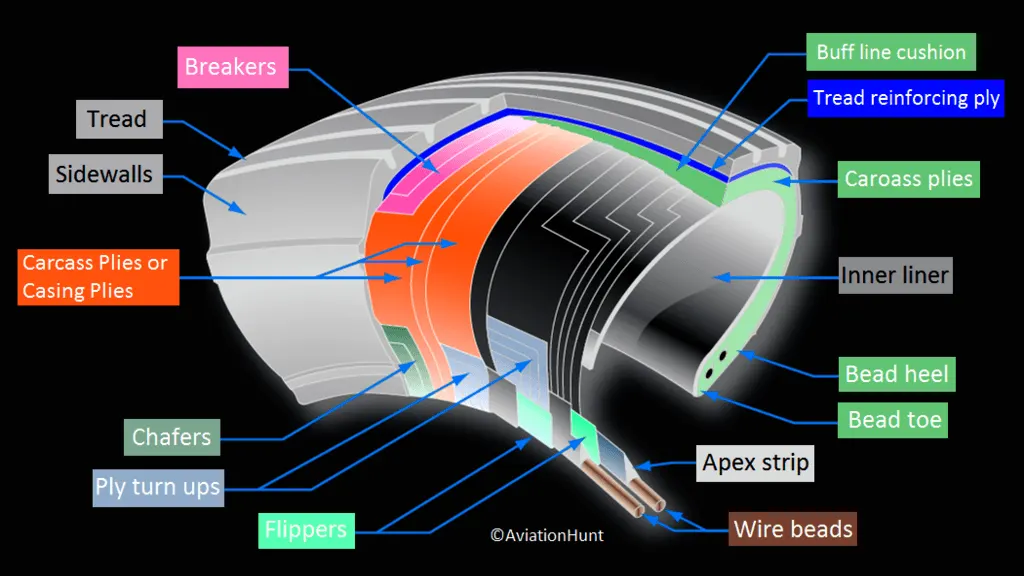
An aircraft tire is designed to withstand extremely heavy loads for short durations. The number of tires required for aircraft increases with the weight of the aircraft, as the weight of the aeroplane needs to be distributed more evenly. Aircraft tire tread patterns are designed to facilitate stability in high crosswind conditions, to channel water away to prevent hydroplaning, and for the braking effect.
Aircraft tires also include fusible plugs(which are assembled on the inside of the wheels), designed to melt at a certain temperature. Tires often overheat if maximum braking is applied during an aborted takeoff or an emergency landing. The fuses provide a safer failure mode that prevents tire explosions by deflating in a controlled manner, thus minimizing damage to aircraft and objects in the surrounding environment.
Design and construction:
An aircraft tyre is constructed for the following purposes.
- They support the weight of an aircraft while it is on the ground.
- It also provides the necessary traction for braking and stopping an aeroplane.
- Tyre also helps to absorb the shock of landing and provide cushioning for the roughness of takeoff, roll-out, and taxi operations.
Unlike an automobile or truck tyre, it does not have to carry a load for a long period of continuous operation. However, an aircraft tyre absorbs the high impact loads of landing and also it’s operating at high speeds for a short time when required.
Study 6: Calculating the force and power required to push/pull an aircraft by a towing vehicle, with necessary assumptions.
Here the pushback trucks experience two types of forces:
i) Rolling resistance force
ii) Aerodynamic drag force
Rolling resistance force - The formula used for the rolling resistance force is mentioned below,
Frr = u*m*g
where,
u is the coefficient of rolling resistance, m is the mass and g is the acceleration due to gravity.
This rolling resistance force acts on both the pushback truck and the aircraft.
so first considering the aircraft, u = 0.02, m = 40,000 kg
Frr (aircraft) = 0.02*40000*9.81 = 7848 N
and Now considering for the Pushback truck, u = 0.09, m = 1000 kg
Frr (pushback truck) = 0.09*1000*9.81 = 883 N
Therefore the total resistance will be the sum of the aircraft & pushback truck rolling resistance = 7848 + 883 = 8731 N
Aerodynamic force - The aerodynamic force to move an aeroplane on an absolute flat runway with no wind at constant low speed is usually very negligible.
Since the aerodynamic force is assumed to be negligible, the net force acting on the pushback truck, Fnet = Frr (pushback truck) + Frr (aircraft) = 8731 N
The power required is,
P = F*V, V is the velocity in m/s by which the pushback truck either pushes or pulls the aircraft
P = 8731*9.72 = 84.86 KW
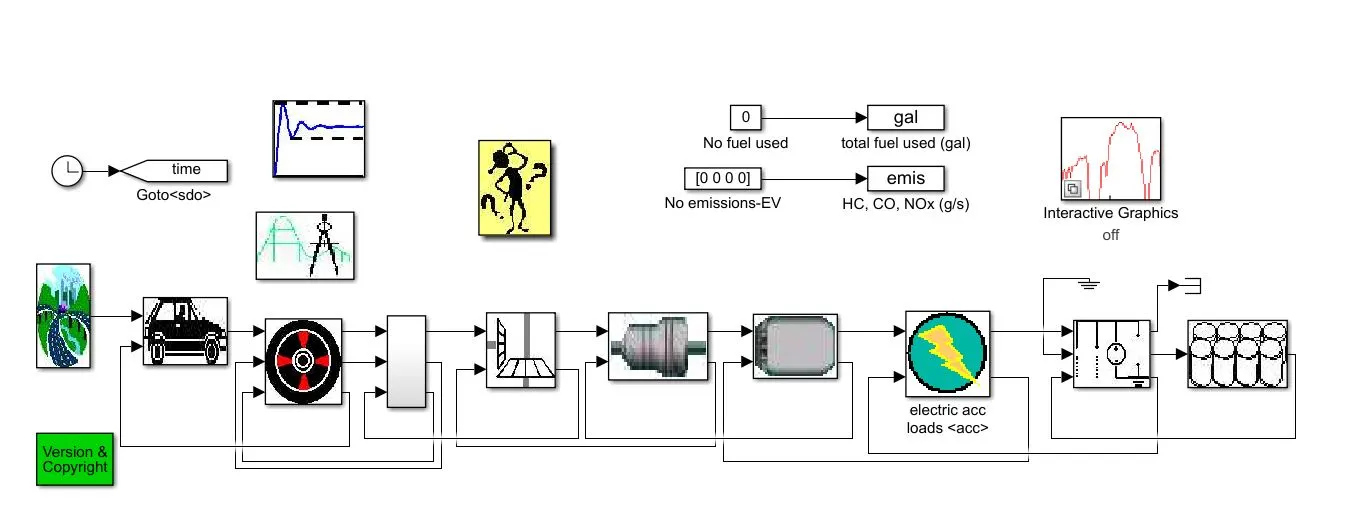
Study 7: Designing an electric powertrain with the type of motor, it’s power rating, and energy required to fulfil aircraft towing application. Estimating the duty cycle range to control the aircraft speed from zero to highest. Taking all required assumptions. Preparing a table of assumed parameters. Creating a block diagram of the powertrain.
a) Motor Type
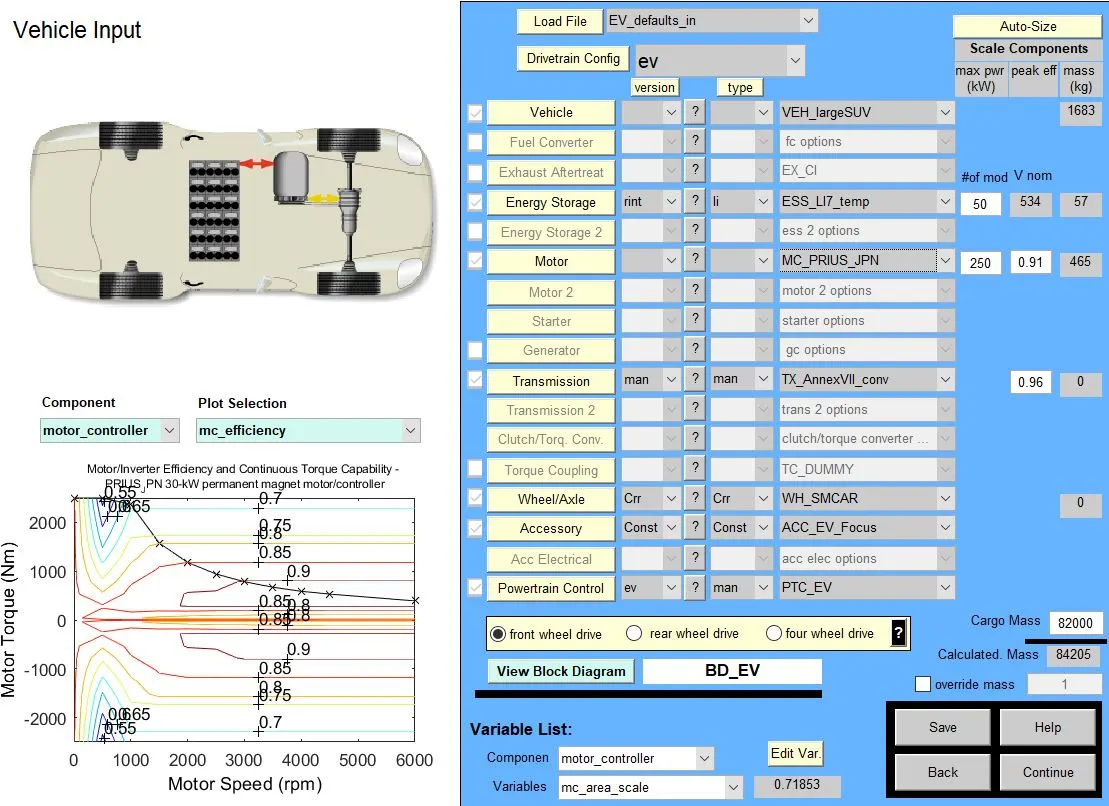
The Induction motor is preferred over the BLDC motor for the high kW range due to its operating range and cost. ADVISOR tool is used to design the model.
b) Power rating
The power required by the motor is 184 kW since the motor has an efficiency of 90% & the motor is designed to run at 80% of the full capacity for safe operations in the motor. The 250kW power motor is chosen for our application.
Power rating - 250kW.
c) The energy required for aircraft
The mass of the vehicle of 84205 kg.
Energy = P*T
P - Motor power (kW).
T - Taxing time (s).
The average taxing time for an aircraft is 10mins (i.e) 600 seconds.
E = 184.28*600.
= 110.57 MJ.
The energy required for the vehicle is 110.57MJ.
d) Duty Cycle range
The 250kW motor has a full load current of 420A & a full voltage of 400V.
Pin = Iin * Vin.
Vin = 250/420.
Pout = Iout * Vout.
The current at the input and output are the same. So the ratio power at input & output is equal to the voltage ratio.
Pout / Pin = Vout / Vin.
184.25/250 = 0.737.
The duty cycle range is from 0 to 73.7%.
e) Block diagram
References:
https://www.engineeringtoolbox.com/plane-pull-force-people-d_2083.html (for towing force calculations)
Help Center - MATLAB & Simulink (mathworks.com) (for ADVISOR motor design)