Project 1 - Parsing NASA thermodynamic data
Aim
Write a code in matlab/Octave to parse the NASA thermodynamic data file and then calculate the
themodynamic properties of various gas species
Objective
1. Write a function thet extracts the 14 co-efficient and calculats th enthalpy,entropy and specific heats
all the species in the data file.
You will be reading this file NASA thermodynamic data
2. Calculate the molecular weight of each species and display it in the command window.
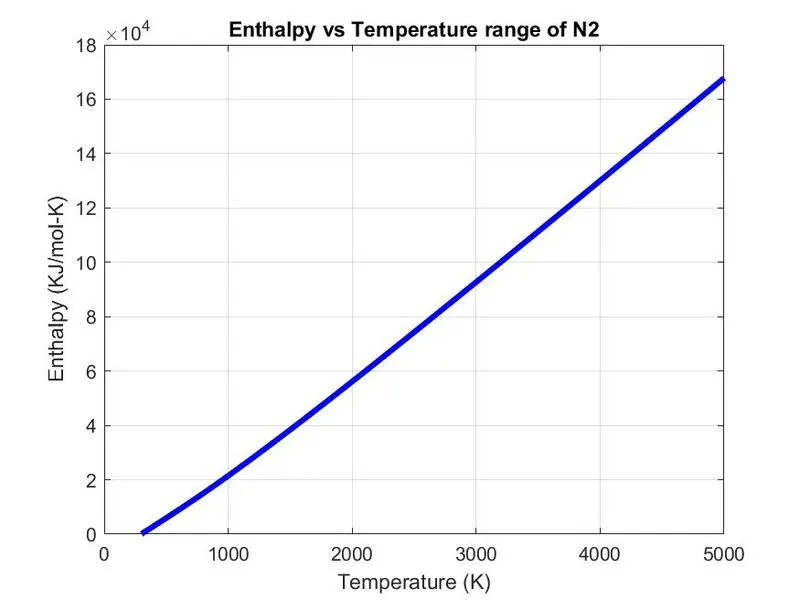
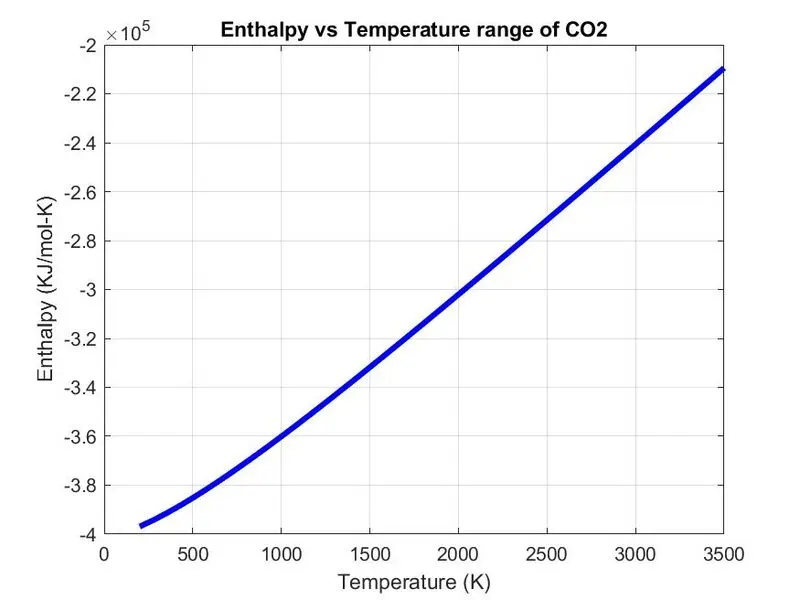
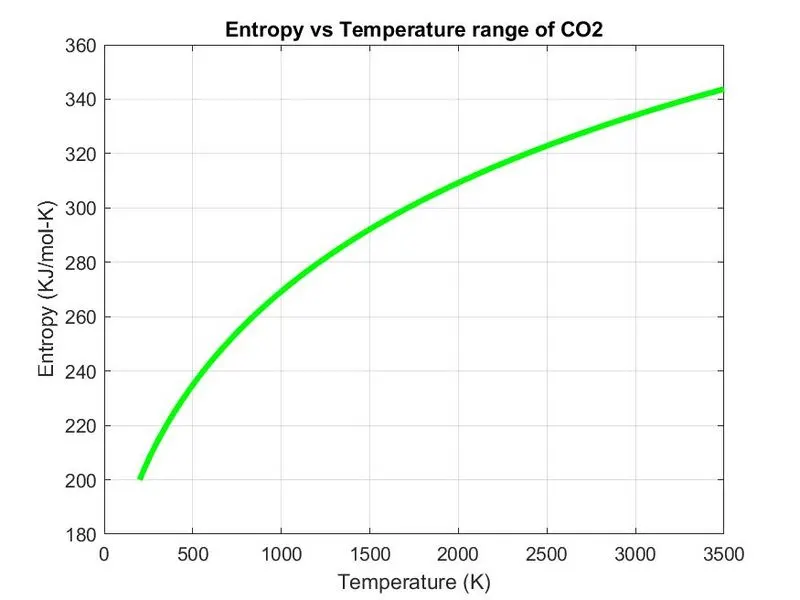
3. Plot the Cp,Enthalpy and Entropy for the local temperature range(low tmperature:high temperature)
specific for ech species.
4. Save the plots as images with appropriate names and dump them in seperate folders for ach species
with suitable names. All these should be generated automatically.
5. The main program that you will submit will just take the "THERMO.dat"file as an input and generate
Cp,H and S plots.
6 Screenshot of the windows where all the folders are saved.
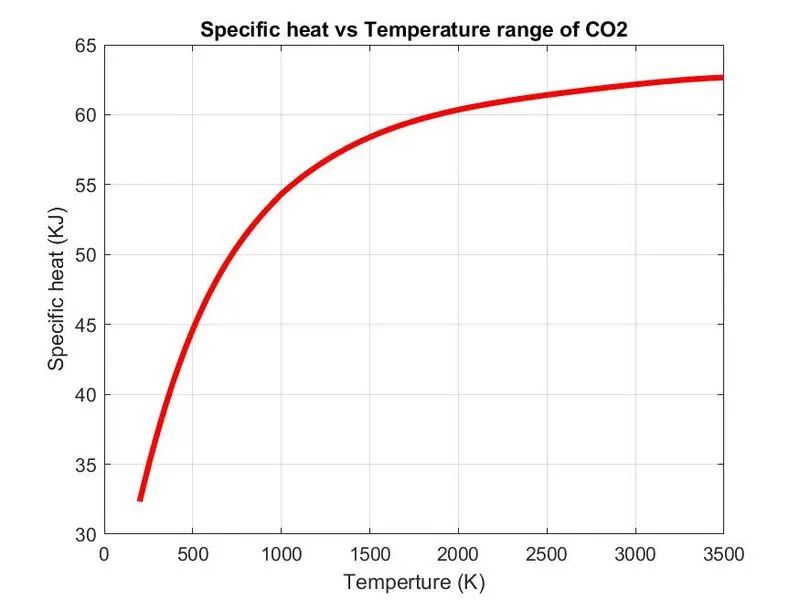
7.Plot for O2,N2 and Co2 species to be show
The Formulae

Where
R = Universal Gas Constant
T = Temperature
Cp = Specific Heat(K)
S = Entropy(KJ/mol-K)
H = Enthalpy(KJ/mol)
a(i) = Coefficient where, i = 1 to 14
Definitions
File Parcing
Parcing ,syntax analysis is the process of analysing a string of symbols,either in natural language,
computer languages or data structures,conforming to rules of a formal grammar. The term parsing
comes from latin pars(orationis).Meaning part of speech.Within computational linguistics the term is
used to refer to formal analysis by a computer of asentance or other string of words into its constituent,
resulting in parse tree showing their syntactic relation to each other,which may also contain sematic
and other information.Some parsing algorithms may generate a parse forest or list of parse trees for
a syntactically ambiguous input.
Parsing a file means reading in a data stream of some sort and building an in memmory model of the
semantic content of that data.This aims at facilitating performing some kind of transformation on the
data.
NASA Thermodynamic File
NASA themodynamic file which is THERMO.dat file in which there are temperature range and 53 species
are given in these data and each species contains 14 coefficient and temperature ranges and we have to
parse these 14 coefficient to find Specific heat.Entropy and Enthalpy using formula.
Specific Heat
The specific heat is the amount of heat per unit mass required to rise the temoerature by one degree
Celsius.
Entropy
Entropy, the measure of a system's thermal energy per unit temperature that is available for doing useful
work.Because work is obtained from orderd molecular motion, the amount of entropy is also a measure
of the molecular disorder,or randomness of a system.
Enthalpy
Enthalpy, a thermodynamic quantity equivalent to the total heat content of a system.It is equal to the
internal energy of the system plus the product of pressure and volume.In a system contained so as to
prevent mass transfer,for process at constant pressure, the heat absorbed or released equal to change
in enthalpy.
Program
Functions
Function to find its specific heat:-
%Specific Heat calculation Function

function Cp = Specific_heat(a1,a2,a3,a4,a5,a8,a9,a10,a11,a12,T,R,midtemp)

%calculating specific heat for higher and lower temperature respectively.
for i=1:length(T)

if (T(i) <= midtemp)
    Cp(i) = R*(a8+ (a9*T(i)) + (a10*(T(i)).^2) + (a11*(T(i)).^3) + (a12*(T(i)).^4));

else

    Cp(i) = R*(a1+ (a2*T(i)) + (a3*T(i)^2) + (a4*T(i)^3) + (a5*T(i)^4));

end
end
end
steps
1.Now we will find the the Specific Heat by creating specific heat function and assigning its related
formula coefficient from 14 coeffcients, Gas constant ,Temperature and mid temperature.
2.Now we will create a condition using the"if" loop and make the temperature less than and equal to
mid temperature to specify lower temperature coefficient in the formula.
3.Then we will use the eske condition to specify coefficient of Higher tmperatur coefficient in the formula
4.Then end the loop and function to calculate the "Specific Heat".
Function to find the entropy :-
% Entropy Calculation Function
function S = Entropy(a1,a2,a3,a4,a5,a7,a8,a9,a10,a11,a12,a14,T,R,tempmid)

%calculating entropy for higher and lower temprature respectively.
for i=1:length(T)
if (T(i) <= tempmid)

    S(i) = R*(a8.*log(T(i)) + (a9*T(i)) + ((a10*(T(i)).^2)/2) + ((a11*(T(i)).^3)/3) + ((a12*(T(i)).^4)/4) + a14);

else
    S(i) = R*(a1.*log(T(i)) + (a2*T(i)) + ((a3*(T(i)).^2)/2) + ((a4*(T(i)).^3)/3) + ((a5*(T(i)).^4)/4) + a7);

end
end
Steps
1. Now we will find the entopy function and assigning its related formula coefficient from 14 coefficients,
Gas constant,temperature and mid temperature.
2. Now we will create a condition using the "if" loop and make the temperature less than and equal to mid
temperature to specify lower temperature coefficient in the formula.
3. Then we will use the else condition to specify coefficient of higher temperature coefficient in the
formula.
4 Then end the end loop and function to calculate the 'Entropy'.
Function to find Enthalpy
%Enthalpy calculation function
function H = Enthalpy(a1,a2,a3,a4,a5,a6,a8,a9,a10,a11,a12,a13,T,R,tempmid)

%calculating enthalpy for higher and lower temperature respectively
for i=1:length(T)

if(T(i) <= tempmid)

    H(i) = R*T(i).*(a8+ ((a9*T(i))/2) + ((a10*(T(i)).^2)/3) + ((a11*(T(i)).^3)/4) + ((a12*(T(i)).^4)/5) + ((a13./T(i))));

else
    H(i) = R*T(i).*(a1 + ((a2*T(i))/2) + ((a3*(T(i)).^2)/3) + ((a4*(T(i)).^3)/4) + ((a5*(T(i)).^4)/5) + ((a6./T(i))));
end
end
Steps
1. Now we will find Enthalpy function and assigning its related formula coefficient from 14 coefficient,and
mid temperature
2. Now we will create a condition using the'if'loop and make the temprature less than and equal to mid
temperature to specify lower temperature coefficient in the formula.
3 Then we will use the else condition to specify coefficient of higher temperature coefficient in the
formula.
4. Then end the loop and function to calculate the 'Enthalpy'.
Function to find the molecular weight of the species:-
%Molecular weight Calculation Function
function [MW] = Molecular_weight(species)

% Defining Atomic Name of the species

atomic_name = ['H','C','O','N','Ar'];

%Hydrogen , Carbon , Oxygen, Nitrogen , Argon

%Defining Atomic masses of main species
atomic_weight = [1.008 12.011 15.999 14.007 39.948];

%Molecular weight starting range
MW = 0;

%Adding Atomic Number to obtain particular value
%Loop runs to the length of the species
for i = 1:length(species)
    % Loop runs to the length of the atomic name
    for j = 1:length(atomic_name)
        % function to compare 2 strings
        if strcmp(species(i), atomic_name(j))
            MW = MW + atomic_weight(j);
            position = j;
        end

    end
   %finding more elements in the species and incrementing atomic weight

   n = str2num(species(i));
   if n>1
     MW = MW + atomic_weight(position)*(n-1);
   end
end
fprintf('Molecular Weight of %s : ',species);
fprintf('%f',MW);
disp(' ');
end
Steps
1. Firstly we create an Molecular_weight function MW and assigning its species input to that.
2. Then define the main element of all 53 species in an array atomic_name that are:-'H','C',O,'N',"Ar'.
3. Then by taking the above main elements well create there attomic_weight array from any source like
internet that are:-00812.01115.99914.00739.948.
4. Then we will assign molecular starting range from MW to zero and then create'for' loop condition which
runs to the length of the species and an another tested'for'loop is created which runs to the length of
the string atomic_name.
5. Then we will create a condition using 'if' condtion and 'strcmp' command to compare the species and
atomic_name strings to calculate moleculaar mass if by comparison both string found same then we
will assign its molecular weight.
6. Now we will convert th string to numbers using'str2num' command and assign to then we run a
condition of'if' loop to find whether the species contains more than one element and if there are more
than 1 elements that is n>1 then we will increament the atomic weight by multiplication of position
n-1 to the atomic_weight array.
7. Then we will print the molecular weight using fprintf command and display it using disp.
MAIN CODE
%Input
clear all
close all
clc
%Gas constant (J/(mol-K))
R = 8.314;
%reading date file
%Open and read THERMO.dat file

f1 = fopen('THERMO.dat','r')
t1 = fgetl(f1);

%Now reading Temperature from this file
temp = fgetl(f1);

%Spliting
s = strsplit(temp);

%Converting strings cells into numbers

templow = str2num(s{2});
tempmid = str2num(s{3});
temphigh = str2num(s{4});

%Temperature Range
%Skipping Comment lines
for i = 1:3
   get = fgetl(f1);
end
  %Reading the species
   for j = 1:53
       tline = fgetl(f1);
       % Splitting cell into array
       A = strsplit(tline,' ');
       % To read the name of the species
       species = (A{1});
       % Converting strings cell into numbers
       lowtemp = str2num(A{end-3});
       hightemp = str2num(A{end-2});
       midtemp = str2num(A{end-1});
       T = linspace(lowtemp,hightemp,1000);


       %Getting next line

       tline1 = fgetl(f1);
       %Finding the string E
       a = strfind(tline1, 'E');

       %Finding first 7 higher and second & lower coefficients
       %Finding the Higher coefficients
       a1 = tline1(1:a(1)+3);
       a1 = str2num(a1);
       a2 = tline1(a(1)+4:a(2)+3);
       a2 = str2num(a2);
       a3 = tline1(a(2)+4:a(3)+3);
       a3 = str2num(a3);
       a4 = tline1(a(3)+4:a(4)+3);
       a4 = str2num(a4);
       a5 = tline1(a(4)+4:a(5)+3);
       a5 = str2num(a5);

       tline2 = fgetl(f1);
       b = strfind(tline2, 'E');
       a6 = tline2(1:b(1)+3);
       a6 = str2num(a6);
       a7 = tline2(b(1)+4:b(2)+3);
       a7 = str2num(a7);

       % Finding lower coefficients

       a8 = tline2(b(2)+4:b(3)+3);
       a8 = str2num(a8);
       a9 = tline2(b(3)+4:b(4)+3);
       a9 = str2num(a9);
       a10 = tline2(b(4)+4:b(5)+3);
       a10 = str2num(a10);

       tline3 = fgetl(f1);
       c = strfind(tline3, 'E');
       a11 = tline3(1:c(1)+3);
       a11 = str2num(a11);
       a12 = tline3(c(1)+4:c(2)+3);
       a12 = str2num(a12);
       a13 = tline3(c(2)+4:c(3)+3);
       a13 = str2num(a13);
       a14 = tline3(c(3)+4:c(4)+3)
       a14 = str2num(a14);

       mkdir(['E:\matlab project\NASA\fig\',species])
       % calculate specific heat
       Cp = Specific_heat(a1,a2,a3,a4,a5,a8,a9,a10,a11,a12,T,R,tempmid);
       % calculate Entropy
       S = Entropy(a1,a2,a3,a4,a5,a7,a8,a9,a10,a11,a12,a14,T,R,tempmid);
       % calculate Enthalpy
       H = Enthalpy(a1,a2,a3,a4,a5,a6,a8,a9,a10,a11,a12,a13,T,R,tempmid);
       %calculate Molicular weight of the species
       MW = Molecular_weight(species);
       %writing molecular weight file
       MW_file = fopen('Molecular Weight.txt','w');
       fprintf(MW_file,'Molecular weight of %s is %d ',species,MW);
       %closing the file


      %Plotting Cp, H & S with temperature
        %plot 1| Cp vs T
       figure(1)
       plot(T,Cp,'linewidth',3,'color','r');
       xlabel('Temperture (K)');
       ylabel('Specific heat (KJ)');
       title(sprintf('Specific heat vs Temperature range of %s',species));
       grid on


       %plot 2| S vs T
       figure(2)
       plot(T,S,'linewidth',3,'color','g');
       xlabel('Temperature (K)');
       ylabel('Entropy (KJ/mol-K)');
       title(sprintf('Entropy vs Temperature range of %s',species));
       grid on


       %plot 3| H vs T
       figure(3)
       plot(T,H,'linewidth',3,'color','b');
       xlabel('Temperature (K)');
       ylabel('Enthalpy (KJ/mol-K)');
       title(sprintf('Enthalpy vs Temperature range of %s',species));
       grid on
       cd(['E:\matlab project\NASA\fig\',species])
       saveas(1, 'specific_heat.jpg');
       saveas(2,'Entropy.jpg');
       saveas(3,'Enthalpy.jpg');

       %Molecular Weight
       MW = Molecular_weight(species)


   end
      fclose(MW_file);
Steps
1. Clear all,close all and clc is used to clear all previous commands and plots
2. fopen is used to open the file named 'dat'.
3.'r' is used for read mode
4. 'fgetl' is used to read the file line by line.
5 'strplit' command is used for splitting the string or charector vector at specified delimiter.
6.'str2num' command is used to convert charecter array or string to numeric array.
7.Using ,for & end'loops to skip the next 3 comments
8.'linspace'is used to generate the temperature range
9.'for'loop to read all 53 species one by one and plot them to different folder
10.'strfin' to find one string within another
11.All functions defined previously like the'Specific Heat,Entropy,Enthalpy&Molecular weight' are
one by one.
12.Calculate and display molecular weight
13.'fclose'is used to close the data file.
Results and Plots
Plot:-
Plot for O2
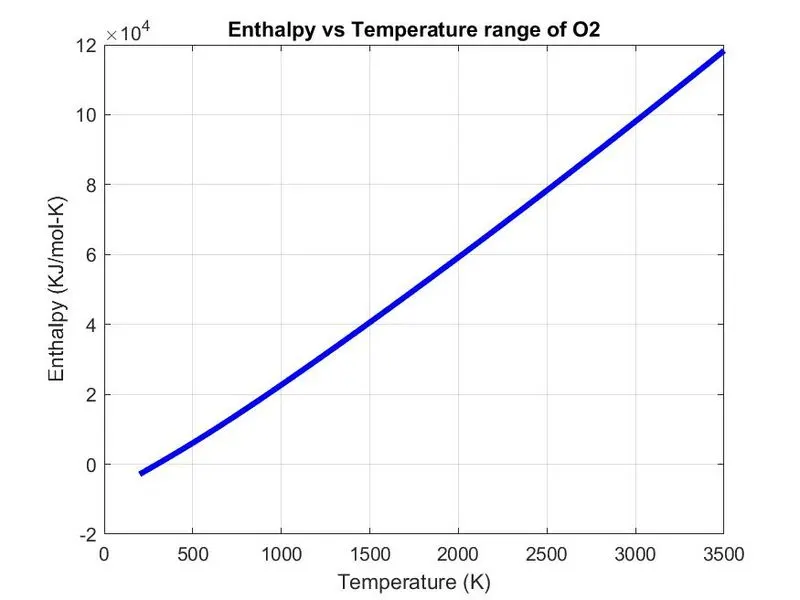
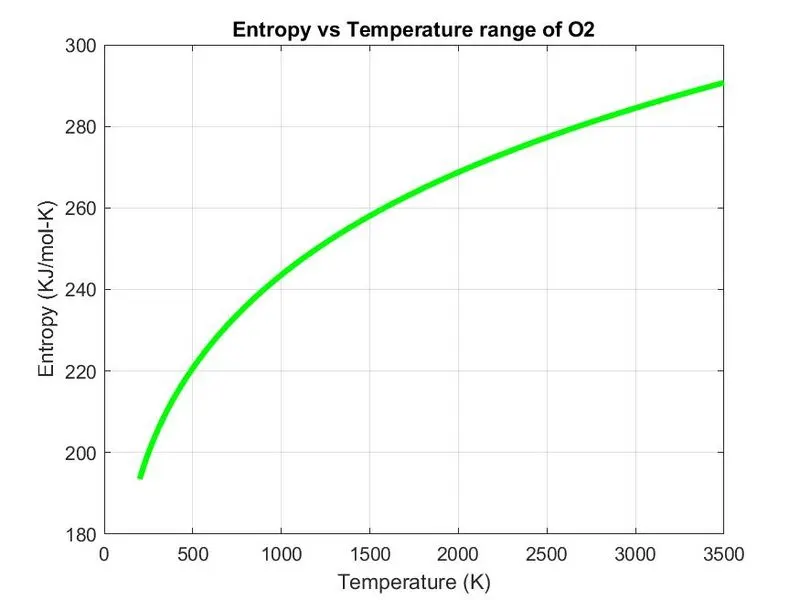
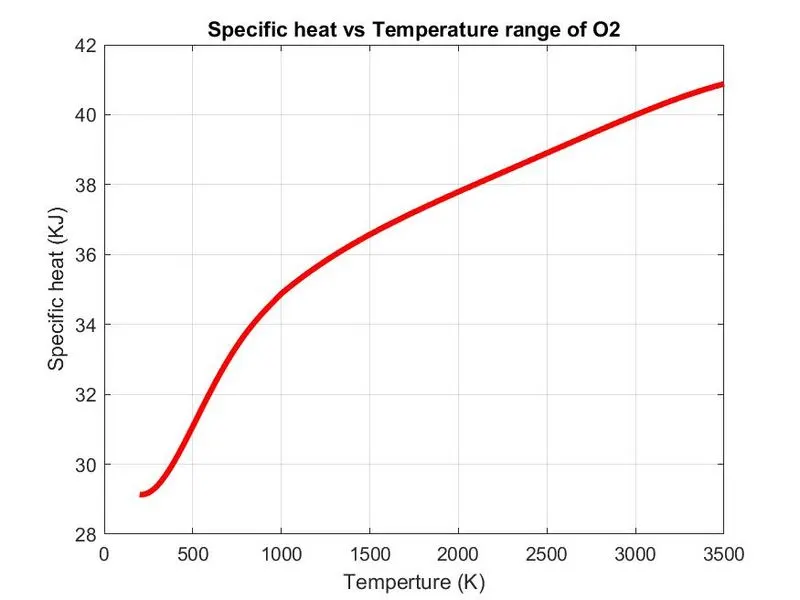
Plot For N2
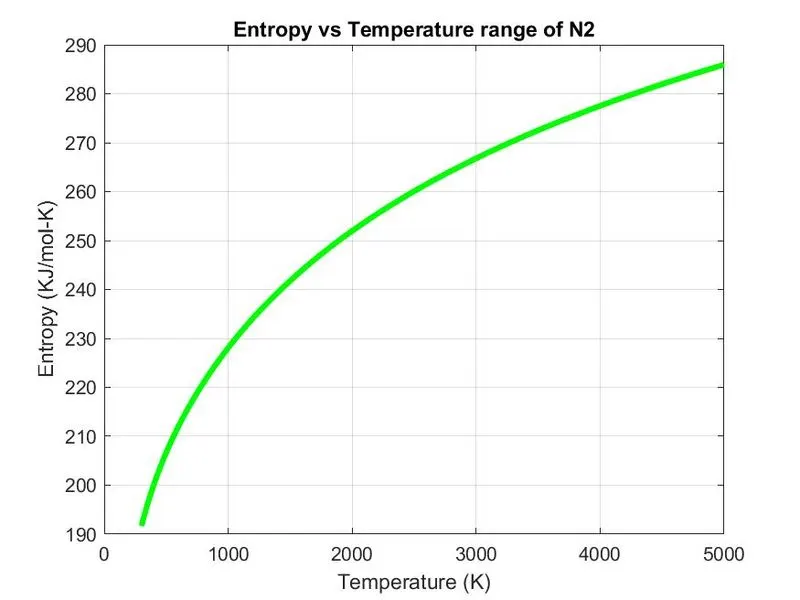
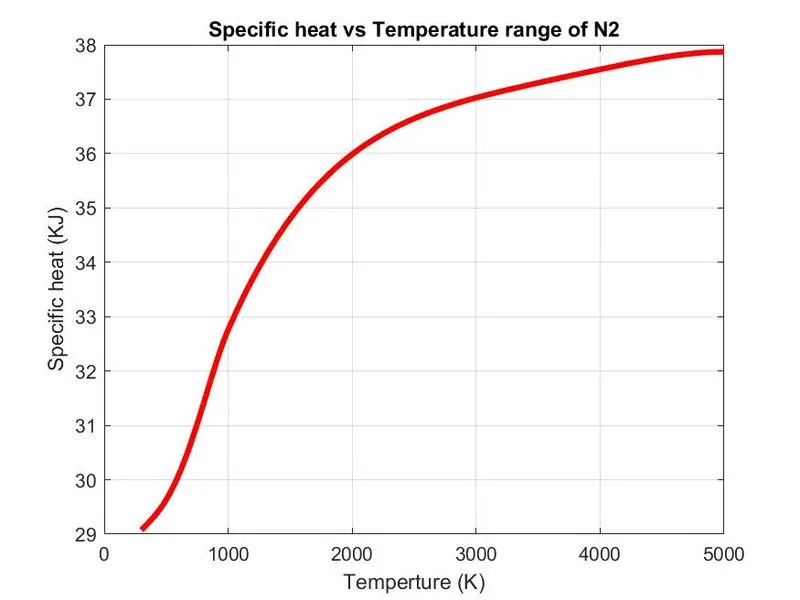
Plot For CO2
Screenshot of the directory where different species are saved:-

Molecular Weight of all species(Text & Screenshot)
Molecular Weight of O : 15.999000
MW=
15.9990
Molecular Weight of O2 : 31.99800
Molecular Weight of O2 : 31.99800
MW=
31.9980
Molecular Weight of H : 1.008000
Molecular Weight of H : 1.008000
MW =
1.0080
Molecular Weight of H2 : 2.016000
Molecular Weight of H2 : 2.016000
MW=
2.0160
Molecular Weight of OH : 17.007000
Molecular Weight of OH : 17.007000
MW=
17.0070
Molecular Weight of H2O : 18.015000
Molecular Weight of H2O : 18.015000
MW=
18.0150
Molecular Weight of H2O2 : 34.014000
Molecular Weight of H2O2 : 34.014000
MW=
34.0140
Molecular Weight of C : 12.011000
Molecular Weight of C : 12.011000
MW=
12.0110
Molecular Weight of CH : 13.019000
Molecular Weight of CH : 13.019000
MW=
13.0190
Molecular Weight of CH2 : 14.027000
Molecular Weight of CH2 : 14.027000
MW=
14.0270
Molecular Weight of CH2(S) : 14.027000
Molecular Weight of CH2(S) : 14.027000
MW=
14.0270
Molecular Weight of CH3 : 15.035000
Molecular Weight of CH3 : 15.035000
MW=
15.0350
Molecular Weight of CH4 : 16.043000
Molecular Weight of CH4 : 16.043000
MW =
16.0430
Molecular Weight of CO : 28.010000
Molecular Weight of CO : 28.010000
MW=
28.0100
Molecular Weight of CO2 : 44.009000
Molecular Weight of CO2 : 44.009000
MW=
44.0090
Molecular Weight of HCO : 29.018000
Molecular Weight of HCO : 29.018000
MW=
29.0180
Molecular Weight of CH2O : 30.026000
Molecular Weight of CH2O : 30.026000
MW=
30.0260
Molecular Weight of CH3O : 31.034000
Molecular Weight of CH3O : 31.034000
MW=
31.0340
Molecular Weight of CH3OH : 32.042000
Molecular Weight of CH3OH : 32.042000
MW=
32.0420
Molecular Weight of C2H : 25.030000
Molecular Weight of C2H : 25.030000
MW=
25.0300
Molecular Weight of C2H2 : 26.038000
Molecular Weight of C2H2 : 26.038000
MW=
26.0380
Molecular Weight of C2H3 : 27.046000
Molecular Weight of C2H3 : 27.046000
MW=
27.0460
Molecular Weight of C2H4 : 28.054000
Molecular Weight of C2H4 : 28.054000
MW=
28.0540
Molecular Weight of C2H5 : 29.062000
Molecular Weight of C2H5 : 29.062000
MW=
29.0620
Molecular Weight of C2H6 : 30.070000
Molecular Weight of C2H6 : 30.070000
MW=
30.0700
Molecular Weight of CH2CO : 42.037000
Molecular Weight of CH2CO : 42.037000
MW=
42.0370
Molecular Weight of HCCO : 41.029000
Molecular Weight of HCCO : 41.029000
MW=
Molecular Weight of HCCOH : 42.037000
Molecular Weight of HCCOH : 42.037000
MW=
42.0370
Molecular Weight of H2CN : 28.034000
Molecular Weight of H2CN : 28.034000
MW=
28.0340
Molecular Weight of HCN : 27.026000
Molecular Weight of HCN : 27.026000
MW=
27.0260
Molecular Weight of HNO : 31.014000
Molecular Weight of HNO : 31.014000
MW=
31.0140
Molecular Weight of N : 14.007000
Molecular Weight of N : 14.007000
MW=
14.0070
Molecular Weight of NNH : 29.022000
Molecular Weight of NNH : 29.022000
MW=
29.0220
Molecular Weight of N2O : 44.013000
Molecular Weight of N2O : 44.013000
MW=
44.0130
Molecular Weight of NH : 15.015000
Molecular Weight of NH : 15.015000
MW=
15.0150
Molecular Weight of NH2 : 16.023000
Molecular Weight of NH2 : 16.023000
MW=
16.0230
Molecular Weight of NH3 : 17.031000
Molecular Weight of NH3 : 17.031000
MW=
17.0310
Molecular Weight of NO : 30.006000
Molecular Weight of NO : 30.006000
MW=
30.0060
Molecular Weight of NO2 : 46.005000
Molecular Weight of NO2 : 46.005000
MW=
46.0050
Molecular Weight of HCNO : 43.025000
Molecular Weight of HCNO : 43.025000
MW=
43.0250
Molecular Weight of HOCN : 43.025000
Molecular Weight of HOCN : 43.025000
MW=
43.0250
Molecular Weight of HNCO : 43.025000
Molecular Weight of HNCO : 43.025000
MW=
Molecular Weight of NCO : 42.017000
Molecular Weight of NCO : 42.017000
MW=
42.0170
Molecular Weight of CN : 26.018000
Molecular Weight of CN : 26.018000
MW=
26.0180
Molecular Weight of HCNN : 41.033000
Molecular Weight of HCNN : 41.033000
MW=
41.0330
Molecular Weight of N2 : 28.014000
Molecular Weight of N2 : 28.014000
MW=
28.0140
Molecular Weight of AR : 39.948000
Molecular Weight of AR : 39.948000
MW=
39.9480
Molecular Weight of C3H8 : 44.097000
Molecular Weight of C3H8 : 44.097000
MW=
44.0970
Molecular Weight of C3H7 : 43.089000
Molecular Weight of C3H7 : 43.089000
MW=
43.0890
Molecular Weight of CH3CHO : 44.053000
Molecular Weight of CH3CHO : 44.053000
MW=
44.0530
Molecular Weight of CH2CHO : 43.045000
Molecular Weight of CH2CHO : 43.045000
MW=
43.0450


Conclution
Using Octave code,the necessary coefficient required to evaluate various thermodynamic parameters for
different species are extracted from NASA thermodynamic data file.The specific heat,entropy&enthalpy for
all the species are calculated and plotted aganist the local temperature range.The molecular weight is
calculated for all the species.
Googledrive link
https://drive.google.com/drive/folders/1lXrqo8ZWE_mF38WWy4TR2w7KfO-oX1YV?usp=sharing