Project-1: Modelling an electric Car with Li-ion battery
First commercialized in 1991, the lithium-ion battery was initially created for the consumer electronics sector. It quickly lent itself to further applications, eventually becoming standard for all devices requiring a portable rechargeable battery. It superseded nickel cadmium (NiCd) and nickel-metal hydride (Ni-MH) technologies.
The operation of a lithium-ion battery
is to circulate electrons by creating a difference in potential between two electrodes, one negative and the other positive, that are immersed in a conductive ionic liquid called the electrolyte. When the battery is powering a device, the electrons accumulated in the negative electrode are released via an external circuit to travel to the positive electrode: this is the discharging phase. Conversely, when the battery is charging, the energy supplied by the charger sends the electrons back from the positive electrode to the negative.
vary by ion types, electrode materials and the associated electrolytes. The 12-volt lead-acid battery that has traditionally been used to power the starter of a combustion-engine vehicle, for example, relies on an electrolyte containing lead ions and electrodes that are lead-based. As for the lithium-ion battery, it uses lithium ions (Li+): hence the name given to this technology.
A lithium-ion battery such as the one inside a car like theis designed as an assembly of individual battery units (cells), connected to each other and monitored by a dedicated electronic circuit. The number of cells, the size of each cell and the way in which they are arranged determine both the voltage delivered by the battery and its capacity, meaning the amount of electricity it is able to store. This is generally stated in watt-hours (Wh), or in kilowatt-hours (kWh) in the automotive industry.
The properties of a lithium-ion battery
Lithium-ion batteries can just as well be found in consumer electronics (telephones, laptops) as in electric cars. The main reason for this large-scale success essentially lies in the storage density that lithium-ion technology allows for.
This concept of density refers to the ratio between offered by the battery and its bulk or weight. By way of comparison, a lithium-ion battery offers a density of around 300 to 500 Wh/kg, i.e. some ten times more than a lead-acid battery.
While we await the potential development of innovations like the , lithium-ion technology today represents the best compromise between capacity, volume and mass in the electric mobility sector. It offers high voltage, easy recharging and durability, which lend themselves to usage scenarios that complement each other throughout its life cycle, in line with the
The comparison of the first four types of electric car batteries can be seen as follows: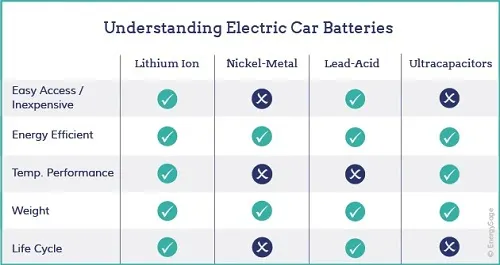
———————————————
Lithium-Ion Battery (Li-On)
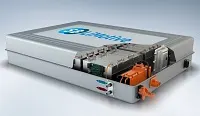 This type of electric vehicle battery is most widely applied is the Li-On battery. This battery may already be familiar to us because it is also used in many portable electronic equipment such as cellphones and laptops. The main difference is a matter of scale. Its physical capacity and size on electric cars is much greater – this is often referred to as a traction battery pack.
Li-on batteries have a very high power to weight ratio. This type of electric car battery is high energy efficiency. Performance at high temperatures is also good. The battery has a greater energy ratio per weight – a parameter that is very important for electric car batteries. The smaller the battery weight (same kWH capacity) means the car can travel further with a single charge.
This battery also has a low “self-discharge” level, so the battery is better than any other battery in maintaining its ability to hold its full charge.
In addition, most parts of Li-on batteries can be recycled, making it the right choice for those interested in environmentally conscious electric cars. BEV cars and PHEVs use the most lithium batteries.
Li-on battery Types
- Lithium Iron Phosphate(LiFePO4) — LFP
- Lithium Nickel Cobalt Aluminum Oxide (LiNiCoAlO2) — NCA
- Lithium Nickel Manganese Cobalt Oxide (LiNiMnCoO2) — NMC
- Lithium Titanate (Li2TiO3) — LTO
- Lithium Manganese Oxide (LiMn2O4) — LMO
- Lithium Cobalt Oxide(LiCoO2) — LCO
Li-ion battery parameters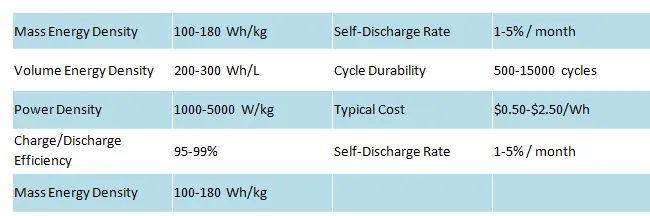
———————————————
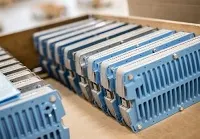
Hybrid Nickel-Metal (NiMH) Batteries
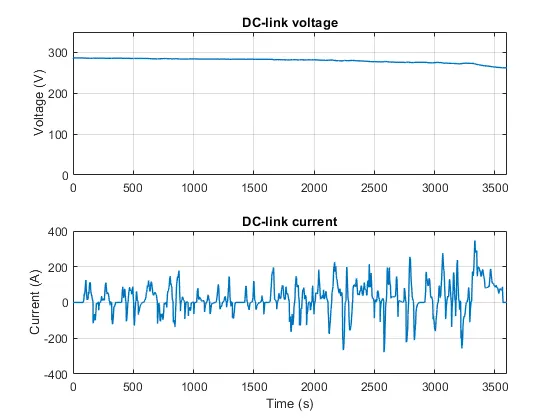
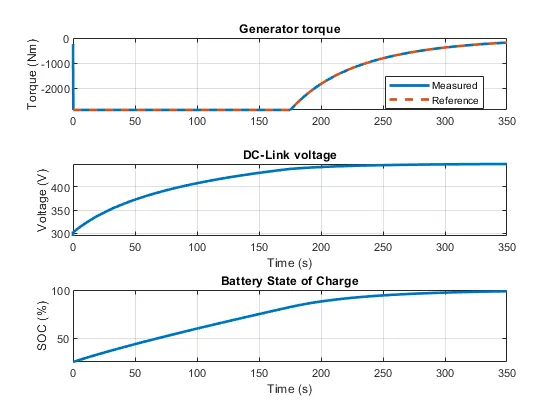
The Static Capacity Test measures the charge and energy capacities of the battery between
maximum and minimum pack voltages when discharged at a one-hour (CД) constant current rate,
based on rated capacity.³ Pack voltage versus capacity discharged during the Static Capacity Test is
Three iterations of the Static Capacity Test are performed at each interval, and
the average results from each interval test are shown in the test results summary t
Voltage versus capacity discharged during the static capacity test
Hybrid Pulse Power Characterization Test Results
The HPPC test is performed to characterize the discharge and charge pulse power capabilities of the
battery at each 10-percent depth-of-discharge interval. Numerical results derived from the HPPC
test results are summarized i. The results from these tests can be compared to
USABC power-assist HEV battery targets.
Motor for EV:
Both AC and DC motors cater to the same purpose of powering up electric cars and contributing to a healthier planet. But there’re some key advantages of using the former over the latter, which is perhaps the key reason why major electric car manufacturers prefer AC electric car motors. Let’s have quick look at them.
- A DC controller can be programmable, but generally it isn’t. AC inverters are just the perfect match for the motor they’re sold with and all the software parameters can be adjusted by the driver to best fit his/her driving style and the batteries.
- Because of the nice set up of the AC system, it’s capable of taking energy back from braking and giving it out under acceleration. So, a huge amount of battery power can be recovered during the normal driving process. Though a few DC systems can also do that, it makes them more expensive and complex.
- AC electric car motors generate favorable torque, thus helping the transmission to last longer. With them, you can be rest assured of avoiding expensive issues like twisted shafts, broken gear teeth, and damaged CV joints, among others.
- Unlike DC electric car motors where reversing is a bit more complicated, all it takes for the inverter (in AC motor) is to swap the sequence of 2 phases, and the rotor starts running in opposite direction.
- Absence of motor brushes eliminates issues like commutator arcing, brush advancing, and self-destroying at high RPM, among others.
- AC motors come with only one moving part, which makes them quiet, long-lasting, low-cost, and relatively trouble-free.
Many car buyers often overlook the importance of permanent magnet motors and induction motors, but these electric motors are capable of enhancing the performance of an electric car as a whole.
Some leading electric car manufacturers using AC and DC motors in their models include Tesla, Nissan, and Chevrolet, among others.
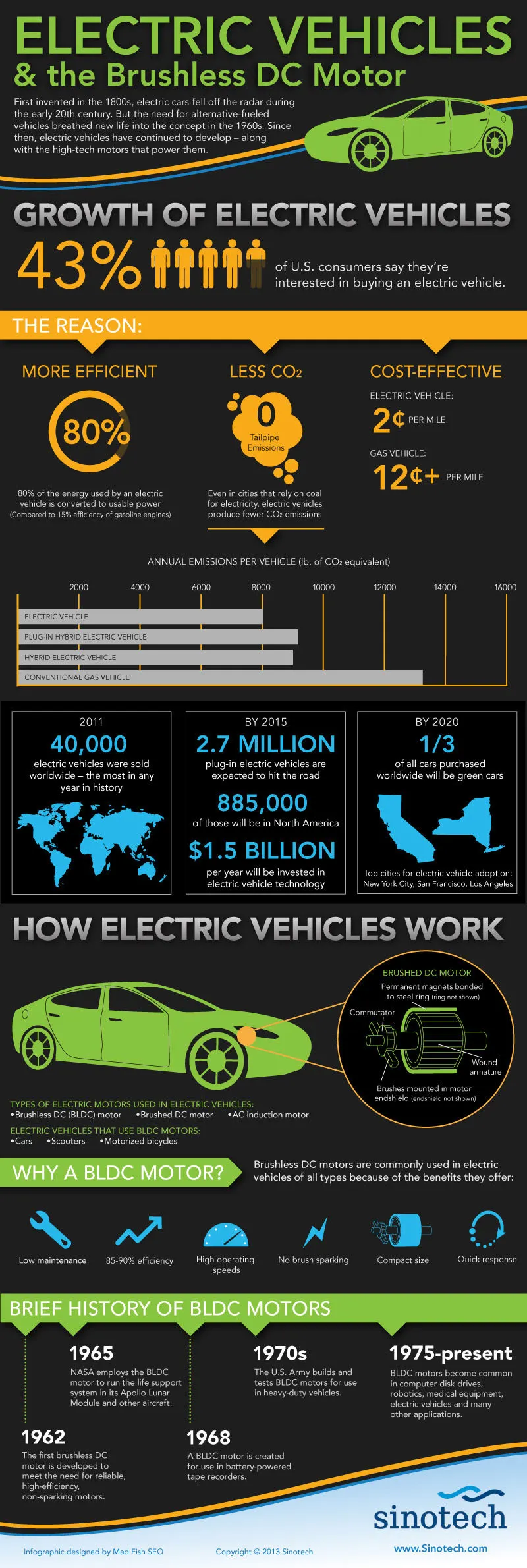
The Brushless DC Motor (BLDC Motor) in Electric Vehicles
Before the latest incarnation of electric vehicles, cars already used BLDC motors for windshield wipers, CD players, and power windows. Today’s automakers use three different types of electric motors in green cars: the BLDC motor, brushed DC motor, and AC induction motor.
The BLDC motor has a permanent-magnet rotor surrounded by a wound stator. The winding in the stator get commutated electronically, instead of with brushes. This makes the the BLDC motor:
-
Simpler to maintain,
-
More durable,
-
Smaller,
-
85%–90% more efficient,
-
Able to respond faster and at higher operating speeds,
-
Simpler to control in regard to speed control and reversing,
-
Lighter,
-
Less prone to the failures that brushed motors experience, and
-
Able to self-start.
The composition of the BLDC motor also keeps the machinery inside a vehicle cooler and thermally resistant. Plus, because the motor is brushless, there is no dangerous brush sparking.
The BLDC Motor Drive
All of today’s hybrid vehicles use a BLDC motor. Green car manufacturers often prefer BLDC motors over the alternatives because the peak point efficiency is higher and rotor cooling is simpler. The motors can also operate at “unity power factor,” meaning the drive can operate at its maximum efficiency levels.
Batteries and brakes. One of the most important components of the BLDC motor drive system is the batteries. In addition to supplying energy to the engine, they allow the electrical receivers to function. Therefore, it’s important that the batteries in green cars be as efficient as possible.
Whenever a battery gets used, an irreversible change in the chemical structure occurs. As a result, a rechargeable battery is most efficient when maintained close to full charge. Thanks to the permanent magnets in the brushless DC motor and the ability for the external torque to work as a generator, a person operating a green car can pulse-charge the battery by applying the brakes. It’s important to note, however, that braking alone won’t fully charge an electric car’s battery.
Motor response. Green car manufacturers and entities like NASA prefer BLDC motors because of their fast motor responses. The high-performance, small-diameter magnetic rotors reduce the inertia of the armature, allowing high acceleration rates, a reduction in rotational losses, and smoother servo characteristics. This optimal motor response also allows for more constant speeds, instant speed regulation and a quieter drive system.
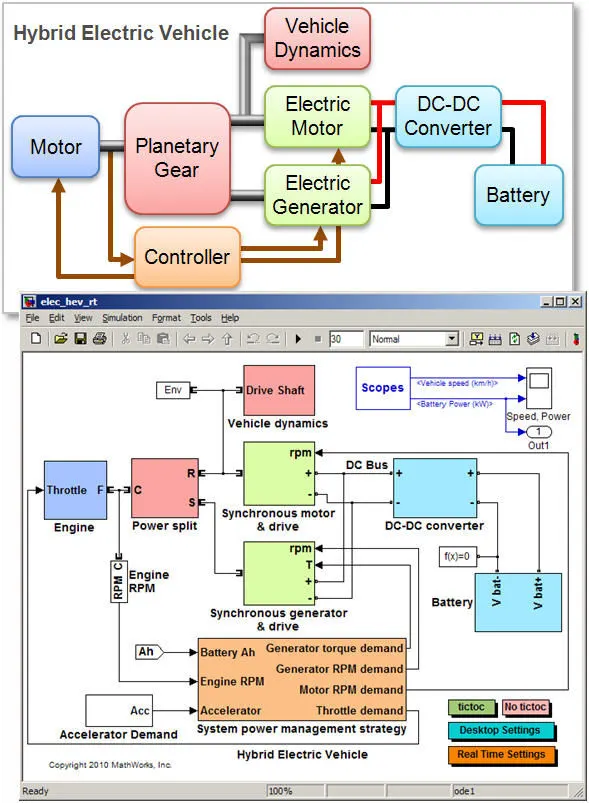
To model BEV, all mathematical equations applied to each part in the BEV simulation have been selected. Six
components are included in the simulation model: the transmission model, motor model, controller model for
battery charge, driving cycle, driver model and longitudinal model vehicle dynamics,
. Simulation of Battery Electric Vehicle
the mathematical equations used by all subsystem blocks have generated the BEV simulation
model. In addition, reflects the battery voltage, current & capacity,
and charging state of the battery. All the data shows the simulation is running in a successful state. Also, the
Latest Driving Cycle was choosen to quantify the amount of emissions from engine and fuel economy in Indoor
Electric V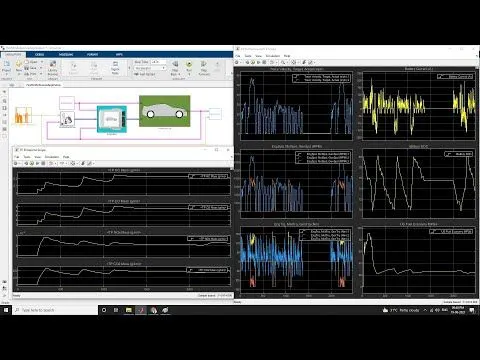
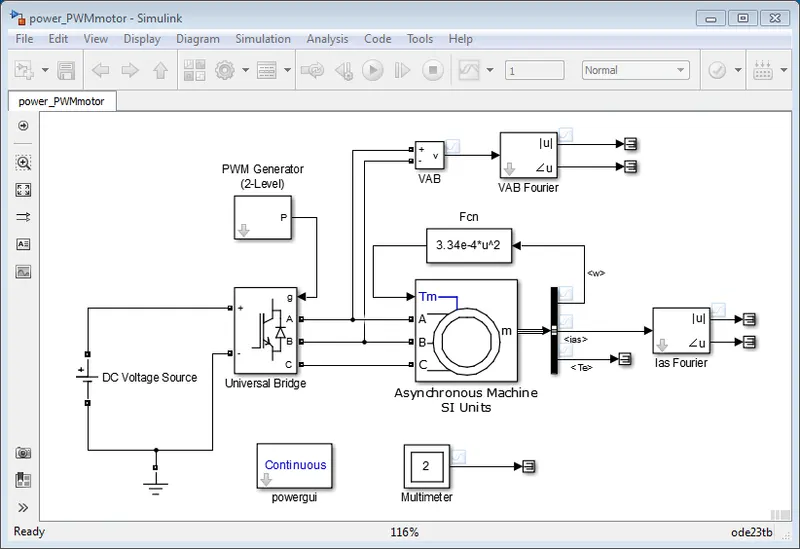
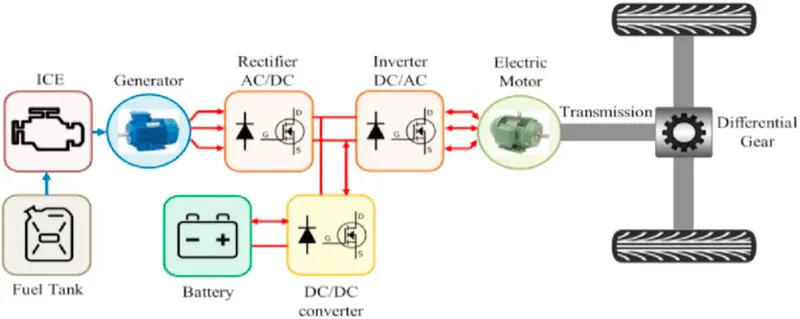
Results: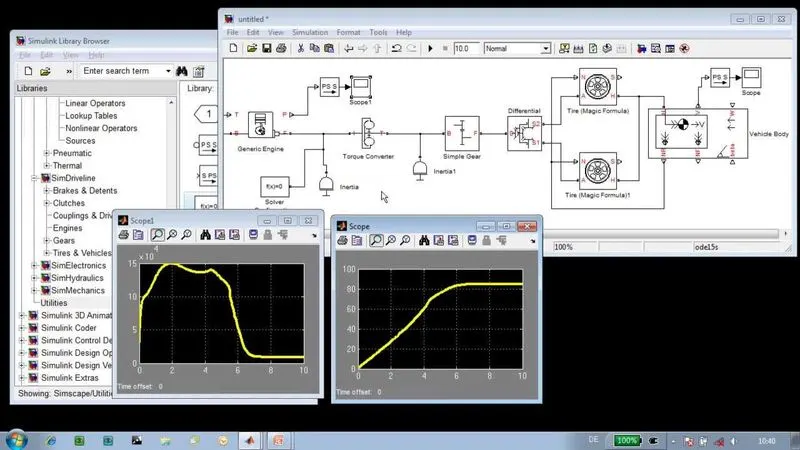
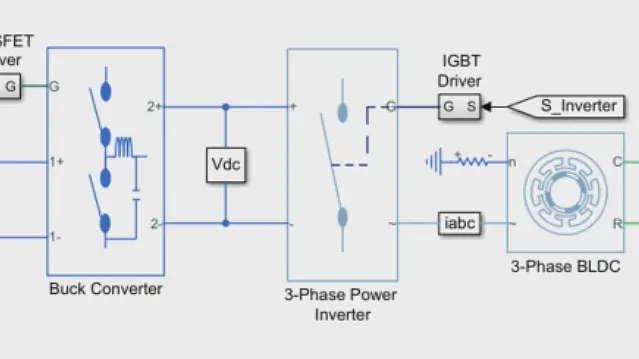
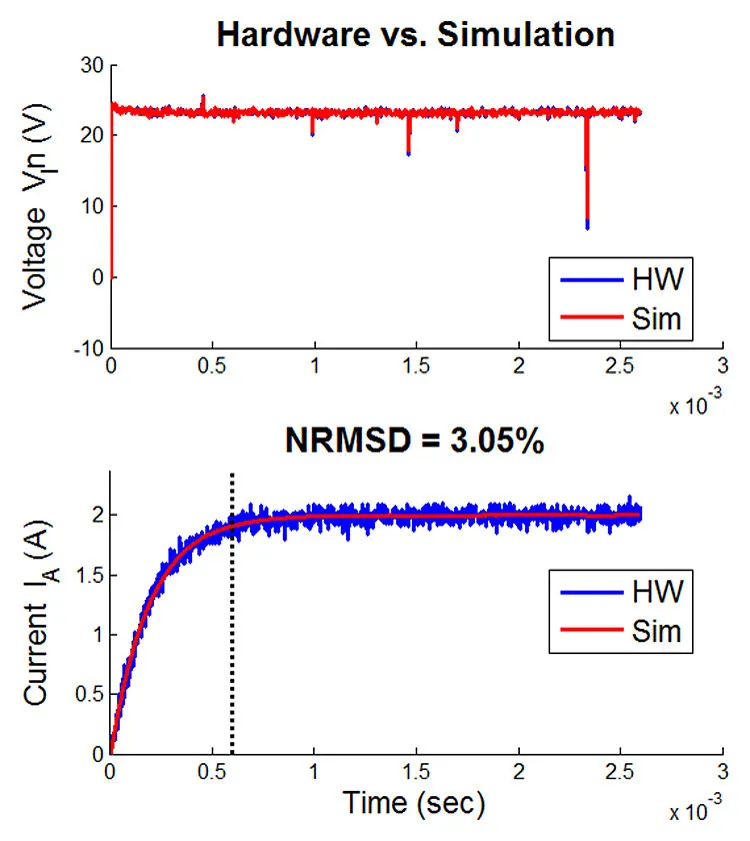
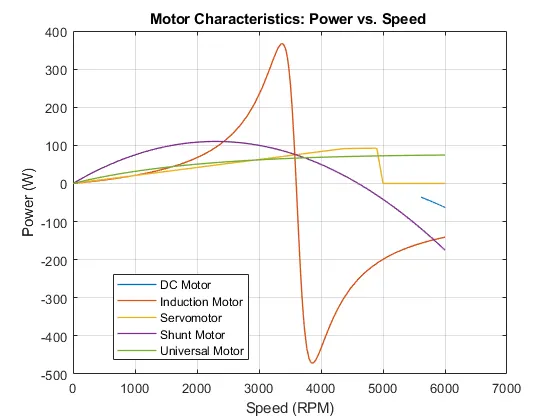
- System design:
- No pulse-width modulation (PWM) or power electronic switching
- Simplified dynamics
- Energy-based, steady-state equivalent and efficiency map modeling
- Control design:
- Ideal switching
- Lumped-parameter modeling
- Linear torque-current relationship
- Motor drive design:
- Non-ideal switching – physics-based modeling of power semiconductors
- Saturation – nonlinear dependence on current and/or rotor angle
- Spatial harmonics – including torque ripple caused by cogging and harmonics in the flux linkage