Project 1 (Mini Project on Vehicle Direction Detection
AIM: To Development the MATLAB Model of Vehicle Direction Determination and to create the Data Dictionary creation & code generation.
Concept of ADAS
Advanced Driver Assistant System (ADAS) are electronic systems that help the vehicle driver while driving or during parking. Through a safe human-machine interface, ADAS increase car and road safety. ADAS use automated technology, such as sensors and cameras, to detect nearby obstacles or driver errors, and respond accordingly.
As most road accidents occur due to human error ADAS are developed to automate, adapt, and enhance vehicle technology for safety and better driving. ADAS are proven to reduce road fatalities by minimizing human error. Safety features are designed to avoid accidents and collisions by offering technologies that alert the driver to problems, implementing safeguards, and taking control of the vehicle if necessary. Adaptive features may automate lighting, provide adaptive cruise control, assist in avoiding collisions, incorporate Satellite Navigation and traffic warnings, alert drivers to possible obstacles, assist in lane departure and lane centering, provide navigational assistance through smart-phones, and provide other features.
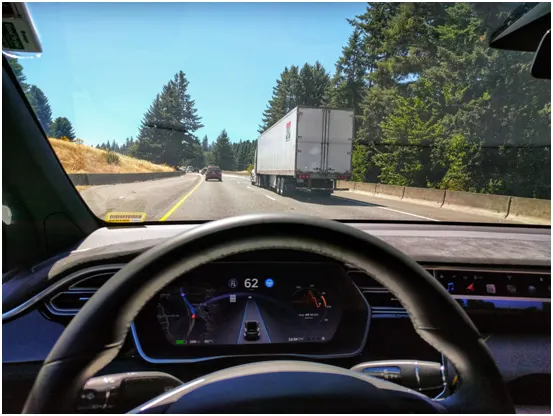
Fig: Assisted control of distance from the leading car centering in lane enabled in a Tesla
Features Examples
Adaptive cruise control (ACC) can maintain a chosen velocity and distance between a vehicle and the vehicle ahead. ACC can automatically brake or accelerate with concern to the distance between the vehicle and the vehicle ahead. ACC systems with stop and go features can come to a complete stop and accelerate back to the specified speed. This system still requires an alert driver to take in their surroundings, as it only controls speed and the distance between you and the car in front of you.
Anti-Lock Braking System (ABS) restore traction to a car’s tires by regulating the brake pressure when the vehicle begins to skid. Alongside helping drivers in emergencies, such as when their car starts to skid on ice, ABS systems can also assist drivers who may lose control of their vehicle.

Fig: ABS Symbol
MATLAB Model of Vehicle Direction Determination
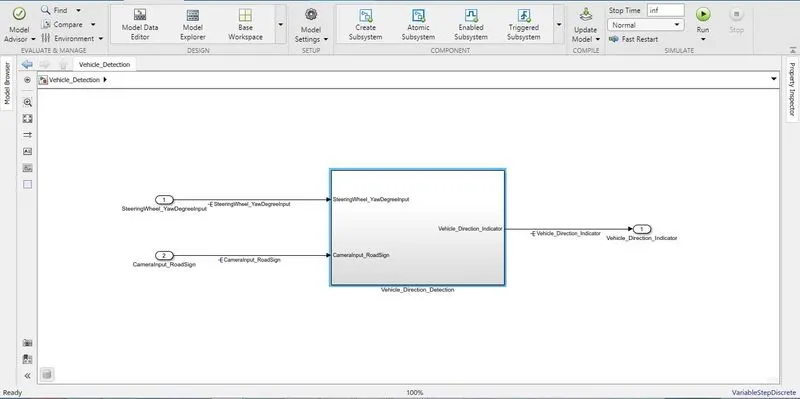
Steering wheel input as yaw rate and Camera input road sign are given as inputs to the system.
Double tab on the Vehicle Direction Detection sub-system tagging requirement 1 & requirement 2 to their corresponding subsystems i.e., Requirement 1 as Vehicle Direction and Requirement 2 as Vehicle Indicator.
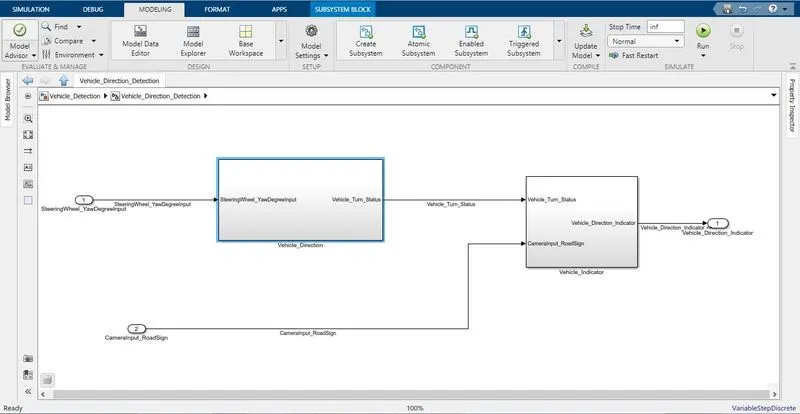
Requirement 1: Vehicle Direction Subsystem
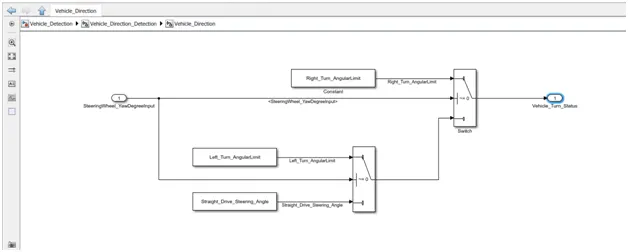
Requirement 2: Vehicle Indicator Subsystem
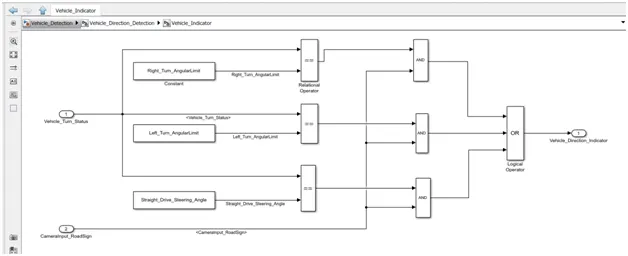
Vehicle Turn status and the Right turn angular limit both are compare to each other if the both signals are same then the output signal will be generated from the relational operator is compare with the camera input signal If the both the signals is equal and OR operator compare with the left turn angular limit (or) straight drive steering angle.
Creating a Data Dictionary
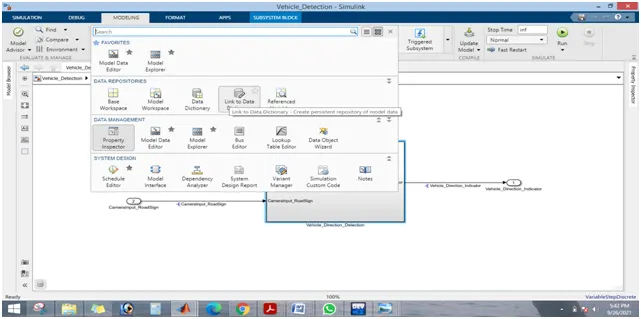
A data dictionary is a persistent repository of data that are relevant to your model. The model Data Dictionary files requires for all signals, parameters used by model based dictionary feature. Model Based Dictionary supported in 3 different formats like SLDD.file, m-file, & mat-file.
Go to Modeling option in Simulink taskbar select Link to Data Dictionary as shown in figure and I have created the data dictionary as vehicle direction detection dd.sldd
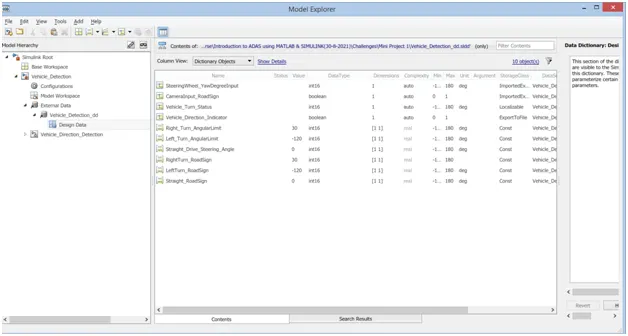
Open the model explorer and determine the input, calibration and output values.
Then Model Advisor and select the our model and a popup window will open
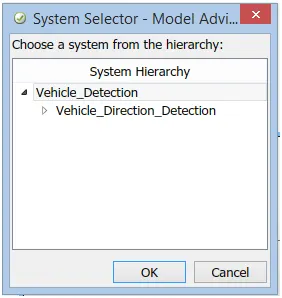
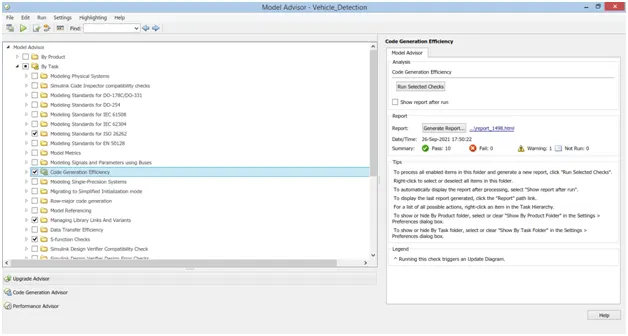
I have checked for the limited tasks and after checks completed generator a report as shown in figure.
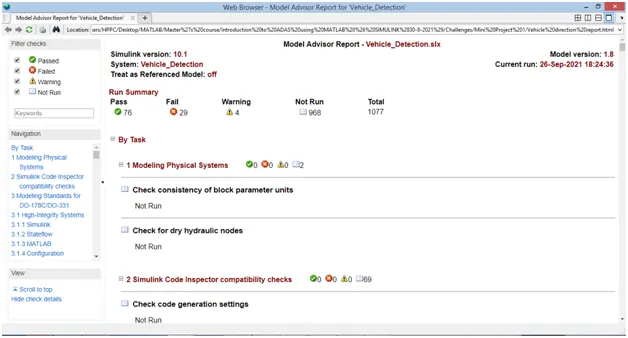
Conclusion:
Thus the MATLAB Model of Vehicle Direction Detection is executed as per given requirements and model advisor report as been submitted.