Project 1 Mechanical design of battery pack
Question: Battery pack capacity: 18 kWh Cell: ANR26650M1-B. Prepare a detailed battery pack drawing along with its enclosure. State your assumptions.
Solution:
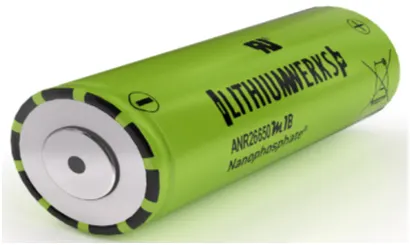
Lithium Werks’ 26650 cells are capable of delivering very high power due to its use of patented Nanophosphate ® battery technology. Based on lithium iron phosphate chemistry (LiFePO4), the cells are inherently safe over a wide range of temperatures and conditions. Whether the application requires outstanding cycle life or stable float reliability, the Lithium Werks’ 26650 cells are suitable for a wide variety of power, pulse, or stand-by applications.
Nanophosphate® battery technology offers stable chemistry, faster charging, consistent output, excellent cycle life and superior cost performance. It provides the foundation for safe systems while meeting the most demanding customer requirements. Multiple layers of protection are employed at the chemistry, cell and system level to achieve an energy storage solution with superior safety and abuse tolerance compared to metal oxide lithium-ion chemistries.
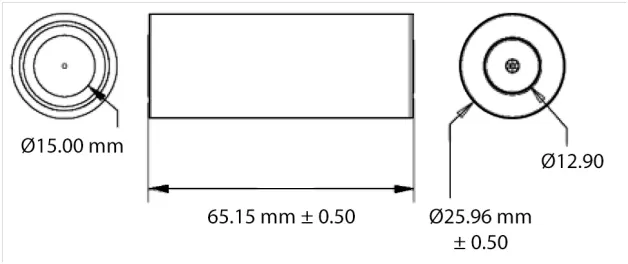
Dimension
Applications
- Energy storage
- Uninterruptible Power Supplies
- Communication technologies
- Aerospace
- Electrified mobility devices
- Industrial equipment
- Medical devices
- Toys
Parameter
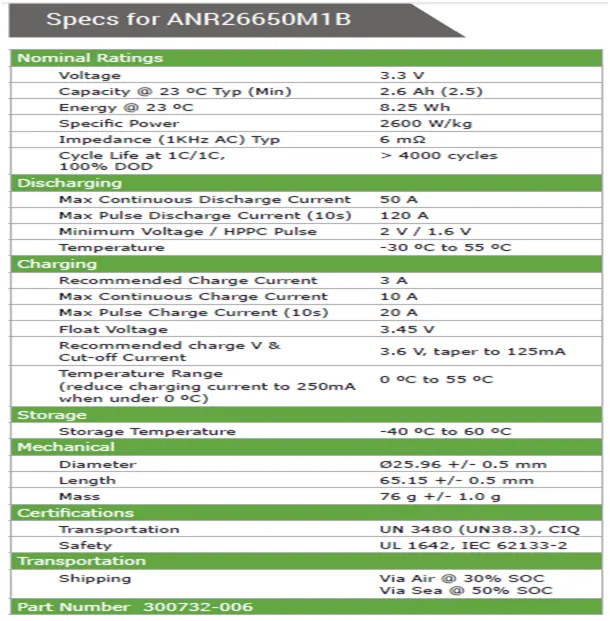
Based on the cell parameters provided by the manufacturers, we can calculate the energy content, volume, gravimetric density and volumetric density for each cell.
With the above cell parameters and the core requirements for the battery (nominal voltage, average energy consumption and vehicle range), we calculate the main parameters of the high voltage battery.
The required battery pack total energy Ebp [Wh] is calculated as the product between the average energy consumption Eavg [Wh/km] and vehicle range Dv [km]. For this example we’ll design the high voltage battery pack for a vehicle range of 250 km and battery pack total energy of 18.6kWh.
Ebp=Eavg⋅Dv
18.1*103= Eavg. * 250
Eavg=18600/250= 74Wh/km
The number of battery cells connected in series Ncs [-] in a string is calculated by dividing the nominal battery pack voltage Vbp [V] to the voltage of each battery cell Vbc [V]. The number of strings must be an integer. Therefore, the result of the calculation is rounded to the higher integer.
Assuming nominal Battery pack Voltage Vbp=297V
Given;
Vbc= 3.3V
Ncs=Vbp/Vbc
Nsc= 297/3.3= 90 cell in series.
The energy content of a string Ebs [Wh] is equal with the product between the number of battery cells connected in series Ncs [-] and the energy of a battery cell Ebc [Wh].
Ebs=Ncs*Ebc
Ebs= 90*8.25
Ebs= 742.5Wh
The total number of strings of the battery packs Nsb [-] is calculated by dividing the battery pack total energy Ebp [Wh] to the energy content of a string Ebs [Wh]. The number of strings must be an integer. Therefore, the result of the calculation is rounded to the higher integer.
Nsb=Ebp/Ebs
Nsb= 18600/742.5
Nsb= 25 cell connected in parallel or string of the battery pack.
We can now recalculate the battery pack total energy Ebp [Wh] as the product between number of strings Nsb [-] and the energy content of each string Ebs [Wh].
Ebp=Nsb⋅Ebs
Ebp= 25* 742.5
Ebp= 18.56kWh approx 18.6kWh
The battery pack capacity Cbp [Ah] is calculated as the product between the number of strings Nsb [-] and the capacity of the battery cell Cbc [Ah].
Cbp=Nsb⋅Cbc
Cbp= 25*2.6
Cbp= 65Ah
The total number of cells of the battery pack Ncb [-] is calculated as the product between the number of strings Nsb [-] and the number of cells in a series Nsc [-].
Ncb=Nsb⋅Nsc
Ncb= 25*90
Ncb= 2250 no of cells of battery pack
The size and mass of the high voltage battery are very important parameter to consider when designing a battery electric vehicle (BEV). In this example we are going to caclulate the volume of the battery pack considering only the battery cells. In reality there are other factors to consider, like: electronic circuits, cooling circuit, battery casing, wiring, etc.
The battery pack mass (cells only) mbp [kg] is the product between the total number of cells Ncb [-] and the mass of each battery cell mbc [kg].
mbp=Ncb⋅mbc
mbp= 2250*0.079
mbp= 177.75 kg
The volume of the battery pack (cells only) Vbp [m3] is the product between the total number of cells Ncb [-] and the mass of each battery cell Vcc(pc) [m3]. This volume is only used to estimate the final volume of the battery pack, since it does not take into account the auxiliary components/systems of the battery.
Volume can be calculated using the formula
Vcc=(Lbc)*π D2 bc/4
Given;
Dbc [m] = 0.026 m; battery cell diameter
Lbc [m] = 0.065 m; battery cell length
Vcc= 0.065*π * (0.026)2/4
Vcc= 3.5*10-5 m3
So, Vbp=Ncb⋅Vcc(pc)
Vbp= 2250*3.5*10-5
Vnp= 0.0776 m3
The volume can be also calculated function of number of strings and number of cells in a string. This calculation method is more appropriate for cylindrical cell, since the volume occupied by a cylindrical cell must take into account the air gap between cells.
The string peak current Ispc [A] is the product between the peak C-rate of the battery cell C-ratebcp [h-1] and the battery cell capacity Cbc [Ah].
Ispc=C-ratebcp⋅Cbc
Ispc= 1*2.5
Ispc= 2.5A
The battery pack peak current Ibpp [A] is the product between the string peak current Ispc [A] and the number of strings of the battery pack Nsb
Ibpp=Ispc⋅Nsb
Ibpp= 2.*25
Ibpp= 62.5A
The battery pack peak power Pbpp [W] is the product between battery pack peak current Ibpp [A] and the battery pack voltage Vbp [V].
Pbpp=Ibpp*Vbp
Pbpp= 62.5*297
Pbpp= 18.5kW
The string continuous current Iscc [A] is the product between the continuous C-rate of the battery cell C-ratebcc [h-1] and the battery cell capacity Cbc [Ah].
Iscc=C-ratebcc⋅Cbc
Iscc= 1*2.5
Iscc= 2.5A
The battery pack continuous current Ibpc [A] is the product between the string continuous current Iscc [A] and the number of strings of the battery pack Nsb [-].
Ibpc=Iscc⋅Nsb
Ibpc= 2.5*25
Ibpc= 62.5A
The battery pack continuous power Pbpc [W] is the product between battery pack continuous current Ibpc [A] and the battery pack voltage Vbp [V].
Pbpc=Ibpc⋅Vbp
Pbpc= 62.5*297
Pbpc= 18.5kW
Conclusion: Battery pack has been designed using following assumption:
- Battery voltage is assumed to be 297V. High voltage is taken in consideration to obtained high speed.
- Range of vehicle is taken as 250Km.
- The obtained data satisfy the following assumption
Battery pack assembly is the process of integrating modules into metal or carbon-fiber composite enclosures that incorporate power, charging and temperature management features. Key components include battery modules, cooling systems, power electronics and battery management systems.
Pouch cell battery module
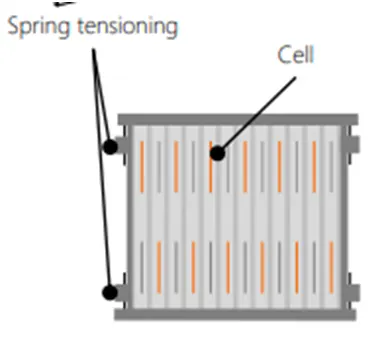
It is important to note that the pouch cells expands/shrinks in its thickness during the charging or discharging cycle. Each pouch cell is inserted into a frame. Due to the swelling of the cells, the frames are arrested flexible by springs. Cooling in a pouch module is optional and can be served by either convective or liquid coolant. For example, pouch cells can be serial connected and cooled via Uprofiles.
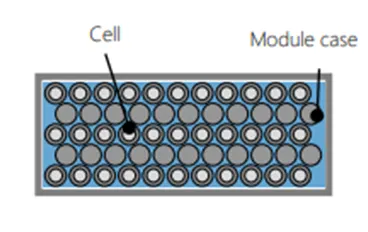
In the architecture of a round cell module, the cells are fixed by the module case. The space between the cells can be used by a cooling system or direct cooling. The metal housing prevents the cell from swelling. At module level, the cells can be connected both serial and parallel. The cells are contacted via a metal plate on both sides.
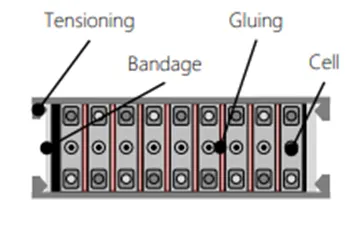
Prismatic cell battery module
Prismatic cells can be installed without remaining gaps. The individual cells are glued together. The adhesive film serves both as electrical and thermal insulator in the event of an accident. The cells are clamped with a bandage and/or a plastic or metal housing.
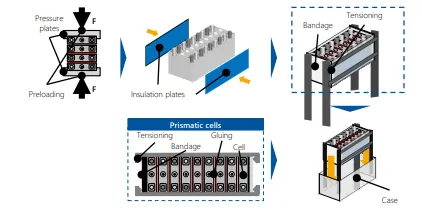
Insulation and Tensioning
Stacked cells are pressed to create a defined stack geometry and minimize swelling during charge and discharge. The pressure is applied onto the stack by a clamping device, a bandage or by the module body itself. Plastic plates or foils are used for heat dissipation and electrical insulation, which prevent heat transfer and current flow between the cells. These are intended to interrupt a chain reaction in the event of a cell failure. Exact positioning of the components on the module and subsequent gluing and/or screwing and insertion into the housing. For pouch cells, instead of gluing, it is possible to insert them into individual frames (drawer systems) and then bracing them.
Electrical Contacting
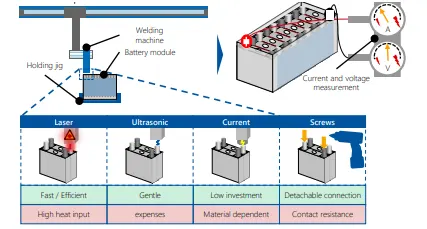
Wiring of the cells by electrical connection of the contact tabs / current collectors. Depending on the module voltage, the cells are contacted to form one or more parallel strings. Contact e.g. by the use of ultrasonic welding (low heat input), laser welding (high precision) or screw connections (electrical losses due to contact resistances). Checking the joints for conductivity by resistance measurements. With a high degree of automation, the welding seams can be inspected during the welding process by an optical inspection.
Mounting of the Slave Circuit Board
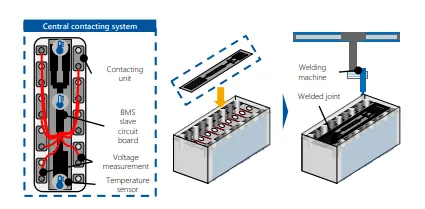
Positioning the slave circuit board of the battery management system (BMS) or a complete contacting unit for processing the data and controlling the sensors. Joining the circuit board to the module by welding and/or screwing. Mounting of the voltage measuring cables by means of screwed or welded connections and gluing of the temperature sensors. Connection of the sensor system to the circuit board via plug connections. Functional test by signal testing and random testing of the weld seams by X-ray or ultrasonic measurement.
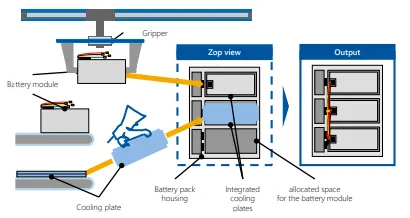
Insertion of the Cell Modules
Mount the cooling plates in the bottom of the battery pack tray for cooling the modules during operation (if necessary also heating function). Insert the battery modules into the pack housing by means of appropriate grippers into the bottom of the pack. Repeat these steps until all modules (here schematically three modules per pack) are inserted. The construction and wiring of battery packs vary greatly between applications and suppliers (e.g. 4S3P, 6S3P, 12S1P etc. / S=Serial, P=Parallel). Two serial module strings are often connected in parallel.Fully electric vehicles have high-energy cells. Hybrid vehicles have highpower cells.