Project 1 Mechanical design of battery pack
Project 1:
To Prepare a detailed battery pack drawing along with its enclosure
Battery pack capacity: 18 kWh
Cell: ANR26650M1-B
In this project, we are going to calculate the all parameters which are required for the build EV battery pack. We are going to use the Cell: ANR26650M1-B for our battery pack.
OBJECTIVE:
1) Collecting the data of Cell: ANR26650M1-B from Nanophosphate High Power LithiumIon Cell PDF.
2) Calculating all Electrical parameters for 18 kWh Battery Pack.
3) Calculating all Physical dimensions for Battery Pack.
4) Consider perfect enclosure for dimensions that we calculated for the Battery Pack
Specifications:
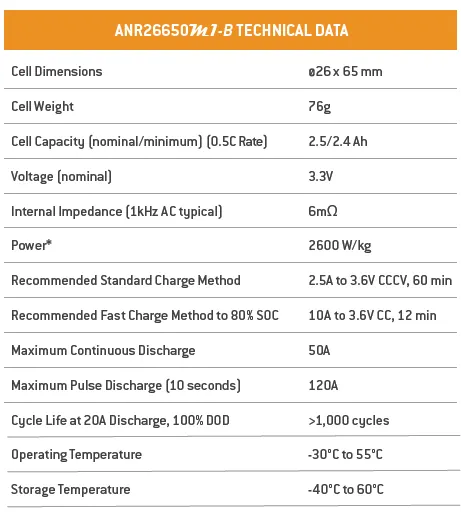
ANR26650M1-B Specifications
Nominal Ratings
Voltage: 3.3 Volts
Capacity: 2.5 Ah
Energy: 8.25 Wh
Specific Power: 2600 W/kg
Impedance (1KHz AC Typical) 6 mΩ
Cycle Life at 1C/1C, 100% DOD: > 4000 cycles
Cell Type: 26650 Lithium Ion Power Cylindrical Cell
Discharging
Max Continuous Discharage: 50 A
Max Pulse Discharge Current >50% SOC (10s): 120 A
Minimum Voltage: 2 Volts
Temperature: -30ºC to 55ºC
Charging
Recommended Standard Charge: 2.5 Amps
Max Charge Rate: 10 Amps
Max Pulse Charge Current <50% SOC (10s): 25 A
Float Voltage: 3.45 Volts
Recommended charge V & Cut-off Current: 3.6 Volts, taper to 125mA
Temperature
(reduce charging current to 250mA when under 0ºC): 0ºC to 55ºC
DATAS FROM DATASHEET:
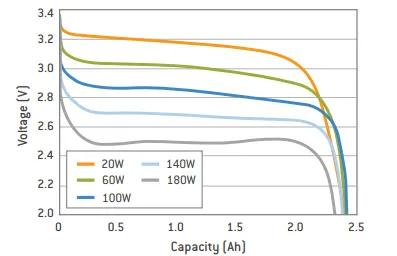
CONSTANT POWER DISCHARGE:(23* C)
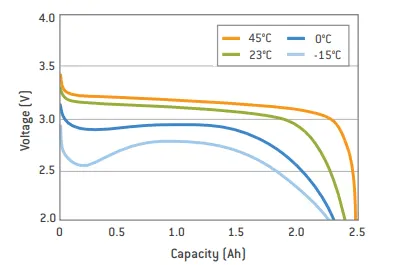
2.5C Constant Current Discharge at Various Temperatures:
Our cells have a low capacity loss and impedance growth over time as well as high usable energy over a wide state of charge (SOC) range, allowing our systems to meet end-of-life power and energy requirements with minimal pack oversizing.
A123’s high-performance Nanophosphate lithium iron phosphate (LiFePO4) battery technology delivers high power and energy density combined with excellent safety performance and extensive life cycling in a lighter weight, more compact package.
PROCEDURE:
1) First we have to start with Cell calculation.
2) After assumptions, we have to do Battery pack calculations.
3) from Cell Dimensions we calculate the surface required for a battery pack.
4) Depending upon the above calculations we build Battery Pack construction
CALCULATION PARTS:
A)CELL DIMENSIONS:
Assumptions: We Assume EV Battery Pack Voltage is 230 V
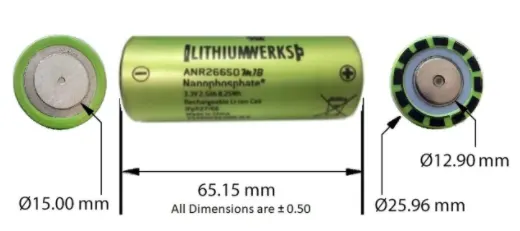
KNOWN DATA FROM DATASHEET:
- Cell Diameter = 26 mm or Cell Radius = 13 mm
- Cell Height = 65 mm
- Cell Capacity = 2.5 Ah
- Cell Voltage = 3.3 V
- Cell Weight = 76 g
Calculations:
Single Cell Calculations:
1) Volume Of the Cell:
For Cylindrical Cells Voume = pi*r^2*h
Where, Radius = 0.013m
Height = 0.065m
Volume = 3.14*(0.013)^2*0.65
Volume = 0.0000344929 m^3 or 3.45*10^5 m^3 //
2) Energy Of Single Cell:
Ecell = Ccell * Ucell
Where,
- Ecell [Wh] – battery cell energy, in watts-hour
- Ccell [Ah] – battery cell (current) capacity, in amperes-hour
- Ucell [V] – battery cell voltage, in volts
Energy, Ecell = 2.5 * 3.3 = 8.25 Wh
Energy, Ecell = 8.25 Wh//
3) Energy Density Of A Cell or Volumetric Energy:
Volumetric energy (Wh/m3) = Single Cell Energy / Volume of each cell
Volumetric energy (Wh/m3) = 8.25 Wh / 0.0000344929 m3
Volumetric energy (Wh/m3) = 239179.65 Wh/m3
4) Specific Energy Density Of A Cell:
Specific Energy Density (Wh/kg) = Single Cell Energy / Weight of each cell
Specific Energy Density (Wh/kg) = 8.25 Wh / 0.076 kg
Specific Energy Density (Wh/kg) = 108.55 Wh/kg //
B) Battery Pack Calculation:
By using Cell Dimension, We can Calculate Battery Pack Calculation by using series and Parallel Connections.
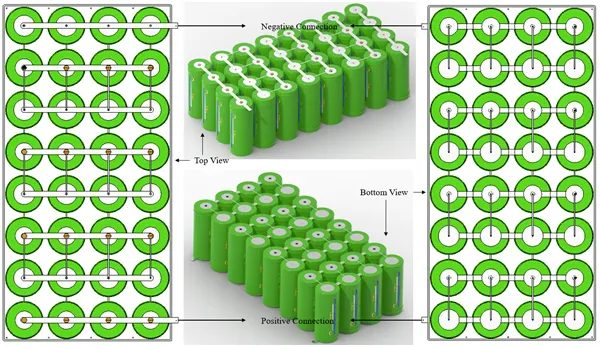
1) Number Of Cells in a Battery Pack:
W.k.t, Energy Of Single Cell = 8.25 Wh//
Required Battery Pack Energy = 18,000 Wh
No.of Cells = 18000/8.25 = Approx 2182//
So, it Clear that minimum No. of Cells Required is 2182//
a) Series Cell Connections,
Assumptions, We Assume EV Battery Pack Voltage is 230 V//
Voltage Depends on the series Connection,
No. of Cells in series = Assumed EV Voltage / Voltage Of a Single Cell
No. of Cells in series = 230 / 3.3 = 69.69
No. of Cells in series =70//
b) Parallel Cell Connections,
Current Capacity Depends on the Parallel Connection,
EPack= CPack * UPack
W.k.t, EPack ,Required Battery Pack Energy = 18,000 Wh
UPack,Assume EV Battery Pack Voltage = 230 V
CPack= EPack / UPack
CPack= 18000/230 = 78.26 Ah//
To Attain this Current Capacity,
No. of Cells in Parallel = Current Capacity of Pack / Current Capacity Of a Single Cell
No. of Cells in Parallel = 78.26 / 2.5 = 31.3
No. of Cells in Parallel=32//
Total No. of Cells For Battery pack = No.of cells in series * No.of cells in Parallel
Total No. of Cells For Battery pack = 70*32 = 2240//
Total No. of Cells For Battery pack =2240//
2) Energy Of a Battery Pack:
Energy of a single cell, Ecell = 8.25 Wh
Total No. of Cells For Battery pack =2240
Energy Of a Battery Pack = Energy of a single cell * No. of Cells
Energy Of a Battery Pack = 8.25 * 2240
Energy Of a Battery Pack = 18.48 Kwh//
3)Mass of the battery pack:
It is the product of the total number of cells and the mass of each battery cell.
Mass of Battery pack = no.of cells * Weight Of Each Cell
Mass of Battery pack = 2240 * 0.076
Mass of Battery pack = 170.24 kg//
4) Volume of Battery Pack:
It is the product of the total number of cells and the mass of each battery cell. This volume is only used to estimate the final volume of the battery pack since it does not take into account the auxiliary components/systems of the battery.
Volume of Battery pack = no.of cells * Volume Of Each Cell
Volume of Battery pack = 2240 * 0.0000344929
Volume of Battery Pack = 0.07726 m3
5) String peak Current of a cell:
It is the product of the Peak C Rate and Cell Capacity.
String peak Current of a cell = Peak C Rate * Cell Capacity
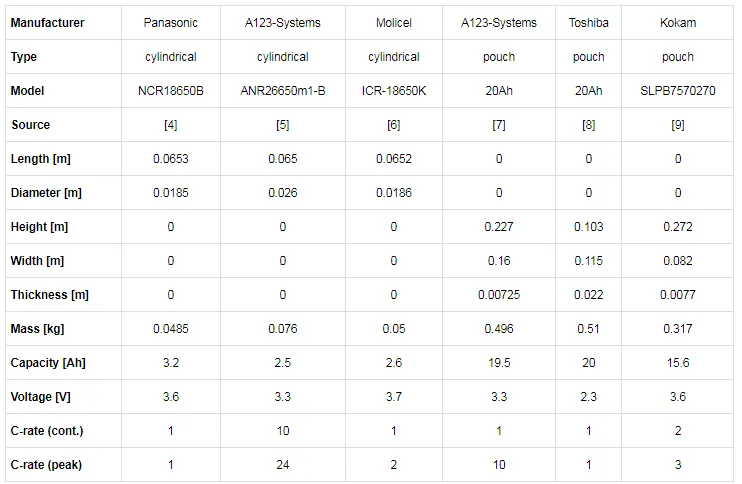
From Datasheet,W.k.t Peak C Rate =24//
String peak Current of a cell = 24 * 2.5
String peak Current of a cell = 60 A//
6) Battery peak Current :
It is the product of the No.of Cells in parallel and String Peak Current.
Battery peak Current = No.of Cells in Parallel * String peak Current of a cell
Battery peak Current = 32*60
Battery peak Current = 1920 A//
7) Battery Pack Peak Power:
It is the Product Of Battery Peak Current and Battery Pack Voltage.
Battery Pack Peak Power = Battery Peak Current * Battery Pack Voltage
Battery Pack Peak Power = 1920 * 230
Battery Pack Peak Power = 441.6 KW//
8) String Continuous Current:
It is the Product Of the Continuous C Rate And Cell Capacity.
String Continuous Current = Continuous C Rate * Cell Capacity
From Datasheet,W.k.t Continuous C Rate =10//
String Continuous Current = 10 * 2.5
String Continuous Current = 25 A//
9) Battery pack Continuous Current :
It is the product of the String Continuous Current and No.of Cells In parallel
Battery Continuous Current = No.of Cells in Parallel * String Continuous Current of a cell
Battery Continuous Current = 32*25
Battery Continuous Current = 800 A//
10) Battery Pack Continuous Power:
It is the Product Of Battery Continuous Current and Battery Pack Voltage.
Battery Pack Continuous Power = Battery Continuous Current * Battery Pack Voltage
Battery Pack Continuous Power = 800 * 230
Battery Pack Continuous Power = 184 KW//
C) Battery Casing dimensions:
Battery Casing Dimension are calculated below:
1. Length of casing
Length = number of cells in series x (cell diameter + margin at both side of cells ) + clearance at side
L = 70 x (26 + 4) + 60 = 2160 mm
2. Breadth of the casing (B)
Breadth = number of cells in parallel x (cell diameter + margin at both side of cell) + clearance at side
B = 32 x (26 +4) + 60 = 1020 mm
3. Height of casing (H)-
Height = Height of cell + margin for wiring
H = 65+35 = 100 mm
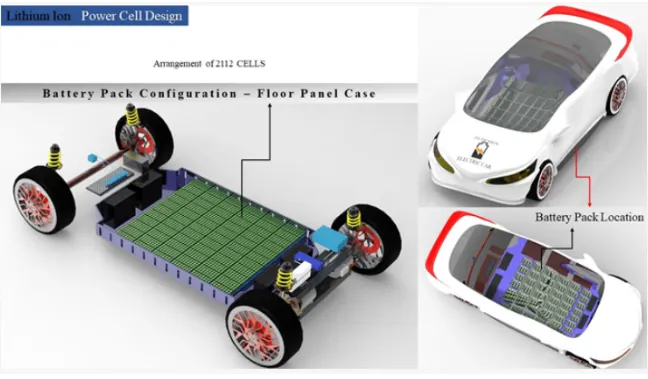
Here I also configure battery pack into electric vehicle lower floor panel case, a simple layout of the battery pack in an electric vehicle is shown below:
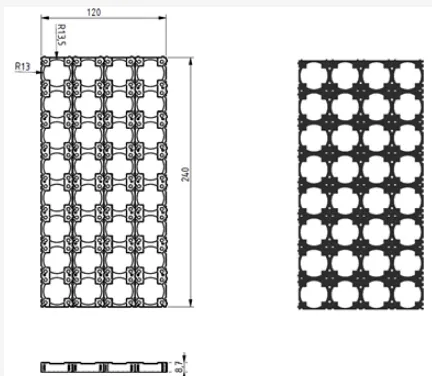
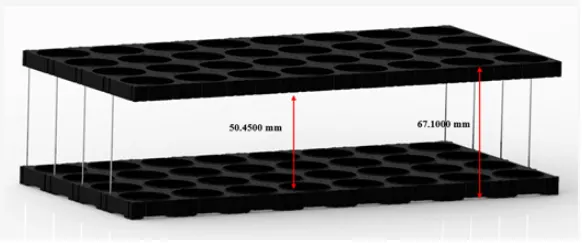
Design of cell holder (Bottom and Top):
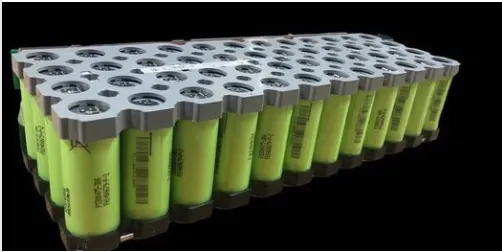
The main function of a battery holder is to keep cells fixed in place safely and securely also it is used to keep cells in a proper arrangement so that there will be a decrease in mechanical vibration, and have a better thermal runway in between the cell gaps. Most of the cell holder is made up of polypropylene or nylon bodies rated for 80–100 °C.
Design of pack cover
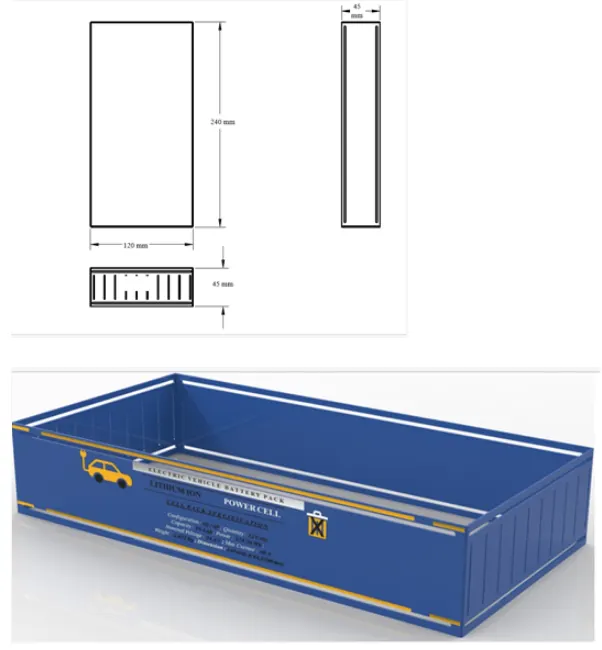
Basically, Pack cover is made up of Aluminium and the reason behind is to keep battery pack for lightweight. The casing/cover thickness is 0.5 mm and the design is as shown below: A bottom cover is shown to cover below the bottom of battery Holder.
Design of Lower floor case for battery pack
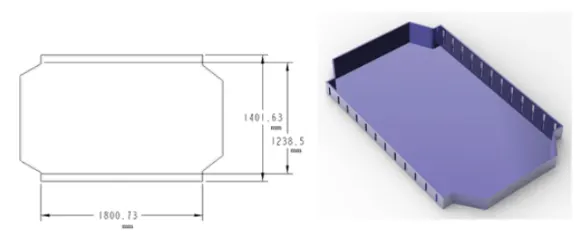
Basically, the lower case is a part which is fitted in an electric vehicle for the assembly of the battery pack. A lower case is also made up of aluminum and it has top cover and bottom cover to battery pack from dust and environmental pollution.
The design of the lower case is shown
Install BMS for the battery pack:
Install cooling structures for air cooling/ liquid cooling
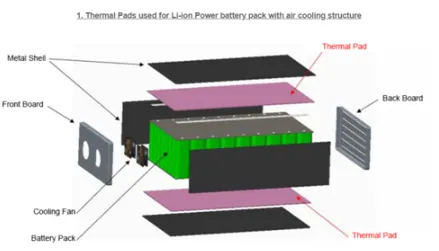
Install thermal pads for battery pack with air cooling
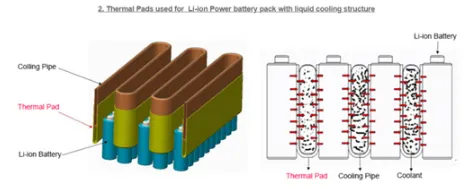
Battery pack with liquid cooling:
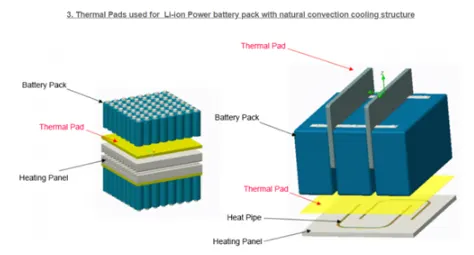
Battery pack with convection cooling structure:
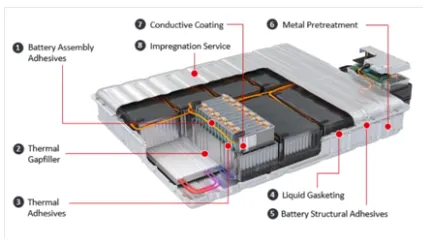
RESULTS:
Calculated Parameters are Tabulated Below:
| CRITERIA | RESULTS |
| Manufacture | A123 - Systems |
| Number of cells in the series | 70 |
| Number of cells in the Parallel | 32 |
| Cell energy | 8.25 Wh |
| Battery pack energy | 18.48 Kwh |
| Total number of cells | 2240 |
| Battery pack mass | 170.24 kg |
| battery pack volume | 0.07726 m^3 |
| Battery pack peak current | 1920 A |
| Battery pack peek power | 441.6 kW |
| Battery pack continuous current | 800 Ah |
| Battery pack continuous power | 184 kW |
Conclusion:
Thus,a detailed battery pack drawing along with its enclosure is Prepared And Calculated.
References:
1) https://x-engineer.org/ev-design-battery-calculation/
2) https://datasheetspdf.com/datasheet/search.php?sWord=ANR26650M1-B