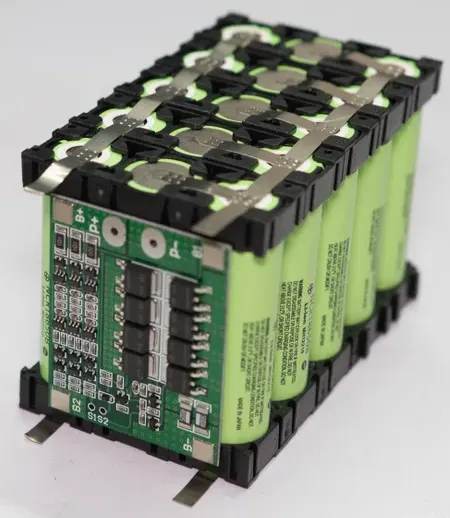
Project 1 Mechanical design of battery pack
SOLUTION:
Data-sheet of the battery: https://datasheet.octopart.com/ANR26650M1B-A123-Systems-datasheet-154674353.pdf
ANR26650M1-B Specifications
Nominal Ratings
- Voltage: 3.3 Volts
- Capacity: 2.5 Ah
- Energy: 8.25 Wh
- Specific Power: 2600 W/kg
- Impedance (1KHz AC Typical) 6 m2
- Cycle Life at 1C/1C, 100% DOD: > 4000 cycles
- Cell Type: 26650 Lithium lon Power Cylindrical Cell
- Discharging
- Max Continuous Discharage: 50 A
- Max Pulse Discharge Current >50% SOC (10s): 120 A
- Minimum Voltage: 2 Volts
- Temperature: -30°C to 55°C
Charging
- Recommended Standard Charge: 2.5 Amps
- Max Charge Rate: 10 Amps Max Pulse Charge Current <50% SOC (10s): 25 A
- Float Voltage: 3.45 Volts
- Recommended charge V & Cut-off Current: 3.6 Volts, taper to 125mA
Temperature
- (reduce charging current to 250mA when under O°C): 0°C to 55°C
Mechanical
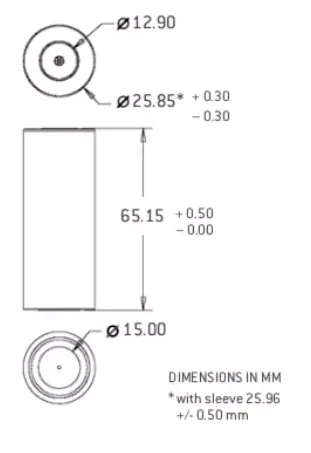
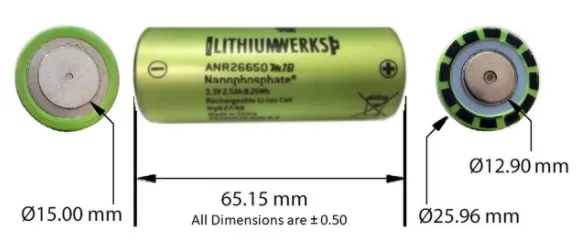
- Diameter: Ø25.96 +/- 0.5 mm (1.0")
- Length: 65.15 +/- 0.5 mm (2.6")
- Mass: 76 g
Calculation as per assumptions:- 18kWh Battery Pack
Calculation for designing an 18kWh battery pack, basically 18kWh is energy require to achieve the vehicle its proper range. It is depending upon the voltage (V) parameter and ampere-hour or capacity (Ah).
Here we design a high voltage battery pack for an electric vehicle to achieve its range up to 220 km. For this calculation, I assumed 400 V a nominal voltage for series connection.
Basically, the value of the volume of the cell is used to find out the total volume of the battery pack.
- Single Cell Energy (Wh)
Cell Capacity (Ah) x Cell Voltage (V)
= 2.6 x 3.3
=8.58 Wh
The value of a single cell is used to calculate the total energy of the battery pack.
- Single Cell Energy Density
Volumetric energy (Wh/m^3) - Single Cell Energy / Volume of each cell
= 8.58 Wh / 0.03451 m^3
= 248.62 Wh/m^3
Gravimetric energy (Wh/kg) = Single Cell Energy/Single Cell Mass
= 8.58 Wh / 0.076 kg
= 112.89 Wh/kg
- Calculation of High Voltage Battery Pack
For design and calculation of battery pack here, I assume a vehicle to achieve 250 km in 18 kWh battery pack. Also, I assume 145.2 nominal voltage for series connection.
So, Vehicle Range - 250 KM (assumed)
- Battery Pack capacity = 18.121 kWh or 18120.96 Wh
Now, We will calculate per km average energy = 18120.96/250
= 72.483 Wh/km.
Therefore,
- Battery Pack total energy = Average energy x km
= 72.483 x 250
- 18120.96 Wh or 18.120 kwh
Let's assume Nominal voltage for series connection - 400 V. Basically, this depends upon the motor power, We can decide the value according to the motor.
- Number of cells connected in series
= Nominal voltage of series connection/Nominal voltage of a single cell
=400/3.3 V = 121
121 Cells will be connected in a series connection to provide a voltage.
- Energy for battery pack (wh)
= No. of cells connected in series x Single-cell energy
121 x 8.58 wh =1,038 wh
- Number of cells connected in parallel
= Battery pack total energy (wh) / Energy for battery pack (wh)
18120.96/1038 =17.45
18 cells will be connected in parallel to provide a proper capacity power.
- Battery pack total energy (wh)
= No. of cells connected in parallel x Energy for battery pack (wh)
18 x 1038 =18684 wh or 18.684 kWh
- Battery pack capacity
= No. of cells connected in parallel x Single cell capacity (Ah)
= 18 x 2.6 Ah = 46.8 Ah
The value of battery pack capacity is used for the total power required by the vehicle.
- Total number of cells for battery pack
No. of cells connected in parallel x No. of cells connected in series
=121 x 18 = 2178
2178 Cells will be used to make a complete battery pack.
- Mass of battery pack
Total no. of cells for batter pack x Mass of single cell
= 2178 x 0.076 kg = 165.528 kg
it is the total weight of cells connected in parallel and series.
- Total volume of the battery pack
= Total no. of cells for batter pack x Volume of single cell
= 2178 x 0.0345 = 75.14 m^3
This is the volume of 2112 cells which are used in the battery pack system.
- Cell peak current (A)
= C rate (Max Pulse Charge Current) x Single cell capacity
= 20 x 2.6 = 52 A
- Battery pack peak current (A)
= Cell peak current x No. of cells connected in parallel
=52X18 =936 A
It is used for the operation of the battery pack. By this way, a vehicle will deci
- Battery pack peak power (W)
= Battery pack peak current x Voltage of series connection
= 936 A x 400 V = 374.4 W
- Cell continuous current (A)
Crate (Max Continuous Charge Current) x Single cell capacity
10 x 2.6 = 26 A
- Battery pack continuous current (A)
Cell continuous current x No. of cells connected in parallel
= 26 x 18 = 468 A
This is the power which is supply continue to the whole battery pack system.
- Battery pack continuous power (W)
= Battery pack continuous current x Voltage of series connection
=468 x400V= 18.720 Kwh
MECHANILAL STRUCTURING:
Individual Cell Form Factor:
Battery Base Plate and Frame Structure:

Battery Connection Strips:
To make the battery pack, you have to connect the 2178 cells together by means of Nickel strips or thick wire. Generally. Nickel strips are widely used for this. In general two types of nickel, strips are available in the market: nickel-plated steel strips and pure nickel strips. I will suggest buying a pure nickel. It is a little bit costlier than nickel-plated steel, but it has much lower resistance. Low resistance means, less heat generation during the charging and discharging, which leads to longer useful battery life.

Assembly:
From the previous step, it is clear that our battery pack is made up of 18 parallel strings, and each parallel string has 121 cells in series. Now we have to arrange the cells properly for making the electrical connection among them and with the BMS board.
1. We can make a custom pack of any size according to your requirement.It's like solving a puzzle.
2. It provides space between the cells, which allow fresh air to pass and the battery gets cooled easily.
3. It makes your battery pack solid and reliable.
4. It provides safety anti-vibration to your battery pack