Project 1 - Loss calculation for a DC/DC converter-MATLAB
Loss Calculation for Boost DC-DC Converter
Introduction:
DC-DC Boost converter is a dynamic system because it consists of passive components like Inductor & Capacitor. These compomnents under the effect of thermal stress to generate power losses. The knowledge of these power losses is necessary to evaluate the conversion efficiency of the system. DC- DC Boost converter step up the voltage level. It consists of dc input source,Switching device like MOSFET, diode D, inductor L, capacitor C and load resistance R. The load may be R,RL,RLC etc.
Here we want to find the efficiency of a Boost converter. For that, we know in which part the losses takes place and how much losses occur across each component. Therefore, our main objective is to find out the losses occured in DC-DC converter for finding out the efficiency. The main objective of this project is to provide a mathematical tool for the calculation of power losses in MOSFET based power electronics converter used in automobile application.
Block Diagram of Boost Converter:
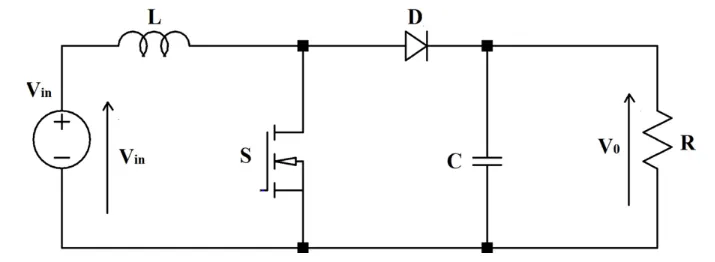
Figure 1. Ideal model of Boost Converter
We know that every paramemters in the universe is having an internal resistance which causes the losses across it and producses the heat. It adversly affect on the efficiency as well as performance. In ideal dc-dc converter, the losses is negligible and hence we get an 100% efficiency but practically it is not possible. Figure 1 shows the ideal model of Boost converter with negligible losses. Figure 2 shows the Boost converter with series losses through inductor (rL) and cpacitor (rC).
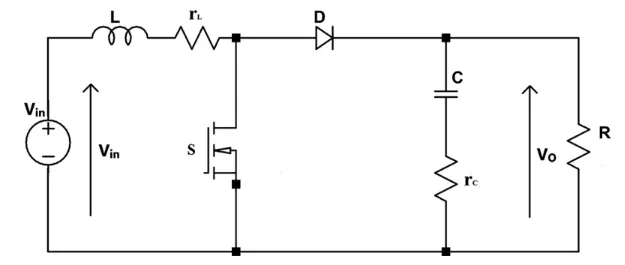
Figure 2. Boost Converter with series losses through inductor & capacitor
Where,
Vin= Input voltage in volt,
L= Inductance of inductor coil in Henry,
rL=Parasitic resistance of the inductor coil in Ohm,
S= High Speed Switching device (MOSFET),
Rds= Drain to Source On state resistance of MOSFET in Ohm (Not shown in figure 2) but it exists in series with a switch.
D= Power diode,
C= Capacitance of Capacitor in Farad,
rC= Parasitic resistance of the capacitor in Ohm,
R= Load reistance in Ohm,
Vo= Output voltage across load R.
Loss Calculation in Boost Converter:
Here we assumed that the operation and the selection of devices used in Boost converter is known. So our main objective of this project is to find out the losses in various components in Boost Converter. For that we assumed some parameters like-
Input voltage (Vin) = 14 volt;
Output Voltage (Vout) = 28 volt;
Drain to Source On State resistance Rds(on) = 0.023 ohm;
Switching frequency (Fs) = 100 kHz = 10^5 Hertz;
Diode Forward Voltage (VF) = 0.7 volt;
Forward Diode Resistance (RF) = 5 mOhm = 5*10^-3 ohm;
Parasitic resistance of Inductor (rL) = 0.3 ohm;
Rarasitic resistance of Capacitance (rC) = 40 mOhm = 40*10^-3 Ohm;
Output Capacitance (Co) = 100 pF = 10^-10 Farad;
Load Resistance (R) = 10 Ohm
Calculation:
For Boost Converter:
Vout / Vin = 1/ (1-D) -------------------------------------Formula
28/14 = 1/(1-D)
D = 0.5
Duty Cycle (D) = 0.5
In Boost Converter, the losses takes place at :
1) MOSFET (Metal Oxide Semiconductor Field Effect Transistor)
2) Power Diode
3) Inductor
4) Capacitor
We will find out the losses in each component step by step:
1) MOSFET:
MOSFET is a device which acts as a switching device and it operates at a very switching frequency. Here, we assumed that the switching frequency should be 100 kHz. When the switch is ON and OFF, the losses takes place across the switch due to its internal resistance.
There are two types of losses occured in MOSFET:
i) Conduction Losses
ii) Switching Losses
i) Conduction Losses (Pcond) :
When any device conducts the current, the heat is generated and power loss takes across it and it is expressed as:
Pcond = I2RMS(S) * Rds(on) --------------------------------(1)
When Switch is ON, Isw = Iin -------------------------for 0 < t < DT
When Switch is OFF, Isw = 0 ------------------------- for DT < t < T
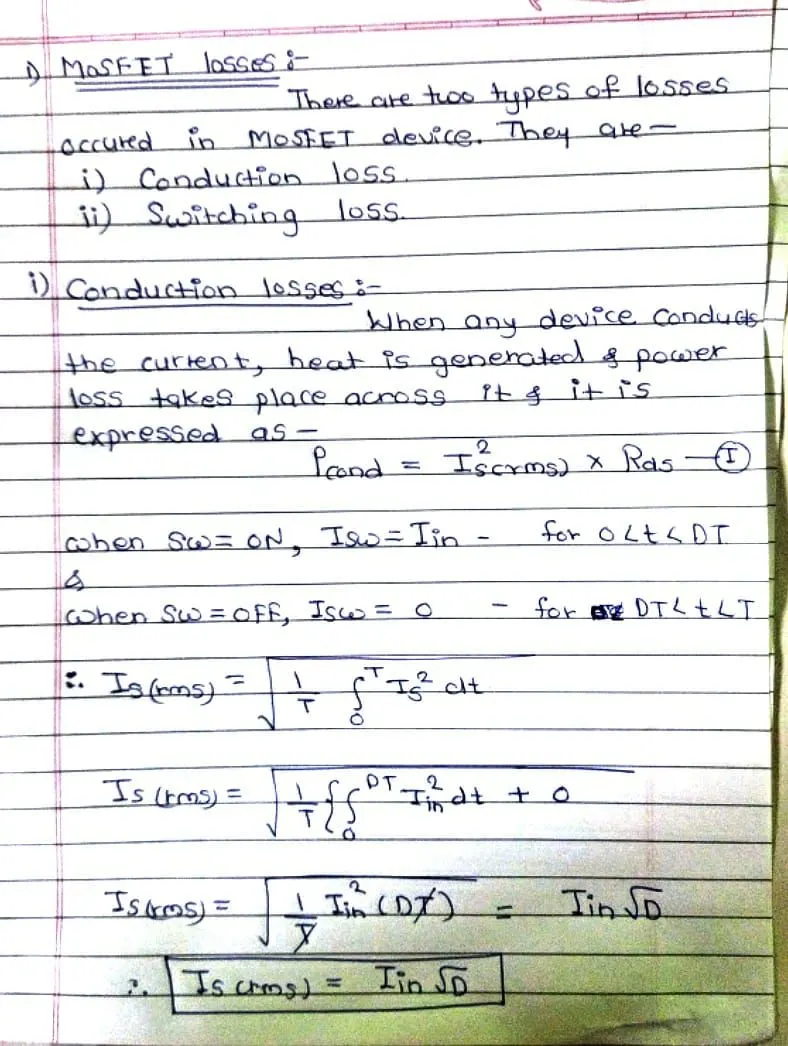
Substitute the value of IRMS(S) in equation 1, we get
Pcond = I2in * Rds(on) *D ----------------------Formula
But,
Iin / Iout = 1/ (1-D) ------------------current ratio formula
hence, Iin = Iout / (1-D)
Pcond = I2out * Rds(on) *D
But Iout = Vo /R------------------------Output current in terms of output voltage and load resistance
Therefore,
Pcond = (V2out * Rds(on) *D) / ( 1-D)2 * R2 ----------------------Formula
Pcond = 28*28*0.023*0.5) / (1-0.5)*(1-0.5)*10*10
Conduction losses in MOSFET (Pcond ) = 0.361 Watt
ii) Switching Loss:
During the switch On & OFF, some power also get lost. So, total switching power loss is given by,
Total switching Loss = Switching loss during switch ON + Switching loss during switch OFF.
Psw = Fs * Co * V2out
But, we assumed that the loss during switch OFF is negligible.
Hence,
Psw = Switching loss during switch ON = (1/2) * Fs * Co * V2out ---------------Formula
Psw = (1/2) * 105 * 10-10 * 28*28
Psw = 392 * 10-5 = 0.00392 Watt
Switching losses in MOSFET ( Psw ) = 0.00392 Watt
Total MOSFET Losses = Conduction Losses + Switching Losses
PMOSFET = Pcond + Psw
PMOSFET = 0.361 + 0.00392 = 0.365
Total MOSFET Losses PMOSFET = 0.365 Watt
---------------------------------------------------------------------------------------------------------
2) Power Diode:
In Boost converter, the power diode is connected in parallel with switching device MOSFET. Therefore, when switch is ON, the diode does not conduct & when the switch is OFF, the diode conducts. During this operation, the power loss occur across the power diode. Hence,
There are two types of losses occured across the power diode and they are:
i) Conduction Losses
ii) Forward Voltage Loss
i) Conduction Losses :
Pcond = I2RMS(d) * RF(Diode) -------------------------------(2)
When Switch is ON, diode does not conduct.
Idiode = 0 -------------------------for 0 < t < DT
When Switch is OFF, diode conduct the current.
Idiode = Iin ------------------------- for DT < t < T
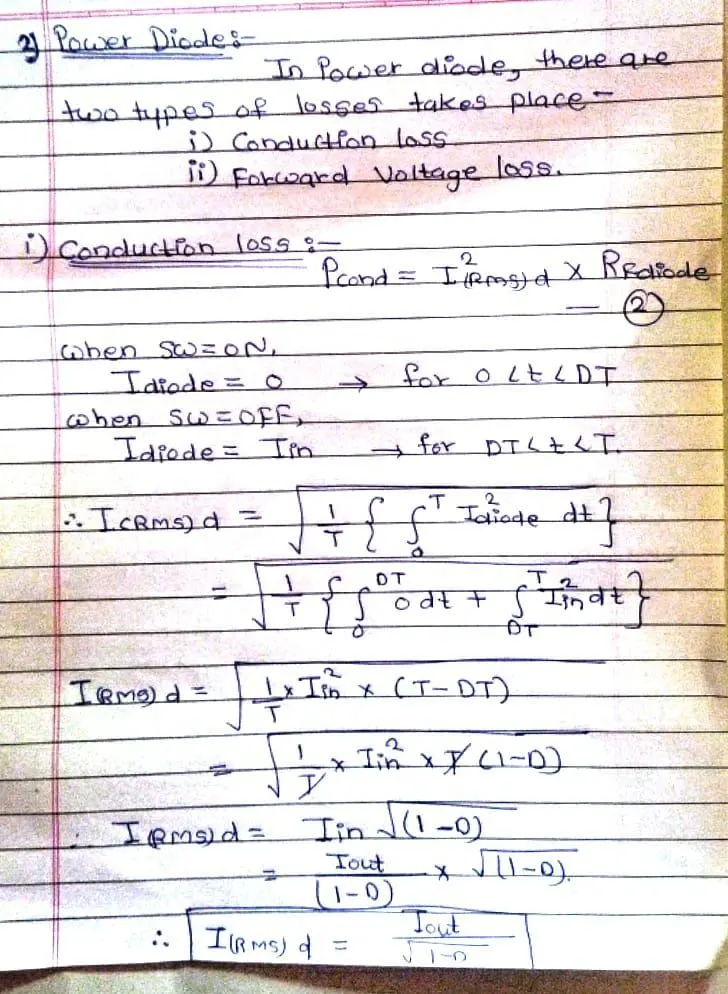
Substitute the value of IRMS(d) in equation 2, we get
Pcond = I2 out * RF(Diode) / (1-D) ----------------------Formula
But Iout = Vout / R
Therefore,
Pcond = V2 out * RF(Diode) / (1-D)* R2 -------------------------------Formula
Pcond = (28*28*5* 10-3) / ( 1-0.5) * (10*10)
Pcond = 0.0784 Watt
Conduction losses in Diode (Pcond) = 0.0784 Watt
ii) Forward Voltage Loss:
When the switch is ON for interval DT, the diode does not conduct. During this interval, some voltage drop occurs across the diode and power loss takes place. This power loss is given by -
Pforward (Diode) = VF* Iout ------------------- Formula
Pforward (Diode) = VF* Vout / R
Pforward (Diode) = 0.7*28/10 = 1.96
Pforward (Diode) = 1.96 Watt
Forward Voltage Loss (Pforward (Diode)) = 1.96 Watt
Total Diode Loss is given by -
Total Diode Losses = Conduction losses + Forward Voltage Losses
PDiode = Pcond + Pforward (Diode)
PDiode = 0.0784 + 1.96 = 2.0384
Total Diode Loss (PDiode) = 2.0384 Watt
--------------------------------------------------------------------------------------------------
3) Inductor Losses:
Inductor is a energy storing device which stores the energy. In Boost Converter, the inductor is connected to input side and therefore it charged during the switch ON and discharged during switch is OFF. During this operation, some energy lost across it due to parasitic inductive resistance rL.
There are two types of Losses occured in Inductor:
i) Core Loss
ii) Copper Loss.
Here, we assumed that the core loss is negligible. Hence, total inductor loss is equal to copper loss.
Copper Loss = RMS Value of Inductive current^2 * parasitic inductive resistance.
Pcu = I2RMS(L) * rL ---------------------------(3)
When Switch SW = ON, Inductor stores the energy.
IL= Iin for 0 < t < DT
When SW = OFF, Inductor discharges through diode.
IL= Iin for DT < t < T
By solving the above equation, we get
IL(RMS) = Iin
Substitute the value of IL(RMS) in equation (3)
Pcu = I2in * rL
But, Iin = Iout / (1-D) = Vout / (1-D) *R
Pcu = V2out * rL / (1-D)2 * R2 --------------Formula
Pcu = (28*28*0.3 ) / (1-0.5)2 (10*10)
Pcu = 9.408 Watt
Inductor Copper Loss (PInductor ) = 9.408 Watt
----------------------------------------------------------------------------------------------------
4) Capacitor Losses:
In Boost Converter, capacitor is coennected across the load to maintain the voltage level constant. This capacitor is connected in parallel with switch. Therefore, when the switch is ON, the capacitor supplies the stored energy to the load. When the switch is OFF, the capacitor gets charged through diode. During this charging & discharging operation, some power loss occured at capacitor terminal and it is expressed as follows:
Pcapacitor = I2RMS (C) * rC ---------------------------(4)
When Switch is ON, SW = ON
Capacitor supplies the current to the load. But the capacitor does not offer sudden chaneg in voltage, therefore to maintain the polarity of voltage across capacitor kept constant, the direction of current gets changed. Hence, the direction of capacitor current is opposite to that of the load current.
Ic = - Iout -------------for 0 < t < DT
When Switch is OFF, SW =OFF
Capacitor gets charged through inductor L & diode D. Hence capacitor current is the difference between diode current & output current. But, diode current is same as input current. Because, the diode & inductor is connected in series with input as well as output when Switch is OFF. Therefore,
Ic = Iin – Iout --------------------------------for DT < t < T
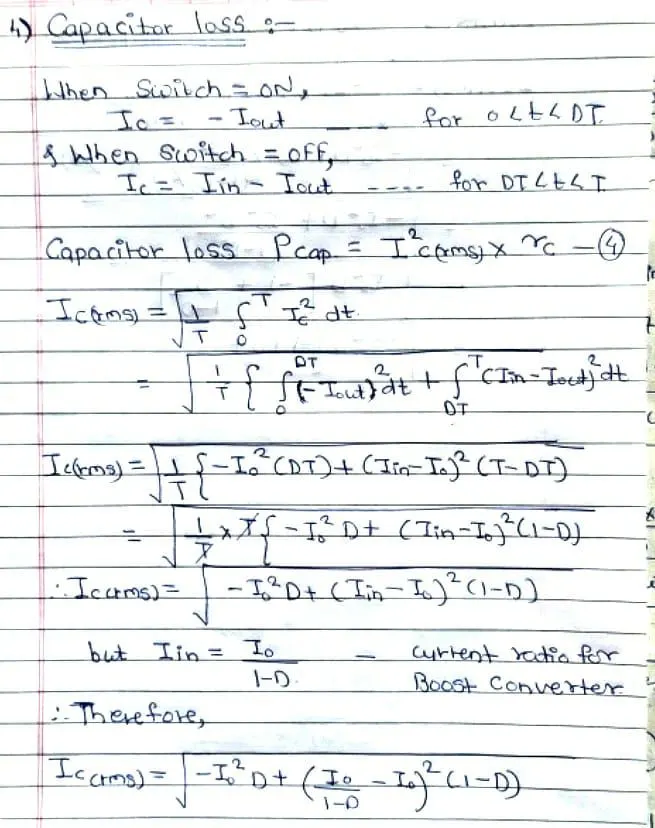
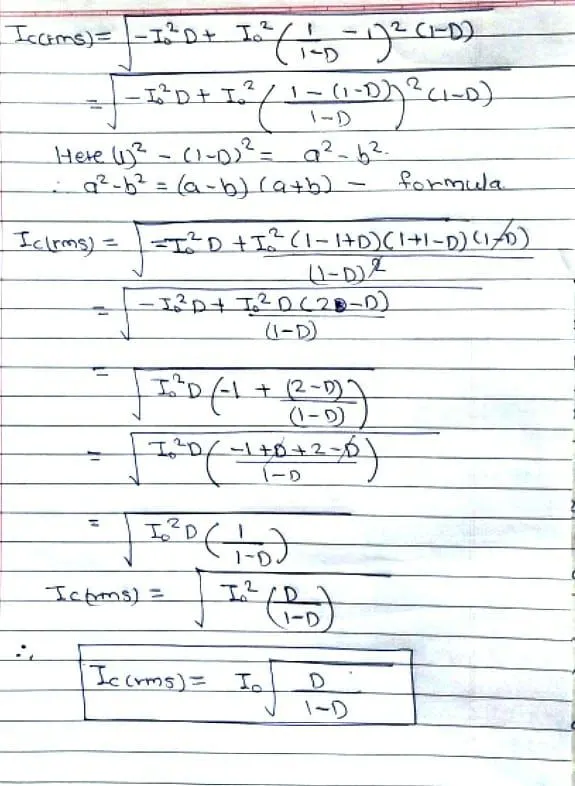
Substitute the value of IRMS (C) in equation 4, we get
Pcapacitor = I2 out * D * rC / (1-D)
But Iout = Vout / R
Pcapacitor = V2 out * D * rC / (1-D) * R2-----------------------Formula
Pcapacitor = (28*28*0.5*40 * 10-3) /( 1-0.5) * 10*10
Pcapacitor = 0.3136 Watt
Capacitor Loss (Pcapacitor) = 0.3136 Watt
--------------------------------------------------------------------------------------------------
Total Losses In Converter is given by :
Total Losses :
PTotal Losses = PMOSFET + PDIODE + PInductor + PCapacitor
= 0.365 + 2.0384 + 9.408 + 0.3136
= 12.125 Watt
Total Power Loss (PTotal Losses ) = 12.125 Watt
------------------------------------------------------------------------------------------------
Efficiency of the Boost Converter is given by :
Efficiency in percentage = ( Output Power ) * 100 % / (Output Power + Total Losses )
ῃ % = (Pout* 100%) / (Pout + PTotal Losses )
Output Power is given by :
Pout = V2out / R = 28*28 / 10 = 78.4 Watt
Total Output Power ( Pout) = 78.4 Watt
Efficiency (ῃ %) = ( 78.4 * 100 ) / ( 78.4 + 12.125 )
= 86.6 %
Efficiency of Boost Converter (ῃ %) = 86.6 %
With the help of above mathematical analysis, we can find out the losses in Boost converter.
------------------------------------------------------------------------------------------------