Project 1 Hood
Report on: Design and modeling of hood using Siemens NX-CAD
Objectives:
- Design hood outer paneland and inner panel according to the Euro NCAP standards.
- Design of LatchEmboss
- Design of HingeEmboss
- Different operations used in hood
A detailed report about the hood components and assembly with all the parameter considered for the design.
Answer:
Hood:
The hood is a top component of the body in white (BIW). A car hood is also known as a bonnet in some countries. It's used to protect the engine and other accessories, and it also absorbs the majority of the impact force across the body, ensuring the vehicle's safety. It also facilitates maintenance and repair work on the engine and its components. The hood of a front-engine car can be hinged at either the front or rear edge, or it can be divided into two sections, one on each side, each hinged along the centre line, as on older versions (e.g. the Ford Model). It is a front class-A body of the car. Because of these all consideration and a proper design must be implemented. The hood design must be in aerodynamic shape, fancy and luxurious looks.
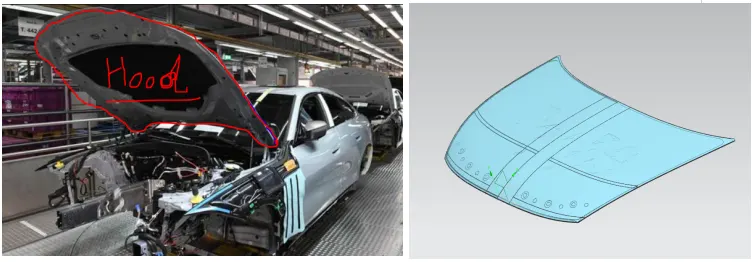
Reducing the weight of a vehicle, particularly from the front, is critical for improving its performance and economy while also producing low emissions. Hoods are normally fashioned of the same material as the rest of the body, taking into account all of these factors. Steel, aluminium, fibreglass, or carbon fibre can all be used. To make the vehicle lighter, various aftermarket businesses create fibreglass or carbon fibre steel hood replacements. Most automobiles have a hood system that includes an inner panel, outer panel, hood latch/lock handle, hood release cable, and hinge assembly. The hood lock handle is typically found beneath the steering wheel, close to the driver's seat, or in the door frame.
Hood design consideration:-
The hood of a car is considered as the frontal BIW fully enclosure component. To avoid air resistance from the car, it must be designed in an aerodynamic shape. It was also designed to protect passengers inside the vehicle as well as pedestrians in the case of an accident. Engine noise and vibration should also be taken into account and avoided or minimised.
The Hood consists of the following major component as:
- The outer panel
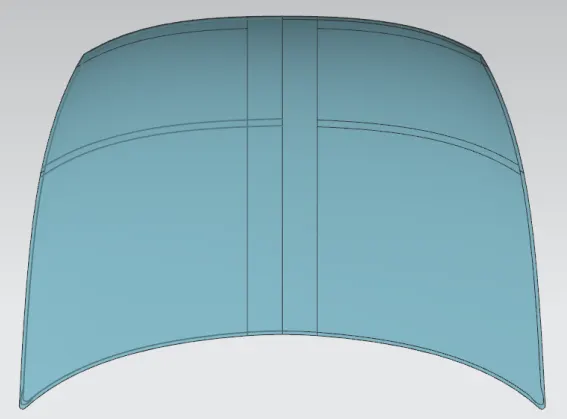
The outer panel, used to cover the inner panel of the hood. It is also considered as the class-A type of the car body, because it is visible from the outside. This component must be considered for the styling. It is first component that subjected to any type of impact.
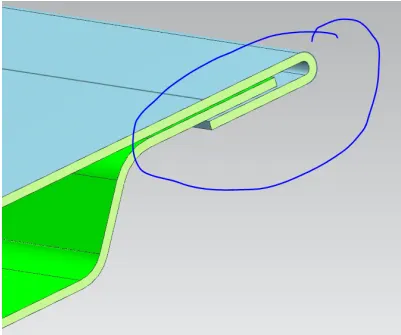
This part is intact with inner panel so to have a perfect combination. Its edges are wrap around inner panel this type of wrap called hem operation.
- The inner panel
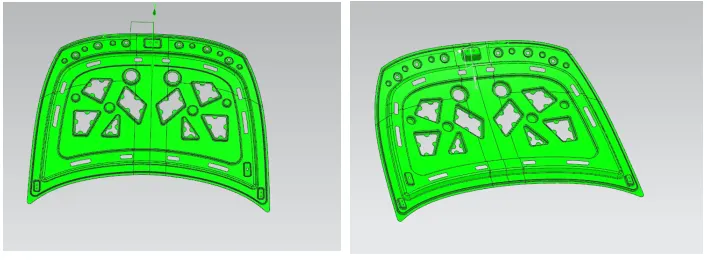
This is a class-B surface, which cannot be visible directly from the outside. The top and bottom section of the inner panel are presented below. For this hood part, many factor must be considered for the designing such as: less weight, high stiffness, good force distribution at the time of impact, good heat remover, minimal harness and vibration. The steps embosses were provided for good stiffness and avoid localization of forces. For hinge we need flat surface, so direct emboss will not work, because it will give some curvature. So for creating a emboss for the hinge as well as striker, must create a datum plane and create emboss based on datum plane.
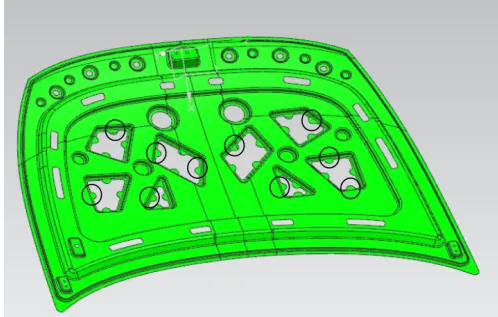
MASTIC: Because of the aesthetic criteria, the outer panel cannot be bolted or welded to the inner panel. This can be avoided by using the appropriate mastic sealant. The black circle in the image represents the half circle region where the mastic was applied to provide adequate contact between the outer and interior panels. The elastic Mastics are an extruded product that comes in a variety of conventional, custom, and complex die-cut shapes and thicknesses to fulfil customer needs for sealing, noise dampening, and vibration reduction. This sealant also improves the system's strength and has an influence of about 80 mm in diameter.
Hemming operation
Hemming is a sheet metal manufacturing technique that entails bending sheets 180 degrees. Hemming is a procedure used to make car body panels and sections like deck lids, trunk lids, doors, hoods, and tailgates. Sheets are folded or folded over another part in this process to obtain a snug fit. Hemming procedures are commonly used to join parts, improve the look of a part, and reinforce part edges.
Reinforcements

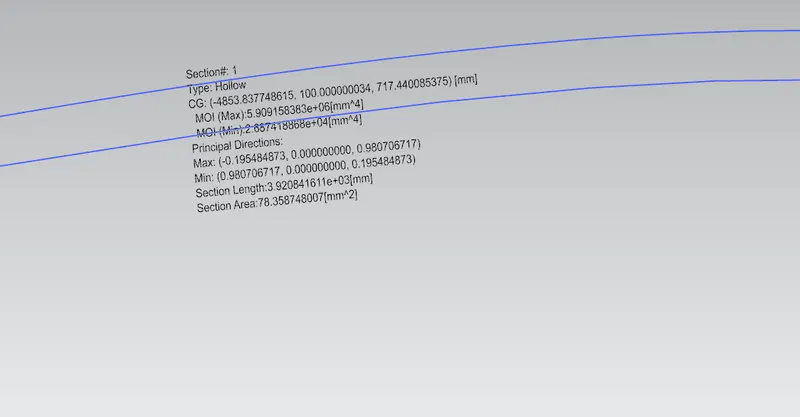
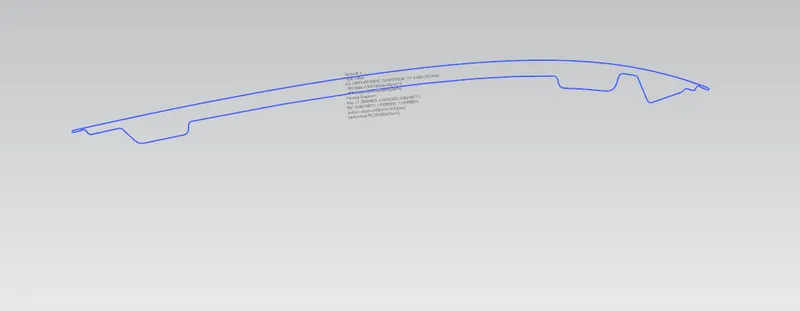
Section modulus calculation
Section modulus S = I/Y
Imin = 26874 mm4
Y= 933.4/2=466.7 mm
S=26874/466.7 mm3=57.58 mm3
Conclusion
It is most important front component of car body. For the designing of the car hood, the parameter such as safety of the passenger as well as pedestrian, light weight with good force distribution must be considered. The proper hood design was done using the NX-CAD by considering all the design parameters.