Project 1 - Device Master File
Device Master File provides confidential information related to about facilities, manufacturing processes, sterilization, packaging materials, and contract packaging and storing of the products, as well as nonclinical and clinical study data] associated with device regulatory submissions to a specific country. This file may contain general description of the device, its variance, intended purpose, & accessories in combination with other device, Warnings, mode of action scientifically demonstrated with description and novel features of the device. They may also include, device specifications, for example, drawings, calculations, components relevant GSPR information, tissues of human and animal origin, toxicity, biological safety and biocompatibility with stability, storage, analytical performance with verification and validation information with clinical data risk management analysis, including risk minimizing measures.
Introdcution
Infusion Pump is a device that is used to administer dosage of IV fluids at a reguloar time interval.The machine helps in administrating fluids on a set time setting set up by the doctor resposible for the patient. The doctor will put in the fluid bag containing the medicine and set some time for the medicine to be administered to the patient. The device can administer dosage as little as 0.1ml per drip which would be physically impossible for a human being to administer every minute. That is why infusion pumps are used.
Types of infusion:
Ambulatory Infusion Pumps
This one is the opposite of the stationery infusion pumps. Ambulatory infusion pumps are lightweight and mobile; it can be used in homes. The infusion pumps often used in treating people with debilitating diseases, because they require medication throughout the day. Mobile and light infusion pumps can help these patients be transported while receiving medication. This kind of lightweight infusion pump solves the challenge of delivering medical infusions while on the go.
Stationary Infusion Pumps
These types of pumps are manufactured to be placed next to the patient's bed. Stationary infusion pumps don't need to be compact and light because they don't require movement. Many patients who use them often suffer from complex or chronic diseases. Bedridden patients with chronic conditions often need medication or dietary infusions. The stationary pumps provide bedside IV infusions for patients who require frequent bedside nutrition or medicine.
Large Volume Infusion Pumps
It is used to inject large amounts of liquid into the patient's body. This type of pump is usually used to provide nutrition to the patient. These pumps are manually or by a computer-controlled roller method to sequentially press the rubber tube to allow the medication to flow at different rates depending on the need of the patient.
Syringe Pump SP-3
These are infusion pumps that deliver low medication volumes for medication required in small quantities, such as hormones. It controls the motor mechanism to push the medication through the syringe into the tube that is delivered to the patient. Many times these are used on babies and young children.
Traditional Infusion Pumps
Traditional infusion pumps can be used in medical environments, such as mobile, home, and long-term care environments. It’s a broader category for many different kinds of pumps. These medical devices can be used for many different kinds of drugs, such as painkillers, antibiotics, etc.
Specialty Infusion Pumps
Specialty infusion pumps are designed to fulfill the needs of exceptional medical cases. These are made to be used in home settings. They are usually used in home care services or treatment of special diseases (such as diabetes) Many of the pumps that fall into this category tend to be mobile. The Specialty infusion pumps category has three types of pumps, including implantable, enteral and insulin infusion pumps.
Regulatory Bodies Approvals, Market history and Price Range
So there are several comapnies out there who sell infusion pumps to the customers. Some of the companies who sell infusion pumps are Smiths Medical, Becton etc. these companies have to follow certain laws in order for their infusion ppumps to sell in the market. The certificates that the manufacturers of this medical device should obtain is ISO 13485 and relevant IEC 60601- Part 1 and 2 certificates by the notified bodies. The market cap for this device has been elevating. The market cap for this device in 2020 was USD 4.4 Bn and expected market cap for 2030 is USD 6.6 BN. The CAGR for 202 to 2030 is 5 percent. The products sell for anywhere between 20000 to 1.5 lakh INR. The market of the infusion pump comes mostly from the NICU and PICU departments of the hospitals as well as small nursing homes who house inn sick patients for large hospitals and need to work according to the standards of the hospital
Features of the machine
The machine is well made in accordance to the safety protocols set by the MDR. The device is equipped with a alarm system to notify the user as well the attendant if there is any problem that occurs. Now there is LED installed in the machine which lights up as soon as the machine faces any problem. Any critical issue, the LED lights up in red colour and if the issue is moderate and still requires immediate attending, the light colour that comes up is yellow. As for the issues which are not very grave are in colour blue. Also the infusion pump prevents backflow of any liquid, i.e. if the nurse by fault puts the infusion kit in the wrong direction, then the machine will not strt sucking the blood out i.e. will not work in opposite direction rather as soon as the machine feels that something is wrong as picked uo by the sensor, the ionfusion will stop immediately. Plus the arm stays steady and the infusion happens at a steady, programmed
The Food and Drug Administration (FDA) has established classifications for approximately 1,700 different generic types of devices and grouped them into 16 medical specialties referred to as panels. Each of these generic types of devices is assigned to one of three regulatory classes based on the level of control necessary to assure the safety and effectiveness of the device. The three classes and the requirements which apply to them are:
Device Class and Regulatory Controls
1. Class I General Controls
- With Exemptions
- Without Exemptions
2. Class II General Controls and Special Controls
- With Exemptions
- Without Exemptions
3. Class III General Controls and Premarket Approval
The class to which your device is assigned determines, among other things, the type of premarketing submission/application required for FDA clearance to market. If your device is classified as Class I or II, and if it is not exempt, a 510k will be required for marketing. All devices classified as exempt are subject to the limitations on exemptions. Limitations of device exemptions are covered under 21 CFR xxx.9, where xxx refers to Parts 862-892. For Class III devices, a premarket approval application (PMA) will be required unless your device is a preamendments device (on the market prior to the passage of the medical device amendments in 1976, or substantially equivalent to such a device) and PMA's have not been called for. In that case, a 510k will be the route to market.
Device classification depends on the intended use of the device and also upon indications for use. For example, a scalpel's intended use is to cut tissue. A subset of intended use arises when a more specialized indication is added in the device's labeling such as, "for making incisions in the cornea". Indications for use can be found in the device's labeling, but may also be conveyed orally during sale of the product. A discussion of the meaning of intended use is contained in The 510(k) Program: Evaluating Substantial Equivalence in Premarket Notification [510(k)].
In addition, classification is risk based, that is, the risk the device poses to the patient and/or the user is a major factor in the class it is assigned. Class I includes devices with the lowest risk and Class III includes those with the greatest risk.
As indicated above all classes of devices as subject to General Controls. General Controls are the baseline requirements of the Food, Drug and Cosmetic (FD&C) Act that apply to all medical devices, Class I, II, and III.
How to determine the classification:
To find the classification of your device, as well as whether any exemptions may exist, you need to find the regulation number that is the classification regulation for your device. There are two methods for accomplishing this: go directly to the classification database and search for a part of the device name, or, if you know the device panel (medical specialty) to which your device belongs, go directly to the listing for that panel and identify your device and the corresponding regulation. You may make a choice now, or continue to read the background information below. If you continue to read, you will have another chance to go to these destinations.
If you already know the appropriate panel you can go directly to the CFR and find the classification for your device by reading through the list of classified devices, or if you're not sure, you can use the keyword directory in the PRODUCT CODE CLASSIFICATION DATABASE. In most cases this database will identify the classification regulation in the CFR. You can also check the classification regulations below for information on various products and how they are regulated by CDRH.
Each classification panel in the CFR begins with a list of devices classified in that panel. Each classified device has a 7-digit number associated with it, e.g., 21 CFR 880.2920 - Clinical Mercury Thermometer. Once you find your device in the panel's beginning list, go to the section indicated: in this example, 21 CFR80.2920 . It describes the device and says it is Class II. Similarly, in the Classification Database under "thermometer", you'll see several entries for various types of thermometers. The three letter product code, FLK in the database for Clinical Mercury Thermometer, is also the classification number which is used on the Medical Device Listing form.
Once you have identified the correct classification regulation go to What are the Classification Panels below and click on the correct classification regulation or go to the CFR Search page. Some Class I devices are exempt from the premarket notification and/or parts of the good manufacturing practices regulations. Approximately 572 or 74% of the Class I devices are exempt from the premarket notification process. These exemptions are listed in the classification regulations of 21 CFR and also has been collected together in the Medical Device Exemptions document.
If you would like a formal device determination or classification from the FDA, consider submitting a 513(g) Request. For instructions on how to submit a 513(g) Request, refer to the guidance document “FDA and Industry Procedures for Section 513(g) Requests for Information under the Federal Food, Drug, and Cosmetic Act Guidance (2012).” For further information, you may view the CDRH Learn training module entitled 513(g) Requests for InformationExternal Link Disclaimer (under the section “How to Study and Market Your Device,” subsection “Classification”).
A device master file (DMF) is a document that contains confidential, detailed information about a medical device or pharmaceutical product. It is submitted to regulatory authorities, such as the US Food and Drug Administration (FDA) or the European Medicines Agency (EMA), to provide information about the design, manufacture, and testing of the product.
DMFs are typically used for products that are difficult to describe in a traditional regulatory submission, such as products with complex designs or those that use new technologies. DMFs can also be used to provide information about raw materials, component parts, and finished products that are used in the manufacture of a medical device or pharmaceutical product.
Regulatory authorities may require that companies submit a DMF as part of the process of obtaining marketing authorization for a product. DMFs are typically kept confidential and are not made available to the public. However, regulatory authorities may share information from a DMF with other regulatory agencies or with other interested parties, such as academic researchers or manufacturers of related products, in order to promote the safe and effective use of the product.
In India, the process for obtaining market clearance for medical devices is regulated by the Central Drugs Standard Control Organization (CDSCO), which is the national regulatory authority for pharmaceuticals and medical devices.
The process for obtaining market clearance for medical devices in India generally involves the following steps:
- Classification of the medical device: Medical devices are classified into four categories based on their intended use and potential risk to the user. Class A devices are considered low-risk and do not require any regulatory clearance, while Class B, C, and D devices are considered to have increasing levels of risk and require progressively more stringent regulatory clearance.
- Registration of the device: Manufacturers of Class B, C, and D devices must register their products with the CDSCO before they can be sold in India. This involves submitting a registration application and supporting documentation, including information about the device's design, intended use, and manufacturing process.
- Testing and certification: Manufacturers of Class B, C, and D devices must also obtain a certificate of conformity from the CDSCO, which confirms that the device meets the relevant quality, safety, and performance standards. This may involve submitting the device for testing at an accredited laboratory.
- Marketing authorization: Manufacturers of Class C and D devices must also obtain marketing authorization from the CDSCO before they can be sold in India. This involves submitting a marketing authorization application and supporting documentation, including clinical data demonstrating the safety and effectiveness of the device.
It is important to note that the process for obtaining market clearance for medical devices in India can be complex and time-consuming. Manufacturers should be prepared to provide detailed and comprehensive documentation to support their applications, and should work closely with regulatory affairs professionals to ensure that their products are in compliance with all relevant regulations.
In the pharmaceutical and medical device industries, regulatory authorities typically require companies to provide detailed information about the design, manufacture, and testing of their products as part of the process of obtaining market clearance. This includes information about the product's intended use, technical characteristics, performance, and safety profile.
Product description is an important part of this process, as it provides regulatory authorities with a clear and comprehensive understanding of the product and how it is intended to be used. Product descriptions typically include information about the product's design, materials, and manufacturing processes, as well as its intended use, intended population, and any relevant contraindications or precautions.
Risk analysis is also an important part of the regulatory process, as it helps regulatory authorities to assess the potential risks associated with a product and determine whether the product is safe and effective for its intended use. Risk analysis typically involves identifying and evaluating the potential risks associated with a product's design, materials, and manufacturing processes, and implementing appropriate controls and safeguards to minimize those risks.
In addition to providing information about the product and its risks, companies may also be required to provide data from clinical trials or other studies demonstrating the safety and effectiveness of the product. This may include data on the product's performance, side effects, and any other relevant clinical outcomes.
Verification and validation are important processes in the development and manufacture of pharmaceutical and medical devices. These processes are used to confirm that a product meets the requirements for its intended use and is safe and effective for its intended population.
Verification is the process of confirming that a product, process, or system meets specified requirements. This may involve reviewing the product's design and manufacturing processes to ensure that they are in compliance with relevant regulations and standards, as well as testing the product to confirm that it meets the specified performance, safety, and quality requirements.
Validation is the process of demonstrating that a product, process, or system is capable of consistently meeting its specified requirements. This may involve conducting clinical trials or other studies to demonstrate the safety and effectiveness of the product, as well as ongoing testing to confirm that the product remains safe and effective over time.
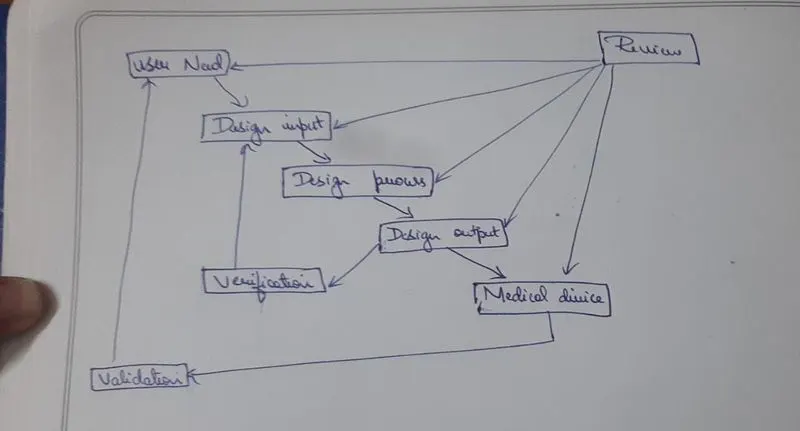
Creating appropriate and regulated documentation of your device during development can be an overwhelming experience. There are several commercial software systems available to help manage your design history file (DHF) or alternatively, you can create a system designed for your needs. Regardless, developing a relationship with a partner that has managed creation of design controls through best practices is prudent.
A good starting point is to go to the regulations, a small excerpt of critical sections of 21 CFR Title 820.30 are as follows:
(1) Each manufacturer of any class III or class II device, and the class I devices listed in paragraph (a)(2) of this section, shall establish and maintain procedures to control the design of the device in order to ensure that specified design requirements are met.
(b) Design and development planning. Each manufacturer shall establish and maintain plans that describe or reference the design and development activities and define responsibility for implementation. The plans shall identify and describe the interfaces with different groups or activities that provide, or result in, input to the design and development process. The plans shall be reviewed, updated, and approved as design and development evolves.
(c) Design input. Each manufacturer shall establish and maintain procedures to ensure that the design requirements relating to a device are appropriate and address the intended use of the device, including the needs of the user and patient. The procedures shall include a mechanism for addressing incomplete, ambiguous, or conflicting requirements. The design input requirements shall be documented and shall be reviewed and approved by a designated individual(s). The approval, including the date and signature of the individual(s) approving the requirements, shall be documented.
(d) Design output. Each manufacturer shall establish and maintain procedures for defining and documenting design output in terms that allow an adequate evaluation of conformance to design input requirements. Design output procedures shall contain or make reference to acceptance criteria and shall ensure that those design outputs that are essential for the proper functioning of the device are identified. Design output shall be documented, reviewed, and approved before release. The approval, including the date and signature of the individual(s) approving the output, shall be documented.
(e) Design review. Each manufacturer shall establish and maintain procedures to ensure that formal documented reviews of the design results are planned and conducted at appropriate stages of the device’s design development. The procedures shall ensure that participants at each design review include representatives of all functions concerned with the design stage being reviewed and an individual(s) who does not have direct responsibility for the design stage being reviewed, as well as any specialists needed. The results of a design review, including identification of the design, the date, and the individual(s) performing the review, shall be documented in the design history file (the DHF).
(f) Design verification. Each manufacturer shall establish and maintain procedures for verifying the device design. Design verification shall confirm that the design output meets the design input requirements. The results of the design verification, including identification of the design, method(s), the date, and the individual(s) performing the verification, shall be documented in the DHF.
(g) Design validation. Each manufacturer shall establish and maintain procedures for validating the device design. Design validation shall be performed under defined operating conditions on initial production units, lots, or batches, or their equivalents. Design validation shall ensure that devices conform to defined user needs and intended uses and shall include testing of production units under actual or simulated use conditions. Design validation shall include software validation and risk analysis, where appropriate. The results of the design validation, including identification of the design, method(s), the date, and the individual(s) performing the validation, shall be documented in the DHF.
(h) Design transfer. Each manufacturer shall establish and maintain procedures to ensure that the device design is correctly translated into production specifications.
(i) Design changes. Each manufacturer shall establish and maintain procedures for the identification, documentation, validation or where appropriate verification, review, and approval of design changes before their implementation.
(j) Design history file. Each manufacturer shall establish and maintain a DHF for each type of device. The DHF shall contain or reference the records necessary to demonstrate that the design was developed in accordance with the approved design plan and the requirements of this part.”
Management, creation and execution of a design history file for each type of device take experience and grit. Completing a risk analysis, or hazard analysis early in the design phase for medical devices is not only required, but is important for successful development. The FDA led in this respect, creating regulations documented in 21 CFR Section 820. Today we have standards such as ISO 13485 and ISO 14971 (risk analysis) to guide our global de-risking of medical devices. We have developed industry standard best practices for design control management including risk analysis processes that help move a device efficiently and effectively through the early stages of development. The regulations and standards are straightforward to implement, and gain complexity as company size and risk tolerance grow. Keeping control or iterating on your quality management system of industry standard best practices is important when developing a medical device and requires surveillance and dedication to keeping patients safe while not being sidetracked. Today, as our industry has evolved, device risk requirement generation has become a part of medical device design and development. These tools are useful and necessary in the development process. We have experience with risk analysis, creation of user needs, design control file creation, process validation, clinical evaluations and many other activities as identified in ISO 14971 that are required to produce a safe medical device. We can help at any stage with the development of your medical device.
Analytical performance reports are documents that provide detailed information about the analytical methods and testing procedures used to evaluate a product's quality and performance. These reports may include information about the accuracy, precision, and sensitivity of the analytical methods, as well as the results of the testing.
Clinical performance reports are documents that provide detailed information about the clinical studies conducted to evaluate a product's safety and effectiveness. These reports may include information about the study design, population, and results, as well as any adverse events or other clinical outcomes observed during the study.
Stability is an important consideration in the development and manufacture of medical devices. It refers to the ability of a product to maintain its quality and performance over time, under specified storage and handling conditions.
Shelf-life is the period of time during which a product is expected to remain stable and suitable for use, when stored under the conditions specified by the manufacturer. Shelf-life is typically determined through stability testing, which involves storing the product under specified conditions and periodically evaluating its quality and performance over time.
In-use stability refers to the ability of a product to maintain its quality and performance when it is being used or administered. This may be influenced by factors such as the product's handling and storage conditions, as well as the duration of use.
Shipping stability refers to the ability of a product to maintain its quality and performance during transportation. This may be influenced by factors such as the product's packaging, handling, and storage conditions, as well as the duration of transportation and the environmental conditions encountered during shipping.
Stability testing is an important part of the regulatory process, as it helps to ensure that products are safe and effective for their intended use. Manufacturers are typically required to provide stability data as part of the process of obtaining market clearance for their products. This may include data on the product's shelf-life, in-use stability, and shipping stability, as well as any relevant storage and handling instructions.
Risk Analysis
The risk analysis of the machine is done by keeping the machine charging for beyond capability hours. The batteries and PCB are check for short circuiting anf is made sure that both are fire proof and do not cause any internal fire on their own. Also it checked if the PCB will discharge charge onto the person touching the machine while it has been charge continuously. Also it is checked if anything that is used on this machine will harm the patient in any way.
Risk Management
For making sure that the things checked above do not happen, several things have been kept in mind during the designing of the machine. The materials that are used in the machine are electric proof, will prevent the fire from happening and are temperature sensitive and can easily disperse the heating that happens from overcharing the device and also its continuous use. Also sensors are added to the design to make sure the machine does not pull the blood out of the patient if the nurse accidentally puts the infusion set in reverse.
Design and Manufacturing Information
The design of this device has been made to be eco-friendly by not using too many small components to form the device. The device has been casted in from a single cast and then the parts are assembled in them. Also for the assembly, the parts were 3D printed to prevent any carbon footprint in the form of transportation of material and the manufacturing line was made in order to minimise the harmful effects of work on human beings by making them work in coherrence with the machines to lesser the burden on them. Also the batteries were made from recycling the old batteries which were in extremly good condition thus reducing e-waste in the process.
Labelling and Packaging
The device is labelled as Class B since the machine will be using invasing procedure to provide the medicine to the patient. the packaging of the material is made in a way that the package does not get damaged during the delivering procedure. The packaging is made out of 100% recyclable material and several layers are used so that the packaging is quite sturdy when it comes to bumps and slight nudging during the delivering. The shelf-life of the product is quite good since the machine needs to be put on patients for use. The shelf life of the material outlasts the shelf life other products in the market. Also the PCB is sturdy and better at handling heat as well as the components used are of good quality.
Post Market Surveillance
PMSPs are documents that outline the specific post-market surveillance activities that a manufacturer plans to undertake in order to monitor and evaluate the safety and performance of a medical device. PMSPs may include activities such as clinical follow-up studies, analysis of adverse event reports, or monitoring of product performance.
Post-market surveillance reports (PMSRs): PMSRs are documents that provide a summary of the results of post-market surveillance activities. Manufacturers are typically required to submit PMSRs to regulatory authorities on a regular basis, in order to provide updates on the safety and performance of their products.
Post-market surveillance is an important part of the regulatory process, as it helps to ensure that medical devices continue to meet the relevant regulatory requirements and remain safe and effective for their intended use. Manufacturers should work closely with regulatory affairs professionals to ensure that their post-market surveillance activities are in compliance with all relevant regulations.
The device has been found with minimum complaints from the consumers. The device has been running good and the after sale service respond has been good from the customers. The complaints seen generally from the customer side is of the battery backup. The batteries of all the infected pieces has been changed and the devices have been up and running. All of the data regarding it is also attached in the form of booklets.