Project 1 - Design Enterprise Security Model
Project 1- Design Enterprise Security Model:
Agenda of Project:
- Introduction detail about the task and include the bank security infrastructure.
- Express the details of security model were using for bank infrastructure.
- Express the real-time scenario online banking and background working security boundary.
- List the checklist for security model design at both customer and bank authorities.
Introduction:
Detail about Task:
In this project need to design the security model for bank sector infrastructure which customer to enjoy its banking services online with a facility to access its banking website on the internet. All the devices in the model need to hardening every week and keep report the device along from their mechanism and maintenance
Enterprise security:
Definition: Enterprise security is a security term used to describe all the security measures that organizations take to protect their assets, networks, and systems from outside threats. It includes such measures as installing firewalls, performing security audits, using encryption, and monitoring user activity. It also includes measures to prevent malicious attacks, such as preventing the spread of viruses, implementing access control policies, and educating users on security protocols.
Security Model:
Definition: A security model is a set of rules and regulations designed to protect the confidentiality, integrity and availability of a system or network. It typically defines the security architecture, policy, mechanisms and procedures necessary to enforce security across the entire system. It also outlines the roles and responsibilities of users and administrators in maintaining the security of the system.
Block Diagram of Bank security Model:
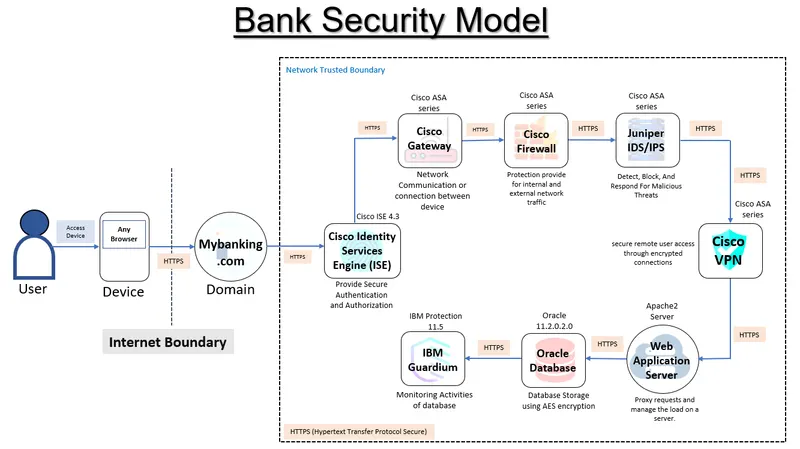
Detail about device and infrastructure were used in the bank security model:
In this bank security model here use some device were protection, privacy, monitoring, data storage, safe-guard the transaction and some operations include in this security model. In this security model there is some lists of devices were included they are,
- Cisco Identity Service Engine (ISE).
- Cisco Gateway.
- Cisco Firewall.
- Juniper IDS/IPS.
- Cisco VPN.
- Apache2 Web Application Server.
- Oracle Database.
- IBM Guardium.
a). Cisco Identity Service Engine (ISE):
Cisco Identity Services Engine (ISE) is a network security solution that provides a single policy platform to control access to network resources based on identity. It is an identity-based network access control system that combines multiple security functions such as authentication, authorization, posture assessment, profiling, and network access control into a single platform.
Cisco ISE can be used in an online banking security model infrastructure to provide authentication and authorization to users. Cisco ISE can be used to authenticate users against existing databases, such as Active Directory, or to authenticate users through various authentication protocols, such as RADIUS. It can also be used to assign different levels of access to each user based on their credentials, such as allowing only certain users to access certain banking services. Cisco ISE can also be used to monitor user activity and detect any suspicious behavior. Additionally, it can be used to provide granular access control and ensure that only authorized users are allowed access to the online banking services.
b). Cisco Gateway:
Cisco Gateway is a type of networking device that provides secure access to a network by connecting multiple systems and devices across a wide range of networks. It acts as a bridge between networks, allowing users to securely access resources that are not on their local networks. Cisco Gateways also provide security features such as encryption, network segmentation, firewall protection, and intrusion detection. They can be used to connect networks in different locations, such as remote offices and branch offices, or to connect multiple networks within a single organization.
Cisco ISE can integrate with Cisco gateways to provide secure access to the corporate network. Gateways are devices that act as a bridge between two networks. Cisco gateways can be used to enable secure communications between two or more networks, such as the corporate network and the Internet. Cisco ISE allows the gateway to authenticate and authorize users and devices connected to the gateway, ensuring that only authorized users and devices are able to access the corporate network.
c). Cisco Firewall:
Cisco Firewall is a network security system that helps to protect an organization’s network infrastructure from malicious attacks and other security threats. It works by blocking unauthorized access to the organization’s network by filtering the incoming and outgoing traffic and inspecting and validating the data packets. The firewall also helps to ensure that sensitive data is kept secure, and that only authorized users can access the information.
Cisco firewall technology can be used in online banking to protect customer data from attackers. Firewalls can be used to create a barrier between the customer and the financial institution, blocking malicious traffic from entering the network. This can help protect against viruses, malware, and phishing attacks. Firewalls can also be configured to block certain types of traffic, such as file sharing, and to restrict access to certain websites and services. Additionally, firewalls can be used to create user authentication processes, which require users to provide credentials in order to access the system. This can help ensure that only authorized users can access the customer's financial information.
d). Juniper IDS/IPS:
Juniper IPS/IDS is a type of Intrusion Prevention System (IPS) and Intrusion Detection System (IDS) used to provide an additional layer of security to online banking. It is designed to detect and block malicious traffic attempting to access or compromise the security of a banking system. It can help protect against malicious activity and unauthorized access to the bank’s networks, websites and customer data. Juniper IPS/IDS can also be used to detect and block attempts to access confidential customer information such as passwords and credit card numbers. Additionally, it can be used to monitor account and transaction activity to ensure compliance with government regulations.
IDS: IDS (Intrusion Detection System) is a type of security technology that monitors and detects malicious activity on a network. Unlike IPS, it does not take action to prevent malicious activity, but rather alerts a security administrator to any suspicious activity that it detects. It does this by monitoring network traffic for suspicious patterns and behaviors.
IPS: IPS (Intrusion Prevention System) is a type of network security technology that monitors and detects malicious activity on a network and then takes action to prevent the malicious activity from occurring. It does this by inspecting all incoming and outgoing network traffic and analyzing it for suspicious activity.
e). Cisco VPN:
Cisco VPN is a type of virtual private network (VPN) technology that uses the Internet or other networks to securely connect two physical or virtual networks. It allows users to send and receive data across public or shared networks as if their devices were directly connected to the private network. Cisco VPN uses the Internet Protocol Security (IPsec) protocol to provide secure encryption and authentication of data sent over the public network.
Cisco VPN is a secure way for online banking customers to access their accounts. It provides users with a secure tunnel to connect to the bank's servers, allowing them to securely access their accounts and perform transactions. Because the tunnel is encrypted and secure, customers can be sure that their personal and financial information is protected from hackers. It also ensures that the bank's servers are secure and that no one can intercept or modify the data that is sent and received.
f). Apache2 Web Application Server:
Apache2 is a web application server used to host websites and web applications. It is part of the Apache HTTP Server project, which is an open-source web server developed by the Apache Software Foundation. Apache2 is a popular web server due to its flexibility, stability, and scalability. It is capable of running on multiple platforms and supports a wide range of programming languages, including PHP, Perl, and Python. Apache2 also provides a secure environment in which to run web applications, and supports a variety of protocols, including HTTP, HTTPS, and FTP.
Apache2 is a powerful and highly scalable web application server that is often used to host online banking applications. It provides robust security and support for advanced technologies such as SSL encryption, providing a secure environment to store sensitive customer data. Apache2 is also able to handle large amounts of data and traffic, allowing online banking applications to handle a high number of concurrent requests. Additionally, Apache2 is highly configurable, allowing developers to tailor the server to fit the exact requirements of their online banking application.
g). Oracle Database:
A secure Oracle database is a database that has been configured to ensure that data is protected from unauthorized access. This includes implementing strong authentication, encryption, and access control measures, as well as regularly auditing database activity. It also involves utilizing Oracle Database Security features such as Oracle Database Vault, Label Security, and Audit Vault. By implementing these security measures, organizations can ensure that their Oracle database is secure and protected from malicious attacks.
Oracle database is used in online banking to store and manage customers’ financial information, including account balances, transaction histories, and personal information. Oracle databases provide security and reliability for financial data, as well as scalability and flexibility for rapidly changing customer needs. It also allows for quick access to customer data, as well as fast and secure data processing for transactions. Additionally, Oracle databases enable banks to customize their services and better serve customers, allowing them to customize their online banking experience.
h). IBM Guardium:
IBM Guardium Data Protection is an enterprise-level data security solution that helps businesses protect sensitive data from threats and breaches. It provides comprehensive data protection capabilities including data masking, data encryption, data activity monitoring, and data auditing. It also offers access control, user access privileges, data loss prevention, and data governance. The solution helps organizations comply with data privacy regulations such as GDPR and the HIPAA Privacy Rule.
IBM Guardium Data Protection 11.5 helps secure online banking systems and protect sensitive customer data. It provides advanced data security capabilities such as monitoring, auditing, alerting, and policy enforcement, as well as encryption, masking, and tokenization. It helps banks ensure compliance with applicable laws and regulations, and protect their customers’ data from unauthorized access. Guardium Data Protection 11.5 helps banks monitor user activity, detect suspicious behavior, and block potential threats. It also provides an end-to-end solution for data protection and compliance, so banks can protect their customers data while still providing the convenience of online banking.
Real-time Scenario of Security Model for Online Banking:
In every online transaction or financial information through online banking process there is some security protocols were followed by the bank to secure database and other financial works of the customer those who access the online banking in any device and browser.
There is step by step protocol were bank followed in security model,
Step 1: When user (costumer) uses their device login into online banking account with biometric (fingerprint), User ID, Pin or Password where Cisco ISE is analysis and check the authentication of person who is using the online banking account, if the person has use correct authentication the Cisco ISE allow the request passed to Cisco gateway.
Step 2: Inside the security model boundary the Cisco Gateway is used as bridge to connect the several devices while process the secure transaction. After the authentication is finish then the gateway is processing the request in secure manner to database in bank. The Connected devices with Cisco gateway are VPN, IPS/IDS, Web-server, firewall, database, etc. to secure network of online bank transaction.
Step 3: The Cisco Firewall is getting the authotication access from Cisco Gateway, it is used to identify the inside and outside traffic from online banking security network. The firewall analysis the authentication and autorization data of user check and block any unknown person or malicious threat is takes place to steal the finical information of particular costumer who access the banking at online sector.
Step 4: The Juniper IPS/IDS where monitor activities while user access the online banking. It is used to analysis ID and Password with account details of responsible user while access transaction. If any malicious activity is happened it’s tried detect the activity and block unknown access.
Step 5: After Juniper IPS/IDS is approve the authorication and authorization traffic then Cisco VPN is used to encrypt those public messages as private code is process when the web-server application is identifying the message to transaction in the bank network. The Encryption is protecting message transaction in between end-to-end device where include in security model.
Step 6: The apache2 web-server application is receive the encrypted message from VPN where analysis user (costumer) needs like banking transaction and finical information. The web-server is decrypting the user needs and transfer request from VPN because the message gets decrypt in web-server to identify the user needs.
Step 7: The Oracle Database receive the transaction message from firewall analysis the traffic inside and outside the network. The user (costumer) allows to access to database check finical information and transaction in online banking due to secure policies in security model.
Step 8: The IBM Guardium is handled overall security policies inside the security model on online banking. reducing the risk of malicious attacks. Banks can also use it to create a secure environment for customers to access their accounts and perform other banking activities.
User (costumer) where trust transaction because the Guardium Data Protection 11.5 helps to establish compliance with industry standards and regulations, such as GDPR, PCI-DSS, and HIPAA. Additionally, it enables organizations to monitor data access and usage, as well as detect and prevent data breaches.
Checklist for Online Banking Security Model:
Checklist of online banking from User (Costumer)side:
- Use a secure device like computer or mobile to access online banking.
- Make sure the operating system and web browser are up-to-date.
- Set up a strong password according to password guidance for the online banking account.
- Do not share the password or account details with anyone like known an d unknown persons or in any other unknown websites.
- Always log out after using online banking.
- Use two-factor authentication for additional security.
- Install a reliable antivirus and anti-malware software.
- Never click on links or open attachments in emails purporting to be from your bank.
- Monitor the account regularly and look out for suspicious activity.
- Use a secure connection when conducting online banking.
Checklist on Bank Security Side as in Security Model:
- Security Policies and Procedures: Establish clear security policies and procedures for all staff members, including access to sensitive information, data storage, and password protection.
- Establish access control: Create policies and procedures to control physical and logical access to systems, networks, and bank data.
- Implement authentication protocols: Establish authentication protocols for users to access systems, networks, and data.
- Monitor security logs: Monitor security logs for suspicious activity and take appropriate action.
- Implement anti-virus and malware protection: Install and regularly update anti-virus and malware protection software.
- Establish a data backup and recovery plan: Create a data backup and recovery plan to ensure that any lost data can be recovered in a timely manner.
- Regular Update the Patches of components: The Security components where keep check at regular up-to-date. Because of avoid the bugs in later version of components.
- Firewalls and Intrusion Prevention: Establish and enforce policies to protect the bank from unauthorized access from the Internet.
- Regularly test systems: Test systems regularly to ensure that they are secure and up-to-date.
- Use encryption: Encrypt data to protect sensitive information.
- Educate employees: Educate employees on security protocols and procedures.
- Implement disaster recovery plans: Develop disaster recovery plans to ensure that the bank can quickly recover from any cyber-attacks or natural disasters.
- Monitor systems for threats: Monitor systems for any potential threats and take appropriate action
- Maintain Policies: Follow the regular policies from the government side approval for security concerns.